Found the content on this page useful? Share it with your team!
Your firm has a point of view. Put it in the brand guide.

.png)
Table of Contents
An AEC brand guide documents how your firm thinks, sounds, and proves its claims, so every proposal reads like it came from the same firm. Good brand guidelines go beyond logo rules to cover brand voice, evidence standards, and visual choices.
I have seen a lot of AEC brand guidelines over the years. Some are excellent. Some spend 14 pages explaining clear space around the logo and approximately three sentences explaining how the firm should actually sound. You can guess which part gets more use during a proposal deadline.
That imbalance mattered when most proposal content was written and reviewed by people who knew the firm well. It matters more now.
AI adoption among architecture and engineering firms rose from 53 percent to 70 percent in a year. More proposal teams can generate competent first drafts, summarize technical material, and clean up rough writing quickly. That is useful. It also means polish is becoming easier for everyone to produce.
The firms that stay recognizable will be the ones that have been specific about what makes their thinking different. And “professional, trusted, client-focused” is not specific.
A distinct brand sounds like the way your firm actually thinks
AEC firms often treat brand voice as a writing problem. It is usually a judgment problem first. Two firms can both be concise, confident, and professional while approaching the same project very differently.
Take a school modernization pursuit.
One firm might write: Our collaborative phasing approach minimizes classroom disruption and supports successful project delivery.
Perfectly acceptable. Also perfectly forgettable.
Another might write: Before we set the phasing plan, we map arrival routes, exam schedules, and utility shutdown windows with facilities staff. Those constraints determine the construction sequence.
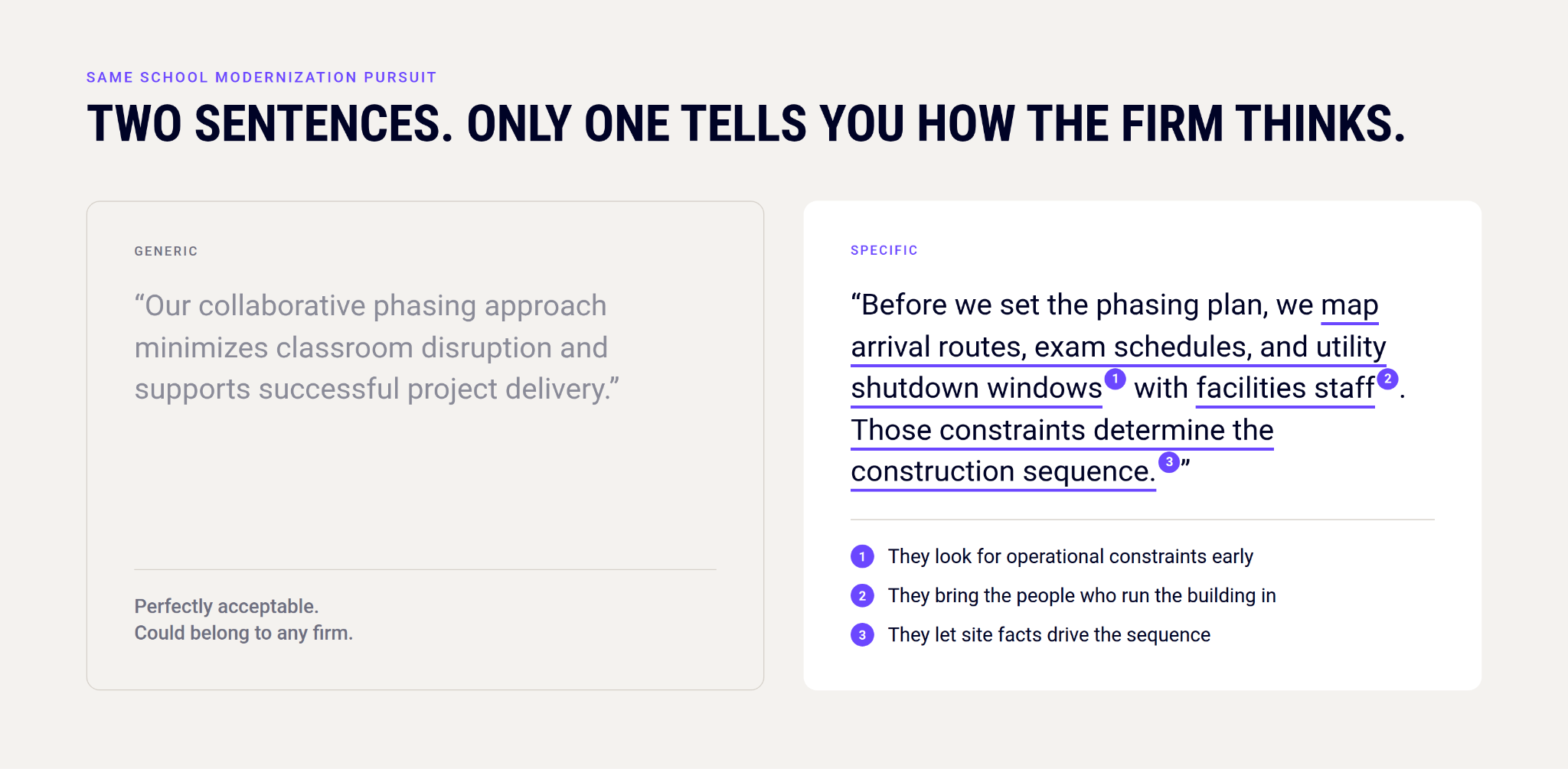
That sentence tells me something (in fact, several things) about the firm. They look for operational constraints early. They involve facilities staff. They let those facts shape sequencing. That is brand.
Not because somebody sprinkled personality into the copy. Because the writing exposes how the team works. If you are trying to make your firm more distinctive, start there. Ask your technical leaders:
- What do we consistently notice that others miss?
- What do we refuse to compromise on?
- What questions do we ask earlier than other firms?
- What mistakes have taught us to work differently?
- What do clients repeatedly thank us for after the project is over?
Documenting and codifying those answers are much more useful than compiling a list of approved adjectives.
Brand voice guideline should contain decisions, not vibes
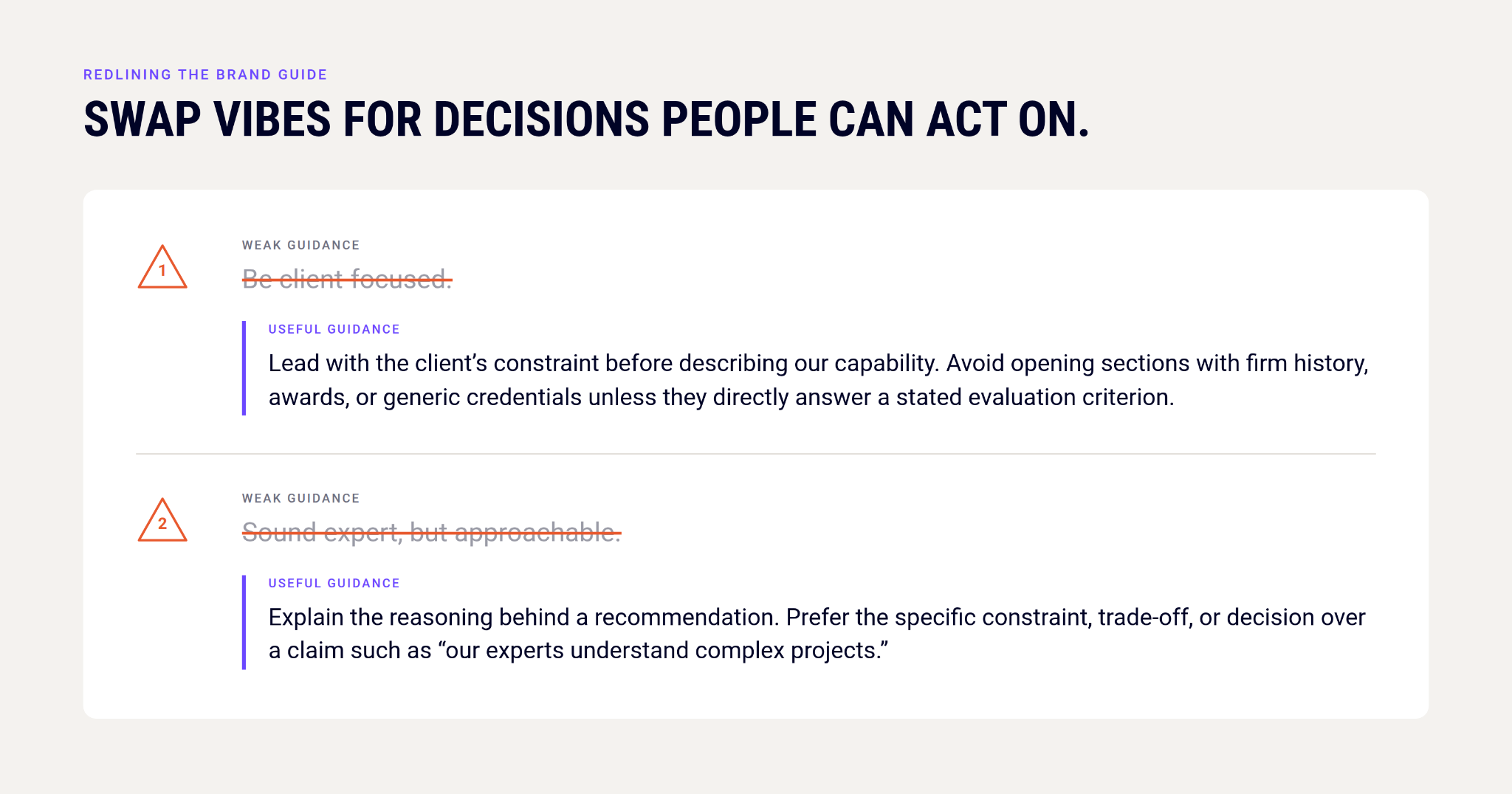
A lot of brand guidance stops at something like: Our voice is confident, clear, collaborative, and human.
Fine. Sure. Now imagine you are a proposal coordinator at 7:15 p.m. trying to decide whether a paragraph is on-brand. What exactly are you supposed to do with “human”?
A useful guideline turns broad principles into decisions people can make.
The useful versions can actually transform a draft. Someone can apply them. So can an AI system. And that last point is becoming important. If your brand standards are vague, AI has very little to work with beyond patterns it has seen elsewhere. That is how firms end up with highly competent sentences that could belong to anyone.
6 elements every AEC brand guide needs
These are the things that I would (and have) centered effective brand guides on:
1. What your firm believes about the work
Every strong firm has opinions, whether they have written them down or not.
Maybe you believe early contractor involvement prevents expensive redesign. Maybe your transportation team believes public communication deserves the same rigor as technical design. Maybe your healthcare practice has learned that maintenance staff should be involved much earlier than owners expect.
Write those beliefs down. They are far more interesting than “we value excellence.”
2. How your people make decisions
Capture the recurring judgment behind the work. For example:
- We validate operational constraints before developing the phasing recommendation.
- We show the trade-off when a client has competing priorities.
- We do not describe an approach without explaining why it fits this project.
- We support performance claims with a project, metric, or named example where possible.
Now your brand guide starts to influence the actual proposal, not just the adjectives inside it.
3. Language you want to earn, and language you have retired
Every AEC marketer has a mental list of words. Collaborative. Innovative. Best-in-class. Client-centric. Unwavering commitment.
I am not saying you can never use them. I am saying they should have to earn their place.
If you say “collaborative,” show who is collaborating, when, and what changes because of it. If you say “innovative,” name the unusual decision. If you say “proven,” provide the proof.
Your guideline should include examples of language that sounds like your firm and common phrases that should trigger another pass.
4. Your proof hierarchy
This is one of the most useful things a marketing team can document. When making a claim, what counts as strong proof? You might rank evidence like this:
- Measured project outcome
- Relevant client result
- Specific project example
- Repeatable method
- General statement of capability
Now compare "We are experienced in complex phased renovations" with "On the Westview modernization, the team completed three occupied construction phases without closing the campus."
The second one does more work. Your brand guideline should encourage people toward that level of evidence.
5. What your brand looks like when words are not involved
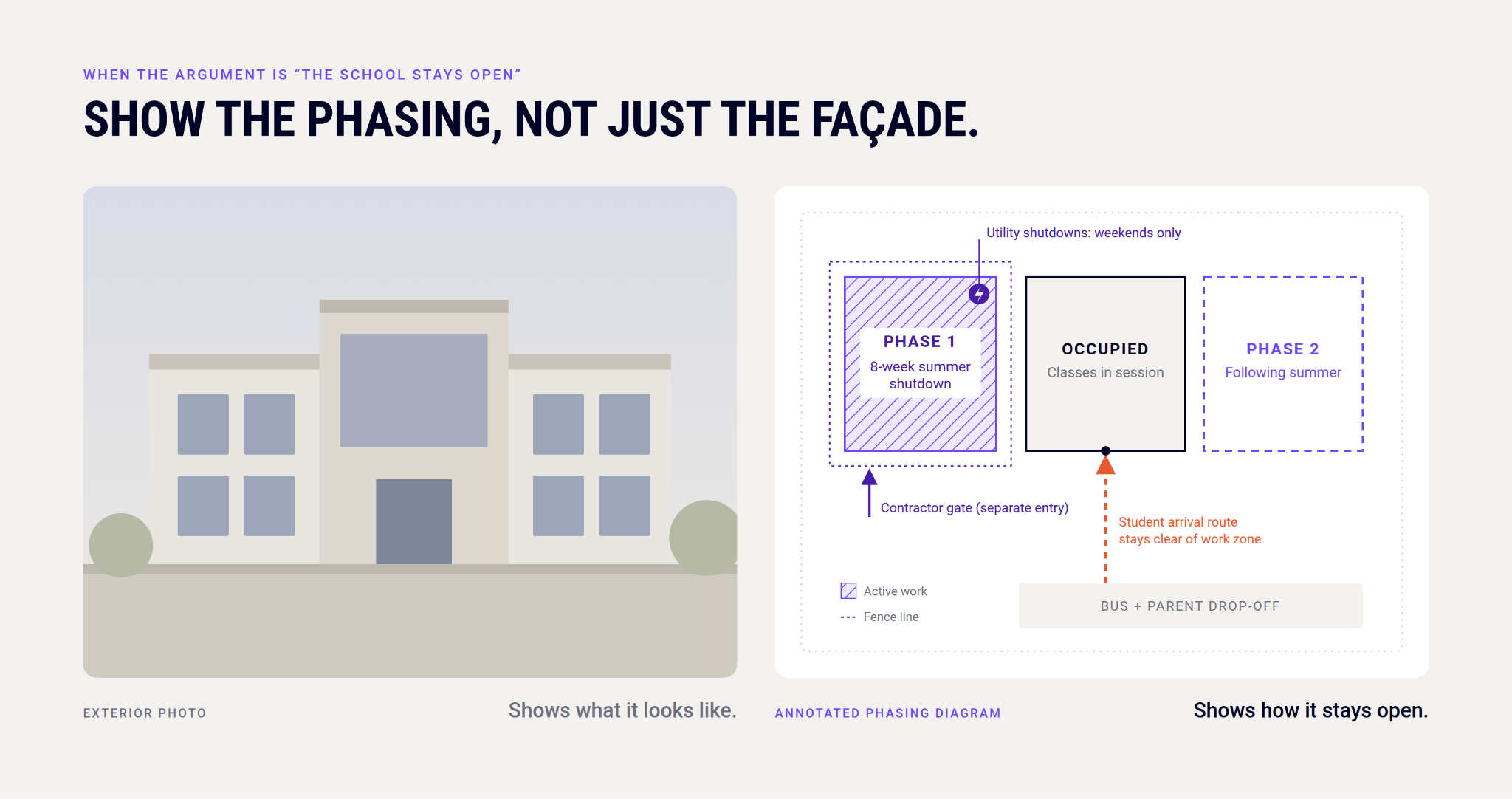
This part can often get neglected, especially when it comes to using AI for proposal writing. But AEC firms communicate visually all day: project photography, renderings, phasing diagrams, site plans, maps, charts, staff photography. Those choices say as much about the firm as the copy.
If your proposal is making an argument about keeping a facility operational during construction, the best image may be an annotated phasing diagram rather than just another polished exterior photograph.
Your visual guidelines should answer questions such as:
- What kinds of images help explain our work?
- When should we use a process graphic instead of project photography?
- What makes a project image current enough to use?
- Which treatments are approved?
- What safety, privacy, PPE, or branding checks apply?
- What should never make it into a client-facing document?
Those rules are especially useful because image selection gets messy fast. Someone downloads an old project photo. Someone crops it oddly. A hard hat disappears from frame. A rendering from an early design phase gets used after the project has changed.
Nobody is trying to break the brand. They are trying to finish the proposal. Good systems account for that reality.
6. Define what stays fixed and what should flex by pursuit
Here’s a little thing I learnt over the years. Brand consistency is often misunderstood as telling the same story every time.
Of course, some parts of the brand should stay consistent: Your terminology. Your evidence standards. Your visual rules. The way you explain technical judgment. The principles the firm believes in.
But if your brand guide makes every proposal sound identical, congratulations: you built a very expensive template.
In proposal writing, parts of your proposal should change depending on the client:
- Which proof leads?
- Which project example appears first?
- Which strength gets the most space?
- Which client concern frames the narrative?
- Which visual evidence best supports the argument?
Getting that right is the difference between being consistent and being repetitive.
The real test: can someone use the guide at 6 p.m. on deadline day?
I like beautiful brand books as much as the next marketer. I like useful ones more. A useful brand guideline should help a proposal manager make a better decision without calling the marketing director. In essence, it should answer:
- What do we sound like?
- What do we believe?
- What do we prove?
- What do we avoid?
- What does a strong example look like?
- Which visual belongs here?
If the document cannot help with those questions, it is probably a brand presentation, not a working standard.
A strong brand still needs positioning for the client
Go back to the school district example. Your firm has an award-winning education project with great photography. It also has a smaller renovation delivered during an eight-week summer shutdown with no schedule slips.
Both projects may fit your brand perfectly. Only one may be especially useful to this client. Suppose the district’s past RFPs, debriefs, and meeting notes keep returning to one concern: classrooms must be ready on the first day of term. Now the summer shutdown project deserves more attention.
The point is not to change who your firm is. The point is to choose the part of your experience the client has the most reason to care about.
That is where institutional knowledge becomes part of brand strategy. A useful pursuit process should help marketers answer:
- What has this client consistently prioritized?
- Which concerns keep appearing across their RFPs?
- Where have our previous submissions been strong?
- Where have the same gaps shown up more than once?
- Which examples from our experience best answer those concerns?
- Which claims do we have strong evidence for?
A brand guide can tell you how your firm should show up. It cannot tell you which part of the firm the client needs to see first. That requires insight. If you want to see what that insight looks like in practice, read our piece on how Kantiv's Client Intelligence Agent reads your client history before the go/no-go.
Distinctiveness without relevance is self-expression. Distinctiveness tied to the client’s priorities is positioning.
How AI makes brand guideline enforcement practical
AI will make a lot of AEC marketing faster, there is no denying that. Your job is making sure the faster version still looks and sounds like you. This is the part I find interesting about the next generation of AEC marketing tools. Once the standards are explicit, they no longer have to live only in somebody’s head. Pursuit history also becomes much easier to peruse.
Kantiv’s Style Guide Agent, for example, can check proposal content against a firm’s actual language and writing rules while the team is drafting.
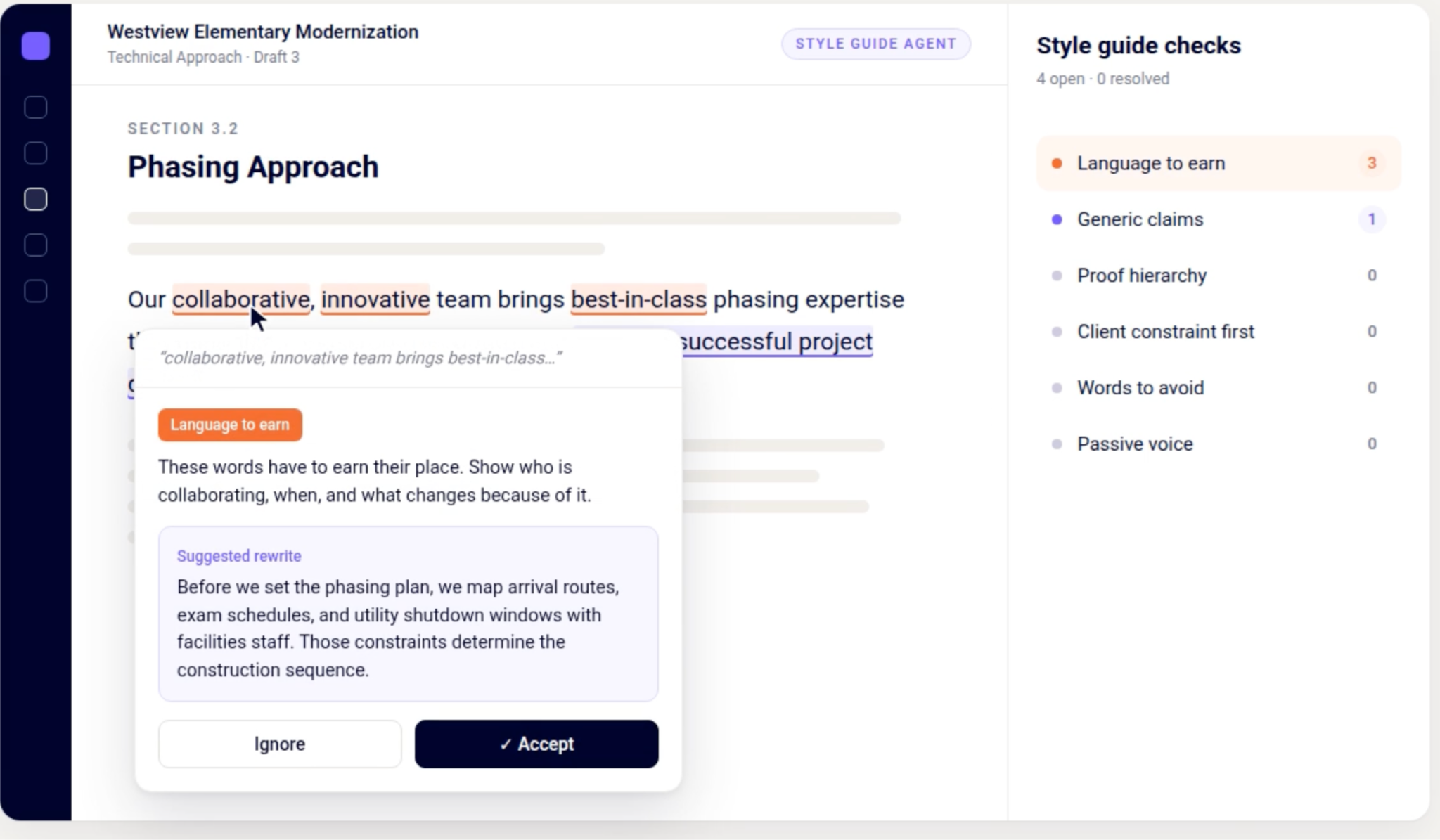
The Image Compliance Agent does the same kind of checking for visuals, including brand treatments, privacy, PPE, site safety, and image integrity. Image Intelligence helps teams find imagery that fits the story they are trying to tell. Kantiv Insights Agents helps the team decide which part of that point of view matters most in this pursuit. And the InDesign plugin carries those checks into the place where a lot of final proposal decisions actually happen: inside the layout.
That is the useful role for AI here: helping the firm apply the pursuit history, personality, judgment, and standards it has already decided are worth protecting at scale.
Want to see how this works in practice? Book a demo so we can show you how Kantiv helps AEC teams turn brand standards, pursuit history, and client insight into stronger proposals without adding another layer of manual review.
FAQs
What should an AEC brand guide include?
Six things: what your firm believes about the work, how your people make decisions, language to earn and retire, a proof hierarchy, visual guidelines, and rules for what stays fixed versus what flexes by pursuit.
How is brand voice different from brand guidelines?
Brand voice is how your firm sounds and reasons in writing. Brand guidelines are the full working standard, covering voice, evidence, visuals, and usage rules.
How do you use brand guidelines with AI tools?
Write them as specific decisions rather than adjectives, so both people and AI can apply them. Tools like Kantiv's Style Guide Agent can then check drafts against your actual rules.
What is a proof hierarchy?
A ranked list of evidence types, from measured project outcomes down to general capability statements, that tells writers which proof to lead with when making a claim.