Found the content on this page useful? Share it with your team!
AI-ready data: Why bad data will wreck your AI strategy before your next RFP

.png)
Table of Contents
I’ve seen a lot of AI demos over the last couple of years. Most of them look pretty incredible. Ask a question, wait a few seconds, get a polished answer. Find the right project. Draft a resume. Analyze a pursuit. Pull together what you know about a client.
Then you start asking where the answer came from. That’s usually where things get interesting.
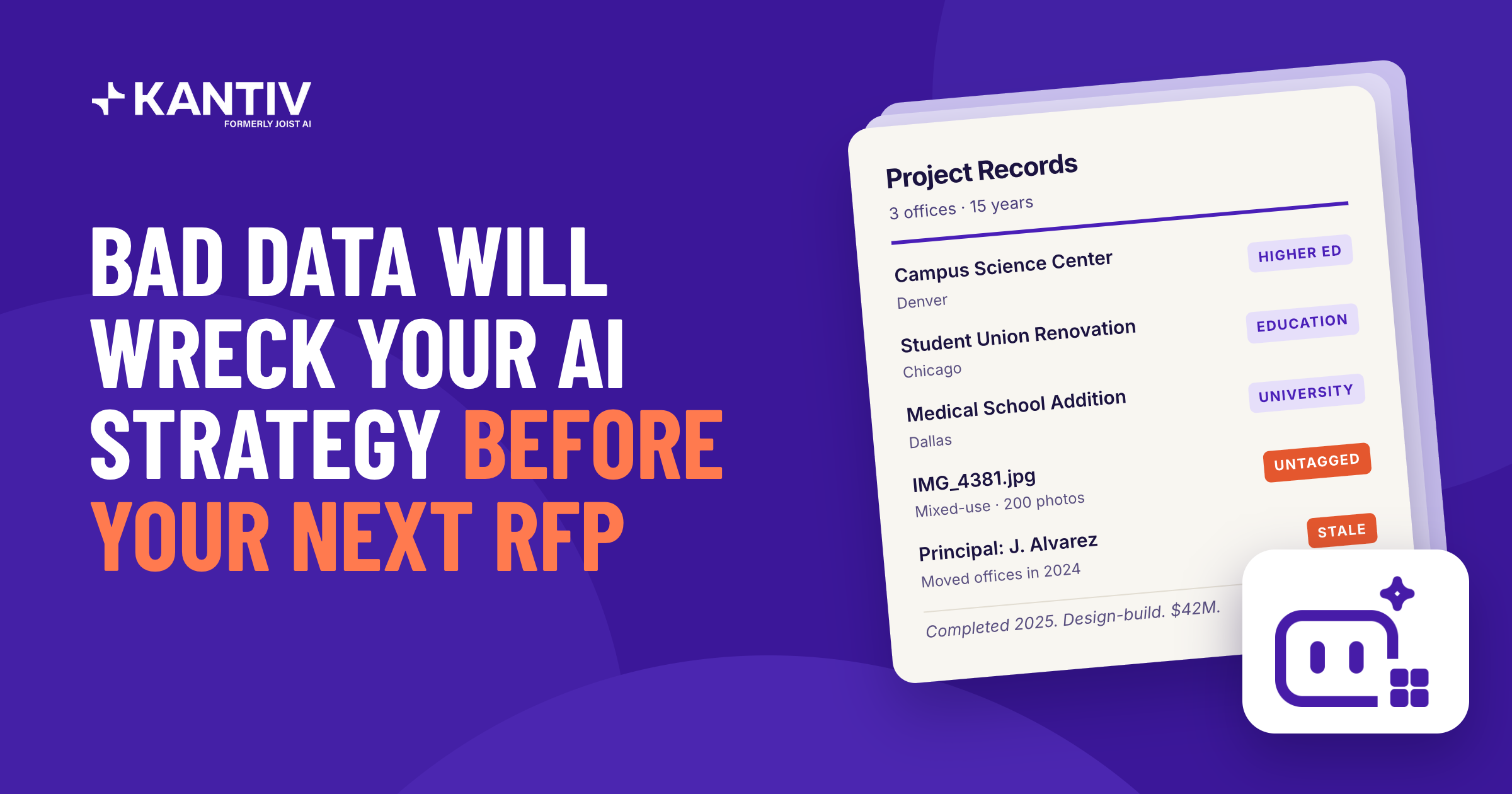
Say you ask an AI agent to find your three best higher education projects for a new pursuit. It comes back with three good-looking recommendations. Except you find your strongest university project is missing. One of the recommended project sheets lists a principal who moved offices two years ago. And the project that probably gives you the best story never appears at all because the detail that made it great—the BIM coordination approach that saved two weeks on the schedule—still lives in the project manager’s head.
AI did exactly what you asked. It just had bad information to work with. That’s a problem more AEC firms are going to run into as AI moves from writing copy to actually doing work.
AI-ready data is firm information that is complete, consistently classified, current, and traceable to a source, so an AI system can find and use it accurately. For AEC firms, that means project records, resumes, certifications, and photos that an AI agent can search reliably during a pursuit.
Autodesk’s 2026 AI Pulse found that 59% of organizations across Design and Make industries either use or expect to use agentic AI within a year. 44% are already investing in it. AEC firms clearly see where this is going. The less exciting part is getting the data ready. The latest SMPS Foundation research makes that pretty obvious. 71% of respondents said improved data management and infrastructure will be highly impactful, but only 10% said their firms are highly ready. AI-enabled workflows show almost the same spread: 68% see high impact, while only 13% report high readiness.
That is a pretty big disconnect.
We’ve spent a lot of time talking about which AI proposal software AEC firms should adopt. I think more firms need to spend time asking a less interesting question first: What data will those tools actually have to work with?
Your AI can only use the knowledge that made it into the system
Anyone who has worked around AEC pursuits knows how much valuable information never makes it into a project record.
A project closes. The team knows exactly what happened. They know the design decision that saved the client money. They know which site condition nearly blew up the schedule. They know why the original plan changed and what they would do differently next time.
The formal record often says something like: Completed 2025. Design-build. $42M.
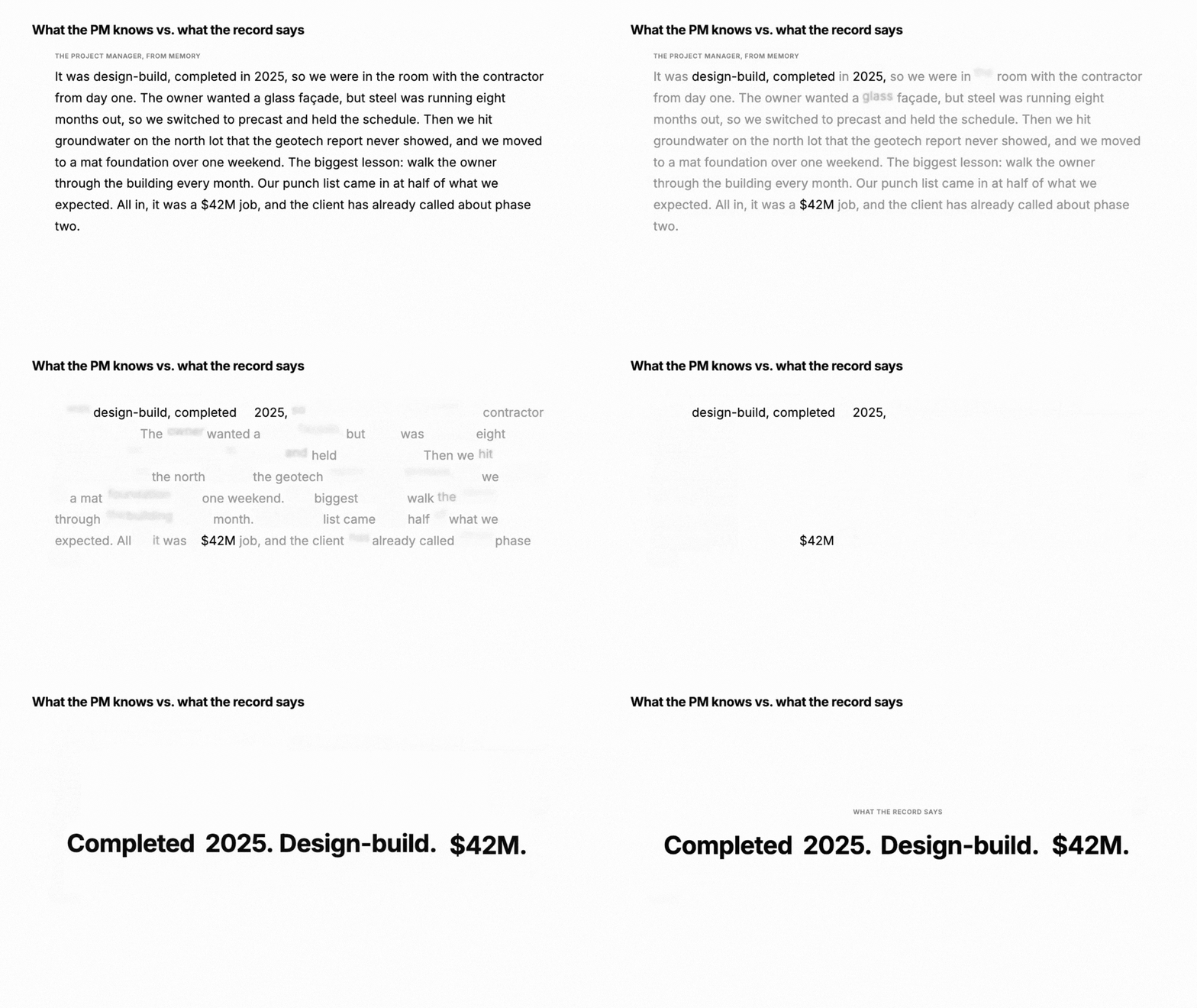
Technically correct. Not exactly a killer win theme.
Then everyone moves on. The PM starts another project. Marketing has deadlines. The closeout meeting gets pushed. Nobody deliberately decides that the information isn’t worth capturing; there is simply always something more urgent to do.
Six months later, an RFP lands that is almost identical. Now everyone wants that story.
Generative AI made this problem easier to ignore because you could give it whatever context you happened to have and ask it to write something better. Agentic AI makes the missing information much harder to ignore. An agent searching thousands of firm records cannot use the story that never got recorded.
This gets more important when you look at the workforce side. ACEC reports that nearly 26 percent of the AEC workforce is over age 55 and nearing retirement. That institutional knowledge has a shelf life. And no, I don’t think the answer is another mandatory closeout form everyone ignores.
Stored data is not the same as AI-ready or usable data
The second problem is probably familiar to anyone who has inherited a SharePoint site after a merger. You can have an unbelievable amount of information and still struggle to answer a basic question.
Imagine 15 years of project sheets, resumes, proposals, project photography, client notes and fee information. It is all technically there. But Denver calls a project “Higher Ed.” Chicago uses “Education.” Dallas uses “University.” Half the older projects have no market tag at all. Your photo library includes 200 images from a great mixed-use project. The filenames are nondescript like IMG_4381, IMG_4382, and so on.

Good luck.
That was annoying when a coordinator had to search for the information manually. It becomes a data-quality problem when an AI agent is expected to make decisions based on it. (Remember how your best project didn’t show?)
Consider a completely reasonable pursuit request: Find our design-led water infrastructure projects over $50 million in the Southwest where this principal had oversight.
For an AI system to answer that reliably, several things have to be true:
- It needs to understand what counts as water infrastructure
- Project values need to be captured consistently
- Staff roles need to mean the same thing across records
- Geography needs to be structured
- The principal-project relationship needs to exist in the data.

A folder full of PDFs may contain the answer. That doesn’t mean your AI can reliably identify the answer. If three offices describe the same kind of work three different ways, your AI is going to have a hard time finding the best answer.
And that is the big difference between stored data and usable data.
AI data readiness is ongoing work, not a one-time cleanup
Let’s say you solve all of that. You spend six months cleaning the library. Market sectors get standardized. Resume data is updated. Project sheets are refreshed. Everyone agrees on the taxonomy. Beautiful! The spreadsheet was clean... for about 15 minutes.
Then someone earns a PE license. A project finishes construction. A principal switches offices. A project cost changes. A client gives useful feedback during a phone call. Your clean database has already started getting old. A one-time cleanup gives you a static snapshot, while the underlying firm keeps changing.
This is the part of AI readiness I think gets underestimated. Data quality sounds like a project. In practice, it is ongoing work. And AEC marketing teams are not sitting around wondering what to do with their spare time.
So the work gets delayed until someone needs the information for a live pursuit. Then you find the bad resume, missing certification, or incomplete project record while the clock is running. Not ideal.
Bad data gets more expensive when AI agents starts acting on it
A chatbot giving you a mediocre answer is annoying. An agent using a bad answer to complete five more steps is a different problem. That is one reason the shift toward agentic AI changes the conversation around data quality.
An agent may eventually search your records, identify matching projects, compare qualifications, draft project descriptions, assemble staff information, and feed that material into a pursuit workflow. If the first project match is wrong, the downstream work can be wrong too. And because AI is very good at producing confident, professional-looking output, bad information does not necessarily arrive looking suspicious.
Autodesk found that 65% of Design and Make leaders already say AI improves decision-making, up 10 percentage points from the previous year. That is encouraging, but better AI-assisted decisions still depend on the information those systems can access.
Five questions to test whether your firm’s data is AI-ready
For an AEC firm, I would start with a few boring questions before getting too excited about the agent demo:
- Could the system find the right project even if another office classified it differently?
- Does it know that a resume changed last month?
- Can it tell which project metric is current when three documents disagree?
- Does the project record contain the lessons the delivery team actually learned?
- Can someone verify where the answer came from?
If the answer to most of those is “sort of,” you probably have some work to do.
These five questions test your data. The agent itself needs its own checklist: which tools it can invoke, what permissions each tool has, which actions need fresh human approval, and whether you can reconstruct a run after something goes wrong. We laid out eight questions to ask before putting an agent into production.
How AI agents can keep your project data AI-ready
The AI-readiness work nobody really wants to own: traditionally, keeping this information useful requires somebody to continuously tag files, chase updates, interview project teams, reconcile records, and clean up whatever changed. That somebody often ends up being marketing.
This is where I think agents get interesting, for a reason that has nothing to do with writing proposal copy. They can help maintain the data that other AI depends on.
Kantiv Data Agents are designed around two fairly unglamorous jobs:
- The Tagging Agent applies the firm’s taxonomy to projects, documents, resumes, and images as they enter the system.
- The Data Collection Agent identifies missing or stale information, gathers updates through structured conversations, and routes proposed changes through human review.
A project closes and nobody wrote the story down? Capture it while the PM still remembers it. An engineer earned a new credential? Update the record before the next pursuit discovers the problem.
Eight hundred files arrive through an acquisition with inconsistent classifications? Apply the existing firm taxonomy rather than asking someone in marketing to spend the next six months tagging PDFs.
None of that sounds as flashy as asking an agent to write a proposal. I’d argue it is more important.
Because once that foundation is dependable, all the more interesting use cases get better: project matching, client intelligence, pursuit analysis, resume generation, Chat, and whatever comes next.
The SMPS readiness numbers tell me the industry already understands this at some level. Firms see data infrastructure and AI-enabled workflows as important. They just haven’t caught up operationally yet. Because AI can do a lot with good firm data. With bad firm data, AI can also help you be wrong much faster. And it will make the answer look great.
That is probably where I would focus right now. Before asking how much of your proposal process AI can automate, look at the information underneath it.
If you need help figuring this out for your firm, book a chat with us. We’ll be happy to help you figure out next steps to getting your data AI-ready!
FAQs
What does “AI-ready data” mean for an AEC firm?
It means project records, resumes, and credentials are complete, consistently tagged, current, and traceable, so an AI agent can retrieve accurate answers during a pursuit.
Why does data quality matter more for agentic AI?
Agents act on what they find. A wrong project match early in a workflow carries through every step that follows.
How often should AEC firms update project and resume data?
Continuously. Records go stale whenever a project closes, a license is earned, or a principal changes offices, so a one-time cleanup doesn’t hold.