Found the content on this page useful? Share it with your team!
3 Step AI Productivity Audit for AEC Professionals

.png)
Table of Contents

AI has moved beyond being a curiosity. For AEC professionals, it can save hours each week on reports, emails, and admin-heavy tasks. The challenge, however, is knowing where to apply it in your own workflow.
This is where a Productivity Audit comes in. It’s a simple three-step exercise designed to highlight the exact tasks in your job that AI can take off your plate or help you complete faster and more consistently.
Contents
- Step 1: List Your Weekly or Monthly Tasks
- Step 2: Categorize Each Task
- Step 3: Run the AI Test
- Putting It into Practice
- Why This Matters
Step 1: List Your Weekly or Monthly Tasks
Start by capturing the work you do regularly. Look at your calendar, notebooks, or task manager and write down the activities you complete every week or month.
Examples might include:
- Writing project reports
- Sending client emails
- Updating site logs
- Reviewing specifications
- Cleaning up spreadsheets
The goal is to capture the repeatable, recurring tasks that take up your time.
Step 2: Categorize Each Task
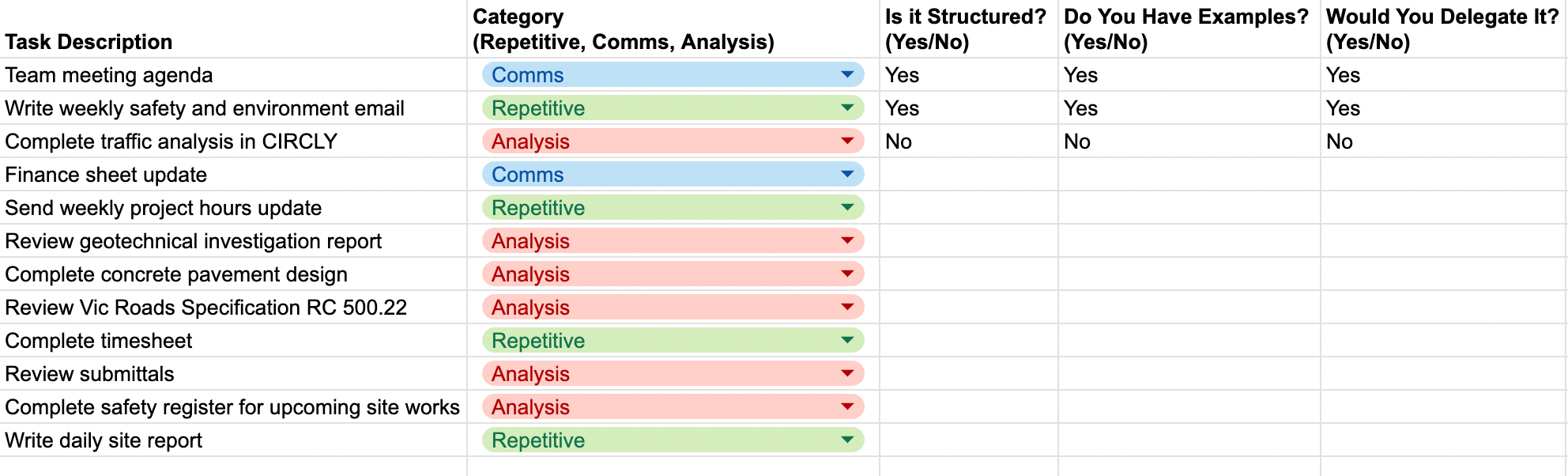
Next, ask yourself what kind of task each one is. This sorting helps us to see where AI adds the most value. A simple framework is to group them into three categories:
- Repetitive – Manual, time-consuming, or recurring tasks
- Comms – Emails, updates, or reports
- Analysis – Comparing data, reviewing scopes, extracting insights
For example:
- Writing project reports and updating site logs → Repetitive
- Sending client emails → Comms
- Reviewing specifications → Analysis
This step helps you see where AI can add the most value.
Step 3: Run the AI Test
Now apply the AI Test to each task to decide which it is ready to handle. For each task, ask yourself three questions:
Ask yourself three questions:
- Is this task repeatable or structured?
- Do I already have examples of this kind of work?
- Would I delegate this to a junior if I could?
If the answer is “yes” to any of these, chances are AI can help.
Putting It into Practice
Once you identify a task, the next step is to test it with AI. Write a clear prompt and feed it the information you’d normally include. Review the output, refine it, and until you get to your final result.
When you’ve reached a version that works well, go one step further. Ask the AI:
“I complete this task every week. Can you create a reusable prompt with placeholders for inputs so I can quickly update it each time?”
This turns your experiment into a template. Save it and, over time, you’ll build a prompt library, a set of ready-to-use instructions tailored to your role. That library becomes a powerful asset, letting you complete repeatable tasks faster, more consistently, and with less effort.
Why This Matters
A productivity audit is not about replacing your expertise. It’s about freeing up your time so you can focus on higher-value work, whether that’s managing teams, solving complex problems, or driving projects forward.
By systematically reviewing your workflow and testing where AI fits, you’ll uncover dozens of small opportunities that add up to significant time savings. Even saving one hour per week quickly compounds into days of extra capacity over the course of a year.