Found the content on this page useful? Share it with your team!
OpenAsset vs Loopio: What AEC Firms Should Consider When Evaluating Proposal Software

.png)
Table of Contents
.png)
If you're evaluating OpenAsset and Loopio, you're probably looking for more than a proposal tool. You want a platform that helps your team find the right content, respond to RFPs faster, maintain brand consistency, and stop rebuilding proposals from scratch every time.
Both these platforms help AEC marketing teams manage proposals and content. But they come at the problem from different directions.
OpenAsset started as a digital asset management (DAM) platform built specifically for AEC firms, then expanded into AI-assisted proposal writing with Shred. Loopio started as an RFP response automation tool for B2B sales teams, then expanded into security questionnaires and due diligence questionnaires across multiple industries.
This guide compares OpenAsset and Loopio across the areas that matter most to AEC marketing and proposal teams, including content management, RFP workflow, AI capabilities, integrations, and long-term fit, so you can decide which platform is the better choice for your firm.
The key difference between OpenAsset +Shred AI and Loopio
OpenAsset was founded for the AEC industry. Its core product is a DAM: a centralized library of project photos, resumes, boilerplate, and proposal content, and it has recently added AI-assisted proposal writing through Shred. The platform's center of gravity is asset management. Proposals are built on top of the DAM.
Loopio was built for B2B RFP response teams across industries. Its core product is a response automation workspace, a content library, smart assignments, automated review cycles, and integrations with CRMs and collaboration tools. The platform's center of gravity is the RFP response itself. Asset management is secondary.
That raises a few important questions:
- How different are OpenAsset and Loopio when you actually use them day to day?
- Which platform is better for AEC-specific proposal workflows?
- How do their AI capabilities compare?
- Which one is the better fit for a firm that wants to win more of the right pursuits?
Let's start by looking at what proposal management software has grown into today.
What is proposal management software?
A proposal management platform typically centralizes your firm's content: past proposals, project descriptions, resumes, boilerplate, images, and makes it reusable when a new RFP lands. The software allows proposal teams, marketing leaders, and seller-doers to respond faster and more consistently.
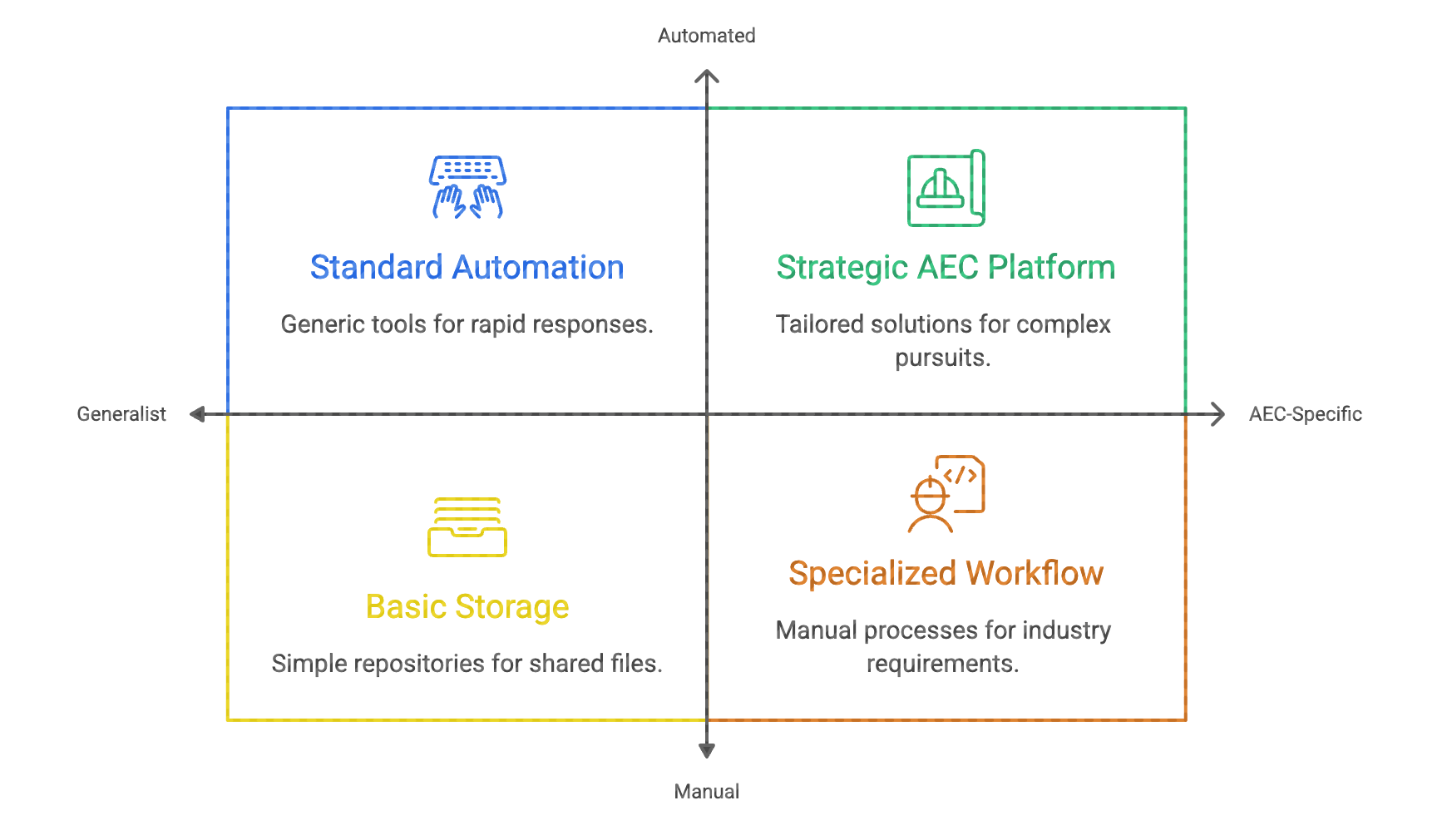
The foundation of these platforms is a content library. Store once, find later, reuse across pursuits. Most products in this category include some combination of content search, template management, AI-assisted response drafting, and integrations with CRM, cloud storage, and communication tools.
But AEC proposal teams face a specific set of challenges that generalist RFP tools don't always account for:
- Project descriptions and resumes need to be tailored per pursuit, not just pasted in
- Visual assets: photos, diagrams, project sheets are central to the response, not an afterthought
- Compliance requirements (SF-330, SOQ, addenda) are AEC-specific
- The same people writing proposals are often chasing the next pursuit, not sitting in a dedicated RFP desk
A strong proposal platform needs to handle all of this, not just answer questionnaires faster.
What is pursuit intelligence?
Pursuit intelligence is the practice of structuring and surfacing an AEC firm's institutional knowledge: past project experience, people, client history, and proposal outcomes, so it can be consistently applied during high-stakes pursuits.
Unlike proposal automation, which focuses on generating content faster, pursuit intelligence focuses on making what a firm already knows accessible and reusable. The result is a team that starts every pursuit from its strongest position rather than rebuilding from scratch.
The distinction matters because the bottleneck for most AEC firms is not writing speed. It is accessing and applying what the firm already knows.
Comparing the tools from an AEC firms perspective
Both OpenAsset and Loopio help teams manage content and respond to proposals. But they approach the problem from different starting points.
OpenAsset + Shred AI: DAM first, proposals second
OpenAsset's foundation is its digital asset management platform. Firms use it to store, tag, search, and resize project photos, resumes, and boilerplate. The recent addition of Shred brings AI-assisted RFP analysis, compliance checking, and content gathering into the same workspace.
The platform is designed for AEC marketing teams that need a centralized library of visual and written assets and want proposal writing tools built on top of that library.
Loopio: RFP software first, everything else second
Loopio's foundation is its response automation workspace. Teams use it to manage RFPs, RFIs, security questionnaires, and DDQs with a content library, smart assignments, automated nudges, and review cycles. The platform supports integrations with Salesforce, HubSpot, Slack, MS Teams, and SharePoint.
Loopio is designed for B2B response teams across SaaS, financial services, healthcare, and business services. It is not built specifically for AEC.
Where they overlap
Both platforms include:
- A content library for reusable answers and assets
- AI-assisted response drafting
- Integrations with CRM, cloud storage, and communication tools
- Collaboration features for contributors and reviewers
- Security and compliance certifications
Where they differ
The biggest differences come down to industry focus and platform center of gravity.
OpenAsset is AEC-native. Its DAM handles project photos, resumes, and AEC-specific document types. Shred adds RFP analysis tailored to AEC pursuits. But the platform's knowledge management layer is built around files and assets, not around the relationships between projects, people, clients, and outcomes.
Loopio is a strong RFP response tool. Its smart assignments, review cycles, and content library are well-designed for questionnaire-style responses. But the platform was not built for AEC pursuits, it does not handle project descriptions, resumes, or visual asset management the way an AEC firm needs.
We'll look at those differences in more detail throughout the rest of this guide.
OpenAsset vs. Loopio: How should AEC firms choose between them
Both OpenAsset and Loopio are mature platforms with real customers and real value. They also overlap across many core capabilities, which makes feature-list comparison less helpful than evaluating them based on what your team will experience after implementation.
Here's how we'd evaluate both platforms.
The TL;DR version
OpenAsset is a DAM with added proposal writing tools. Loopio is an RFP response automation platform, built for B2B sales teams across industries. Neither platform connects your firm's project experience, people, and client history into a knowledge graph that surfaces the right expertise when a pursuit opens.
Feature comparison of OpenAsset and Loopio across core proposal and knowledge management capabilities:
| Capability | OpenAsset | Loopio |
|---|---|---|
| Best for | AEC DAM + proposals | B2B RFP response teams |
| AEC-native | Yes | No |
| DAM | Yes | No |
| AI-assisted RFP analysis | Yes (Shred) | Yes |
| Content library | Yes | Yes |
| Smart assignments | Limited | Yes |
| Knowledge graph | No | No |
| Pursuit intelligence | No | No |
| Go/no-go visibility | No | No |
| SF-330 / SOQ support | Limited | No |
| Integrations | AEC-adjacent | CRM, Slack, MS Teams |
| Pricing | Custom | Custom |
1. AEC specificity
This is the first filter. AEC proposals are not generic RFPs. They require project descriptions tailored to the client, resumes matched to the pursuit, visual assets that show the firm's work, and compliance with AEC-specific document formats.
OpenAsset is built for AEC. Its DAM organizes content by project, by client, by discipline. Shred's RFP analysis understands AEC document structures. The vocabulary, the workflows, and the asset types are all AEC-native.
Loopio is built for B2B. It handles questionnaires, security reviews, and RFPs across SaaS, finance, and healthcare. The platform doesn't have AEC-specific document types, resume management, or project description tailoring built in.
Questions to consider:
- Does the platform understand what a pursuit is in your firm?
- Can it handle SOQ, SF-330, and addenda the way your team needs?
- Will your team have to work around the platform's assumptions?
What's missing?
Both platforms treat AEC knowledge as a filing problem. OpenAsset files assets in a DAM. Loopio files answers in a content library. Neither one connects your firm's projects, people, clients, and pursuit outcomes into a knowledge graph that surfaces the right experience automatically when a pursuit opens.
A true pursuit intelligence platform structures your firm's knowledge around the way pursuits actually happen. When an RFP lands, the right past projects, the right resumes, and the right client history surface based on what the pursuit requires, not because someone remembered to tag them. That kind of structured knowledge layer is what lets a marketing team show up as strategists, not assemblers.
2. Knowledge management and reuse
Both OpenAsset and Loopio have content libraries. Both let you search, tag, and reuse content. But the way they structure knowledge is different.
OpenAsset organizes content as assets: photos, documents, boilerplate. Search is asset-centric. You find a file, then use it. The DAM is strong for visual content, and the tagging system is built for AEC project metadata.
Loopio organizes content as Q&A pairs. Search is question-centric. You find an answer, then use it. The library is strong for questionnaire-style responses where the same question comes up across multiple RFPs.
Questions to consider:
- Can your team find the right content without knowing exactly what to search for?
- Does the platform surface related content automatically?
- When someone leaves, does their knowledge stay in the system, or does it walk out the door?
What's missing?
Neither platform connects the relationships between your firm's projects, people, clients, and proposal outcomes. A past proposal isn't just a document, it's a record of what worked, what didn't, and which client responded to which story. When those relationships are structured, your team walks into every pursuit already knowing what they have to work with.
A knowledge graph that maps projects to people to clients to outcomes means your firm's experience is findable by relationship, not just by keyword. When a pursuit opens for a transportation client in Colorado, the platform surfaces the firm's relevant projects, the people who worked on them, and the win themes that resonated, without anyone having to remember and search manually.
3. Proposal and RFP management workflow
OpenAsset's Shred handles RFP analysis, compliance checks, and content gathering. The workflow is designed around AEC pursuits: upload the RFP, extract requirements, match content from the DAM, and draft responses. The compliance checker flags missing requirements before submission.
Loopio's workflow is built around questionnaire responses. Import the RFP, assign questions to SMEs, use the content library to auto-suggest answers, and track review cycles. Smart assignments and automated nudges keep contributors on track. The workflow is strong for high-volume, short-form Q&A responses.
Questions to consider:
- Does the platform handle the full AEC pursuit workflow, from RFP intake to compliance-checked submission?
- Can technical staff contribute directly without the back-and-forth of email chains?
- Does it track addenda and update requirements as they come in?
What's missing?
Both platforms focus on the response phase of the pursuit. But the work that determines whether a proposal wins happens before the RFP lands, in the go/no-go decision, in the win strategy, and in the content that already exists and is ready to use.
A pursuit intelligence platform starts before the RFP. When your firm's knowledge is structured and accessible, the response phase gets faster because the team isn't starting from scratch. They're starting from a position where the right projects are already matched, the right resumes are already tagged, and the right client history is already surfaced. The first draft comes together in minutes, not days, and the team spends their time on win strategy, not on assembling content.
4. Managing assets
OpenAsset's DAM is its strongest capability. Project photos, resumes, boilerplate, and marketing collateral are stored in a central library with AEC-specific metadata. Search, resize, and sharing are built in. For firms that need a dedicated DAM, OpenAsset handles this well.
Loopio does not have a DAM. It stores text-based Q&A content in its library but does not manage visual assets: photos, diagrams, project sheets, or branded templates. Firms using Loopio would need a separate tool for visual asset management.
Questions to consider:
- Does your team spend time hunting for project photos across drives and inboxes?
- Can you resize, reformat, and share visual assets without leaving the platform?
- Does your DAM connect to your proposal workflow — or are they separate tools?
What's missing?
OpenAsset has a strong DAM. But even the best DAM is still a filing system. It stores and tags assets. It does not understand what is in the asset: which project, which client, which people, which outcome.
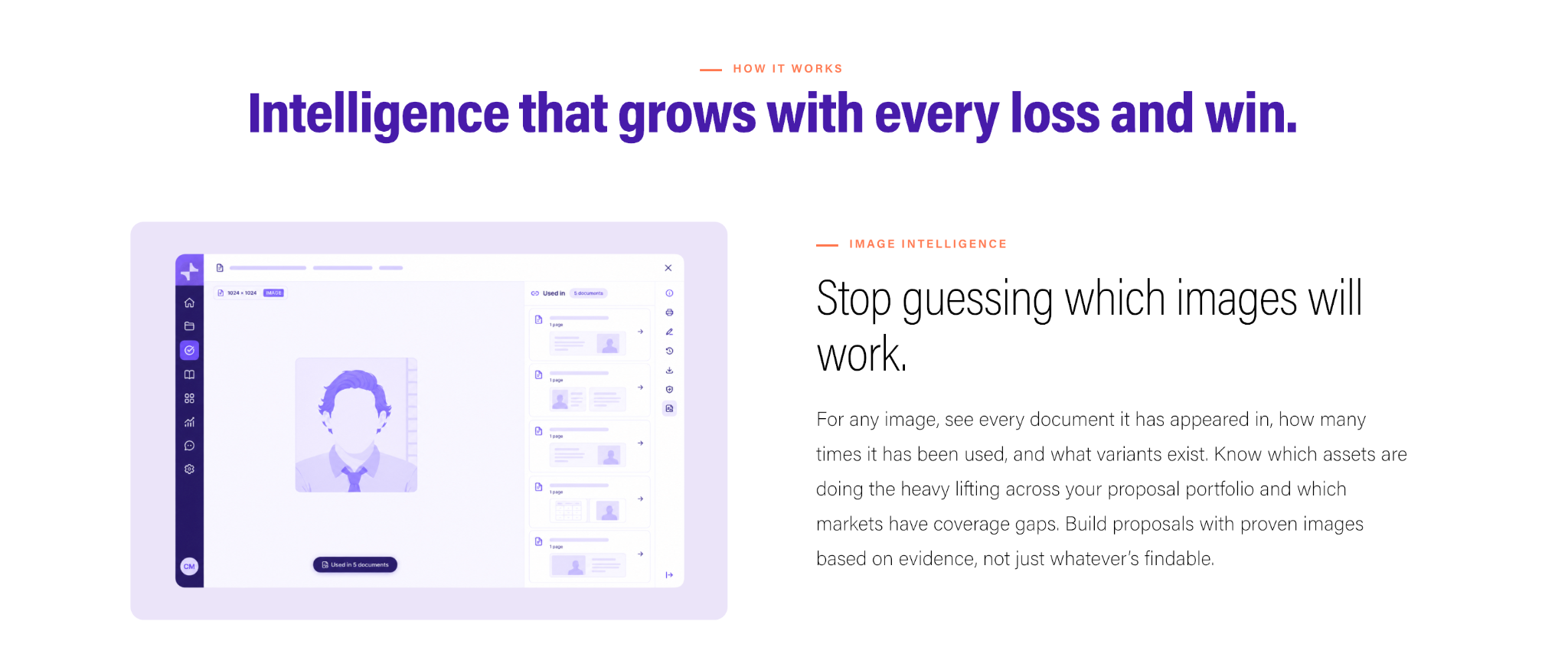
A pursuit intelligence platform with an Image Management and Intelligence automatically tags and labels images by what is in the photo. The right visuals surface instantly when building a pursuit response, without needing a separate DAM. When the DAM is part of the knowledge graph, your team does not have to leave the proposal workflow to find the right photo. It shows up because the platform knows which projects are relevant to this pursuit.
5. AI capabilities
OpenAsset's Shred brings AI into RFP analysis, compliance checking, and content gathering. The AI reads the RFP, extracts requirements, and pulls relevant content from the DAM. It is designed to reduce the manual work of reading RFPs and assembling first drafts.
Loopio's AI assists with answer suggestions from the content library. When a question comes in, the platform suggests the best matching answer based on past responses. The AI is tuned for questionnaire-style matching: find the closest prior answer, adapt it, and insert it.
Questions to consider:
- Does the AI understand AEC document structures, or does it treat everything as a generic questionnaire?
- Does the AI improve over time as your team uses the platform?
- Can the AI match content based on relationships (project, client, people), not just keywords?
What's missing?
Both platforms use AI to find and assemble content. Neither uses AI to build a structured picture of your firm's knowledge that gets sharper with every pursuit.
When AI is built on a knowledge graph, it can surface the right projects, people, and proof points because it understands the relationships between them. The platform learns what wins with each client, which strategies have worked, and which content resonates. Every pursuit makes the next one sharper. That is the difference between AI that finds files and AI that understands your firm.
6. Integrations
OpenAsset integrates with AEC-adjacent tools. Its partner integrations connect the DAM to proposal workflows and CRM systems. The platform is designed to fit into an AEC firm's existing tool stack.
Loopio integrates with a broad set of B2B tools: Salesforce, HubSpot, Microsoft Dynamics, Slack, MS Teams, SharePoint, OneDrive, Google Drive, Box, Seismic, Highspot, Okta, and Azure. The integration list is comprehensive for enterprise sales teams.
Questions to consider:
- Does the platform connect to the tools your AEC firm actually uses: Deltek, SharePoint, Egnyte?
- Can SMEs contribute from within the tools they already work in?
- Does the integration go both ways, or is it one-way data flow?
What's missing?
Both platforms integrate with external tools. But neither platform treats your firm's knowledge itself as the integration layer. When your projects, people, clients, and proposal outcomes are structured in a knowledge graph, that knowledge becomes the connective tissue between every tool your firm uses. The CRM, the proposal workspace, the DAM, and the compliance checker all pull from the same verified source of truth, instead of each tool maintaining its own disconnected copy of the same information.
7. Visibility and analytics
OpenAsset provides visibility into DAM usage: which assets are used most, which projects are referenced. Shred adds some pursuit-level visibility around RFP requirements and compliance status.
Loopio provides visibility into response workflow: project milestones, completion status, and contributor activity. Managers can see which questions are answered, which are pending, and where bottlenecks are.
Questions to consider:
- Can you see where your firm is winning, and why?
- Can you make smarter go/no-go calls based on firm intelligence?
- Does the platform show you what wins with each client?
What's missing?
Neither platform gives you a picture of where your firm wins and why. That picture comes from structuring pursuit outcomes: wins, losses, and the strategies behind them, in a way that compounds over time.
A pursuit intelligence platform shows you which clients respond to your story, which strategies actually close, and where your firm has a competitive edge. When that picture gets sharper over time and you bring it into a leadership conversation, the way your firm sees marketing changes. Marketing stops being the team that formats proposals and becomes the team that drives revenue strategy.
8. Security and compliance
Both platforms take security seriously. OpenAsset and Loopio both hold SOC 2 certification, encrypt data in transit and at rest, and support SSO.
Security also means compliance with proposal requirements: SF-330 formatting, SOQ structure, addenda tracking, and certification of key personnel. Neither platform was built from the ground up to handle AEC-specific compliance workflows.
Questions to consider:
- Does the platform handle AEC-specific compliance, or do you still need a manual checklist?
- Are compliance issues caught before submission, or after?
- Can you track addenda and update requirements automatically?
What's missing?
Security certifications are table stakes. The compliance gap that matters for AEC firms is proposal compliance, making sure every requirement in the RFx has been addressed before submission. Missed requirements can disqualify an otherwise strong response.
A pursuit intelligence platform tracks every requirement, syncs addenda as they come in, and flags every unaddressed item before submission. Nothing slips through under deadline pressure. When compliance is built into the workflow, your team can focus on the quality of the response, not on whether they missed something in a 200-page RFP.
9. Pricing
Both OpenAsset and Loopio offer custom pricing based on firm size, number of seats, and platform configuration. Neither publishes public pricing.
OpenAsset's pricing is typically scoped per firm and may include separate costs for the DAM and Shred modules. Loopio's pricing starts with a Foundations tier (10 seats) and scales up to Enhanced and Enterprise packages.
Questions to consider:
- Are you paying for capabilities your team will actually use?
- Is the pricing model built for AEC firm sizes, or is it built for enterprise sales teams?
- Will the platform deliver value for every member of your marketing team, or only for a small group?
What's missing?
Pricing models that charge per seat work when the platform serves the whole team. But when the platform only serves proposal responders, the cost per useful seat goes up.
A pursuit intelligence platform that serves the whole marketing team: proposal coordinators, BD leaders, marketing directors, and seller-doers. It means more of your team gets value from the same investment. When the platform's knowledge graph feeds every role, not just the person writing the RFP response, the ROI per seat goes up.
Final verdict
OpenAsset and Loopio are both capable platforms. But they solve different parts of the problem.
OpenAsset is the stronger choice if your firm needs a dedicated AEC DAM and wants proposal writing tools built on top of it. Its asset management is well-designed, and Shred adds genuine value for RFP analysis. The limitation is that it treats knowledge as a filing problem: assets in, assets out.
Loopio is the stronger choice if your team handles high-volume questionnaire-style RFPs across multiple industries and needs a well-built response automation workspace. Its smart assignments and review cycles are solid. The limitation is that it was not built for AEC pursuits: it does not handle project descriptions, resumes, or visual asset management the way an AEC firm needs.
What do both platforms miss?
Neither platform connects your firm's project experience, people, client history, and proposal outcomes into a structured knowledge graph. Neither one gives you pursuit intelligence: the ability to start every pursuit from your strongest position, with the right content surfaced automatically, compliance tracked, and a picture of where your firm wins that gets sharper over time.
If your firm is looking for more than a DAM or a questionnaire tool, if you want a platform that captures, structures, and surfaces your firm's knowledge so your marketing team starts every pursuit fast, on verified data, you might want to evaluate Kantiv.
Kantiv is the pursuit intelligence platform built for AEC firms. It unifies your firm's institutional knowledge across proposals, project narratives, resumes, and client history into a single platform that surfaces the right expertise when it matters.
Your firm's knowledge is scattered across drives, inboxes, old proposals, and people's heads. Kantiv fixes the layer underneath, so your firm's knowledge is verified, organized, and ready before the RFP even lands.
Book a demo to see pursuit intelligence in practice.
Disclaimer: This comparison was prepared by Kantiv based on publicly available product information and documentation at the time of review. Product features, pricing, plans, and availability may change and may vary by configuration. While we strive to keep this information accurate and current, this comparison may not reflect all available product details. For the most current information, please consult each vendor directly.