Found the content on this page useful? Share it with your team!
Everything’s in one place. So why are proposals still so hard?


Table of Contents

I’ve had a version of the same conversation maybe thirty times this year with marketing directors and principals across the AEC industry.
They tell me they’ve adopted AI, their content is centralized, the pilot went fine, and then—somewhere around minute fifteen—the truth comes out: “Kyle, we’re just not seeing the impact we expected.” On paper, their setup looks pristine. Yet the needle hasn't moved.
If that sounds familiar, you aren't alone. Industry data shows 70% of A&E firms adopted AI last year, but only 38% report any measurable positive business impact. Meanwhile, firms submitted 32% more proposals while median win rates dropped to 49%.
The tools are in. The results aren't. My dad was an electrical contractor, so construction was dinner table conversation growing up, and I know how frustrating this is to watch. You've put in the sweat equity to get organized. So why isn't the technology paying off?
Your firm is worth more than what it stores
Most firms have a DAM or a SharePoint drive with a folder structure somebody spent months building. That took real work, and kudos to your team for putting that effort in.
But a repository only holds static pieces:
- The proposal PDF
- The employee resume
- The project cut sheet
- The client record sitting in your CRM
What a folder cannot hold or create are the dynamic connections between those pieces that give the user vital context:
- Which project manager ran that job for that specific client?
- Did the reviewer on that job just get appointed to the selection committee you're pursuing today?
- Was a phased delivery approach the exact reason you won the work?
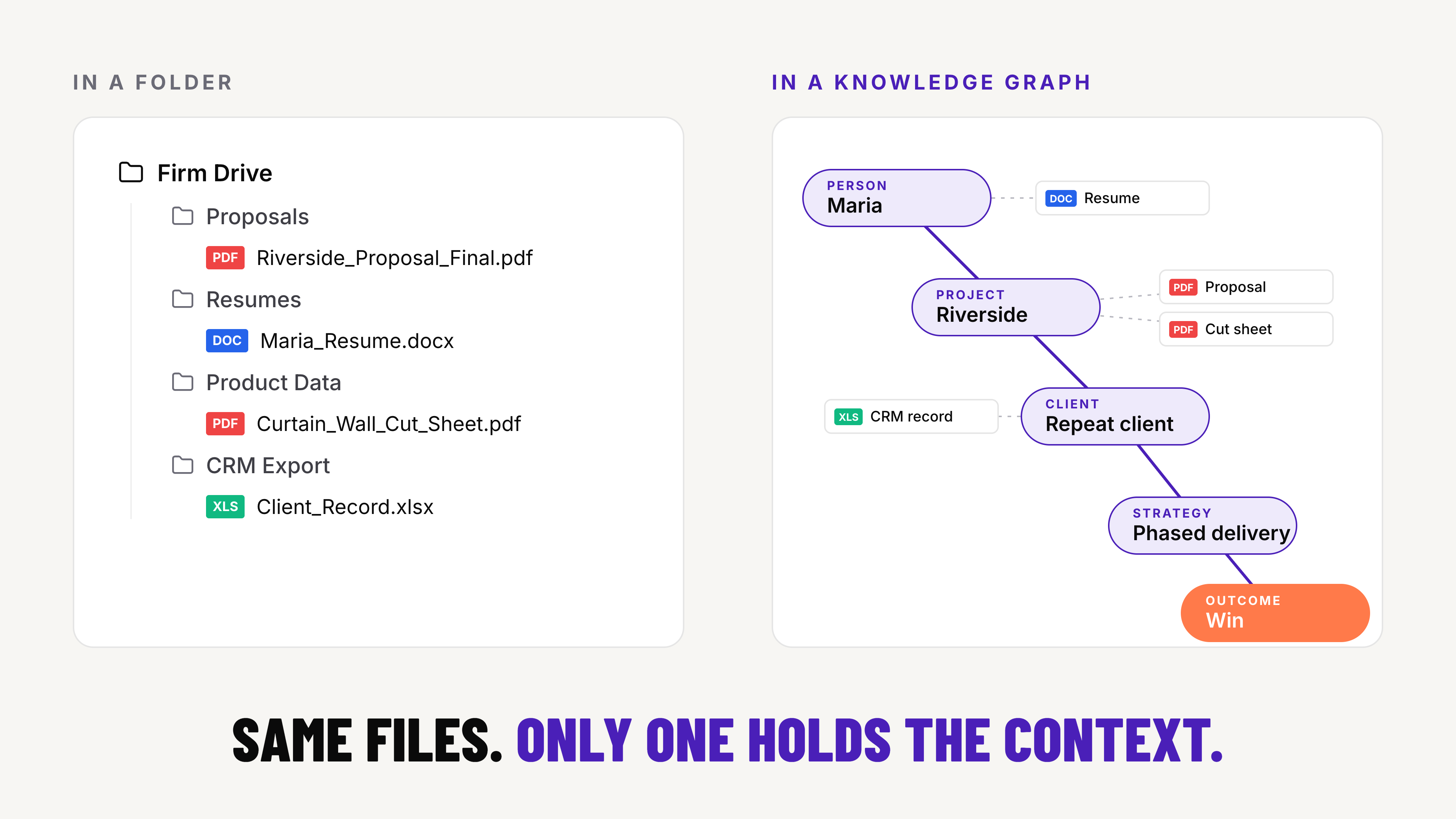
Those connections are where true pursuit judgment lives. When a principal says, "Put Maria on this submittal and lead with the phasing strategy," that isn't magic. That is an experienced leader traversing twenty implicit relationships in two seconds.
None of those relationships can be encompassed in a file. Because standard repositories have nowhere to put a connection, that knowledge stays trapped in people’s heads. It’s available while they're in the room, and gone when they step out or retire.
When a pursuit feels chaotic, the files themselves usually aren't scattered. What’s scattered is the context that links them.
The three symptoms you probably feel on every pursuit
When proposal context is missing, from the conversations I’ve had, it creates three distinct types of breakdowns on every bid:
- The Inaccuracy Trap (Data Problem)
The Symptom: Someone posts in Teams: "Does anyone have the final submittal for Riverside?" You get four replies, three attachments, and two files named FINAL_v2. The team accidentally uses a pre-submission draft with unupdated contract values.
The Root Cause: Disconnected data. There was no systemic way to verify truth without asking a coordinator who left the firm six months ago. - The Speed Bottleneck (Workflow Problem)
The Symptom: It’s Thursday, the submission is due Monday, and your central project library is in immaculate condition. Yet the proposal coordinator doesn't open it. She opens last month’s similar proposal and works backward from it to save time, accidentally carrying a stale resume into the new submission.
The Root Cause: Broken workflow. The library isn't where active work happens, and during a chase, nobody has forty minutes to assemble a bid from scratch. - The Trust Deficit (Closeout Problem)
The Symptom: The pursuit wraps up and everyone immediately scatters to three new jobs. Intended updates to project records, refreshed resumes, and win/loss feedback get pushed to "next week." Six weeks later, those details are lost forever.
The Root Cause: Abandoned closeouts. Nothing feeds back into the system, forcing the next RFP team to start from scratch with older, less reliable data.
The root cause of all your symptoms
Ask your team what’s wrong, and they’ll describe these as three separate pains: Speed, Accuracy, or Trust. But these aren't three separate operational failures they’re describing. All of this is part of a single feedback loop:
- Disconnected Data forces your team to invent manual workarounds.
- Workaround Workflows consume the entire schedule, so post-bid Closeout gets skipped.
- Skipped Closeouts mean zero new intelligence feeds back into your Data, making the next bid even harder.
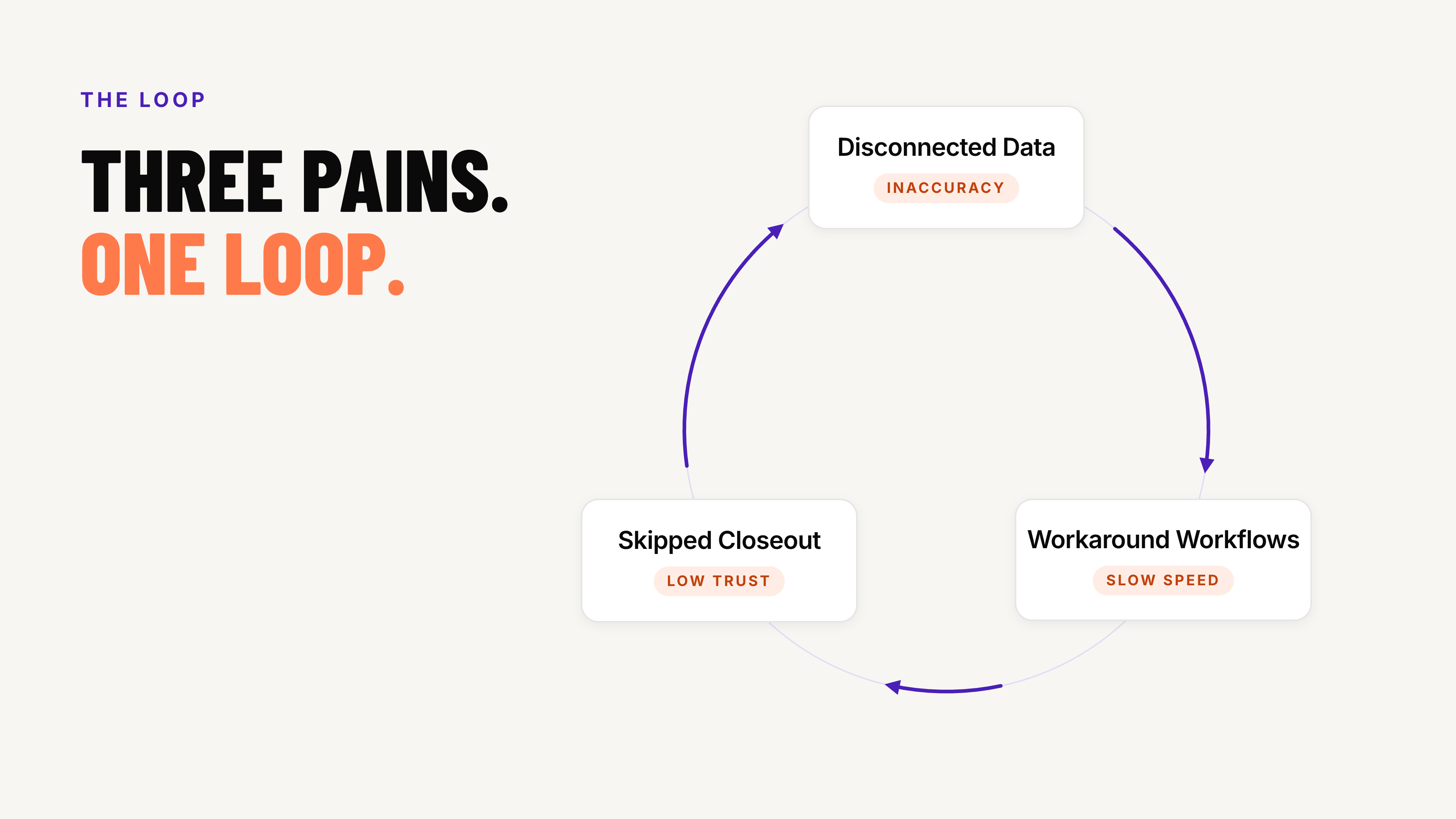
Every pursuit should leave your firm smarter and better positioned for the next win. Instead, most teams spend massive energy running hard in place.
A better organizational system for your files is not going to solve this problem. What you need is a context layer that maps who worked on what, for which client, under what delivery method, and what won.
When those connections become queryable, workarounds disappear because the system already holds the answer. And when workarounds disappear, closeout stops being a separate chore, it becomes a natural byproduct of the pursuit itself.
Why doesn’t generic AI improve AEC proposals?
Once firms have centralized their data and that doesn’t solve the problem the next step is usually pointing a general-purpose AI assistant at SharePoint. These models are impressive, but their output can seem generic.When the output feels generic, the AI isn't the problem—the missing context is.
These generic AI tools lack a core element: a model of your firm.
When you ask a generic AI to build a proposal, it performs simple search retrieval. It gives you fluent, professional text that is fundamentally detached from your firm's actual win strategy. In other words, a general assistant doesn't understand:
- Which teams built which project types
- What technical nuances won a specific client tier
- Which resume version represents a PM's current credentials
This is exactly the context or firm model a “knowledge graph” provides. A knowledge graph at Kantiv is the structured representation of your firm's reality: which teams built which project types, what technical differentiators won a specific client tier, which resume version reflects a PM's current credentials, and how all of those things connect to each other. Without it, AI has no context to reason over. It's autocomplete with good grammar.
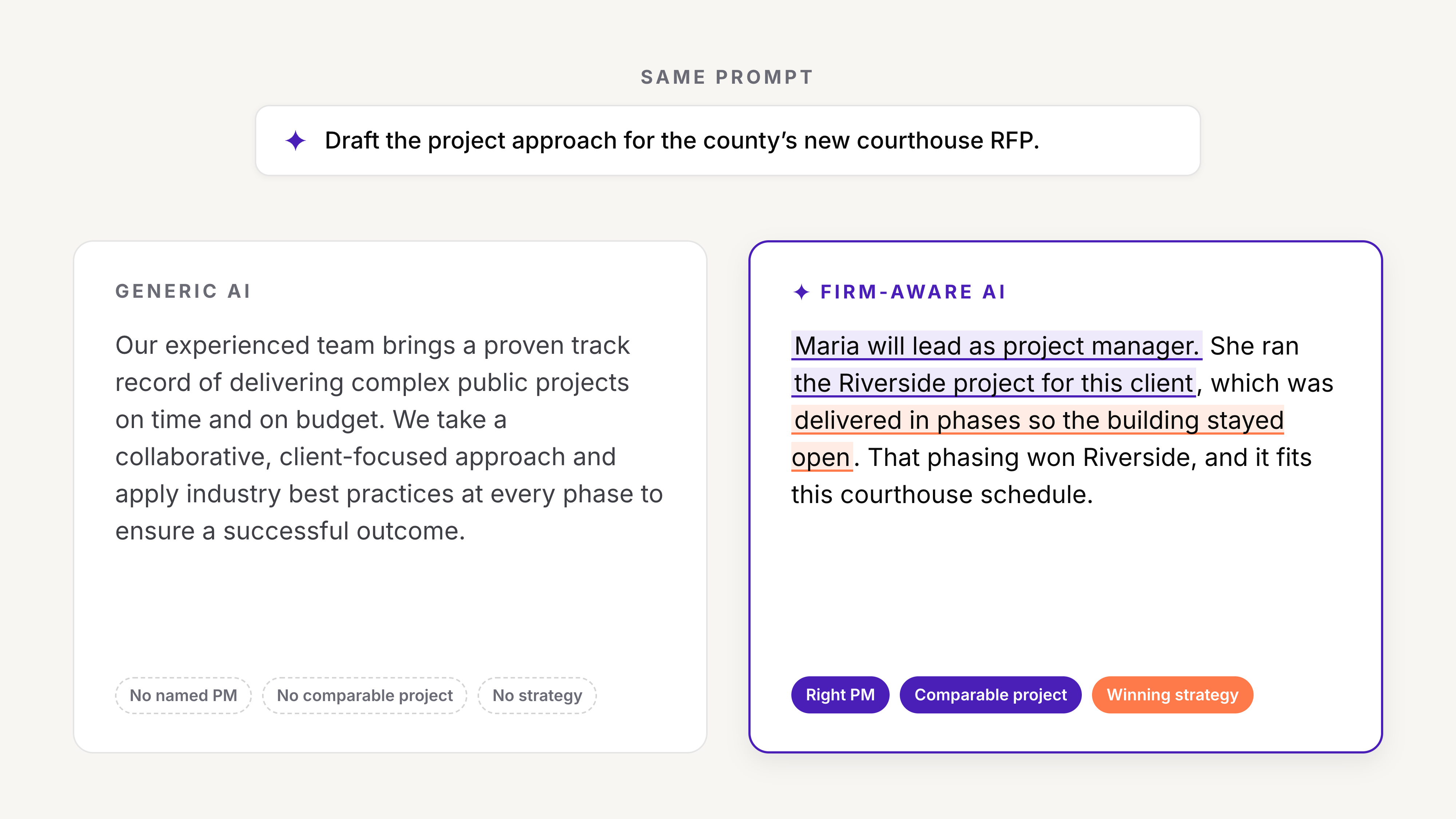
A knowledge graph gives AI the one thing it can't infer on its own: the institutional judgment your best people carry encoded as structure. And the best part? Every new pursuit you go after using Kantiv, adds to your next one.
What a Connected Pursuit Looks Like
Imagine that same high-pressure Thursday, but with your firm's internal relationships mapped by Kantiv’s Knowledge Graph:
- Instant Alignment: The moment an RFP arrives, relevant past projects, winning resumes, and client-specific submittals are instantly surfaced—not through manual folder hunting, but through linked historical context.
- Proactive Drafting: The coordinator starts from verified, compliant firm history rather than a blank document or an outdated past submittal.
- Automated Feedback: When the deal closes, updated resumes and bid learnings loop back into the core system automatically as part of normal workflow completion.
“But what about all the time we spent on consolidating and organizing our files, Kyle? We can’t redo all of that!” , is what you may be thinking. You have nothing to worry about.
Using Kantiv doesn’t mean you need to migrate away from the tools you already rely on—like Deltek, SharePoint, or Egnyte. Instead, Kantiv runs across your existing stack to connect your people, projects, clients, and pursuits into an intelligent, active knowledge network.
Today, over 200 AEC teams use Kantiv to manage billions in submitted proposals, cutting their proposal preparation time roughly in half while winning more work.
Why waiting a year makes this harder to fix
Two things are moving at once, in opposite directions.
Your firm is producing pursuit material faster than it ever has. Submissions were up 32% across the industry last year, and every one of them generates proposals, updated resumes, project records and images that nobody has time to organize. The pile you'd have to work through grows every quarter you postpone.
At the same time, the people who can explain what's in that pile are leaving. An estimated 184,000 engineers retired or left the profession in 2022, and more than 40% of the current workforce has fewer than ten years of experience (ACEC Research Institute, 2025).
A project record with a missing scope field or an unlabeled photo set is fixable today, because someone still remembers. Ask the right person and you have your answer in four minutes. After they retire, that same record is something you either verify from scratch or stop citing. You can buy software next year. You can't buy back the context you lost this year.
Four Questions to Ask Any AI Partner
Whether you talk to us or evaluate another solution, ask these four questions to separate a superficial demo from a foundation built for AEC:
- Does the system get smarter about our firm over time, or does every proposal start from zero?
- Does it become more valuable as more of our team uses it, or does it only serve a single power user?
- Do we maintain total ownership and clean extractability of our own structured data?
- Could a general-purpose AI company release this exact feature next quarter? (If yes, you’re buying a temporary feature, not a lasting foundation.)
I love helping teams solve this puzzle and win more of the work they deserve. Ask me those four questions on a call, and I’ll give you a straight answer.
Find out which layer is holding you back (you may be surprised)
Most leadership teams guess wrong about which stage of their pursuit loop is actually failing. Book a demo with our experts who will help you measure your team's speed, accuracy and trust, pinpoint whether your bottleneck is data, workflow or closeout, so you know where to start.