Found the content on this page useful? Share it with your team!
Speed or Strategy? AEC Firms No Longer Have to Choose


Table of Contents
Ask a room full of firm leaders how they plan to win more work this year, and you'll get a remarkably consistent answer: go after more of it. More RFPs in the funnel, more proposals out the door, more shots on goal. It sounds like ambition. More often, it's the thing holding their win rate down.
The market is tighter than it's been in a while. The SMPS Foundation’s most recent emerging-trends research keeps circling back to what helps firms win work in tighter markets—which tells you where the industry’s head is at. And the honest baseline is sobering. By the SMPS Foundation's benchmark, AEC firms win fewer than half the proposals they submit. Engineering firms, the strongest performers, land around 44%. Flip that over: every firm in the industry is pouring real hours into work it loses more often than it wins.
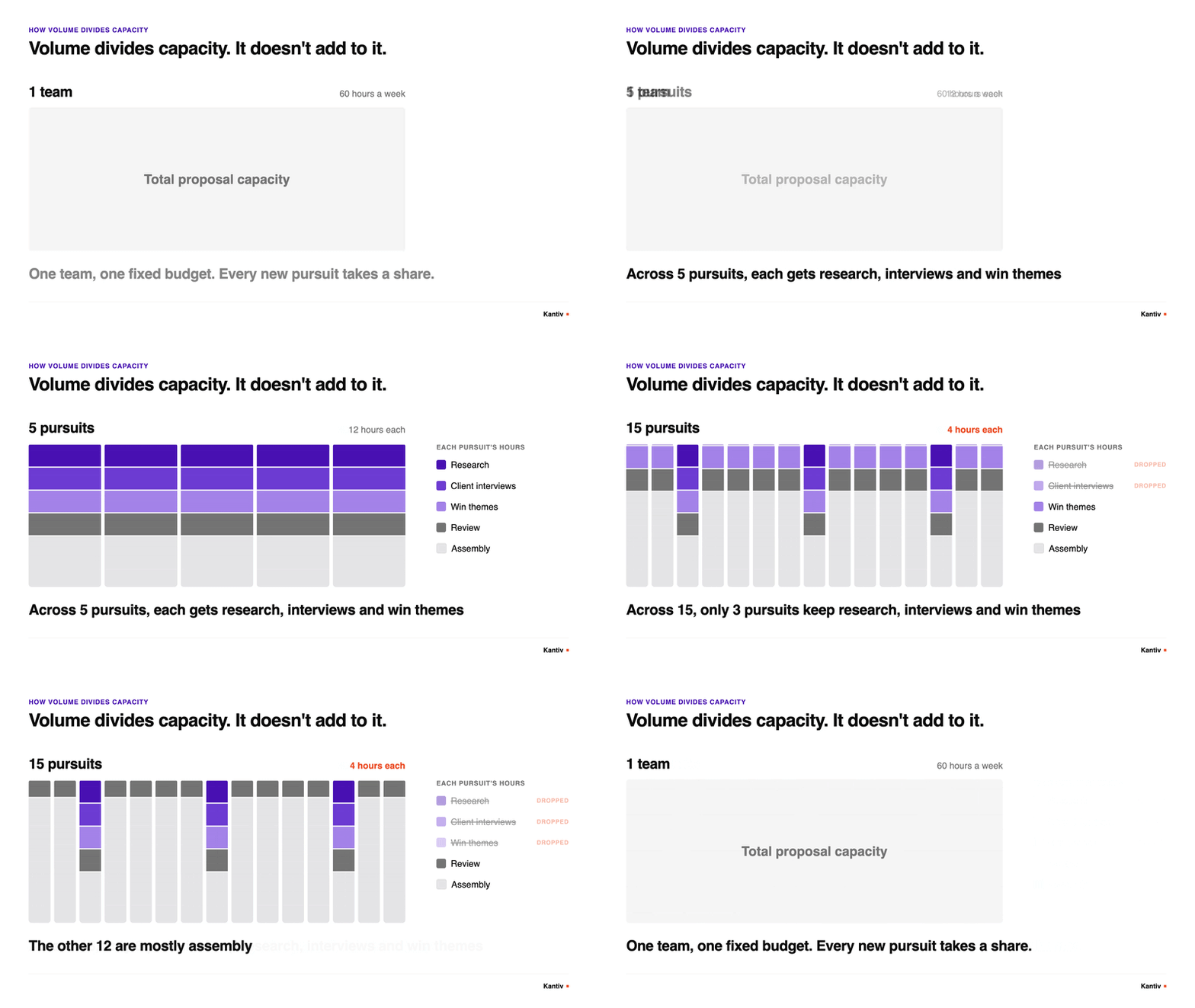
So when competition heats up, the reflex is volume. Pursue everything, decide later. The problem is that volume doesn't add capacity—it divides it. The same proposal team, spread across more pursuits, puts less thought into each one. Quality per bid drops, targeting gets lazier, and the firm ends up submitting more and winning a smaller share. PSMJ has been blunt about where this leads: roughly 80% of AEC firms are stuck competing on price—which is exactly what happens when nothing in your proposal makes a client see a difference worth paying for.
There's also a cost that never lands on a win-rate report: your people. Proposal and marketing teams are the ones who absorb 'pursue everything'—the nights, the weekends, the Friday at 5:00 PM fire drills that quietly become normal. They're small teams carrying this load already, and 'more' is the fastest way to burn them out. Leadership tends to frame volume as a throughput problem. It's a human one too—and the firms that miss that pay for it twice, first in morale, then in the turnover that walks hard-won institutional knowledge out the door.
Here's the part that should sting. A full proposal response runs well over 100 staff hours. When you lose more than half of them, that's not the cost of doing business—it's the single biggest unforced error in the pursuit process. Almost nobody treats it that way.
Which sets up the real question, the one this whole blog is about. When the market tightens, you have two instincts: speed or strategy. Push more proposals out faster, or slow down and make each one count. Most firms pick speed, because speed feels like control. The data keeps pointing the other way—and the firms pulling ahead have stopped treating it as a choice at all.
Clients aren't buying your qualifications
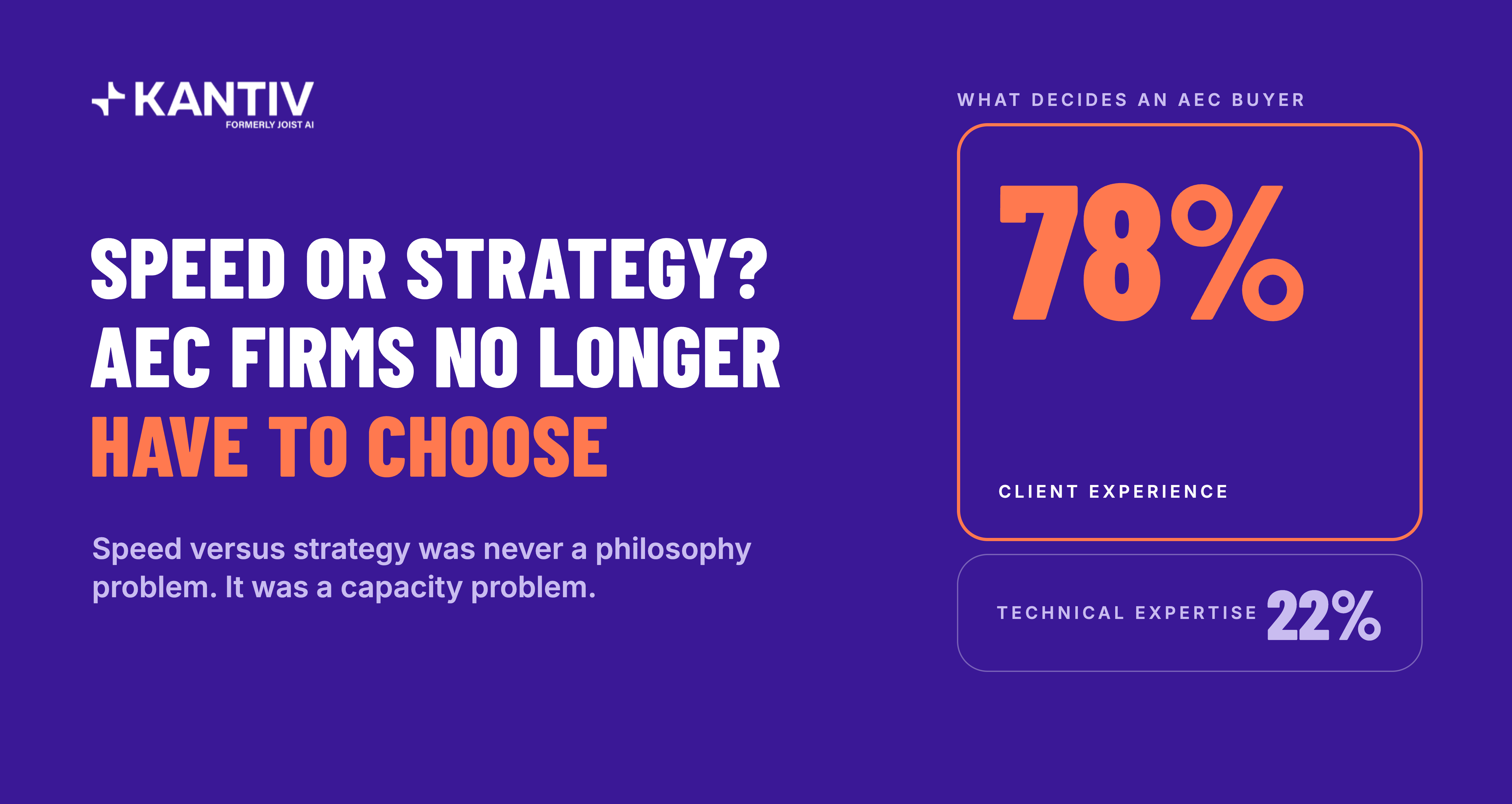
Start with what actually wins work, because most firms get it backwards. Research presented at Amplify AEC this year put a number on it that's hard to shake: client experience accounts for roughly 78% of an AEC buyer's decision. Technical expertise accounts for about 22%.
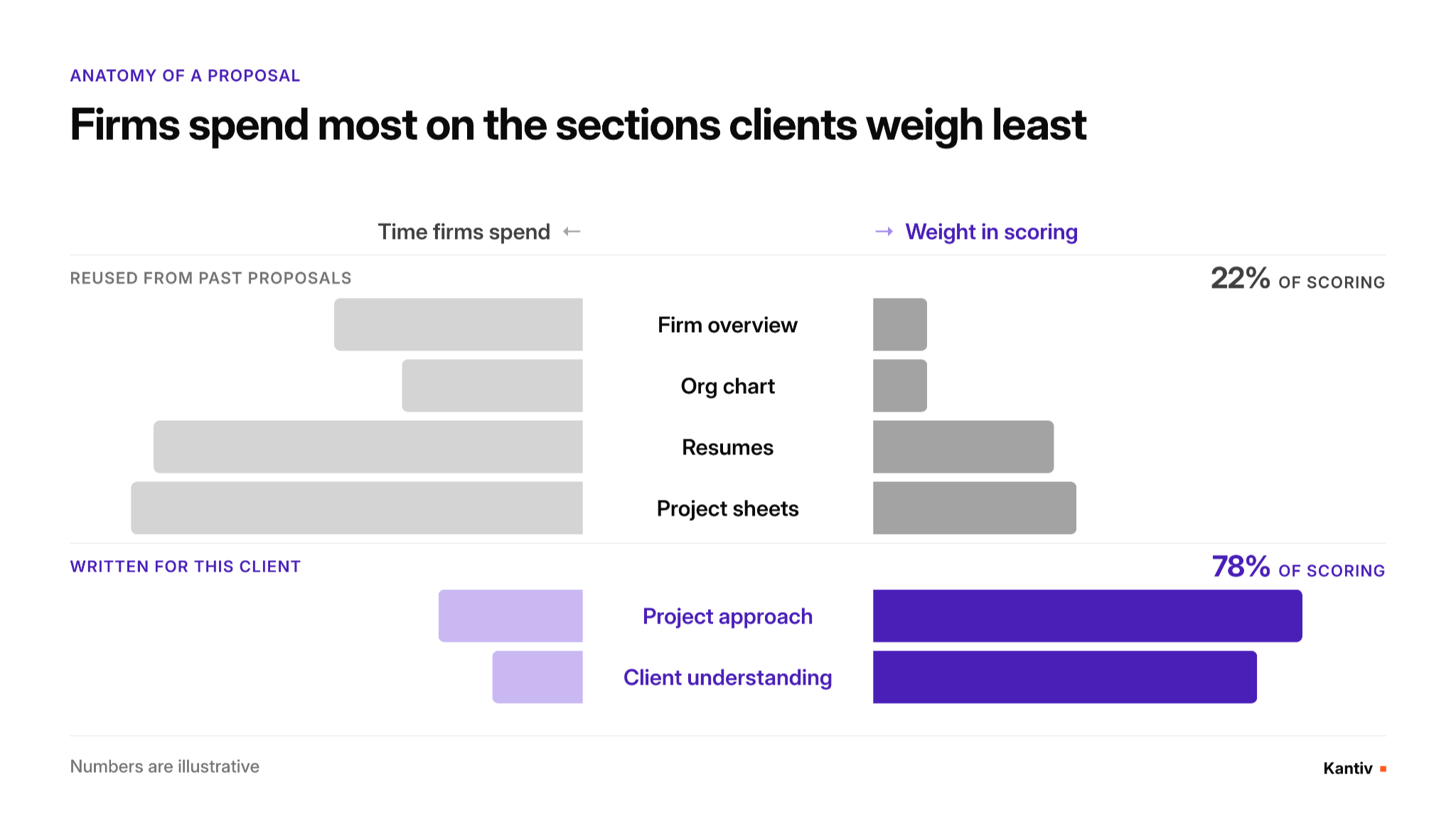
Read that again, because it reorders everything. The thing most proposals lead with—the firm history, the org chart, the project sheets, the technical qualifications—is the smaller half of why anyone picks you. Your team is talented. So is the shortlist you are on. When everyone at the table can do the work, "we can do the work" stops being an argument.
The thing most firms lead with—technical qualifications—is the smaller half of why they win. Everything riding on the other half is customization.
This isn't unique to AEC, which is the uncomfortable part. The same pattern turns up across consumer and B2B research: buyers consistently choose the firm that feels like the right fit over the one with the longer capability list. Work by Bain and LinkedIn found that something like half of B2B buying influence sits with people who never read your technical approach—they go on gut, familiarity, and whether your firm feels like a safe bet to the rest of the committee.
That last part matters more than most proposals account for. Buyers often pick the established, familiar firm not because it's better, but because it's easier to defend internally if the project goes sideways. Familiarity is a risk-management tool. If you're the challenger, generic qualifications won't beat it—the only thing that will is showing, specifically and early, that you already understand this client's world better than the incumbent takes for granted. SMPS's own trend research lands in the same place: broad capabilities and generic qualifications are no longer enough, and clients want to know, clearly and fast, what you bring to their specific project. In engineering, qualifications-based selection makes it formal—you are scored on understanding, not price.
All of which points at one thing: The proposal that wins is the one that is unmistakably about the client.
So why does everyone still send boilerplate?
Because knowing you should customize and being able to are two very different things.
Look at who's actually doing the work. Research summarized by SMPS found that 69% of AEC marketing teams have fewer than ten people—regardless of how big the firm is—and 86% are regularly producing the raw material of pursuits: resumes, project sheets, qualifications. Half of firms are still tracking opportunities in spreadsheets. These are small teams carrying enormous proposal load, with the firm's institutional knowledge scattered across inboxes, hard drives, and the memory of whoever happened to run the last similar pursuit.
Then it gets harder. Firms can't hire their way out: 81% report recruiting as a moderate-to-extreme difficulty, and 76% point to a "missing middle"—the mid-career people who actually know how to run a strategic pursuit are the hardest to find. And the clock is running. A large share of the AEC workforce is heading for retirement this decade, and most of what they know about how their firm wins work has never been written down anywhere.
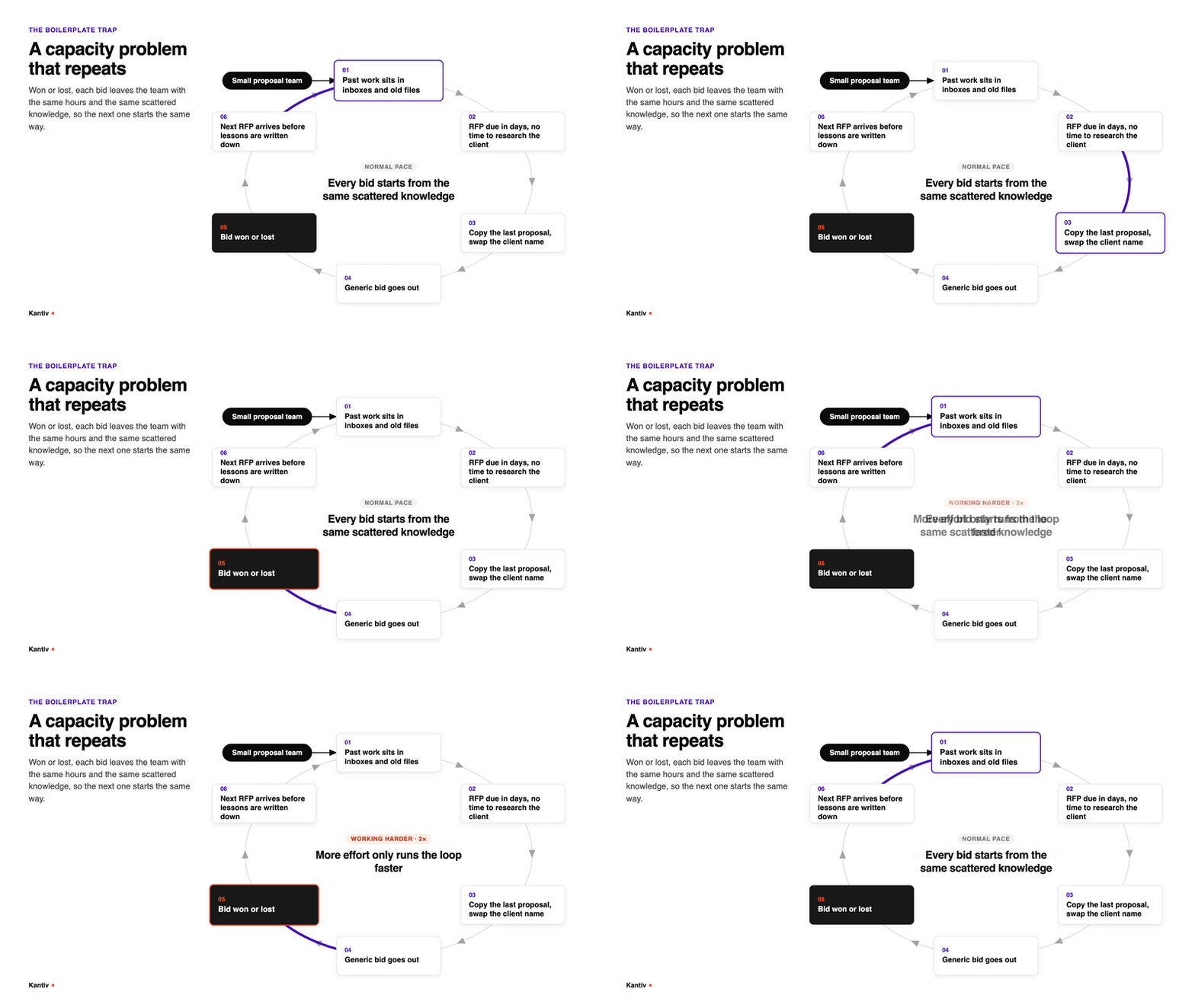
Put it together and the boilerplate makes sense. When a proposal is due Friday and the team is three people deep, you don't reach for the blank page and a strategy session. You reach for the last one that looked close enough and change the client's name. Not because anyone thinks it wins—because it's what the hours allow.
That's the real trap. Speed versus strategy was never a philosophy problem. It was a capacity problem.
What changes when the capacity problem goes away
This is where AI actually earns its place in the conversation—and not the version in every vendor's slide deck.
The most useful way to think about it also came out of Amplify: as AI takes over the engineering of marketing—the drafting, the formatting, the data-gathering, the first pass at a compliance matrix—the human value shifts toward the artistry. Discernment. Judgment. Actually knowing your client instead of just having data about them. AI is not there to write your proposals for you. It is there to hand your best people back the hours they currently burn on assembly, so they can spend them on the 78% that wins.
And the firms that have made that shift are already pulling away. PSMJ's research is striking here: technology-forward firms are nearly twice as likely as technology-static firms to land in the top win-rate bracket—75% and up. The advantage isn't the software. It's what the software frees people to do—pursue more selectively, tailor more deeply, and bring strategy to pursuits that used to get a copy-paste because there was no time for anything else.
This is the shift we spend our days on at Kantiv—turning a firm's scattered proposal history into something its team can actually draw on, fast—but the tool is beside the point here. The point is what becomes possible. Satterfield & Pontikes claw back eight to ten hours on every pursuit. Benesch tripled productivity on some proposal workflows. None of those firms used the time to simply produce boilerplate faster. They reinvested it in the part that actually moves a win.
Speed stopped being the enemy of strategy the moment the busywork stopped eating the strategy's hours.
What the firms pulling ahead actually do
If you want to be on the right side of this, it's less about buying something and more about building a habit. A few moves that can help turn reclaimed capacity into better pursuit work:
- Get ruthless and more deliberate at the front end. Fewer, better-matched pursuits beat more, weaker ones every time. A real go/no-go process—one that can actually say no—is how reclaimed hours end up on winnable work instead of spread thin across everything.
- Treat institutional knowledge as an asset, not a byproduct. Every proposal, win or loss, is intelligence about how the firm competes. The firms pulling ahead capture it in one place their whole team can reach, instead of letting it retire or walk out the door.
- Spend the reclaimed time on the client, not the template. The hours AI gives back go into the 78%—the specific understanding of this owner, this project, this committee—not into producing more generic pages faster.
- Let your best people be strategists again. The marketer's job moves from production to judgment: from order-taker to the person at the table shaping which pursuits to chase and how to win them.
None of that requires choosing between moving fast and being strategic. That was always a false choice—one the industry only accepted because, for a long time, the hours genuinely didn't exist.
The market is going to keep getting more competitive, and client experience is only going to count for more, not less. The firms that treat every proposal as a chance to prove they understand a client—and that build the capacity to actually do it—will take share from the ones still changing the name on last year's template and hoping volume carries them.
Speed or strategy was never the real question. The real question is whether your firm has built a way to have both. The ones that have aren't working harder. They have just stopped losing more than half their effort to a choice they no longer need to make.