Found the content on this page useful? Share it with your team!
22 AEC Industry Trends and Statistics Shaping How Firms Win Work

.png)
Table of Contents
AEC firms are submitting more proposals, and winning less.
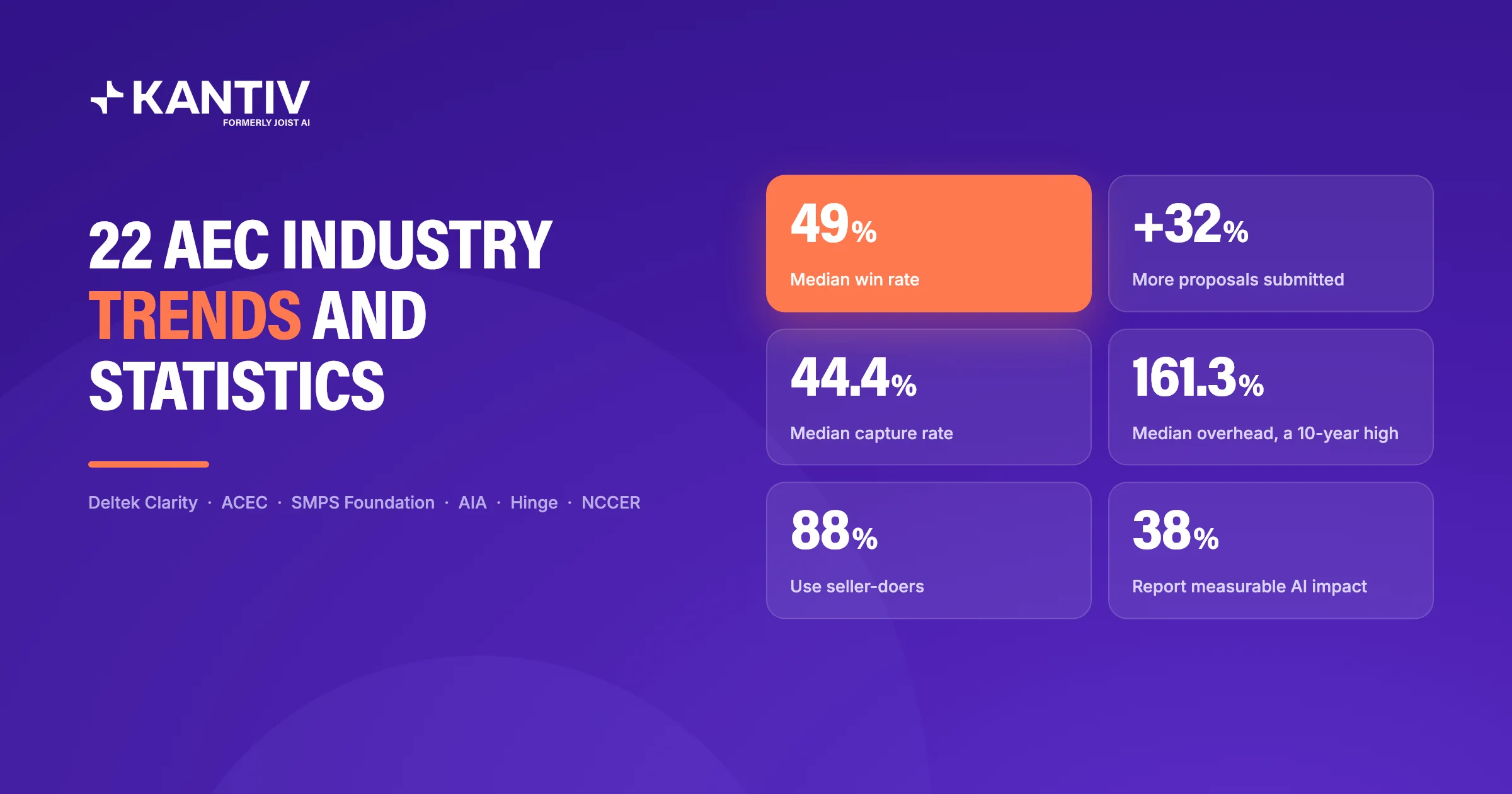
Across nearly 900 architecture and engineering firms, proposal volume increased 32% in one year. Yet the median win rate fell to 49%, while capture rate, the share of pursued contract value actually won, dropped to 44.4%.
Every pursuit consumes marketing capacity and billable technical time, whether it wins or loses.
The 22 benchmarks below reveal why more proposal activity is not translating into more wins, and what firms can do differently. They examine the rising volume of pursuits, declining win rates, growing time demands, and uneven adoption of AI. Together, they point to a simple conclusion: winning more work depends less on producing more proposals and more on choosing well, finding the right evidence and using people’s time effectively.
Firms are pursuing more, but converting less
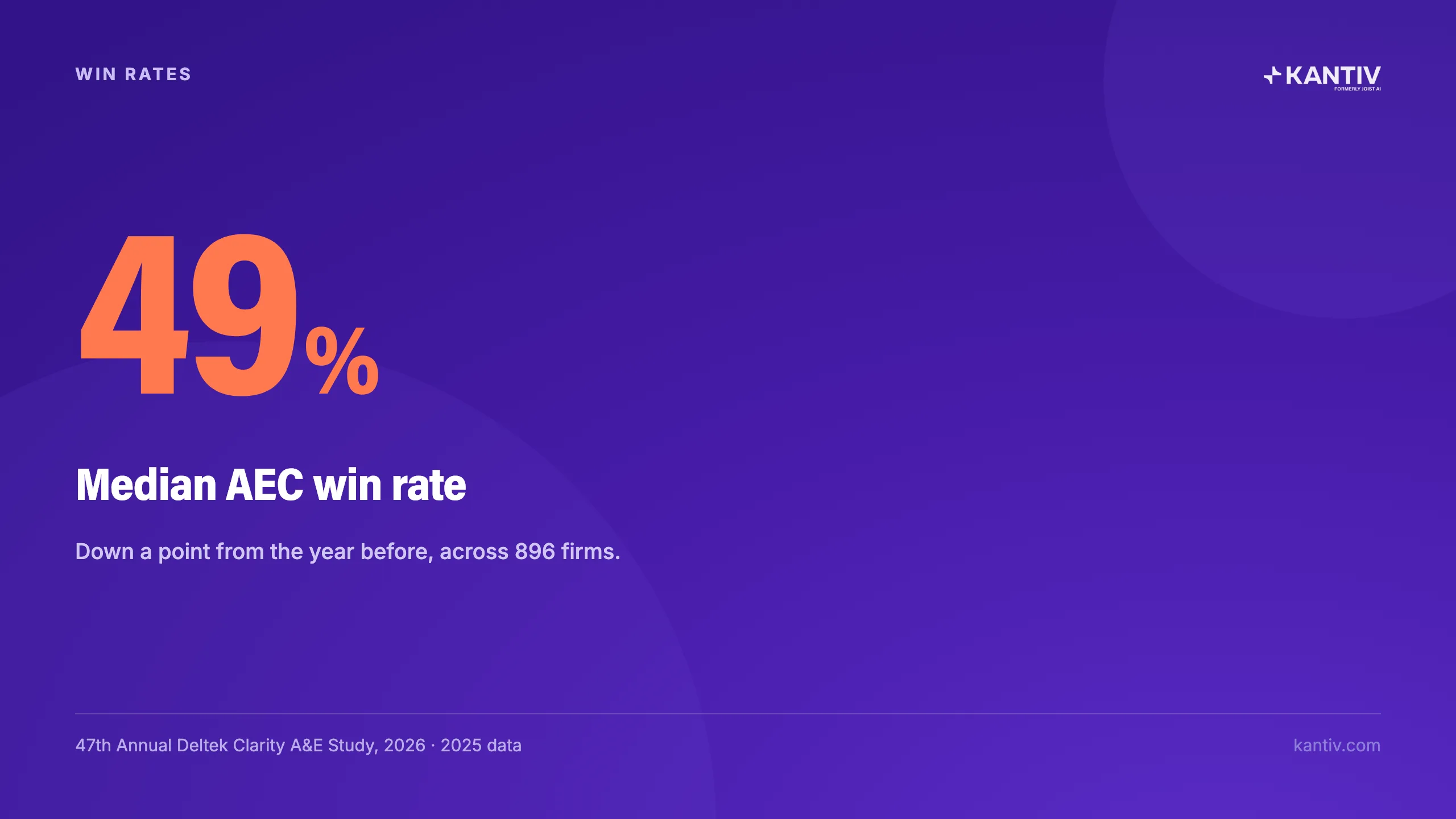
1. The median AEC win rate is 49%
Across nearly 900 firms in the United States and Canada, the median competitive win rate is 49%, down one percentage point from the year before.
While that is a benchmark, and not a target, the number that matters most is your own. If you can't produce your win rate from the last 12 months and break it down by client, market, project type and pursuit value in under an hour, that's the first thing to fix.
Then put it next to your capture rate from number 3 below. Win rate is measured in pursuits; capture rate weights them by dollars. If your capture rate is the higher figure, the jobs you're winning are larger than the ones you're losing, which is a win in its own right for your firm. If it's lower, you're spending the same submission effort on smaller awards, and your win rate alone will never show you that.
2. Firms submitted 32% more proposals than the year before
Just how much are firms submitting? Proposal volume across those same firms rose 32% in a single year.
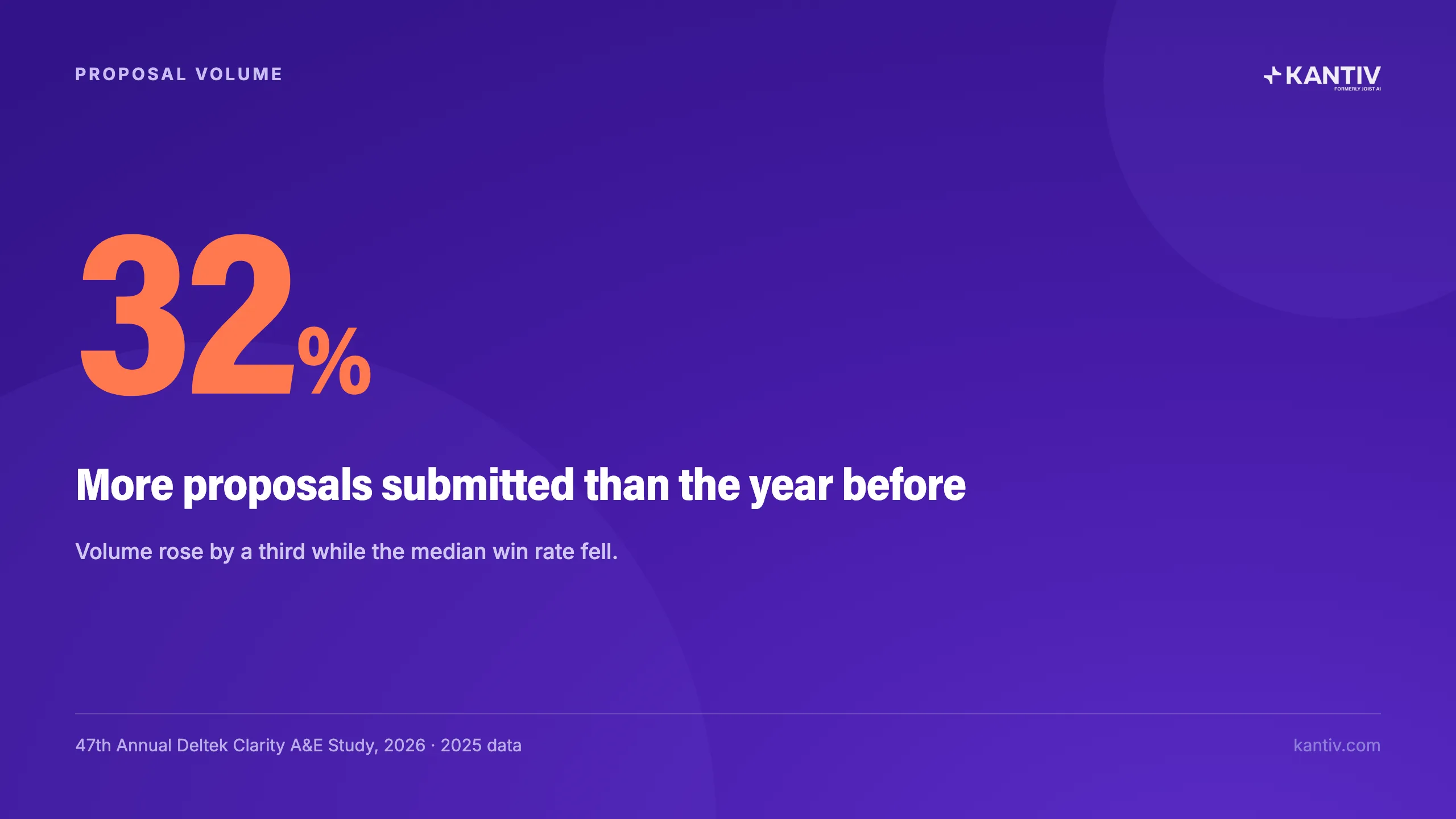
More opportunities can be good news. But proposal growth is only productive when conversion and economics hold with it. If volume rises while win rate falls, the firm is doing more work for each award.
This is often a sign that opportunities are entering production before anyone has made a disciplined go/no-go decision about whether they are worth pursuing.
3. The median capture rate fell to 44.4%
Capture rate measures awarded value as a share of dollars submitted, and the industry median fell to 44.4%, its lowest since 2019. The top quartile captured 61.3% of the value it pursued, while the bottom quartile captured 30.2%.
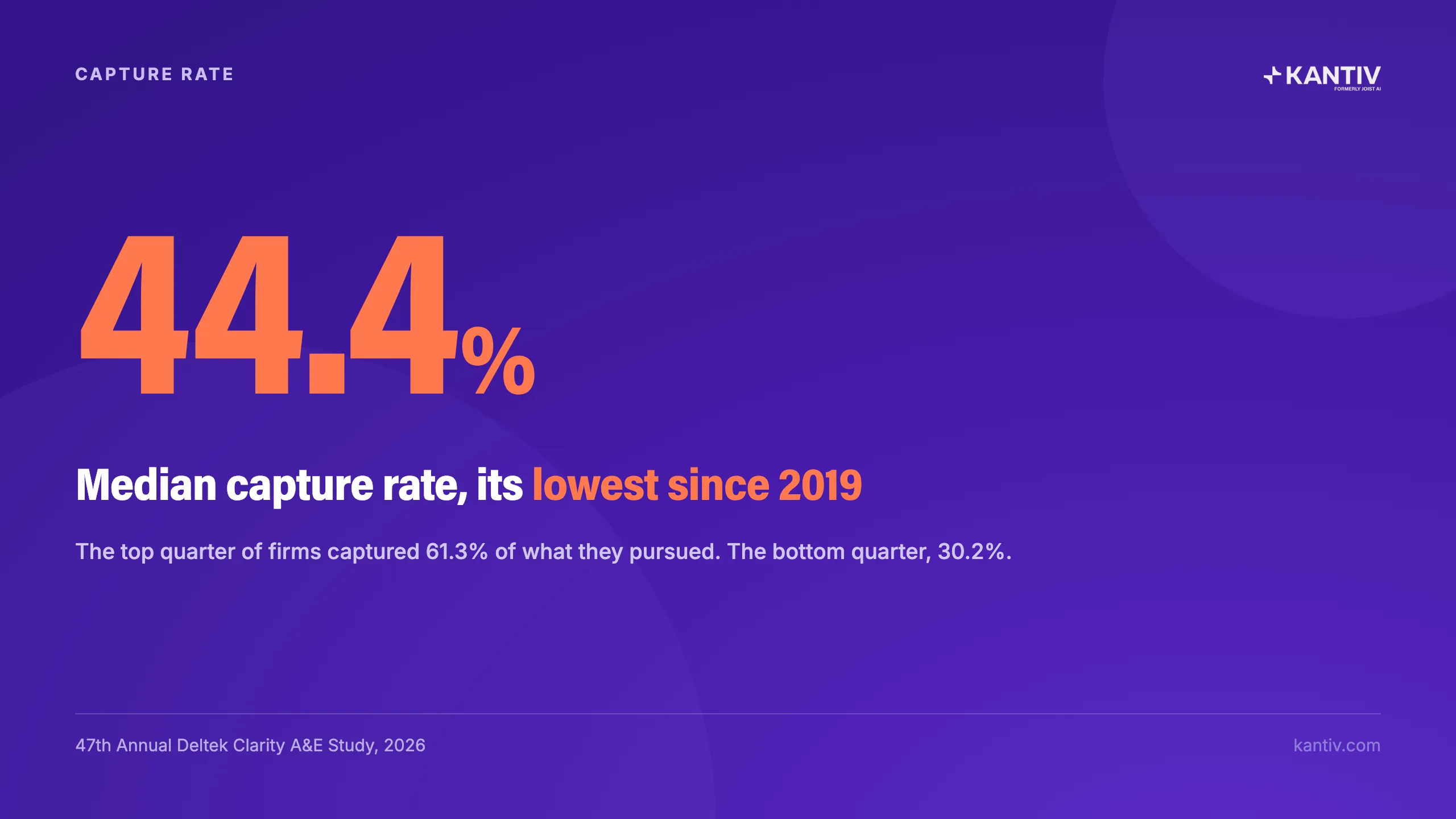
That 31-point spread shows that firms need to measure which opportunities they win, not just how many.
4. 8 out of 10 A&E firms have a formal go/no-go process
80% of A&E firms report a formal go/no-go process before committing to a pursuit. Among firms without one, 49% now say they're considering it, up from 29%.
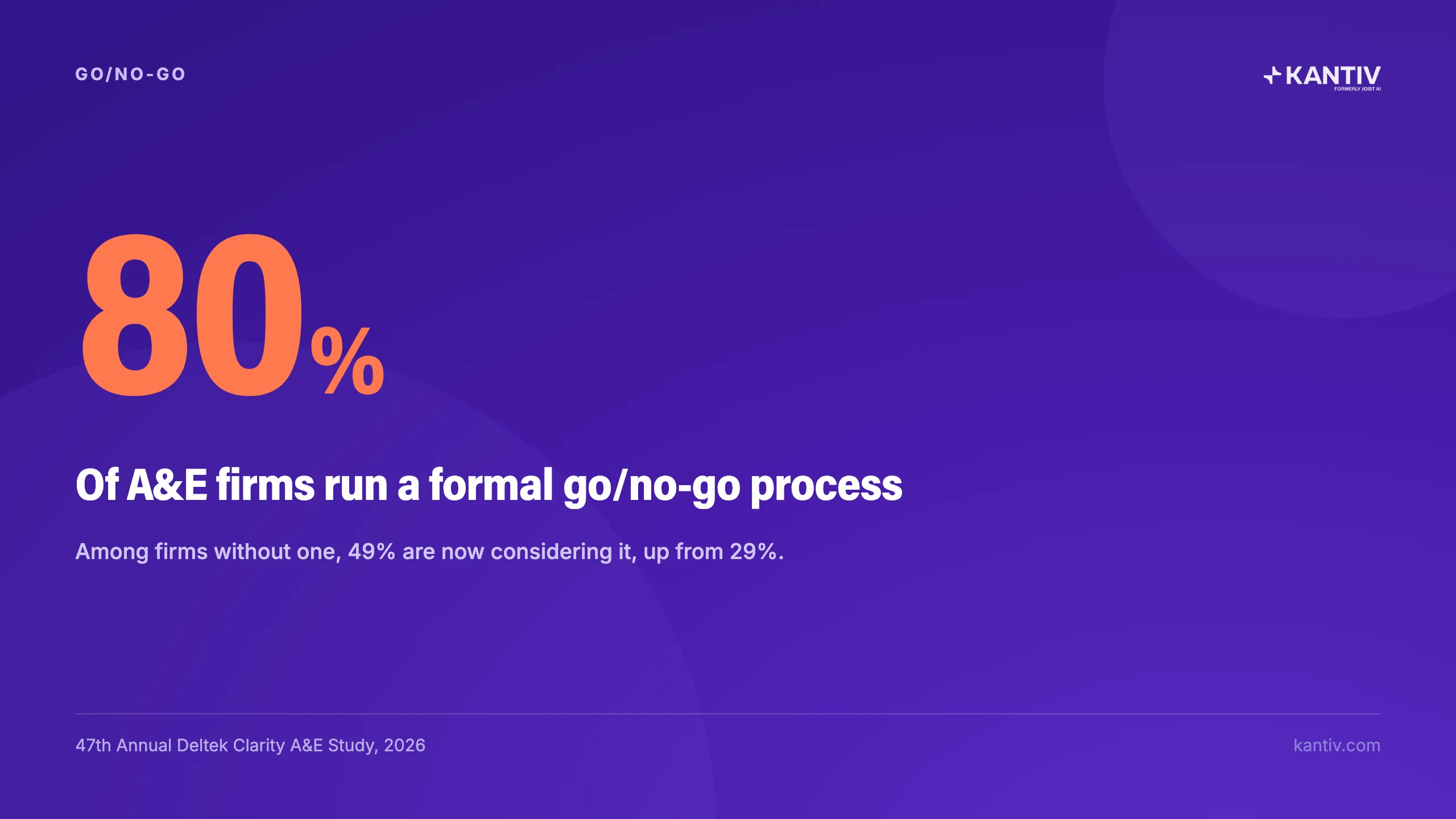
Having a go/no-go scorecard used to be a differentiator. Today, four out of five firms have one, so it no longer is.
If you're in the 20% without one, the fastest version fits on an index card: do we know this client, have we done this work, and can we name why they'd pick us. Most no-go calls are obvious once you have that answer in writing.
5. Only 38% of firms apply their go/no-go process to every opportunity
Of the firms with a go/no-go, 38% apply it to every opportunity. But 32% reserve it for strategic pursuits only. That leaves a large share of opportunities entering the pipeline through exceptions, relationships or informal judgment.
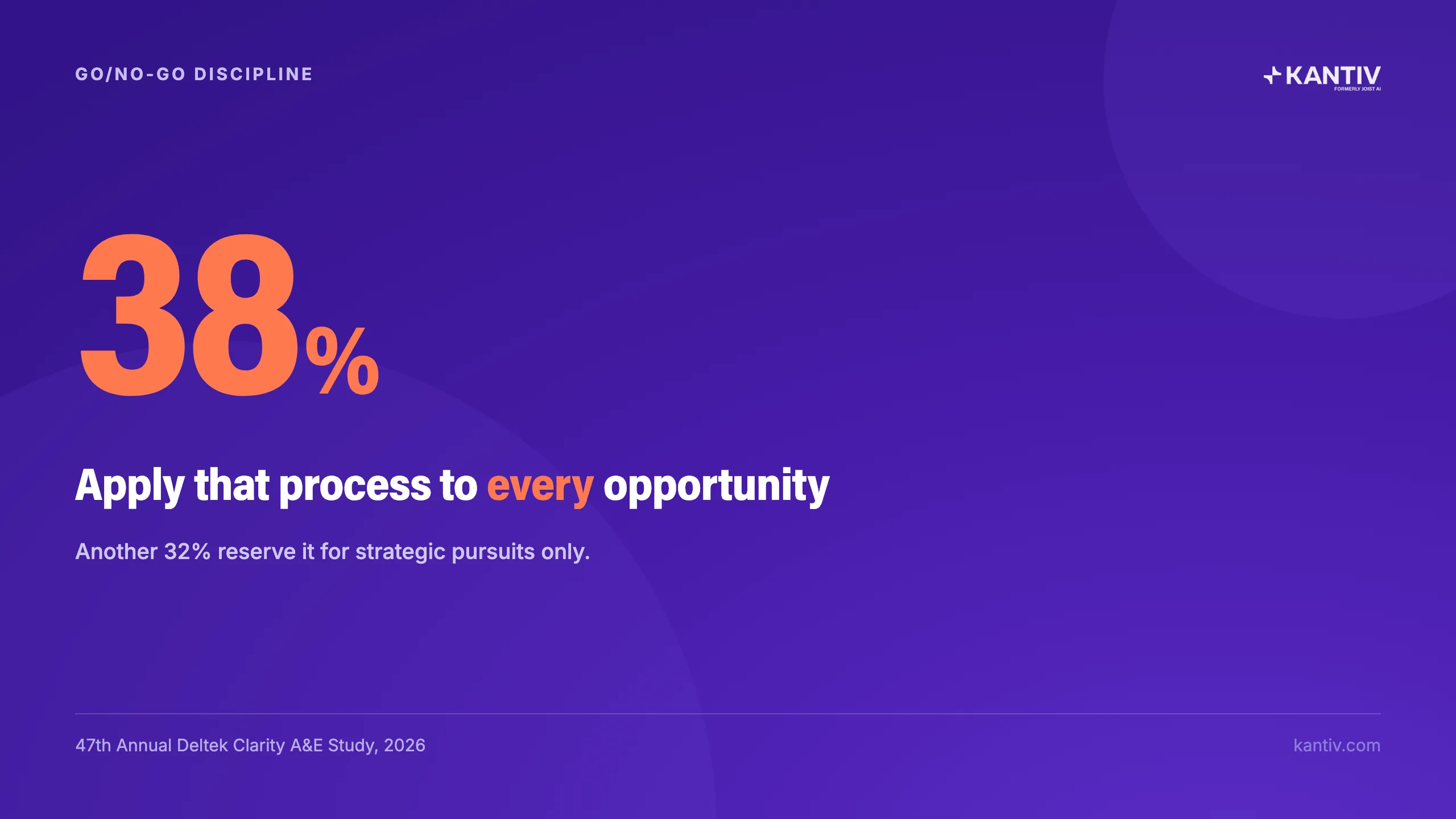
The problem with reserving your go/no-go process for strategic pursuits is that once you've already decided to chase, there’s nothing left for the scorecard or process to decide. And ironically, the process earns its keep on the ambiguous ones, like repeat clients with new scopes, or agencies where you have no past performance.
Firms also need a rule for overrides. You should name in advance who in your firm has the authority to overrule a "no," and have them put the reason in writing.
6. Most AEC firms invest about 5% of revenue into marketing and BD
AEC firms put about 5% of revenue into marketing and business development. A widely repeated rule of thumb in the trade puts the staffing that buys at roughly one marketing or BD professional per 35 staff.
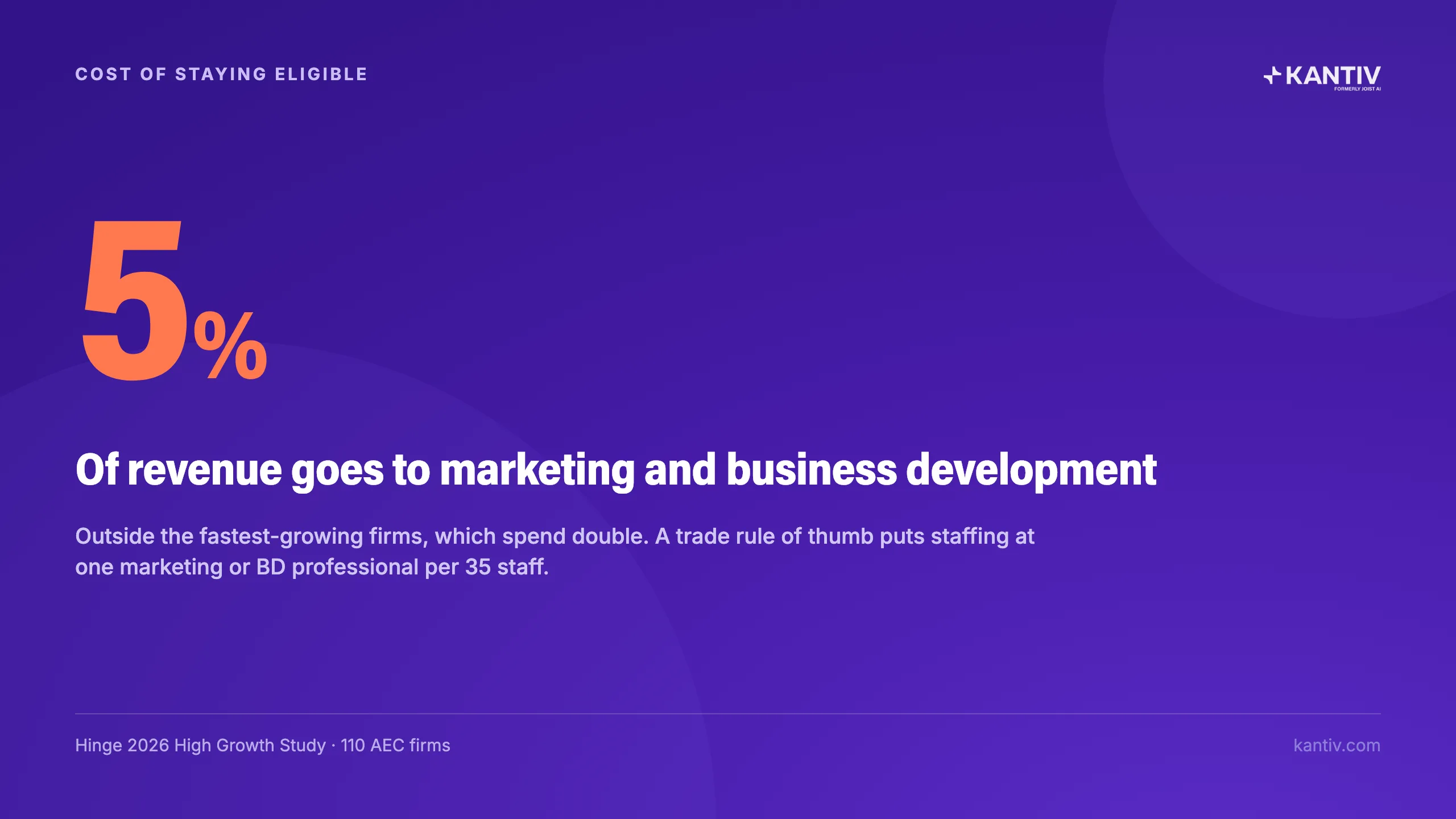
5% is solid as a benchmark, but what does it actually mean in the greater context of your firm? Rather than benchmarking against 5%, benchmark your marketing spend against your capture rate. Two firms can both spend the same amount, but if one converts 61% of the value it chases while the other converts 30%, more budget potentially just buys more kicks at the can. The fix here, again, is to be more selective on which pursuits get funded.
Pursuit capacity is under pressure
7. 47% of AEC firms say proving marketing's value is critical, but only 16% feel ready
47% of firms called proving the value of marketing and business development highly impactful. However, just 16% rated themselves highly ready to do it.
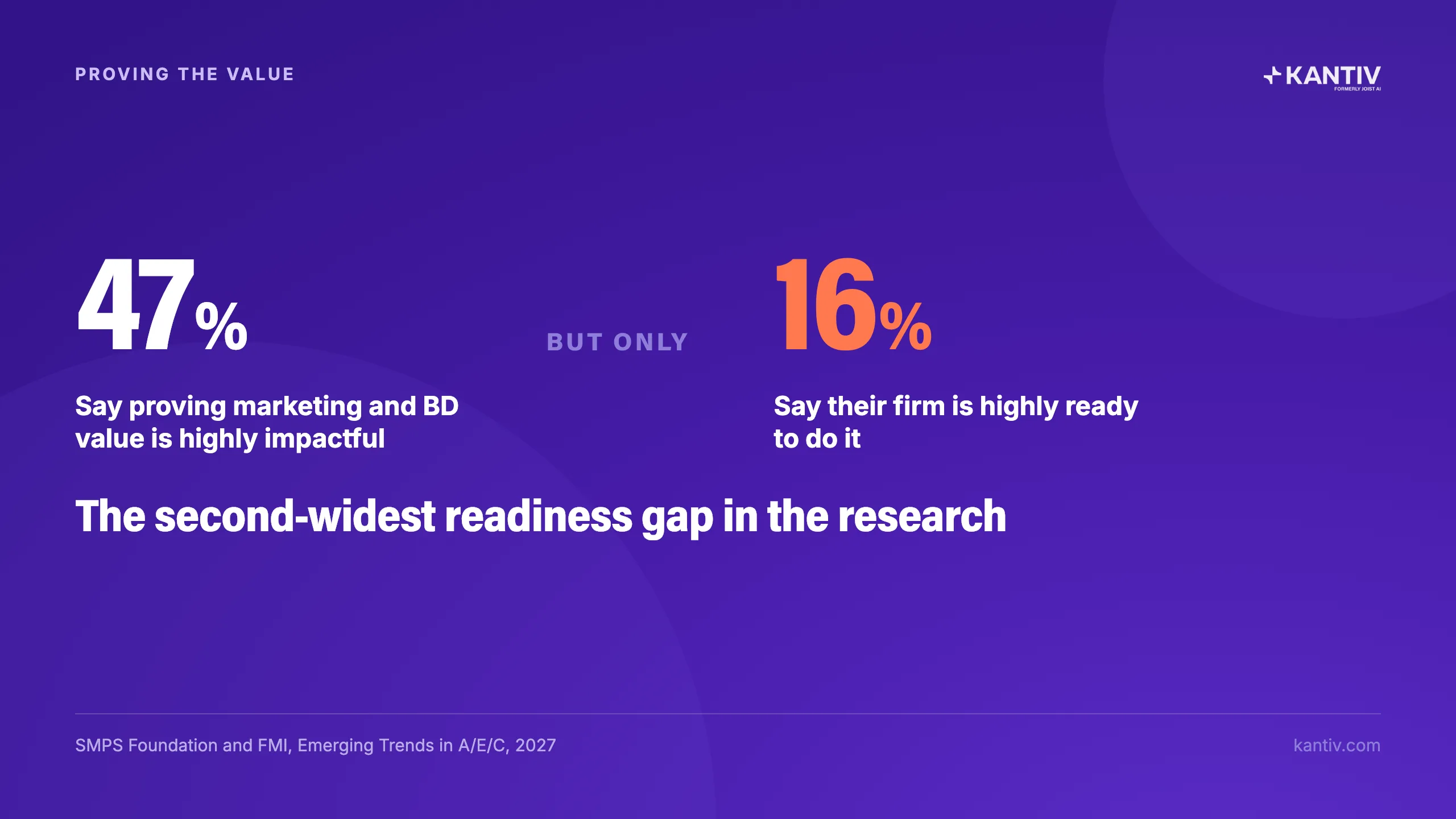
Many teams can report visible activity: proposals submitted, campaigns launched, website traffic and events attended. Far fewer can connect that activity to capture rate, revenue quality or performance by pursuit type.
That gap matters because it shapes investment. Marketing and BD functions that cannot demonstrate commercial impact are more vulnerable when budgets tighten.
8. Firms relying on generalist marketers fell from 69% to 52% in one year
SMPS research cites the CMO Insights Report 2025 on the move away from generalists, while specialist roles in areas like data, digital campaigns and automation grew by double digits.
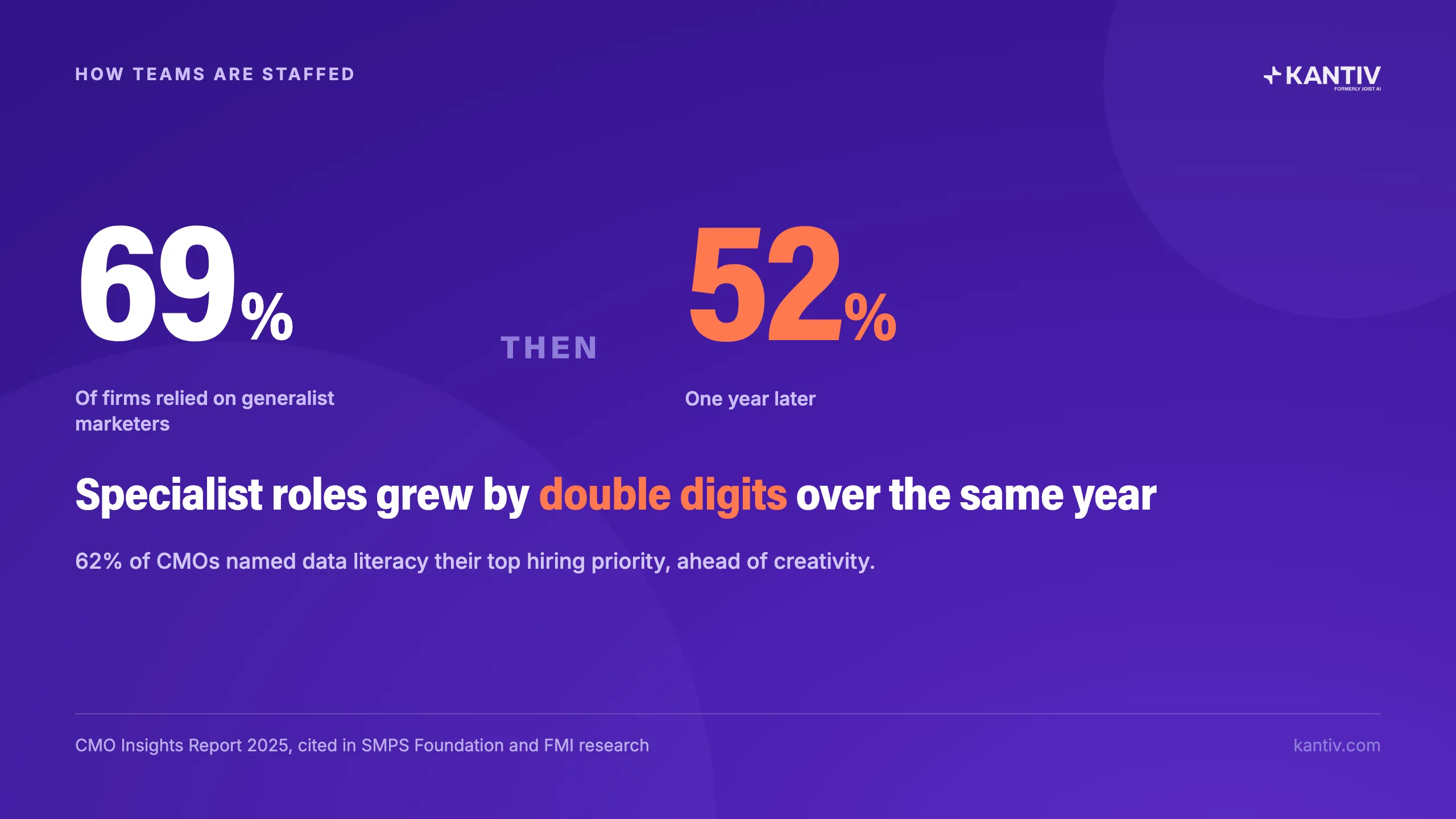
This is a broader marketing benchmark rather than an AEC-specific one, so it should be treated as a directional signal. Even so, the pressure is familiar: marketing work is becoming more specialized as firms expect teams to manage data, systems, analytics and revenue attribution alongside communications and proposals.
9. 88% of firms use seller-doers, either alone or in a blended model
40% of firms run a seller-doer-only model and another 48% run a blended one. That means 88% of AEC firms rely on technical staff to help win the work they will deliver.
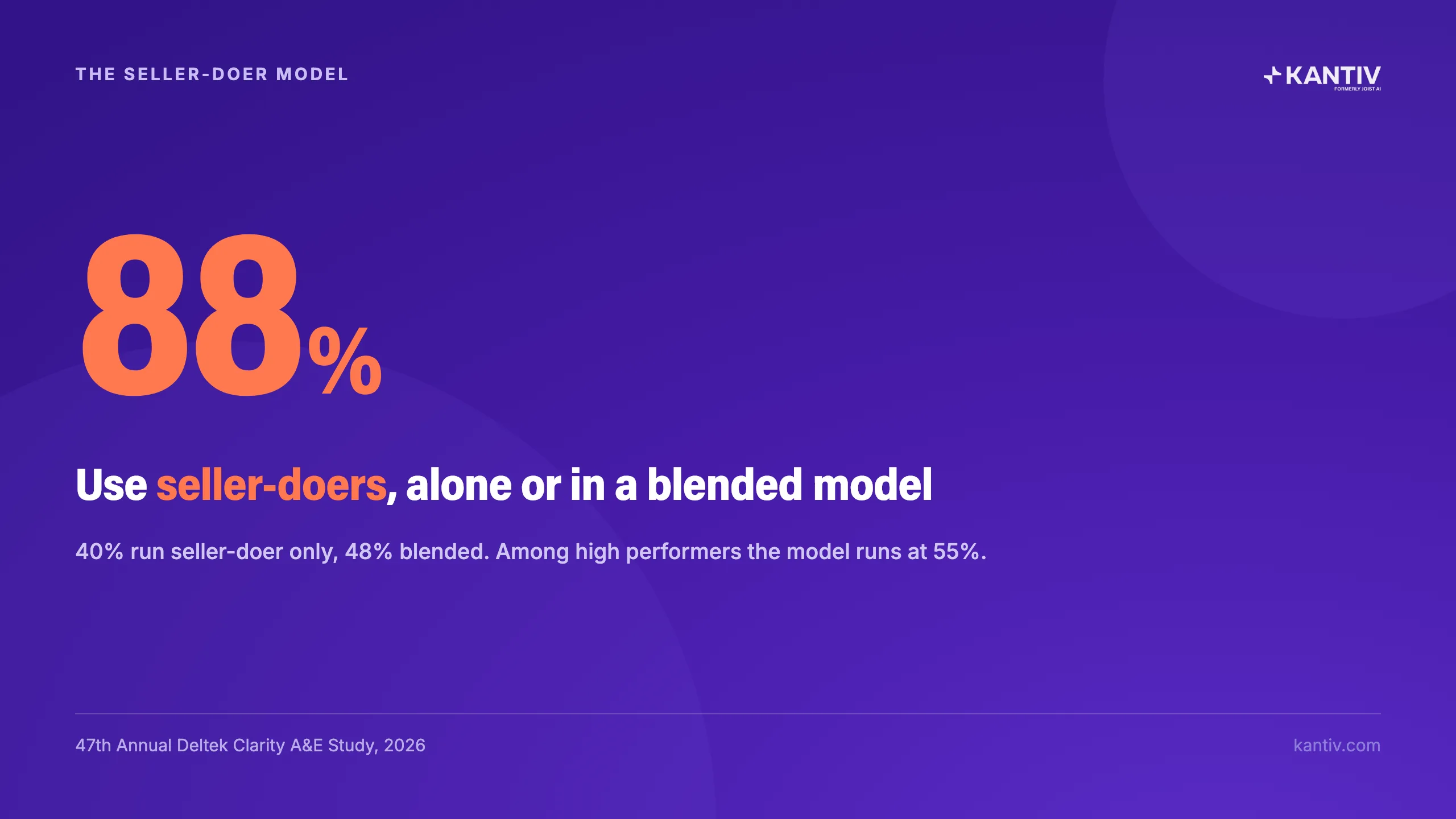
That makes sense in qualifications-based selection. When an evaluator is scoring relevant experience, the engineer, architect or project manager who delivered the comparable work is often the most credible person to explain it.
The challenging tradeoff is that seller-doers are billable, so business development and utilization end up competing for the same hours. If firms want technical leaders to participate meaningfully in pursuits, the pursuit process should be designed to take less of their time.
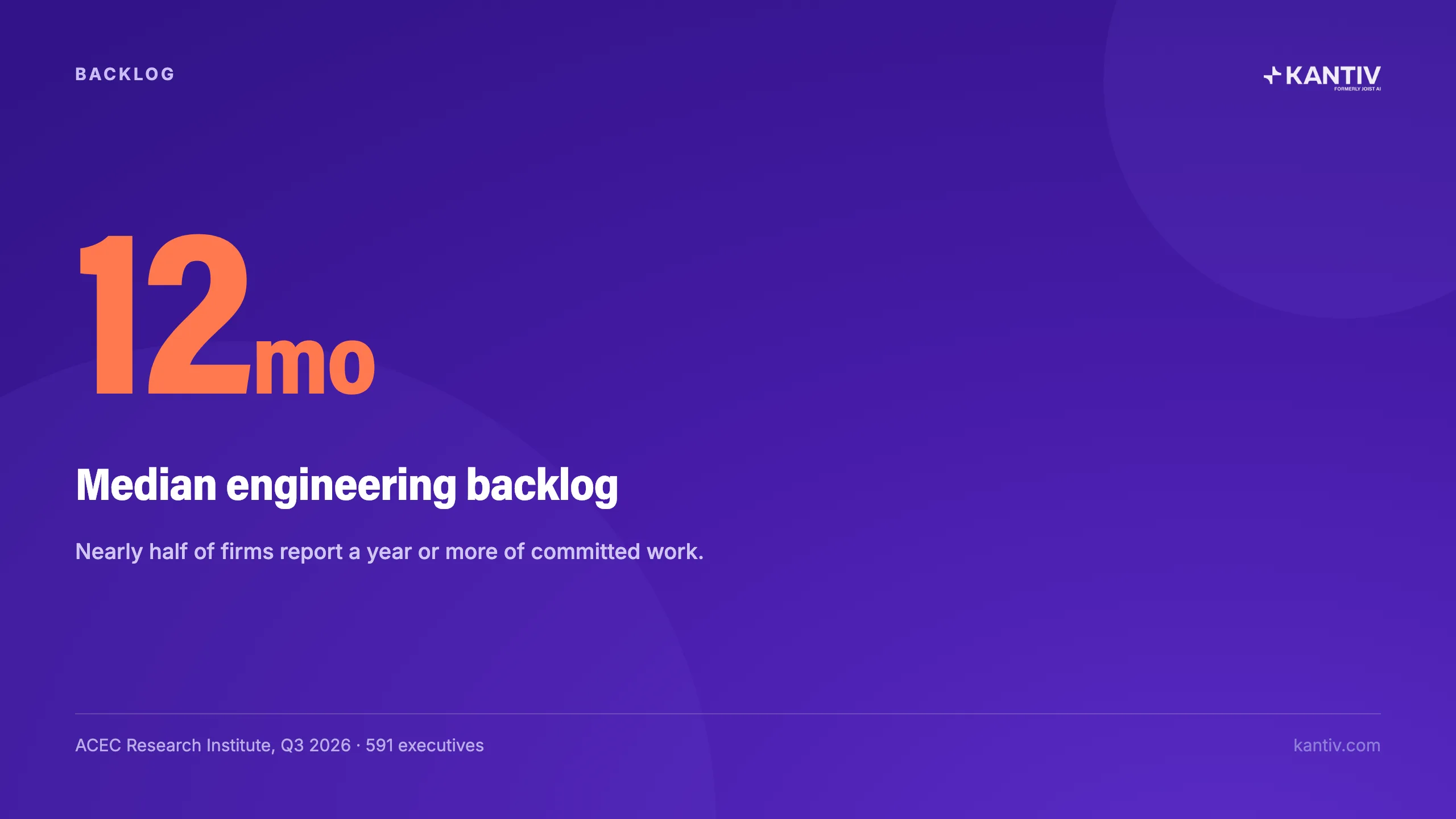
10. The median engineering backlog is 12 months
Among 591 engineering-firm executives surveyed by ACEC, the median backlog is 12 months, with nearly half reporting a year or more of committed work.
A healthy backlog should change what qualifies as a worthwhile pursuit. Because when delivery capacity is scarce, the opportunity cost of a poor-fit project rises.
A full book gives firms permission to be selective. The go/no-go conversation can move beyond “Can we win?” to “Is this the work we want our limited capacity committed to?” Firms that use it that way are often the ones posting 61.3% capture rates.
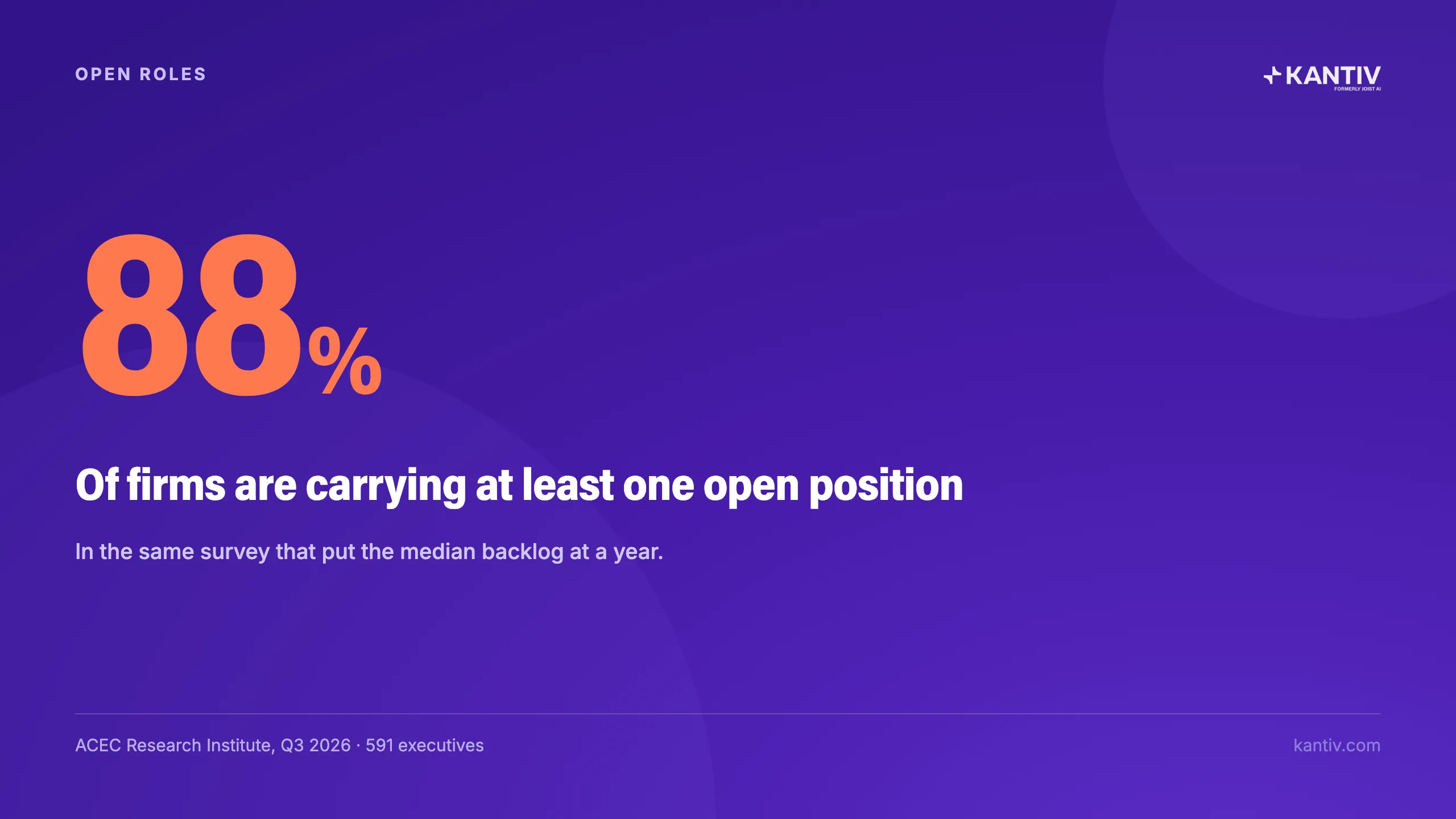
11. 88% of firms are carrying at least one open position
88% of firms report at least one unfilled role, in the same survey that put the median backlog at a year. So the typical firm in this industry is holding a year of committed work and is short-staffed while it delivers it.
Open roles do not only affect delivery. They push more project and pursuit work onto the people already in the firm.
Proposals may still leave on time, but the quality losses are subtler: one fewer review, a generic win theme, an expired reference or a comparable project that nobody had time to find.
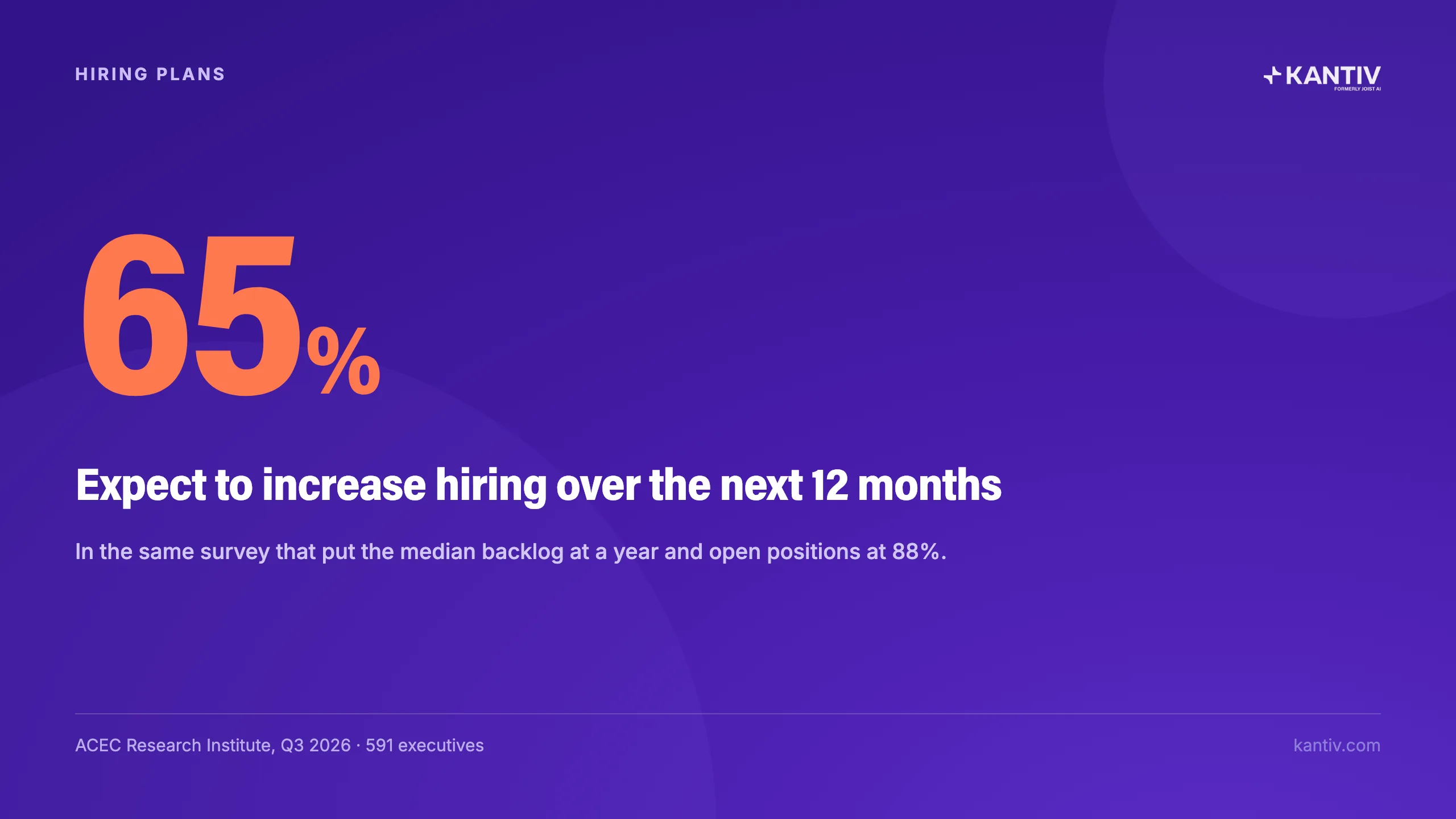
12. 65% expect to increase hiring over the next year
65% of firms expect headcount to grow in the next 12 months.
Hiring can eventually relieve capacity pressure, but it creates work before it creates capacity. The team members who should be writing win themes instead end up interviewing, onboarding, spending time bringing the new hire up to speed and often redoing work.
New employees also arrive without a firm-specific record of projects, clients and decisions. Firms should plan for that knowledge ramp as deliberately as they plan for salary and utilization.
AI adoption is ahead of AI impact
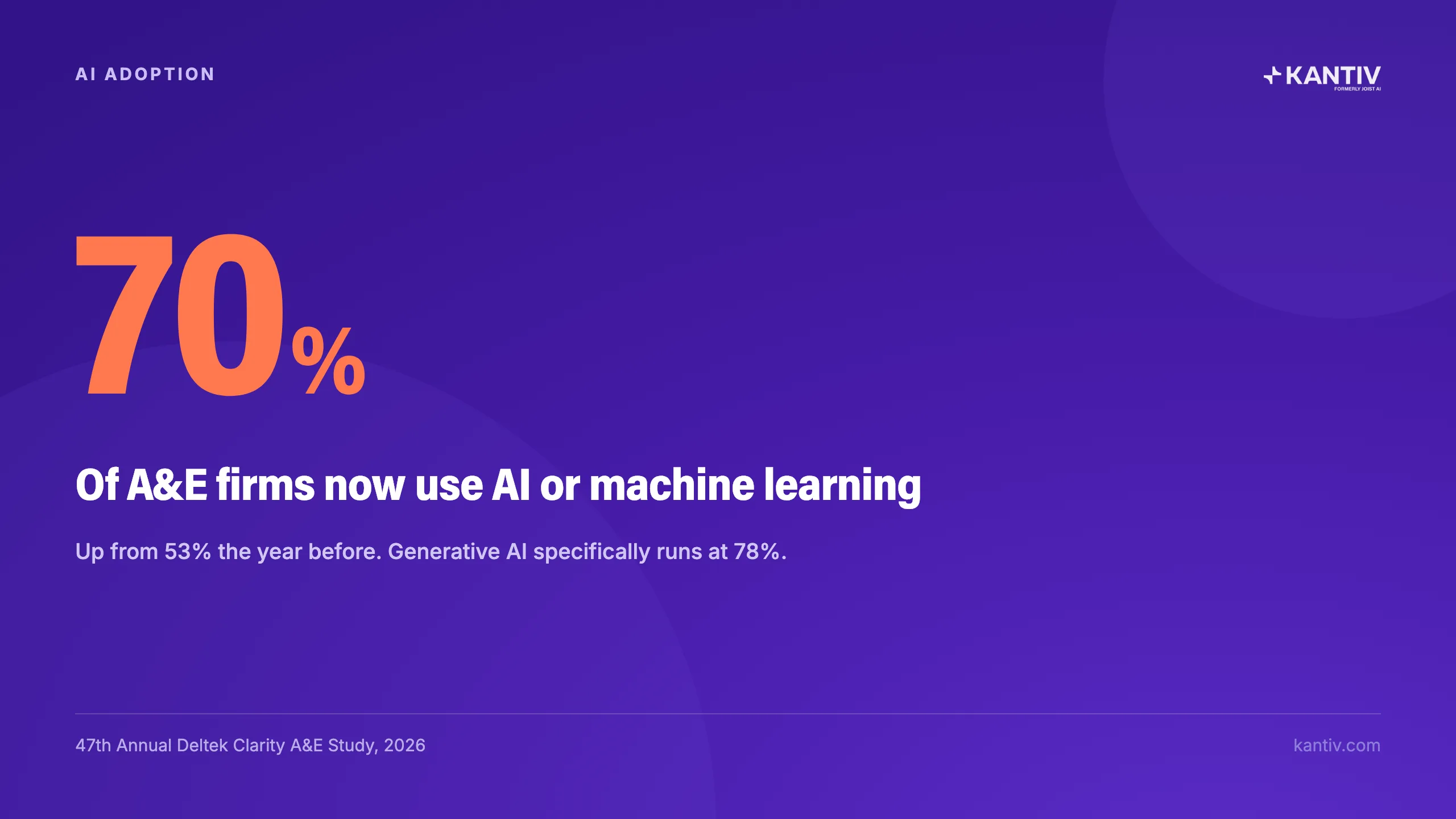
13. 70% of A&E firms now use AI or machine learning
Adoption of AI and machine learning reached 70%, up from 53% the year before. Generative AI specifically rose from 64% to 78%.
AI is no longer an edge case in the industry. Most firms seem to have already crossed the adoption threshold.
The more useful question is what happens afterwards: which workflows change, which data the tools can reach and whether anyone measures the result.
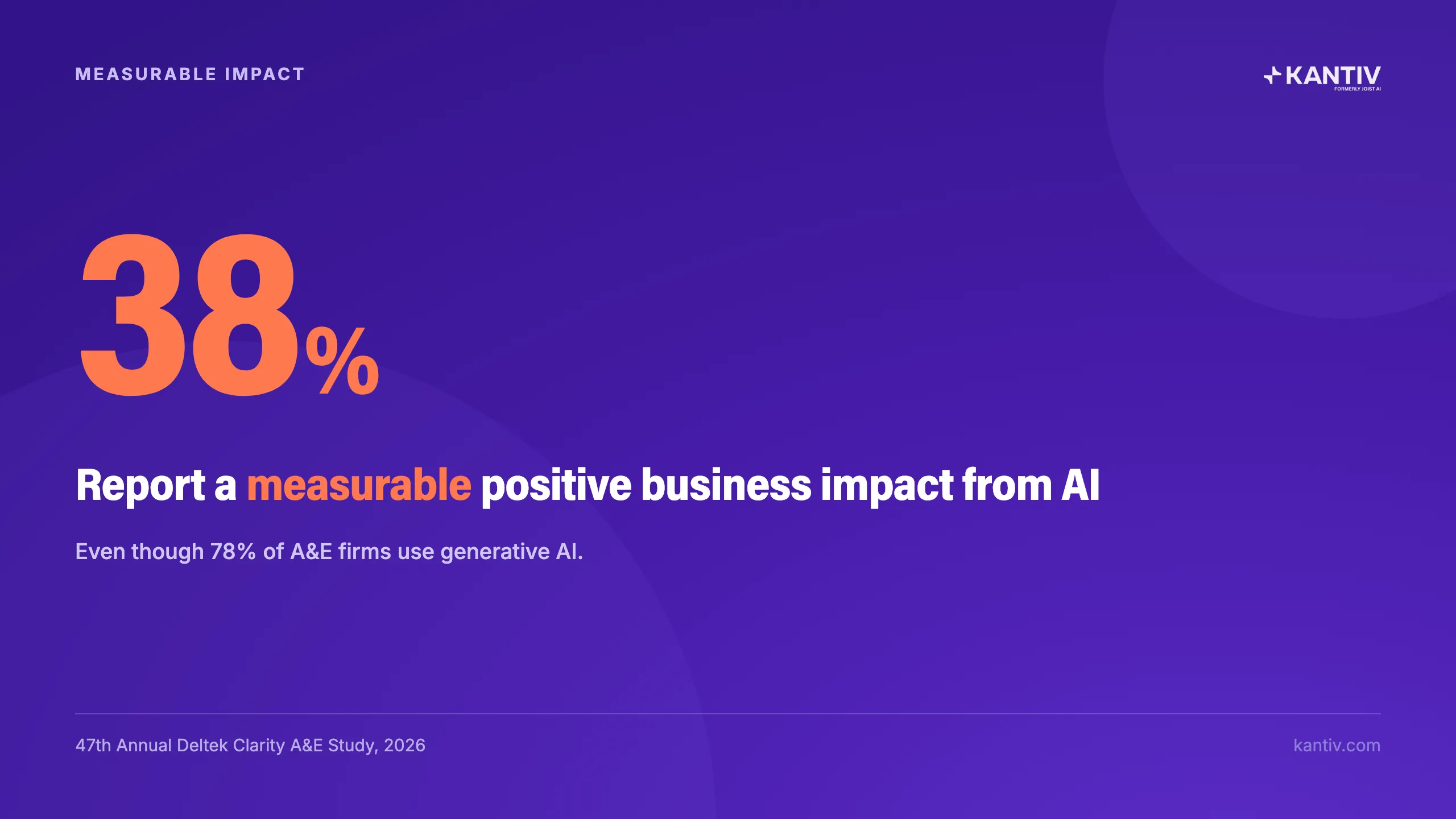
14. Only 38% report measurable AI impact
Although 78% of A&E firms use generative AI, only 38% report a measurable positive business impact.
The firms seeing results are unlikely to win because they generate more text. The larger opportunity is to shorten repeatable workflows: finding relevant projects, summarizing performance records, checking requirements, comparing opportunities and producing a grounded first draft.
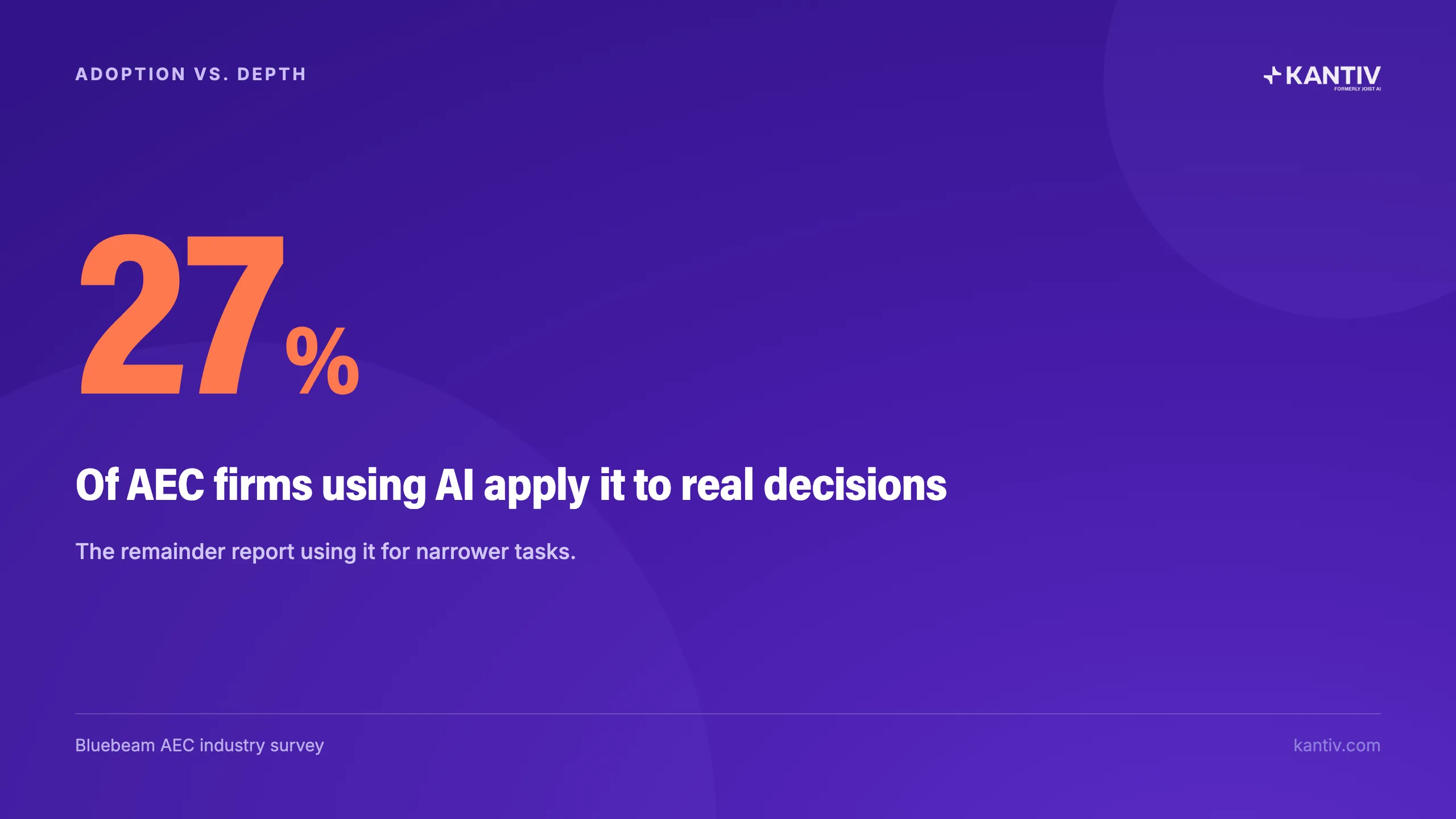
15. Only 27% of AEC firms using AI apply it to real decisions
A survey of AEC firms found that among those already using AI, 27% use it for genuine automation, decision-making, or problem-solving. The remainder report using it for narrower tasks.
The survey has a different population from the Deltek study, so the percentages are not directly comparable. Both findings nevertheless suggest that access to AI is growing faster than operational maturity.
16. 71% say better data infrastructure matters. 10% are ready for it.
In the SMPS Foundation and FMI 2027 Emerging Trends research, 71% called improved data management highly impactful, while just 10% rated their own firm highly ready. It's the widest gap in the study.
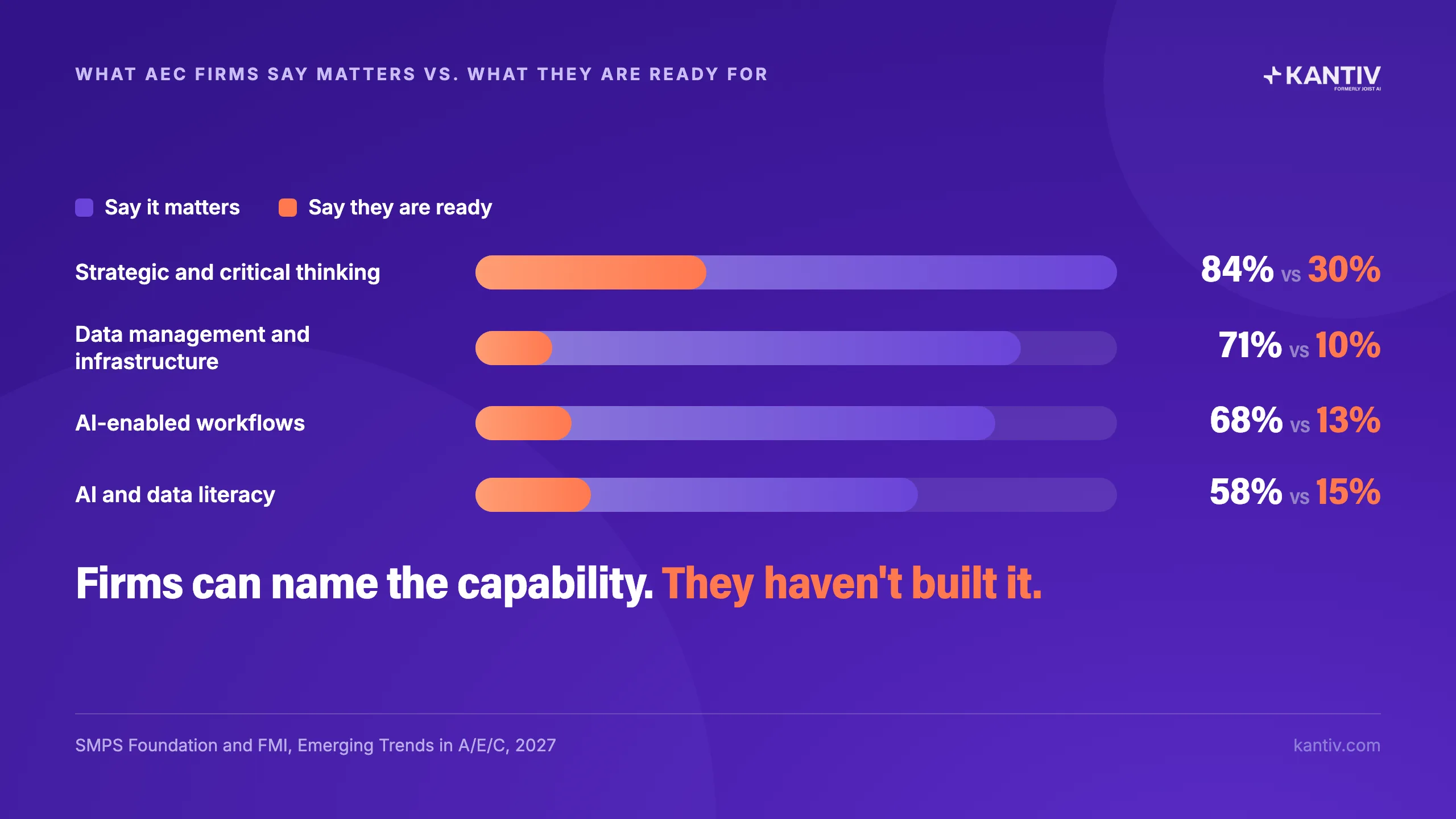
Every other gap in that research runs the same way:
- AI-enabled workflows: 68% against 13%
- Strategic thinking: 84% against 30%
- AI and data literacy: 58% against 15%
Firms can name the capability. They haven't built it. The research itself lands on training over hiring as the way to close them. But AI cannot compensate for fragmented, outdated or inaccessible firm information.
Experience creates a compounding advantage
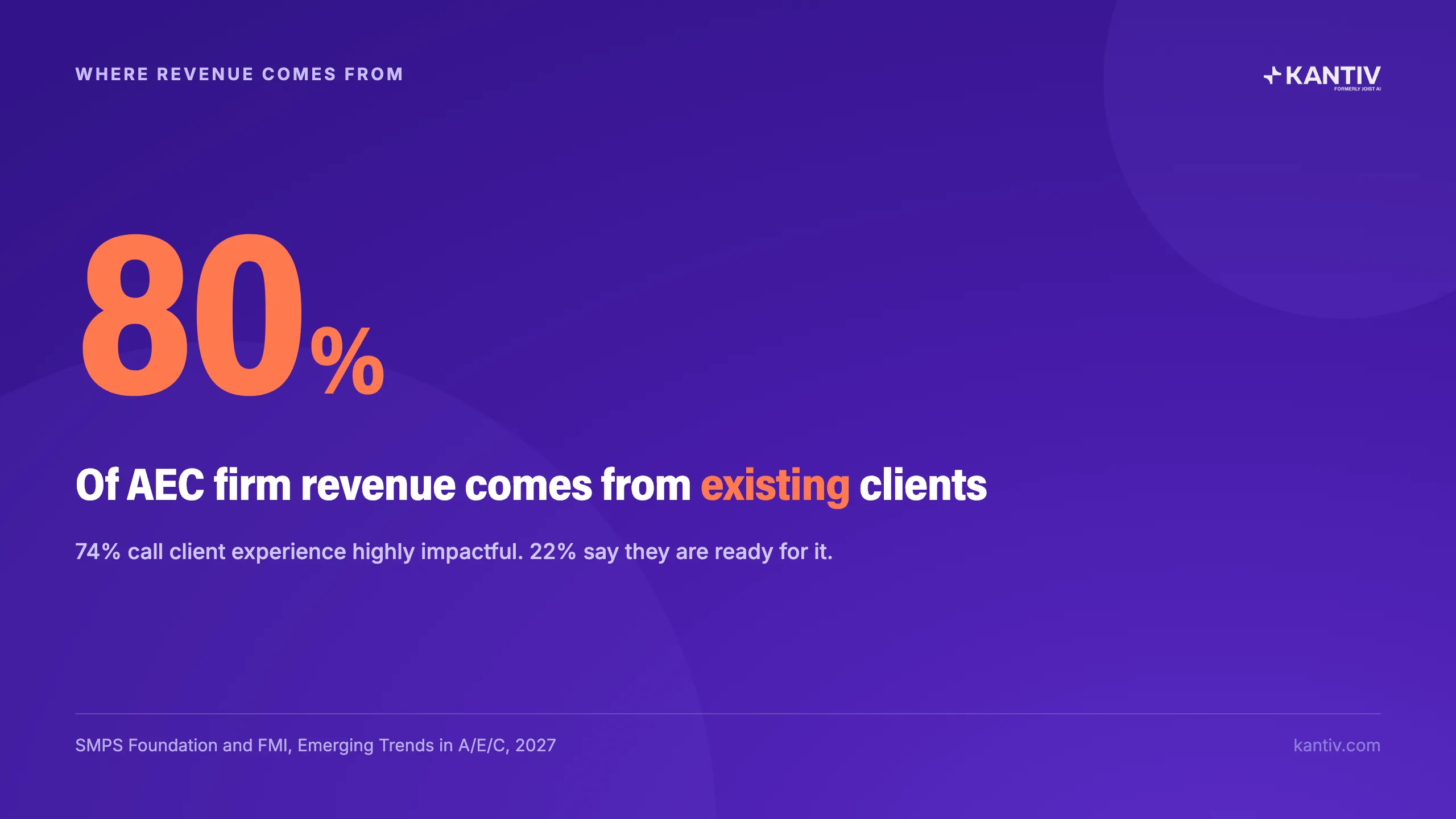
17. 80% of firm revenue comes from existing clients
Roughly 80% of AEC firm revenue typically comes from clients a firm already serves.
Existing clients carry two advantages: relationships and evidence. The firm knows the organization, understands its priorities and already has relevant work to reference.
Yet firms often devote disproportionate pursuit energy to new-logo opportunities. The better growth question may be how to make existing relationships and accumulated project knowledge easier to use across the firm.
18. High-growth firms put 10% of revenue into marketing
Firms sustaining at least 20% compound annual growth devote 10% of revenue to marketing, against 5% for everyone else. They grew 40.7% in the study year, against 8.9% for the average cohort.
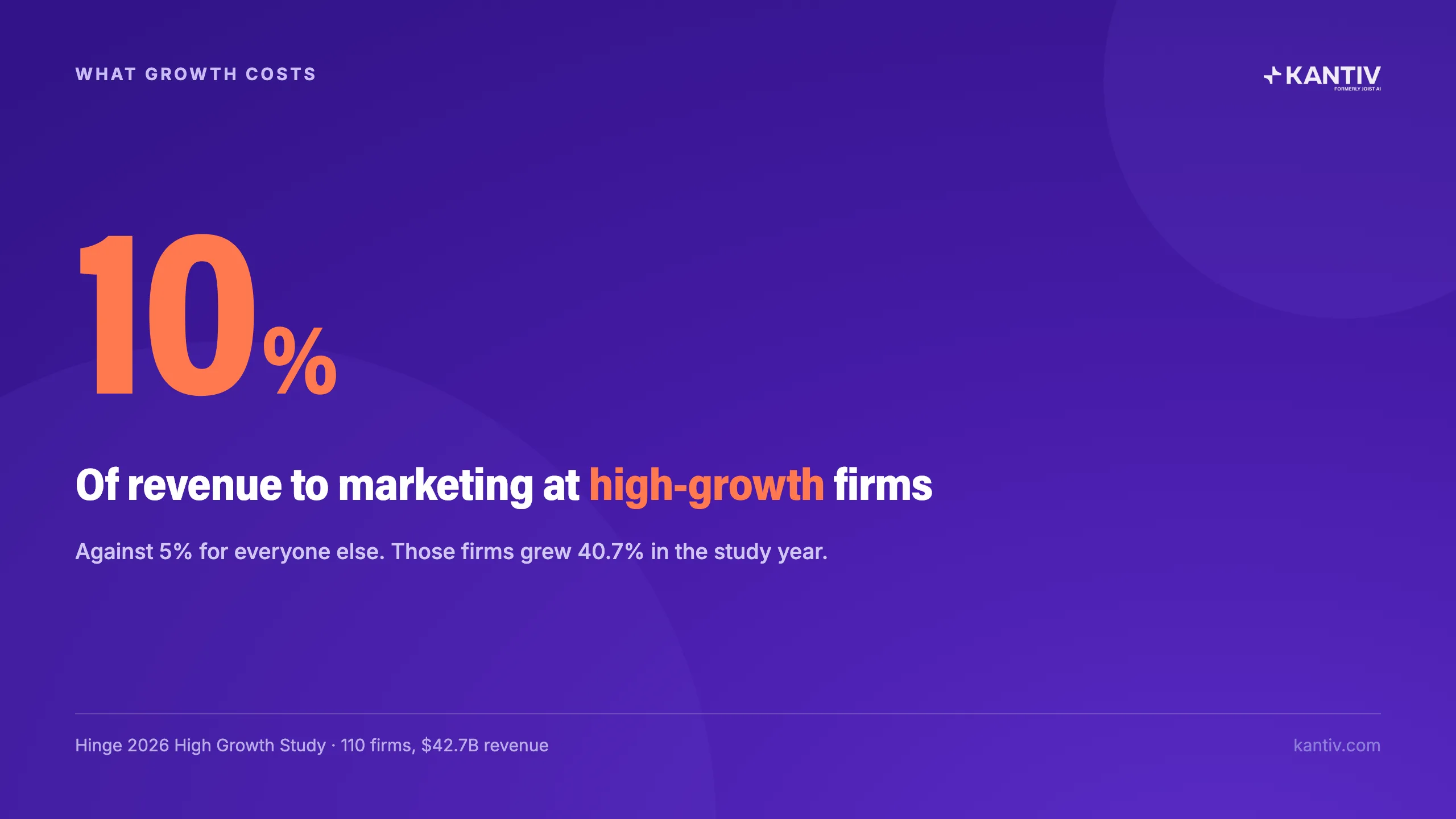
The relationship should not be read as simple causation: spending 10% does not guarantee 40% growth. It does show that high-growth firms are willing to fund the systems and capacity associated with generating demand and winning work.
19. Billings at the smallest architecture firms fell 50%
Billings at the smallest architecture firms fell 50% between 2015 and 2023. Midsize firms lost 40% of their share over the same eight years, and all of it moved in one direction: the largest firms' share rose 40%.
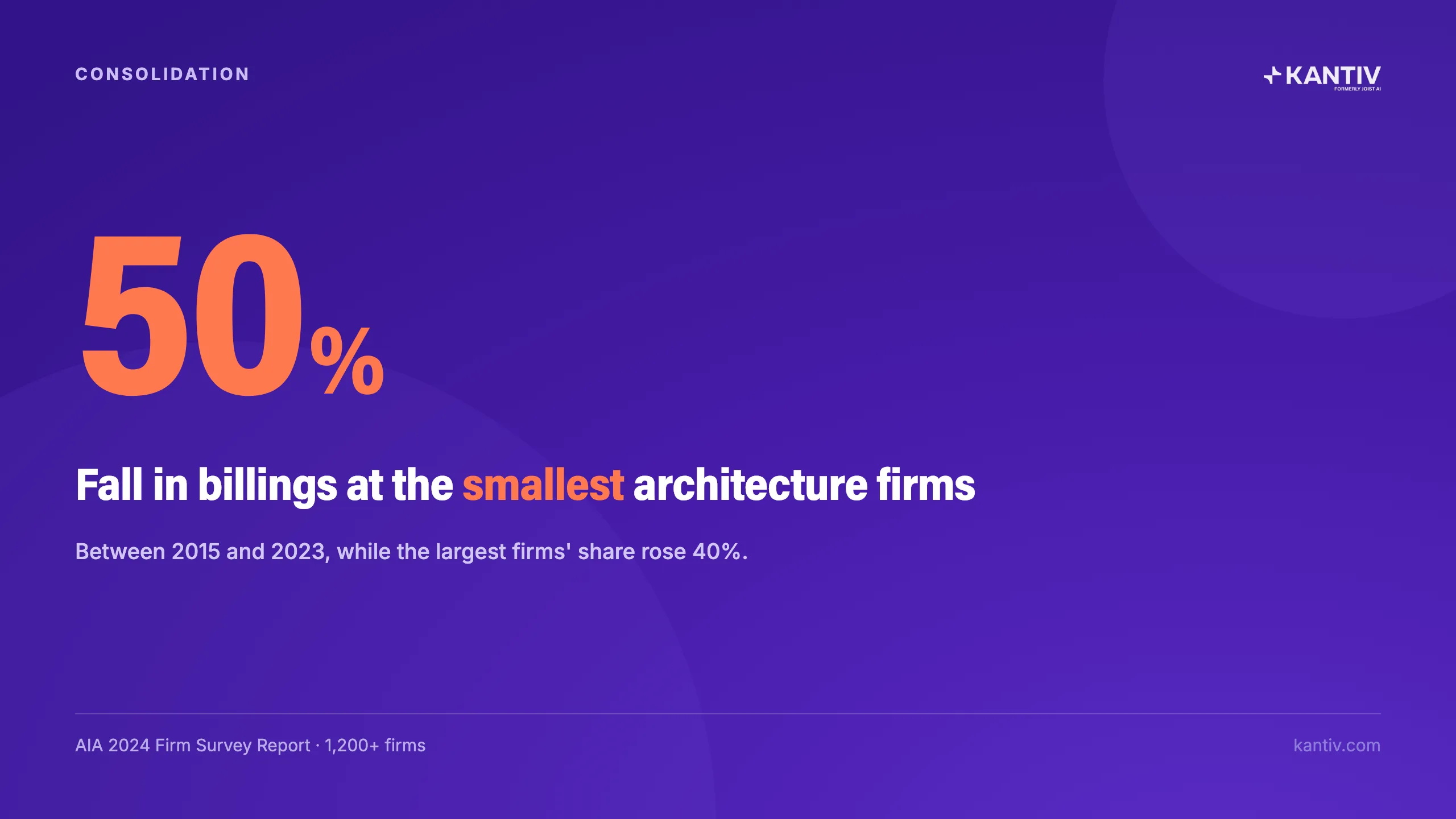
Consolidation usually gets explained as capital or talent. Project scale is the plainer mechanism, although the data does not establish a single cause. However, the work that's grown fastest–data centers, healthcare campuses, and transit–arrives as larger single contracts, and larger contracts carry prequalification thresholds.
That changes what a small firm should be solving for. Matching the scale may not be realistic, and chasing it usually means bidding work you're screened out of anyway. Being the specialist a prime has to bring with them is realistic, and it's a much stronger position to build.
20. 41% of the construction workforce retires by 2031
NCCER projects 41% of the current construction workforce will retire by 2031, against 10% of workers under 25 today.
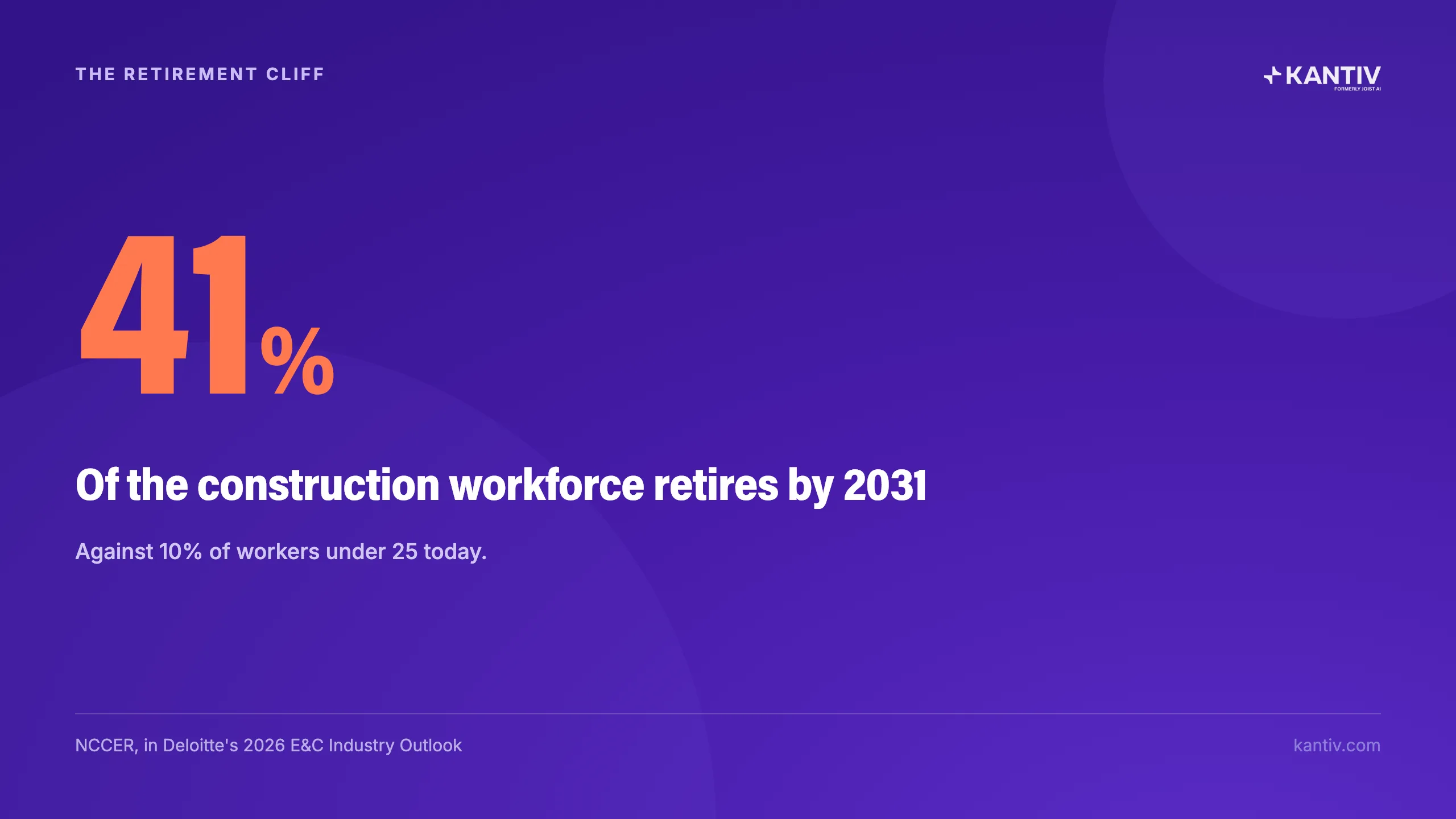
The implications reach beyond hiring. When experienced people leave, firms risk losing the project stories, client context and performance evidence stored in those employees’ memories.
Succession planning is therefore part of pursuit infrastructure. Firms need to preserve what senior employees know before the people, and the proof, walk out together.
21. Median overhead hit 161.3%, a 10-year high
Median overhead reached 161.3%, the highest in a decade, while median utilization fell to 58.9%. Utilization is the share of labor dollars going to billable work.
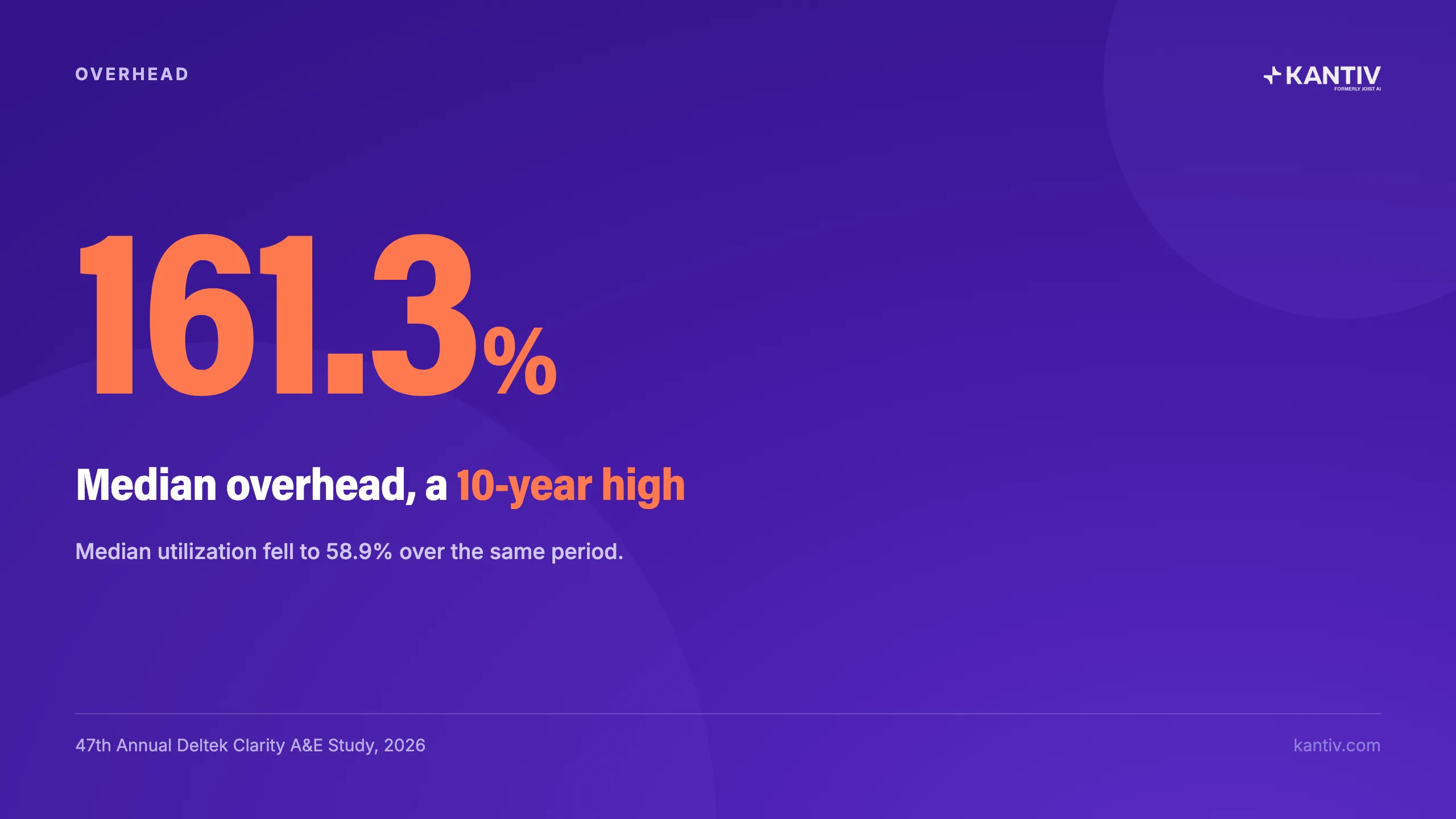
Utilization and overhead move together because business development sits between them.
Pursuit hours are generally non-billable, so asking the same people to produce more proposals increases overhead or takes time away from delivery. The answer is not simply to submit fewer proposals. It is to stop spending senior hours on weak opportunities and repetitive information gathering. Remember, a proposal requiring 40 senior hours and one requiring 25 may produce the same result, but they do not create the same economics.
22. 75% of AEC projects are delivered on or under budget
Only 25% of projects miss budget, so cost control in this industry is genuinely strong. Schedule is where it slips, with 40% running late.
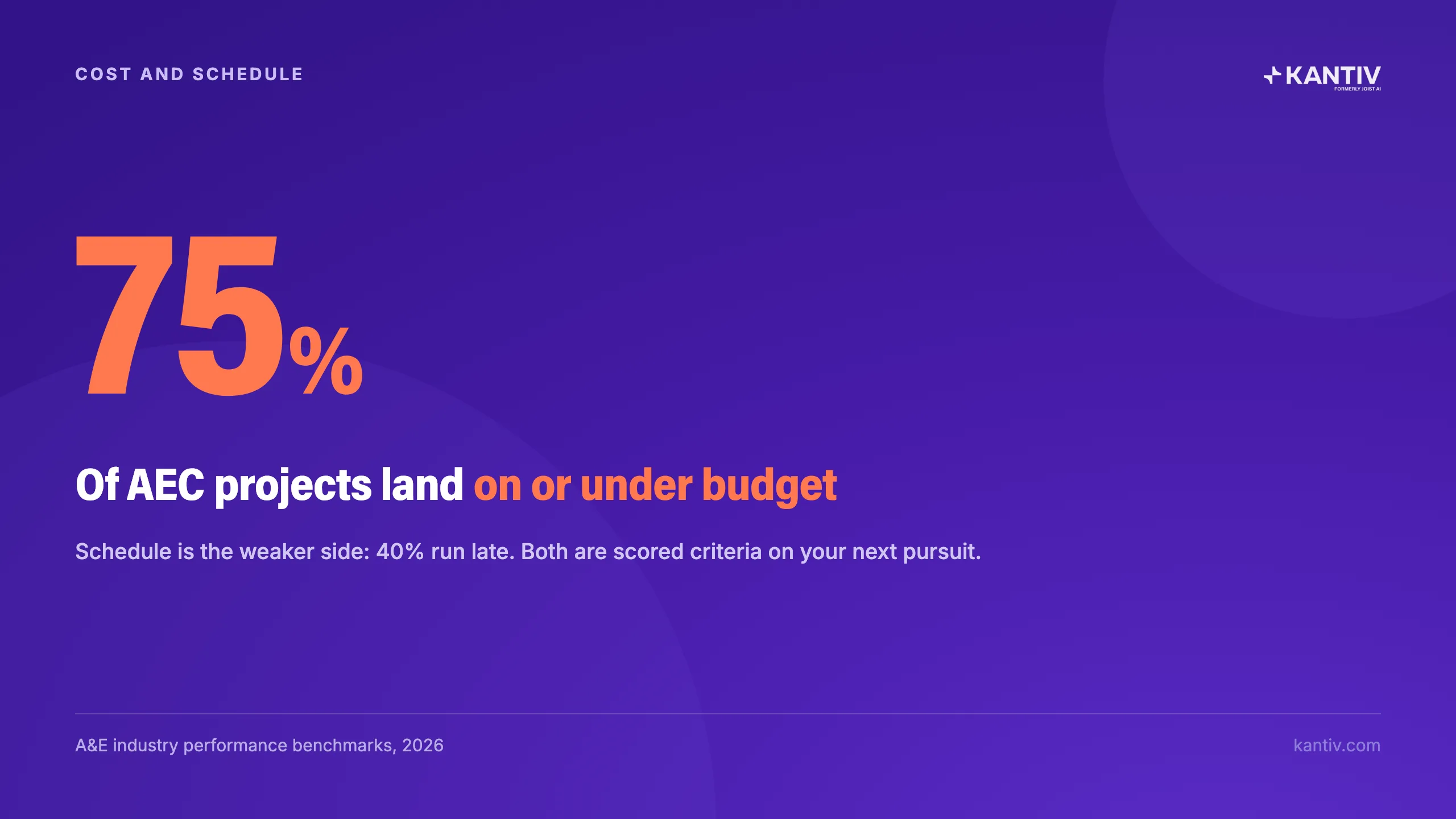
That makes on-time delivery a potentially more distinctive and compelling proof point than basic budget compliance.
The challenge is retrieval. Schedule, cost and quality performance typically live in project systems, while proposals are assembled elsewhere. When those systems are disconnected, strong results never reach the people writing the next submission. The firm has the evidence but cannot use it.
Where the AEC industry goes from here
AEC firms seem to be caught in a volume loop: when conversion weakens, the instinct is to pursue more. But every additional pursuit adds work to the same stretched teams, leaving less time for selectivity, strategy and differentiation.
Breaking that loop requires a different pursuit system:
- Choose before producing. Apply consistent criteria before committing the team’s time.
- Make experience compound. Turn previous projects, relationships and performance into evidence that can be reused, without needing to be rediscovered.
- Learn across pursuits. Preserve the reasons behind wins and losses so the next decision starts with more information.
- Use AI on the repeatable work. AI can accelerate retrieval and production, but only when it has organized, reliable firm knowledge to work with.
The firms that build this system can pursue less indiscriminately without limiting growth. Each project strengthens the next pursuit instead of every proposal starting from scratch.
Kantiv is built around this approach. It connects a firm’s people, projects and past performance in a shared knowledge graph, making it easier to evaluate fit, find relevant evidence and build a qualifications package without repeatedly chasing the same information.
It also keeps pursuit decisions and outcomes connected to that knowledge. The reasoning behind a go/no-go decision, or a win or loss, can inform the next opportunity instead of disappearing when the pursuit ends.
This gives AI something useful to work with: the firm’s own structured experience. Rather than generating generic proposal content, teams can use Kantiv to retrieve and apply the specific proof that supports why they should win.
Want to see how Kantiv works against a live RFQ? Book a demo.
FAQs
How does the AEC industry differ for a 50-person firm versus a 5,000-person firm? The selection rules stay the same regardless of firm size, but the capacity to meet them scales very differently. A 50-person civil firm typically runs pursuits through a handful of seller-doers and one marketing coordinator with no dedicated capture function, while a 5,000-person, ENR-ranked firm can staff a proposal department, a business development team, and specialized capture leads for the largest federal work. The billings-consolidation trend described above is largely this capacity gap playing out at industry scale.
Will AI replace AEC proposal writers and marketing teams? The measured evidence above points toward augmentation rather than replacement. The firms actually using AI for something beyond a chatbot are automating retrieval and first drafts, while compliance checking, win-theme selection, and the decision to bid at all still require someone who understands the client and the scoring criteria. That's also why AI adoption concentrates in the back office rather than eliminating the roles working there.
Do public agencies and private developers select AEC firms the same way? No two client types run an identical process. Federal and most state and local public agencies are bound by the Brooks Act or a mini-Brooks equivalent for architecture and engineering work, so qualifications lead and price follows. Private developers and many institutional owners can weigh price, schedule, and relationship more freely, and construction procurement, even on public projects, frequently runs on separate, often price-competitive, rules from the design side of the same job.
What is AECO, and how does it differ from AEC? AEC stands for architecture, engineering and construction. AECO adds the owner or operator, extending the lifecycle into facilities management, maintenance and the ongoing use of project information. Both terms describe the broader built environment, but AECO reflects a modern shift toward viewing a building or infrastructure asset across its entire lifespan.
What counts as a good win rate for an AEC firm? Across nearly 900 architecture and engineering firms in the United States and Canada, the median competitive win rate is 49%. A firm winning roughly half its competitive pursuits is therefore close to the industry midpoint, but that does not necessarily mean it is performing well.
The comparison depends on what the firm counts as a pursuit and when it records a win. Some firms include sole-source and repeat-client work; others measure only competitive pursuits. A firm should also compare win rate with capture rate. If the capture rate is lower, it may be winning more frequently but losing the larger opportunities.
The most useful benchmark is the firm’s own performance over time, segmented by client, market, project type and contract value, and measuring these consistently.