Found the content on this page useful? Share it with your team!
What Enterprise AI Adoption Actually Looks Like in AEC

.png)
Table of Contents

Every executive at a large AEC firm has lived through at least one enterprise software rollout that was supposed to take months and took years, that promised transformation and delivered a login screen most people quietly stopped using. That memory is the real reason AI stalls at the enterprise level, not skepticism about whether the technology works. Leaders have seen capable software fail to land inside a big, distributed organization before, and they are right to worry it will happen again.
So the useful question isn't whether AI can speed up a proposal or a marketing workflow. It obviously can. The question is whether a 1,000 or 10,000+ person firm can actually put it into production across every region and discipline, connected to how pursuit and marketing teams really work, without a multi-year change effort that collapses under its own weight. The firms getting this right have figured out something the market hasn't fully caught up to yet: enterprise AI adoption is not a login event, it's a change-management undertaking, and when it's run as one, it moves far faster than anyone conditioned by ERP and CRM timelines expects.
Why enterprise scale implementation is harder than it looks
Consider what “enterprise scale” actually means in this industry. Across the largest AEC organizations to recently adopt Kantiv, you're looking at more than 735 marketing and proposal professionals, upward of 115,000 proposals produced every year, content scattered across regional servers and thousands of individual file locations, confidential and private-client work that can't be handled casually, and permission structures that change from office to office and engagement to engagement. That is not a setting where you hand people a tool and hope. Drop a general-purpose AI product into that environment with no implementation discipline and it does exactly what those old software rollouts did: it sits there.
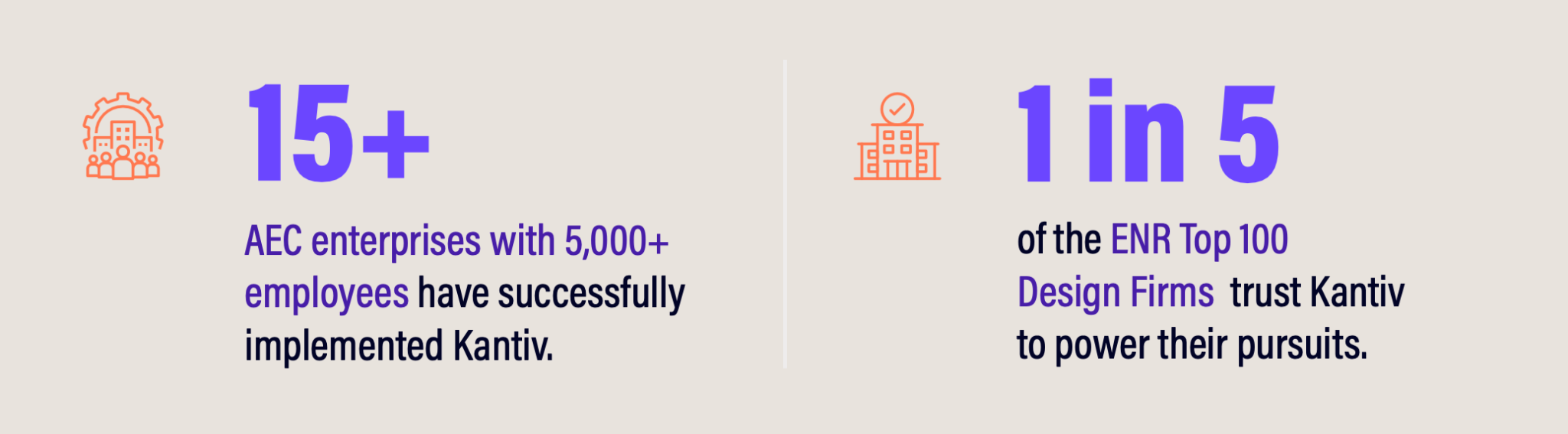
The reassuring part is that this complexity is not unfamiliar territory. Kantiv is in production at more than a dozen AEC enterprises with over 4,000 employees each, and roughly one in five of the ENR Top 100 Design Firms are customers. This isn't a single lucky implementation. It's a repeatable pattern that has held across firms with different practice mixes, different regional structures, and different confidentiality requirements, which is the strongest evidence that the pattern reflects something durable about how large pursuit organizations absorb new capability.
Speed of implementation, without cutting corners
At one national firm operating across dozens of offices and more than 30 distinct disciplines, a firm-wide content library was onboarded across every region and discipline in roughly 90 days from the point of selection, with phased rollout to more than 300 proposal professionals following on a sustained weekly cadence. Not a pilot in one office. The enterprise foundation, live, in about a quarter.

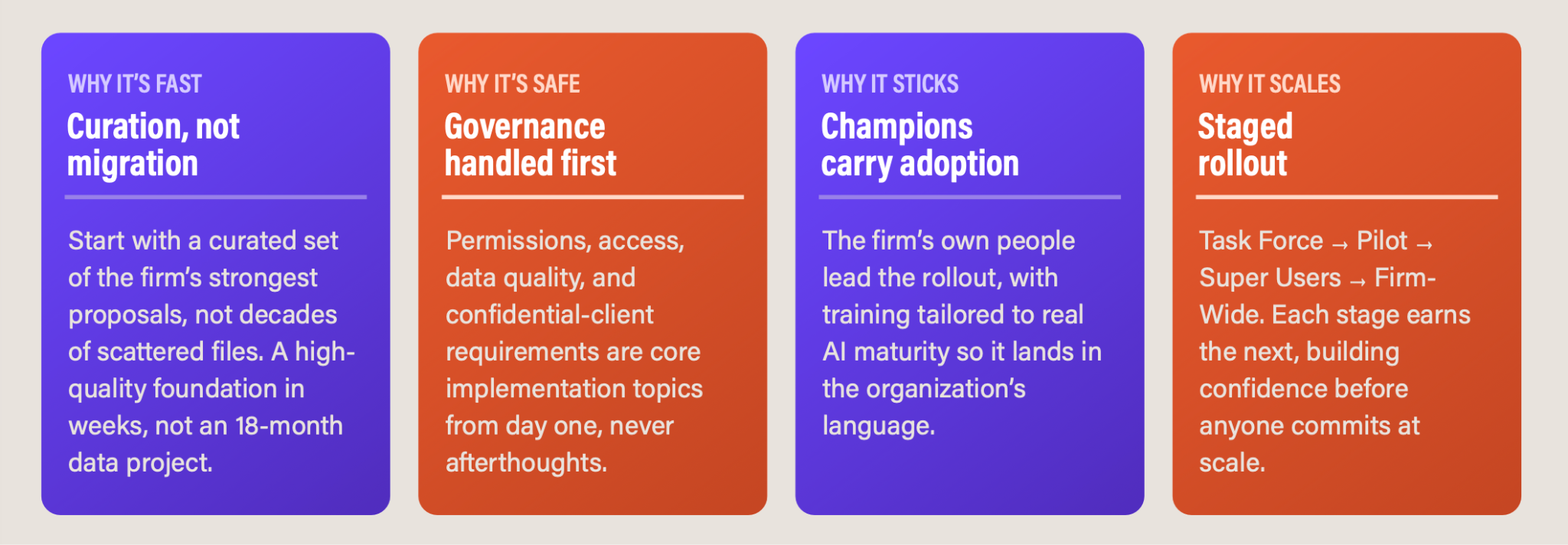
What made that possible is worth understanding, because it's the answer to the fear every large firm carries into these conversations: our data is a mess, this will take forever. It didn't, because the approach was curation, not migration. Rather than trying to ingest decades of historical proposals across ten regional servers, the team curated roughly 1,500 of the firm's strongest proposals, a best-five-per-discipline foundation that gave the platform high-quality material to work from without drowning the system or the staff. You don't boil the ocean. You start with the best of what the firm already knows, and you build from there. That single decision is the difference between a 90-day library and an 18-month data project that never finishes.
Why the implementation works: a playbook, not luck
That kind of speed isn't improvisation, and it isn't a heroic one-time effort that can't be repeated. It comes from a defined implementation methodology that has now run across multiple enterprise engagements, executed in a deliberate sequence with clear readiness criteria before each stage rather than everything at once. Described at altitude, it's five moves:
- Start with the workflow, not the technology. Anchor on the specific pursuit and marketing tasks a team does every week, not on generic AI capability.
- Resolve governance early. Treat permissions, access, source-data quality, and confidential-client requirements as core implementation topics from day one, not compliance hurdles bolted on at the end.
- Stand up a customer-side champion structure. Put the firm's own people at the center of the rollout so adoption is carried in the organization's language, not imposed from outside.
- Meet people where they are on AI. A large pursuit team spans daily AI users and total newcomers, so training is tailored to different comfort levels rather than pushing one generic curriculum that loses both ends.
- Sustain adoption through office hours and feedback loops. Give users a low-friction place to bring real work and surface friction before it quietly kills momentum.
The rollout itself follows a staged path that is the clearest signal of a real playbook at work. It moves in a defined order, an initial task force, then pilot users, then super users, then the broader pursuit community, and each stage has to earn the next before the firm commits more of the organization to it. That sequencing is deliberate. It gives a large firm room to build internal confidence and prove value on a small footprint before anything approaches firm-wide, which is exactly what turns a promising pilot into durable enterprise adoption rather than a rollout that stalls the moment it scales.
How firms de-risk adoption before they commit
The firms that scale fastest also scrutinize hardest, and that's a feature, not a friction. One firm structured its evaluation as a controlled five-week sandbox, measuring AI-generated proposal output directly against human-written baselines for both speed and quality before a single commercial commitment was made. Any enterprise should expect to run that kind of test, and any vendor worth selecting should welcome it.
Governance gets the same treatment. Permissions, upload visibility, source-data quality, confidential and private-client content, and integration with the firm's live CRM so proposal content stays connected to real project and client records, all of it handled as part of the implementation rather than discovered as a problem later.
The real implementation question
These engagements became substantial, multi-year enterprise commitments, but the more telling signal was behavioral. The firms that succeed organize their own task forces, appoint dedicated implementation leads, and coordinate training and rollout on their own initiative, and success comes to be defined not by license counts but by the right users using all the major features consistently. That's what adoption actually looks like when it takes hold.
For a firm evaluating AI at enterprise scale, the question was never whether the software works in a demo. It's whether the partner behind it can operate inside the full complexity of the enterprise, at speed, without breaking, and whether they can do it as a proven, repeatable motion rather than a one-time success they got lucky on. That's the harder thing, and it's the thing that determines whether an investment of this size becomes infrastructure or becomes another tool nobody uses.