Found the content on this page useful? Share it with your team!
What the SMPS 2027 Emerging Trends Report Means for AEC Pursuit Teams

.png)
Table of Contents

The SMPS Foundation and Stambaugh Ness just released their 2027 Emerging Trends in AEC Marketing and Business Development report, and I read the whole thing. A lot of it will feel familiar if you were on the floor at Amplify—the themes I wrote about after that conference now have a full dataset sitting behind them.
But read end-to-end, all the trends point to the real story, and it’s this:
The industry has reached near-consensus on what matters, and almost no one is built to leverage it. The report calls it a readiness gap.
If you lead a marketing or BD team, that gap is the most useful thing in the document, because it tells you where the next two years of advantage are hiding. Here's where the gap is widest, and what each one means if you own growth.
The skills everyone agrees matter are the ones firms are least equipped to build.
Strategic thinking, critical thinking, and communication are the power skills that topped the entire report—84% called them highly impactful, and only 30% of firms feel highly ready to train for them. Add AI and data literacy (58% impactful, 15% ready) and you have a talent stack shifting toward judgment and tech fluency faster than the pipeline can supply it. With an enrollment cliff ahead and a labor market that isn't loosening, you can't hire your way across this. The report's own conclusion is that structured training is the lowest-cost, highest-leverage move available—which really means lifting the floor of the team you already have, so an average contributor operates more like your best one.

The widest gap in the report is data infrastructure, and most firms are trying to solve at the wrong level.
71% of firms say data management and infrastructure will be highly impactful. 10% feel highly ready. That's the biggest importance-to-readiness spread in the entire study, with AI-enabled workflows close behind at 68% versus 13%. The report puts it plainly: "technology-first is not tool-first." Firms keep buying AI features and wondering why nothing compounds, when the constraint sits underneath the tools.

The part that trips up most firms is that when firms hear "data," they picture clean, structured, current records in a CRM or an ERP. That bar is never actually met. The data is always a little out of date and so firms decide they're not ready for AI. But the readiness question isn't whether your structured data is perfect. It's whether your knowledge, structured or not, is being turned into something that stays current, instead of a snapshot that's stale the day it's entered.
Your next win is probably already inside a client you serve, if that relationship knowledge isn't trapped in one person's head.
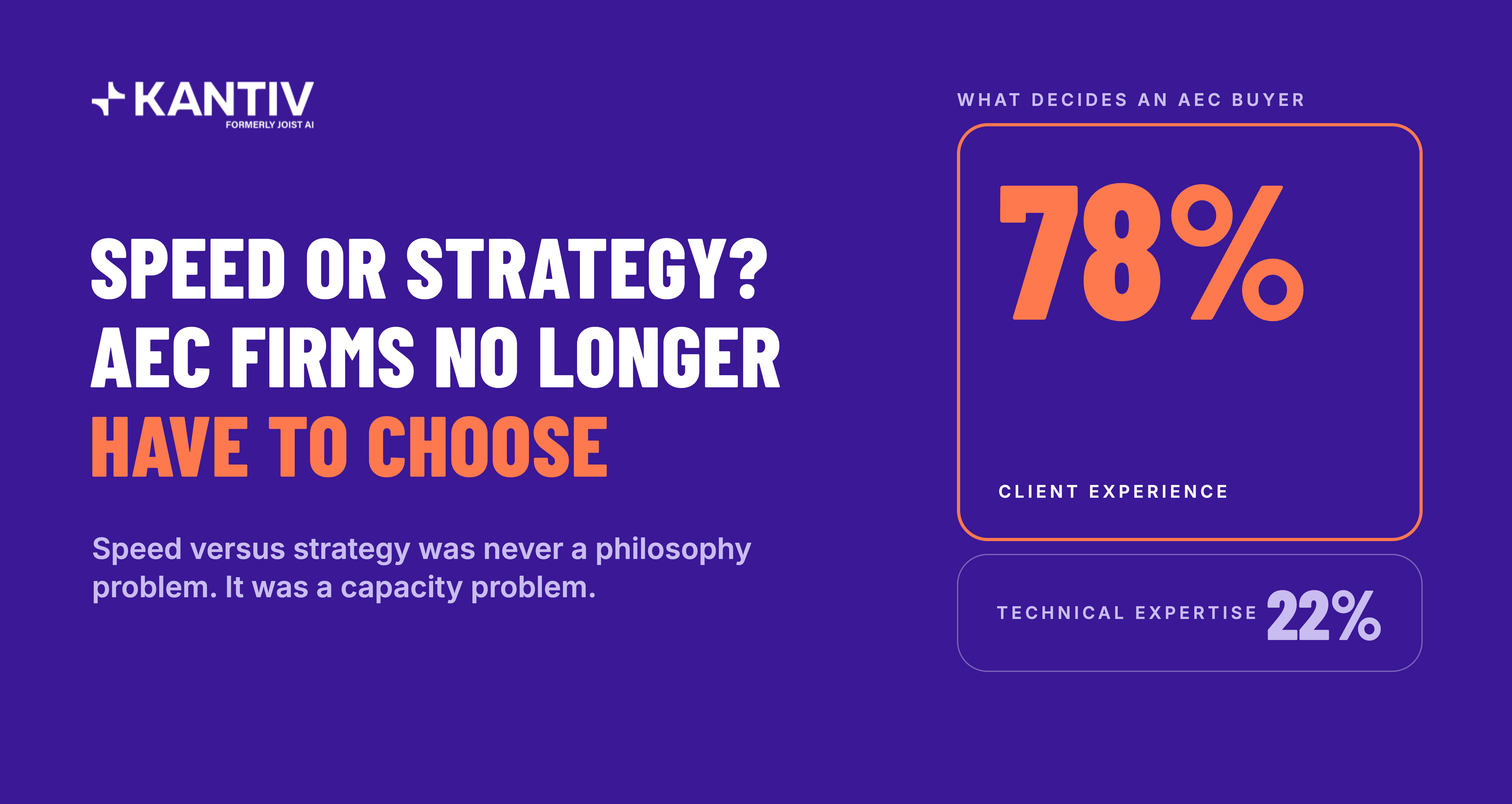
Two of the highest-rated trends were both client-facing: 74% called client experience a differentiator, 65% pointed to growth through existing clients. Readiness sits at 22% and 32%. The report also resurfaces a number worth keeping in front of every BD conversation—89% of pursuit wins involved a pre-existing, long-term relationship. That echoes what Tim Asimos put on screen at Amplify, that client experience drives roughly 78% of AEC buyer decisions while technical expertise accounts for about 22%. The uncomfortable part is that repeat work and account growth are not the same thing. Firms feel strong on repeat revenue and rate themselves middling on cross-selling, which means the relationship intelligence that should drive expansion is stuck informally with individual PMs and seller-doers. That's a systems gap showing up as a relationship problem.
Buyers now shortlist you through AI, and thought leadership is the one muscle firms rate as their weakest.
Of every KPI in the report, thought leadership output is where firms rated themselves lowest—just under a quarter put themselves below average, even though it's one of the most commonly tracked metrics. Only 19% feel ready to leverage expertise-led visibility.
Now line that up against how buyers actually find firms. They're researching you through LLMs—the report names ChatGPT and Claude directly—and Gartner expects traditional search volume to fall about 25% by 2026 as buyers move to answer engines. The channel that decides whether you even make the shortlist has moved, and it runs on the exact capability firms underbuilt. Visible, structured expertise isn't a brand nicety anymore. It's a pursuit input.
Prove it, or you're funded on faith.
47% of firms say proving marketing and BD value will be highly impactful. 16% feel ready to do it. Most still measure what's visible—proposal counts, web traffic, thought-leadership output—rather than what's attributable to revenue. The report's framing is blunt: until you connect the work to revenue, the investment is being made on faith, and faith-based line items are the first ones questioned when the market tightens.
The leaders who close this gap stop having the "can we just automate this function" conversation, because they can show what it returns. Start tracking marketing-sourced and marketing-influenced revenue, and win rate and pipeline by source. It's less glamorous than a campaign, but it's the difference between describing your value and proving it.
What this means if you own growth
Read the trends separately and you get a to-do list. Read them together and you get one problem. Talent, data, client knowledge, visibility, and measurement all converge on the same place—the pursuit—and the report nearly says so on its final action page, urging firms to use client insight, data, visibility, and pursuit intelligence together rather than as separate workstreams.
That's the shift. Readiness isn't the same as effort. AEC marketers are working as hard as they ever have, inside systems that can't compound what they learn, can't share knowledge across a team, and can't prove what they returned. A live poll at Amplify made the same point in one number: only 5% of firms called themselves fully arrived on AI, and 60% put themselves at early infancy. Near-total agreement on the destination, almost no infrastructure for the trip.
That's the layer we built Kantiv around. When a firm's institutional knowledge—proposals, project history, relationships, the unstructured material included—lives in a knowledge graph that stays current as it's fed, most of these gaps stop being separate problems. The talent floor rises because they system provides the intelligence to help improve judgement and decision making. Client intelligence stops walking out the door. Expertise becomes discoverable. And the work becomes measurable. Read that way, the report feels less like news and more like a map of the same territory.
Everyone in the industry just read the same report. The advantage won't go to whoever agrees with it the most. It'll go to whoever closes the gap before it's obvious to everyone else.
The 2027 Emerging Trends in AEC Marketing and Business Development report is published by the SMPS Foundation and Stambaugh Ness. It's a paid report, available here.