Found the content on this page useful? Share it with your team!
How to calibrate your go/no-go matrix using your own wins and losses

.png)
Table of Contents
I was looking at a mid-size engineering firm's go/no-go scorecard a few months back. It had nine criteria, weights adding up to a satisfying 100%, and enough conditional formatting to make your head spin.
But it was still structurally unsound.
It was setup like you’d expect (you’ve probably got a version of this sitting on a shared drive somewhere):
- Client relationship: 15%
- Relevant experience: 15%
- Team availability: 10%
- Strategic fit: 10%
- Competitive position: 10%
Neat rows, clean math, and everyone leaves the meeting feeling appropriately governed. But those criteria aren't doing the same job. Some tell you whether you can pursue the work. Others tell you whether you have a credible advantage. A few mostly confirm something your team decided before opening the spreadsheet.
A go/no-go scorecard is a weighted list of criteria an AEC firm scores before committing to a pursuit. The weights only mean something if they reflect which criteria have separated your firm's wins from its losses. Calibrating the scorecard means scoring 30 to 40 past pursuits against it and letting the results set the weights.
Treating them as roughly equal is the scorecard equivalent of assuming every beam carries the same load because they're all drawn on the same plan.
Which ones are actually load-bearing? Only your pursuit history can tell you and root your decisions in data.
Which go/no-go criteria are must-haves, and which are differentiators?
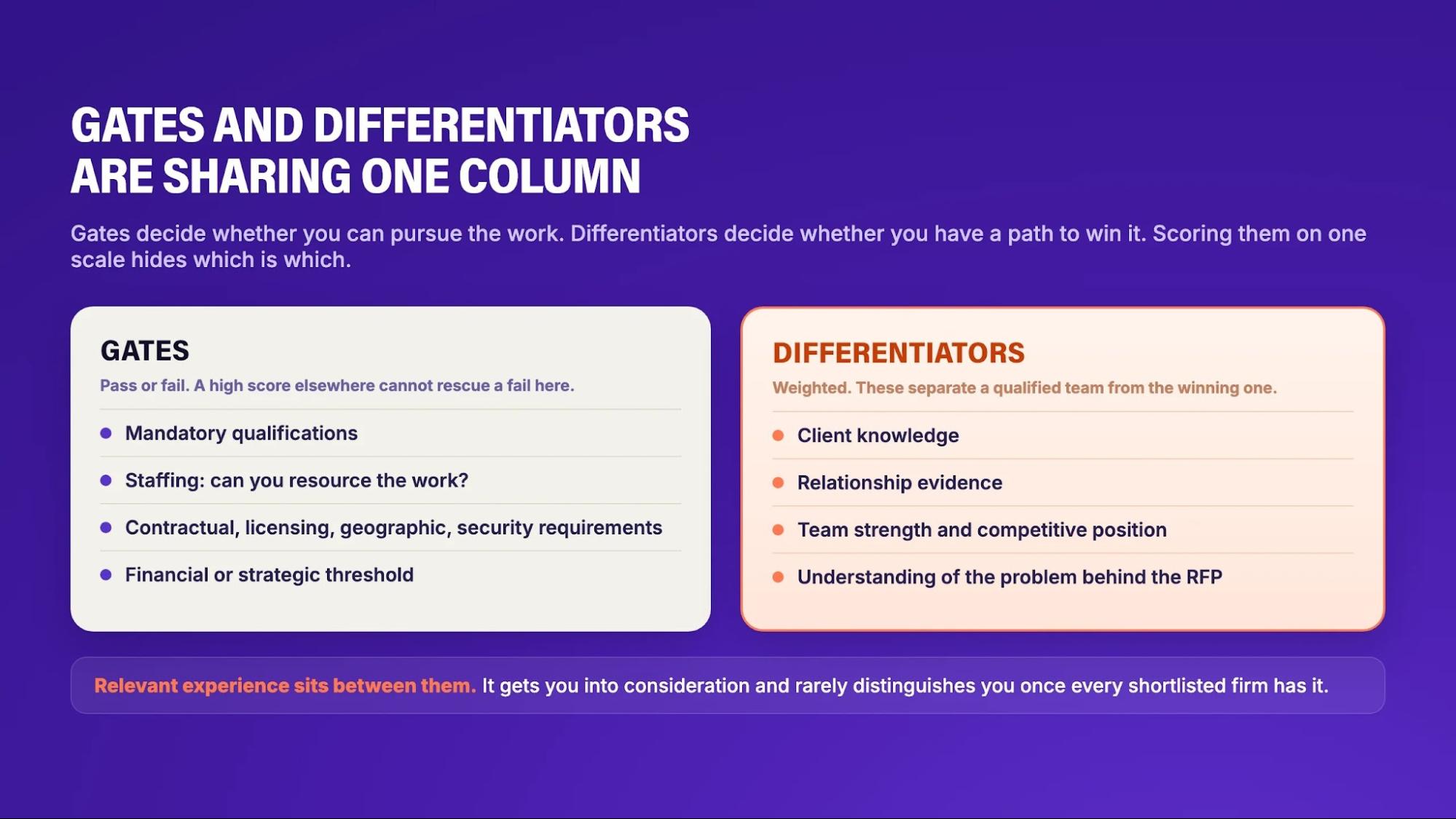
Start by separating the questions you're asking. Some criteria should function as must haves to move forward. If you fail one, adding another seven points somewhere else shouldn't rescue the pursuit.
Think:
- Do you meet the mandatory qualifications?
- Can you actually staff the work?
- Can you meet contractual, licensing, geographic, or security requirements?
- Does the pursuit clear whatever financial or strategic threshold your firm has set?
Those are pass/fail decisions.
Then you have differentiators—the factors that help you determine whether your qualified team has a realistic path to win. Relevant past performance belongs here. So does team strength, client knowledge, competitive position and your understanding of the problem behind the RFP.
Relevant experience is the one that doesn’t sit cleanly on either side. It can be essential for getting you into consideration while doing relatively little to distinguish you once every serious competitor has it. By the time you’re on anyone’s shortlist, the other firms in the running can all point to similar work—that’s usually how they got there.
If your last 20 municipal pursuits all scored a 4 or 5 for municipal experience, that criterion probably isn't helping you choose among them. It's confirming you work in municipal engineering. That’s useful as a fact, but weak as a decision tool.
How do you score client relationship strength?
Relationship is usually where go/no-go meetings get squishy.
One principal says the relationship is strong because they played golf with the public works director in 2019. Someone else says it's weak because your firm hasn't worked with the client directly. Marketing splits the difference, enters a 3, and everybody moves on.
You can make that more useful by scoring evidence instead of impressions. For example:
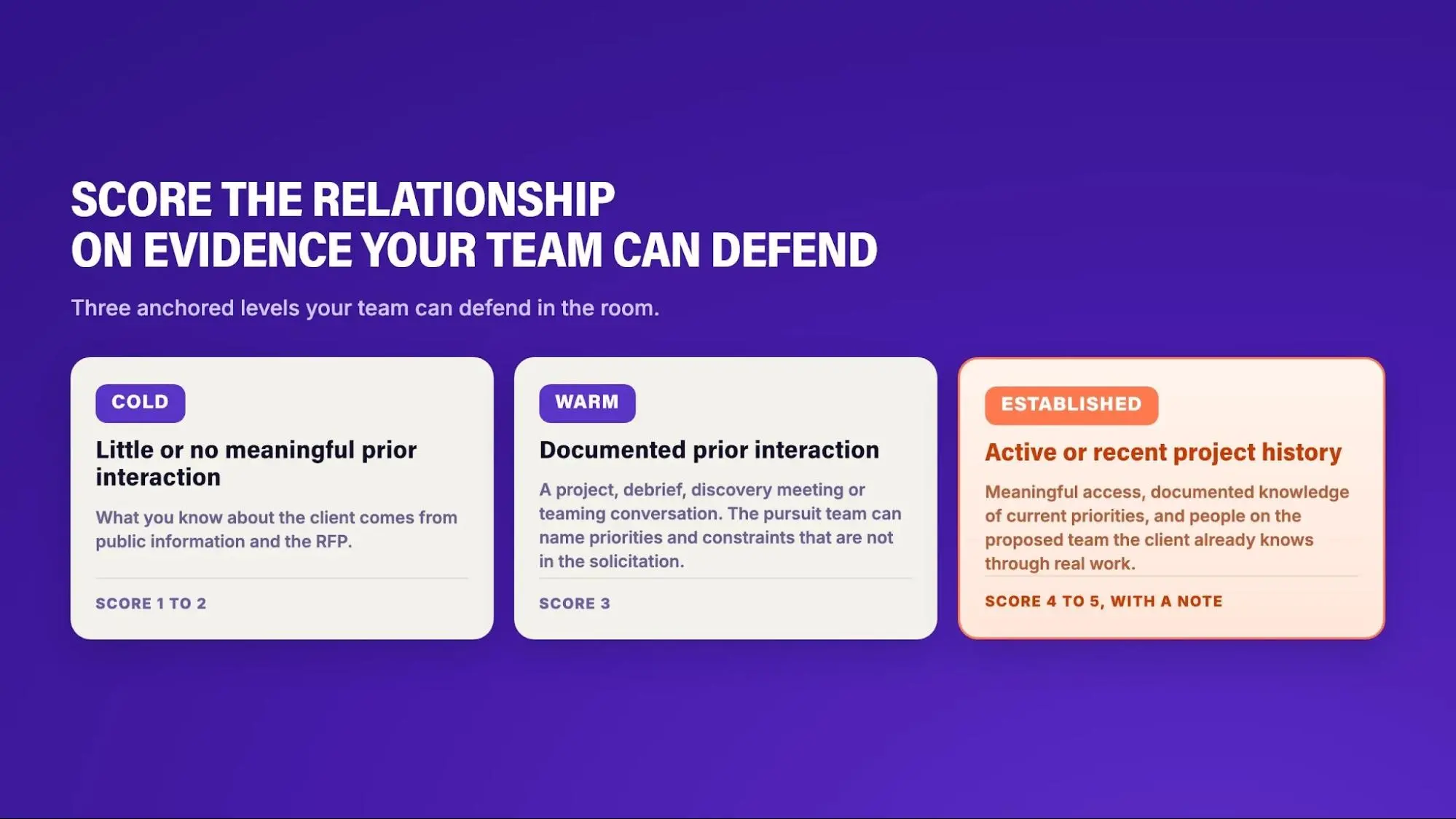
Cold: You have little or no meaningful prior interaction. Your knowledge of the client comes mostly from public information and the RFP.
Warm: You have documented prior interaction: a project, debrief, discovery meeting, teaming conversation, or recent relationship activity. Your pursuit team can name specific priorities, constraints, or preferences that aren't copied from the solicitation.
Established: You have active or recent project history, meaningful access to the client, documented knowledge of current priorities, and people on the proposed team whom the client already knows through real work.
Now you're measuring and scoring something your team can defend, and you're capturing why relationships create a pursuit advantage without pretending procurement rules reward whoever knows the client best. A strong relationship can give you better context, better discovery, more relevant examples and a much clearer understanding of what the client is trying to solve.
That's a lot more valuable than "Bob knows Susan."
How do you weight go/no-go criteria using past pursuits?
You don't need an industry benchmark to recalibrate this. You already have a better dataset: your own pursuits.
Pull 30–40 formally pursued opportunities from the last two or three years. Include the losses (especially the losses).
Then:
- Score each pursuit against the criteria you use today: Score it based on what you knew when you made the go decision, as closely as your records allow. Hindsight has a nasty habit of turning every winning relationship into a 5.
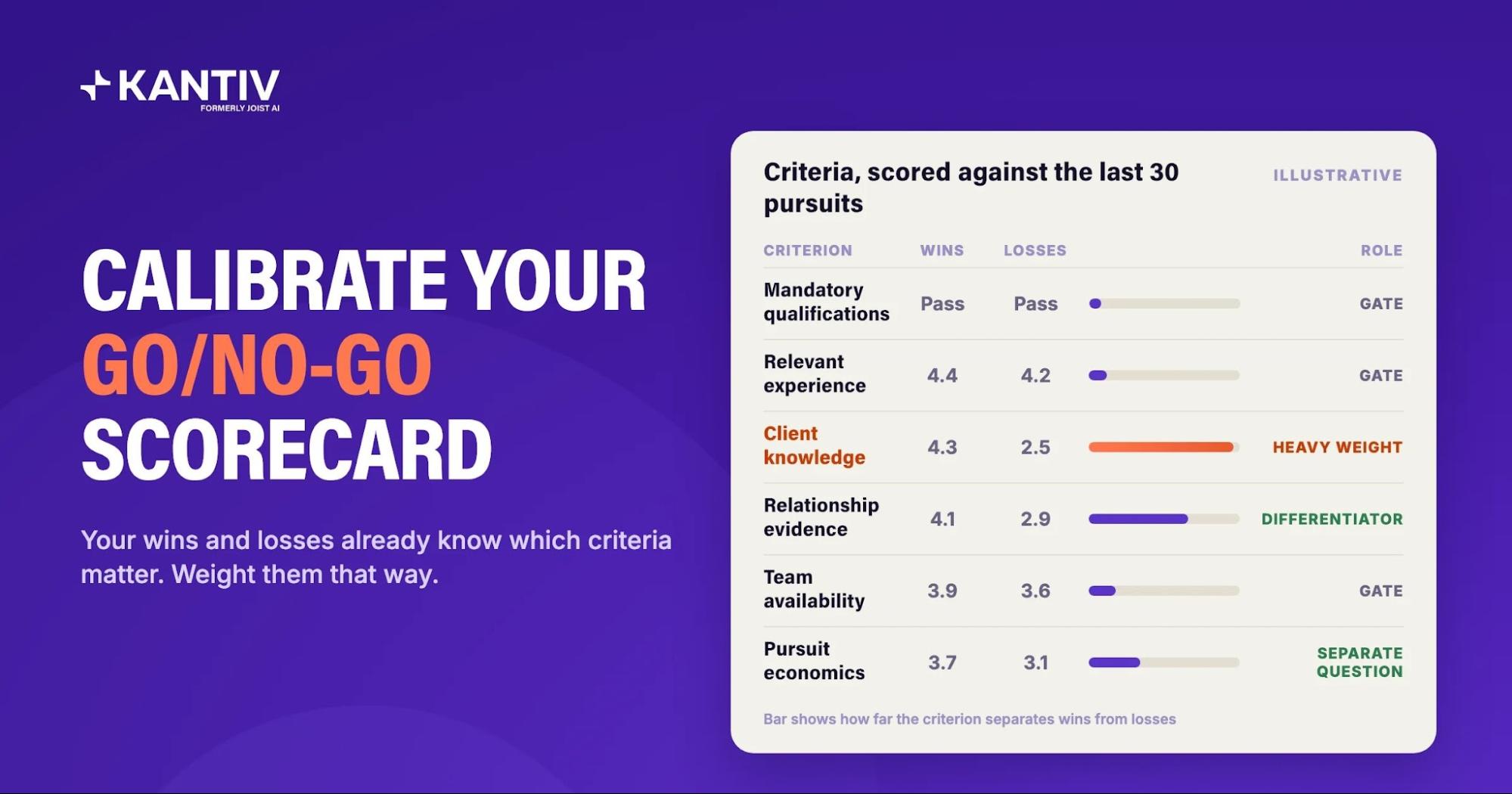
- Compare wins and losses for each criterion: If winning pursuits averaged 4.3 on client knowledge and losing pursuits averaged 2.5, you've found meaningful separation. If wins averaged 4.4 on relevant experience and losses averaged 4.2, that criterion isn't helping you distinguish much.
- Rank criteria by how strongly they separate outcomes: Give more weight to the factors showing a meaningful difference between wins and losses. Treat factors that barely move as must-haves, supporting information, or lower-weight criteria.
- Test the new weighting against old decisions: Would the revised model have pushed obvious losers down? Would it have surfaced strong pursuits your old model underrated?
- Date the model and run the exercise again next year: Your markets, clients, team and competitive position change. Your scorecard should learn with them.
Thirty pursuits won't give you scientific certainty. But it will give you a firmer starting point than a weighting scheme someone built four years ago because 15% felt about right.
This is also the kind of grind AI is good at. Scoring 40 old pursuits by hand is the reason this exercise usually dies on a to-do list. Hand the raw material—proposals, debriefs, win/loss notes—to an AI assistant and have it do the first-pass scoring and the win-versus-loss averages, then you sanity-check the output. You still own the judgment calls, but you just skip the manual grind.
A simple example
Say your analysis looks like this:
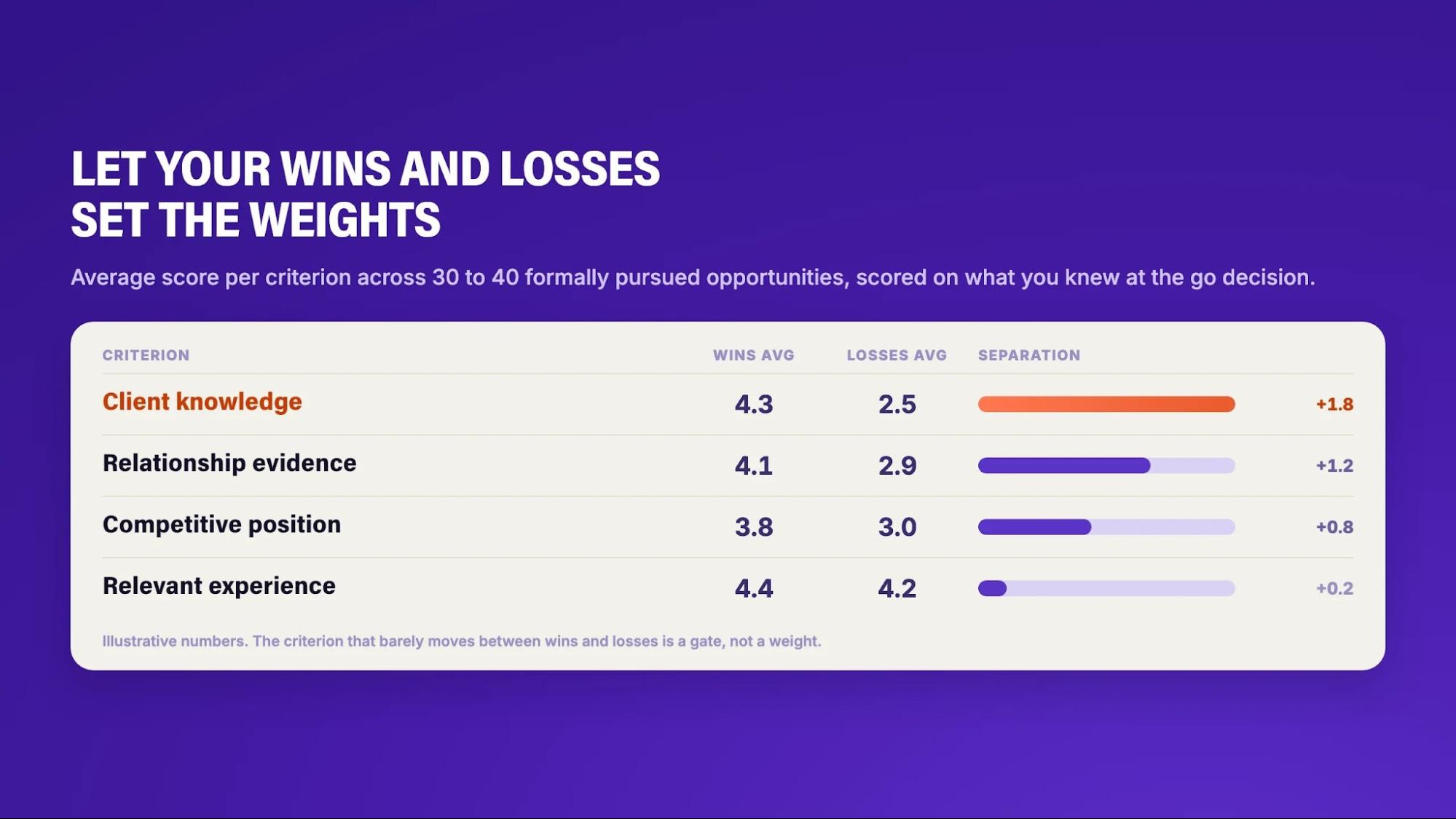
You don't need a data scientist to spot the useful signal. Giving all four criteria similar weights becomes pretty hard to defend. Relevant experience may still be absolutely necessary—keep it as a must-have, or give it enough weight to reflect that—but your own results are telling you client knowledge separates wins from losses far more effectively. That's what the weighting should reflect.
Does every pursuit score a pass? Your scale may need work
There's another problem hiding in a lot of go/no-go models: they make it almost impossible to score badly.
Everything is a 3, 4 or 5. The client relationship? Maybe a 3. Experience? Definitely a 4. Team? Call it a 4. Strategic fit? Feels like a 4.
Congratulations, your 47th pursuit this year has cleared the threshold.
A scoring model that can never tell you no is basically a permission slip with formulas. Set anchors for each score and require evidence for the high ones. A 5 on client knowledge should mean something specific. So should a 1.
You can also force more useful conversations by requiring a short note beside any unusually high score:
Relationship: 5 — Why?
Active project with the same facilities team. PM meets with client monthly. Debrief from previous pursuit identified two current priorities.
That note is more valuable than the number.
Should the scorecard decide whether a pursuit is worth it?
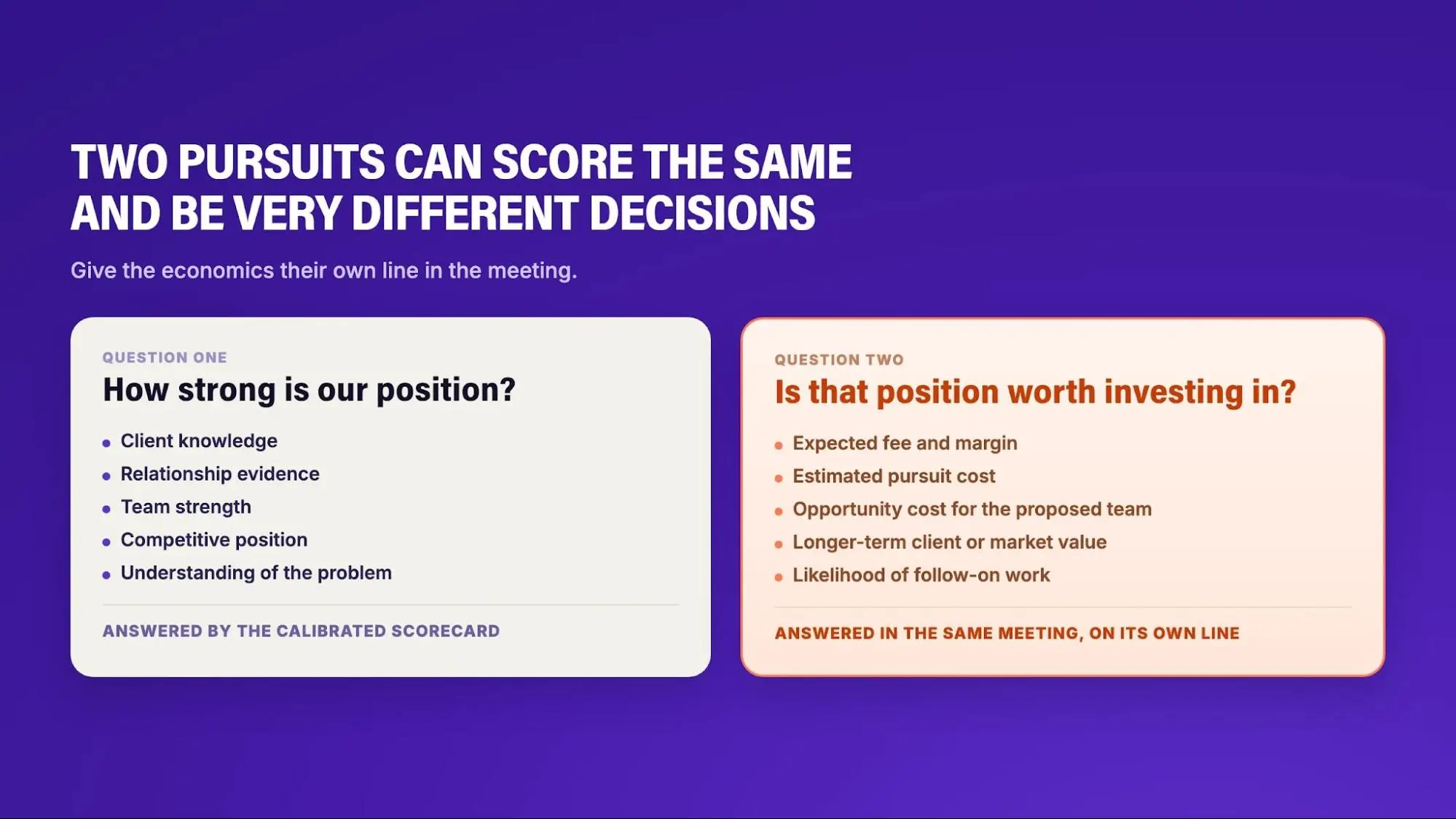
Once your differentiators are calibrated, add one more layer. Two pursuits can have the same competitive score and be very different business decisions.
A high-probability pursuit with a small fee, heavy proposal effort and thin margin deserves a different conversation than a moderate-probability pursuit tied to a major program your firm has been building toward for three years.
Keep those economics visible rather than burying them inside "strategic fit." At minimum, look at:
- Expected fee and margin
- Estimated pursuit cost
- Opportunity cost for the proposed team
- Longer-term client or market value
- Likelihood of follow-on work
Now your meeting can answer two separate questions: How strong is your position? And is that position worth investing in? That distinction alone can save a lot of beautifully formatted bad decisions.
What data does calibration need, and where is it? Answer: usually your pursuit history
The calibration exercise is pretty straightforward. Finding the information usually isn't.
Your relationship history is in CRM. Relevant projects are in proposal folders. Debrief notes are in someone's inbox. Win/loss data is in a spreadsheet maintained by one marketing director who has apparently become the firm's human API.
That makes even simple questions harder than they should be:
- How often do you win municipal water pursuits when you enter with an established client relationship?
- Which project types do you routinely shortlist for but rarely win?
- Which principals have the strongest win history with this client type?
- What reasons keep showing up in debriefs when you finish second?
- Which go/no-go criteria actually correlate with your wins?
If you need three people, four folders and a minor archaeological expedition through Deltek (or your system of record) to answer those questions, your scorecard can only be as smart as the data feeding it.
This is where structured firm knowledge becomes useful. Kantiv builds a Knowledge Graph out of your project history, proposals, and client relationships, and lets your team query it through chat or from inside a pursuit Workspace. The calibration exercise above—the one that eats an afternoon and a marketing director's patience—turns into something you run against a new RFP in a few minutes.
It doesn't make the go/no-go call for you. It gets your team into the room with evidence instead of another round of "I feel pretty good about this one." The call is still yours.
Give each criterion the load it actually carries
A good go/no-go process should make weak pursuits harder to rationalize and strong pursuits easier to defend. You probably don't need a brand-new framework for that. You need the one you already have to reflect what your firm's history actually says, instead of what felt right in a planning meeting four years ago.
Start with the scorecard you have. Separate the must-haves from the differentiators. Define what the scores actually mean. Check them against your wins and losses. Then give more weight to the signals that consistently tell you something useful.
Your scorecard already has the rows. Make sure each one is carrying the load you think it is. And check the structure every year. A scoring model nobody audits eventually becomes another piece of AEC infrastructure everyone assumes somebody else is maintaining.
We’ve had customers say Kantiv’s RFx Analysis have served as a great go/no-go decision tool, and one they don’t have to do anything extra to maintain. If you have any questions on how to refine your own scoring mechanism, or would like to see how Kantiv can help you quickly gather all the right and relevant information for kickoff meetings, book a chat with us.
FAQs
What criteria should a go/no-go scorecard include?
Two kinds. Gates: mandatory qualifications, staffing, contractual or licensing requirements, and a financial threshold. These are pass or fail. Differentiators: client knowledge, relationship evidence, team strength, competitive position, and your understanding of the problem behind the RFP. These are weighted, and the weights should come from your own win and loss history.
How do you weight go/no-go criteria?
Score 30 to 40 formally pursued opportunities from the last two or three years against your current criteria, using what you knew at the time of the go decision. Compare the average score on wins to the average on losses for each criterion. The criteria with the biggest gap get the most weight. Criteria that barely move become gates or supporting information.
What is the difference between a go/no-go decision and a bid/no-bid decision?
They describe the same decision. "Bid/no-bid" is the common term in construction and government contracting, where a price is submitted. "Go/no-go" is more common in architecture and engineering, where qualifications-based selection means the first submission is usually an SOQ rather than a bid.
How often should you recalibrate a go/no-go scorecard?
Once a year. Your markets, clients, team, and competitors change, and a weighting scheme built four years ago reflects a firm that no longer exists. Date the model and rerun the calibration against the pursuits closed since the last one.
What should happen when a pursuit scores well but the fee is small?
Treat it as two decisions. The scorecard answers how strong your position is. A separate look at expected fee and margin, pursuit cost, opportunity cost for the proposed team, and follow-on potential answers whether the position is worth investing in. A high-probability pursuit with a thin margin and heavy proposal effort can still be a no.