Found the content on this page useful? Share it with your team!
Request for Qualifications: How to Read an AEC RFQ Before You Respond

.png)
Table of Contents
A request for qualifications (RFQ) arrives with a familiar note on top. "Looks like a fit. Thoughts?"
You recognize the owner. The project is in a sector your firm knows. Someone has already suggested a teaming partner, and you can practically hear the kickoff meeting being scheduled.
Then you open the attachments.
The owner wants a specialty your team doesn’t cover. Your strongest project may fall outside the completion window. The project manager everyone wants to propose is committed elsewhere.
Any one of those issues could change the pursuit decision. Marketing needs to find them while there is still time to do something about them.
To review an AEC RFQ, establish the scope, eligibility requirements, evaluation criteria, selection process, deadlines, and contract terms. Match the major criteria to verifiable project and personnel evidence, then give leadership a pursuit recommendation with clear conditions.
That first read takes judgment. A summary that repeats the RFQ’s headings leaves the difficult work for the next person.
One engineering prospect described that problem in a conversation with us: the marketing manager rereads every RFQ herself, even after a colleague has summarized it. Understandable, if she still has to establish what the requirements mean for the firm.
A useful review lets her check the important passages and spend her attention on the decision.
By the end of this guide, you’ll have a practical way to organize that review, test your firm’s fit, and identify questions before the clarification window closes. You’ll also have an outline for a pursuit brief you can take into a go/no-go meeting and use to start the response once approved.
What is a request for qualifications?
A request for qualifications asks a firm to demonstrate that it has the experience, people, and capacity to perform an assignment. It typically describes the services the owner wants, the qualifications that will be evaluated, and the instructions for responding.
The owner issues the RFQ. Your firm answers with a statement of qualifications (SOQ) in the owner’s requested format (although federal architect-engineer procurements commonly use Standard Form 330). To put it more simply: RFQs set the requirements. SOQs show how you meet them.
One thing worth noting about the acronym: in purchasing, RFQ can also mean request for quotation, which requests pricing. The full title and instructions establish which process you’re dealing with.
For federal architect-engineer services covered by the Brooks Act framework, qualifications determine the ranking before contract negotiations begin with the most preferred firm. Other owners and procurement methods follow their applicable rules, so confirm when pricing is requested and how it will be used.
This guide covers requests for qualifications for architecture and engineering services, where fee stays out of the picture until later.
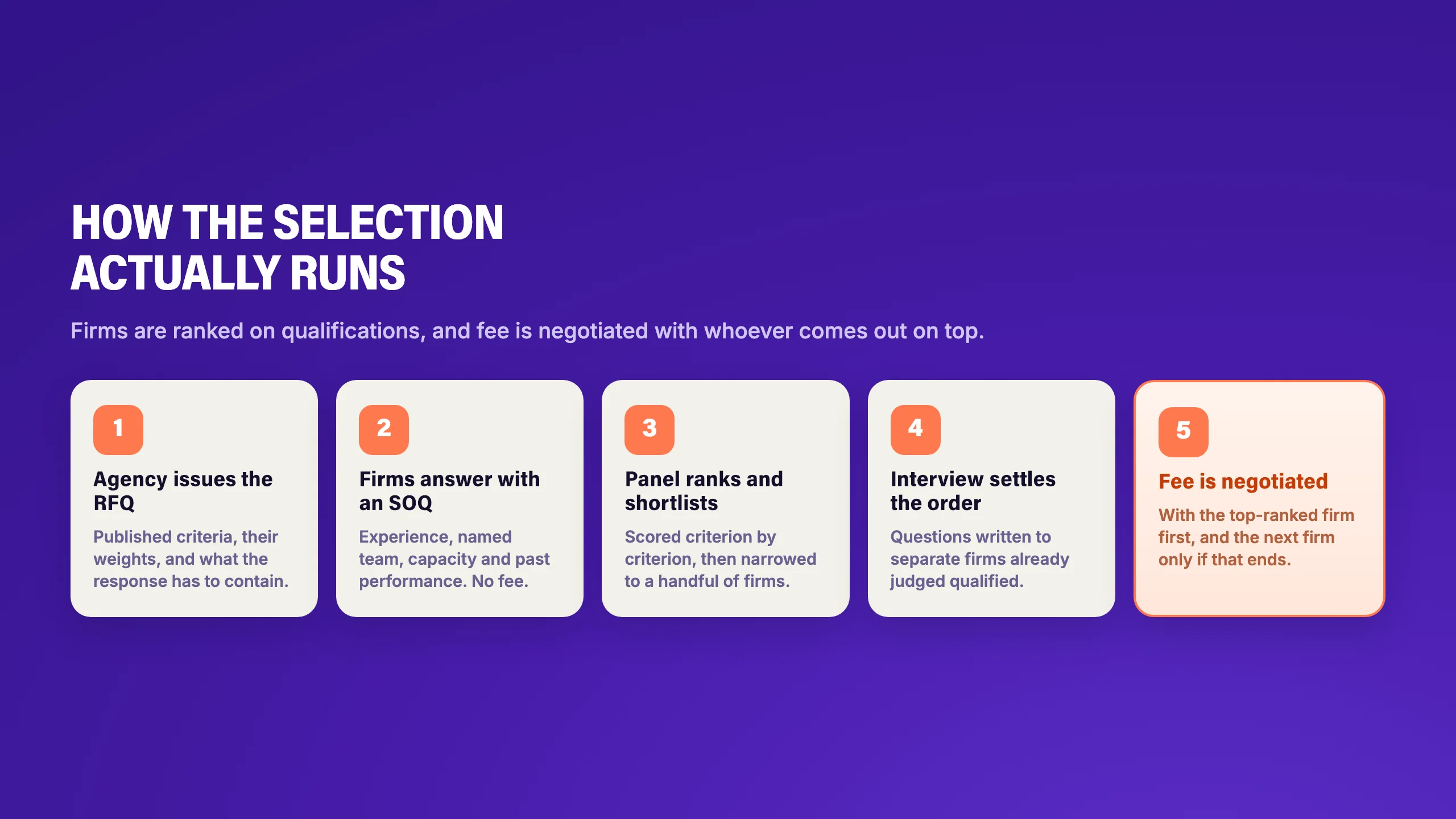
Once you understand the request and decide to pursue it, the SOQ becomes the task (a task we cover in depth in our statement of qualifications guide). Everything below is about the decisions that need to be made before the SOQ is assembled, starting with your first task: understanding what selection entails.
Working out what being selected means
"Selected" can describe several different outcomes.
Before debating whether you can win, establish what winning would mean: A project-specific selection may lead toward negotiating an assignment. An on-call selection may put your firm in a pool competing for future task orders. Prequalification may make you eligible for work that has yet to be advertised.
The submission effort can look similar while the business opportunity differs considerably.
| What's on offer | What to establish in the RFQ |
|---|---|
| A specific project | The assignment, the services, selection stages, the schedule, and the next step toward an award |
| An on-call or term agreement | The service categories, the contract duration, the expected demand, assignment method and minimum commitment |
| An IDIQ (indefinite-delivery, indefinite-quantity) contract | The minimum commitment, maximum value, ordering period, and task-order procedures |
| A prequalification or consultant roster | What eligibility it creates, how long it lasts, and how later work is awarded or assigned, and when renewal is required |
Owners often stack these arrangements. An owner might prequalify firms, select an on-call pool from that list, then issue task orders to pool members. Each step is a separate selection with a different payoff.
For a pool, look closely at how work reaches the selected firms. Is there further competition at the task-order level? Will the owner rotate work among firms, or choose any firm at its discretion? Also confirm whether the advertised value applies to each firm individually or to the entire pool.
This matters because a large ceiling can sound like a large award when it may represent the maximum value available to all firms combined. Ceilings also travel quickly through internal email chains. The explanation of what your firm can realistically expect should be attached.
Federal IDIQ contracts, for instance, must state a minimum and maximum quantity, and the government's obligation is the minimum, not the ceiling. State DOTs and municipalities follow their own rules, so check the RFQ.
Before moving on, make sure you can answer three questions:
- How will work be distributed?
- What portion of the advertised value could your firm reasonably pursue?
- What level of effort will it take to compete for that work?
Give leadership enough context to judge whether the opportunity warrants the initial response and any later task-order pursuits.
Read the scope with someone who will have to deliver it
A familiar project type can make an opportunity feel like a fit before anyone has looked at the scope. "Water treatment upgrade" may sound comfortably inside your experience until the services list turns out to include environmental review, a specialist assessment, and construction-phase support. An RFQ can look like a perfect fit right up until you find the owner wants a discipline you don't provide.
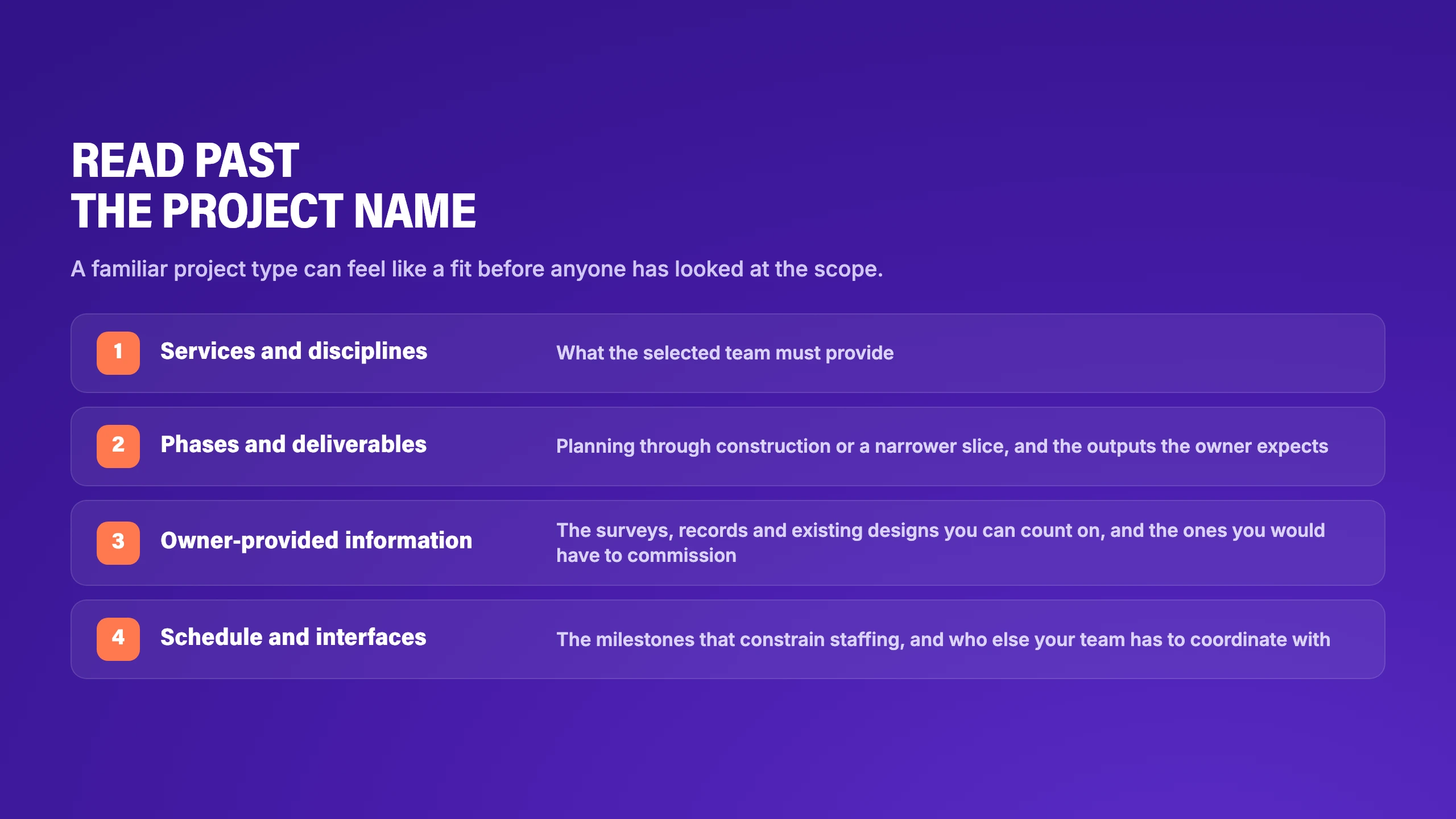
Bring the technical lead into the first read. Ask them to work through the services, disciplines, project phases, deliverables, and schedule with you. Establish which information the owner will provide and which investigations your team must undertake.
The relationships between those details are where delivery concerns emerge. A demanding design schedule looks different when current surveys are available than when the consultant must commission them first.
Pay attention to coordination, too. Who is responsible for interfaces with other consultants, utilities, regulators, or owner teams? A short sentence about coordination can carry a substantial amount of work.
If the package includes a sample agreement, route material insurance, indemnity, ownership, and other contract terms to the appropriate internal reviewer. Give that review time to influence the pursuit decision. Discovering a term the firm cannot accept after a week of production is an expensive way to get an answer.
At the end of this discussion, your scope summary should describe the assignment more precisely than the project title does.
Separate what qualifies you, what earns credit, and what governs submission
An RFQ can place a required registration, an experience criterion, and a PDF naming convention a few pages apart. They all need attention, but for different reasons.
| Requirement type | What it tells you | What your team has to resolve |
|---|---|---|
| Eligibility or minimum qualification | A condition the firm or team must satisfy | Whether you meet it, when it must be met, and the proof you'll need to demonstrate it |
| Evaluation criterion | A basis for comparing responses | Which evidence demonstrates the requested capability, and what weight or priority is stated |
| Submission instruction | How the response must be prepared and delivered | What effort it takes and who will check it |
Suppose an RFQ requires a particular registration, places substantial weight on occupied-facility experience, and limits the response to 15 pages. The registration needs verification. The experience criterion needs a credible project match. The page limit needs interpretation: do resumes and forms count?
Marking all three “covered” would tell the pursuit team very little.
Keep the RFQ’s exact language beside your notes. These categories help organize the review as requirements can overlap, and a submission instruction can carry mandatory consequences. Just like a credential may establish eligibility and also contribute to a scored assessment.
Check the timing as well. Some conditions have to be satisfied at submission. Others apply at a later stage. Record the actual requirement, because every credential and document is due at a specific moment and it's often later than people assume.
Where a gap exists, establish whether it can realistically be closed in time. Give that task an owner before “we’ll sort it out” becomes the basis for a go decision.
Understanding how the owner will narrow the field
The criteria tell you what will be evaluated. The selection procedure tells you what the evaluation leads to. Read for both.
Federal A/E (architecture and engineering) selections evaluate professional qualifications, specialized experience, capacity, past performance, geographic location and knowledge of the locality, and other appropriate criteria under FAR 36.602-1. Other owners publish their own requirements. Use the actual solicitation and any stated weights or order of importance.
Then, look for the mechanics of advancement. What does the written submission determine? How many firms advance, if specified? Are interviews or additional submissions required? How do later stages affect selection? Federal evaluation boards, for example, hold discussions with at least three firms and recommend them in order of preference. State and local agencies set their own numbers.
Clearing a minimum requirement and earning a place in the next round are separate things, and the document should tell you how they relate.
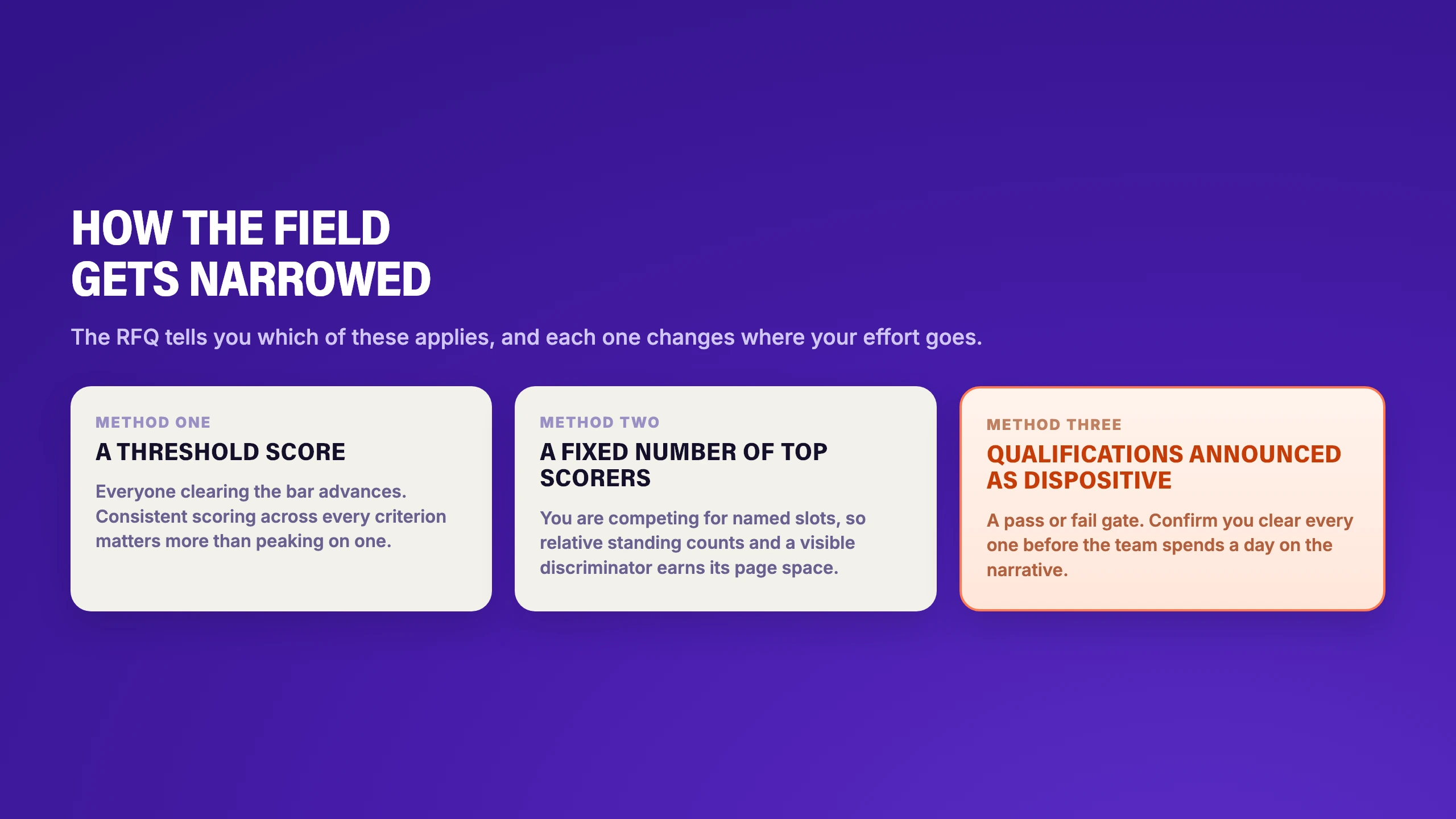
Your first-read notes should answer what the written submission determines, whether criteria are weighted or listed in order of importance, whether the number of advancing firms is stated, what an interview or later stage involves, and when fee enters the process, if at all. Those details also tell you how much effort sits beyond the initial response. A short SOQ followed by a two-hour interview with a scored technical scenario is a different commitment from a selection made on written qualifications alone. Where the procedure is unclear, ask through the authorized channel. The team needs an established process to plan against.
Test the firm’s experience against the owner’s specific request
Reading the criteria is easy. Testing the firm against them takes a more candid conversation than most pursuit meetings allow.
A broad sector match can hide a narrow experience gap. Your firm may have a substantial healthcare portfolio while the RFQ puts particular weight on occupied acute-care renovation. Or it may ask for evidence of managing several concurrent assignments when your strongest references are single projects. At this stage, you need enough verified information to know whether the evidence exists.
Start with the major criteria and identify the projects and people that could demonstrate them. For each match, record the source, the uncertainty, and who will verify it. You can capture this in a simple working matrix:
Criterion → potential evidence → supporting record → unresolved item → verification owner
When filled out it could look like this:
| Criterion | Potential evidence | Supporting record | Unresolved item | Verification owner |
|---|---|---|---|---|
| Relevant renovation experience | Renovation of an occupied office building | Project sheet and client reference | Confirm whether the building remained operational during construction | Project manager |
| Required scope of work | Interior demolition, mechanical upgrades, and finish work | Contract scope and change orders | Confirm which services were performed directly by your firm | Estimating lead |
| Completion date | Substantial completion in June 2023 | Certificate of substantial completion | Confirm that the date falls within the RFQ’s required period | Contracts administrator |
| Key personnel availability | Proposed project manager led the reference project | Résumé and project assignment record | Confirm availability for the anticipated project schedule | Operations manager |
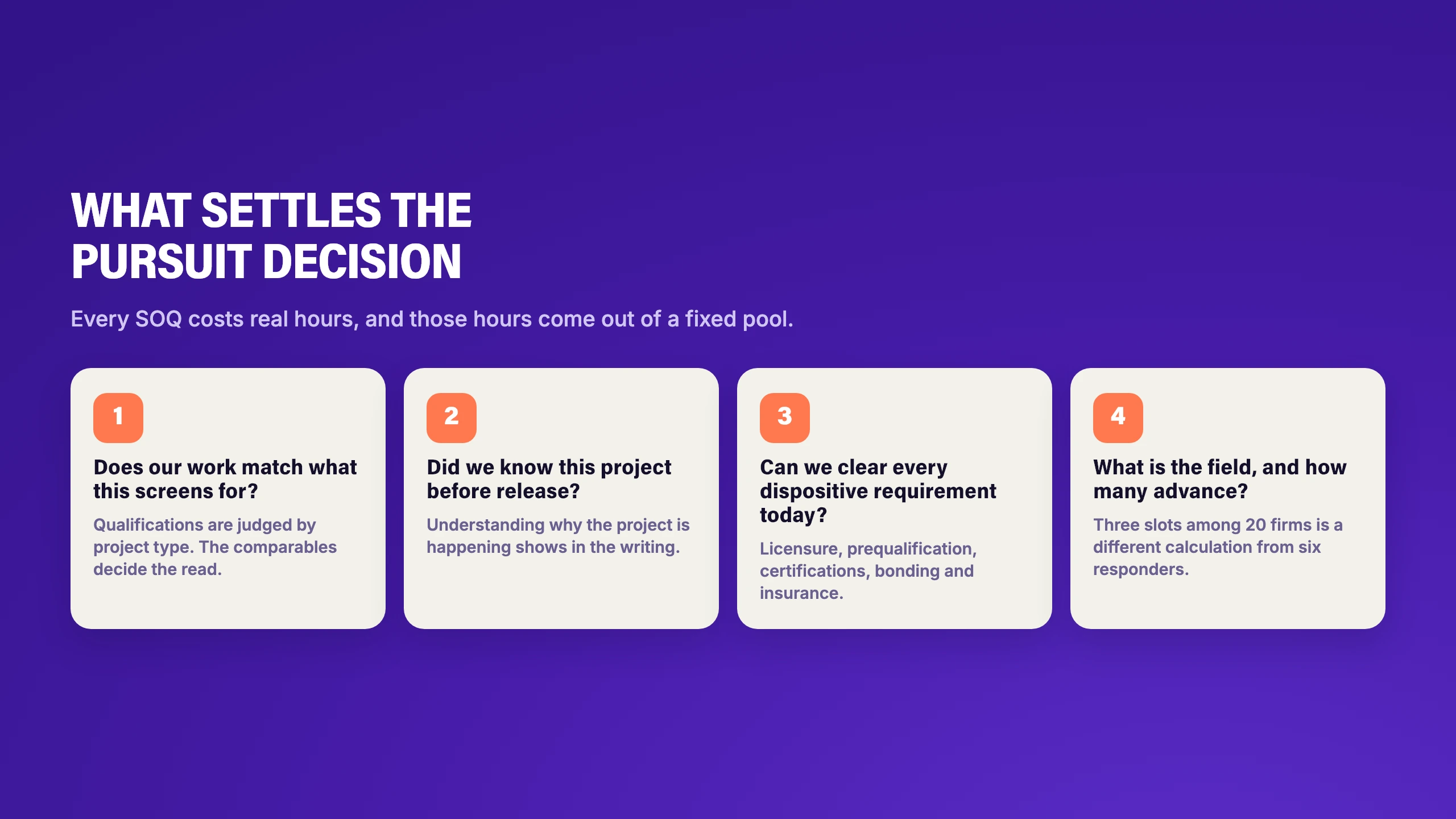
Keep it small enough to use in a decision meeting. You are establishing whether credible evidence exists before asking the team to write polished project sheets.
The exercise is useful because it exposes uncertainty. A project name is a lead to investigate. It becomes evidence once someone confirms what the firm did and whether it meets the requirement. Where you don't know, record the uncertainty, because a panel will.
If a heavily weighted criterion has weak or unconfirmed evidence, raise it in the go/no-go meeting. The team may need a different example, a qualified partner, or a decision to pass.
By kickoff, writers should know which examples to use, why they fit, and what still needs checking. That saves them from discovering halfway through a draft that the flagship project doesn’t meet the owner’s requirements.
Capture the question deadline during the first read
Record the question deadline and submission deadline as soon as the RFQ arrives, including the time zone and authorized submission channel. Also capture any mandatory meeting, site visit, or registration date.
Once the question window closes, the team may have to draft around an unresolved interpretation. An unresolved interpretation can become a writing assumption. That assumption then spreads into project selection, page planning, and the draft.
Good clarification questions cite a specific passage and ask for an answer the team can use. Here are some examples:
| Uncertainty | A focused clarification question |
|---|---|
| The RFQ requires "completed projects" | Does "completed" refer to completion of design services or completion of construction? |
| Team experience is requested without attribution rules | May relevant experience be demonstrated through proposed subconsultants, and how should their contribution be attributed? |
| Resume and overall page limits appear inconsistent | Do the required resumes count toward the overall response limit? |
| A service category is named broadly | Does the requested scope include the specialist assessment described in the attachment? |
| The next selection stage is unclear | Will interview results be combined with written scores or evaluated separately? |
Use the designated channel and cite the section or page. A precise question is easier for the owner to answer and easier for your team to act on. Track official answers and amendments, update the pursuit brief and response requirements, and acknowledge addenda when instructed.
Assign someone to check for updates through submission. The original RFQ may no longer reflect the current requirements.
Give leadership a pursuit brief they can decide from
Without a shared summary, everyone reads the same RFQ and leaves with a slightly different opportunity in mind. The technical lead sees an appealing scope. Business development sees a promising owner. The proposal manager sees the deadline and six missing inputs.
A short pursuit brief brings those views together.
Remember that marketing manager who rereads every RFQ herself after a colleague has summarized it? A brief with source references, verified evidence, and explicit uncertainties makes that review more useful: she can check the important passages and focus on what the firm should do.
Use the following outline:
| Brief field | What to record |
|---|---|
| Opportunity | Owner, solicitation number, and what selection enables |
| Scope | Services, deliverables, and delivery constraints |
| Eligibility | Required qualifications, timing, and verified status |
| Competitive fit | Priority criteria and strongest supporting projects and people |
| Unresolved items | Staffing, teaming, evidence, and clarification needs, with owners |
| Commercial considerations | Ordering arrangements, material contract concerns, and pursuit effort |
| Key dates | Questions, mandatory events, submission, and known later stages |
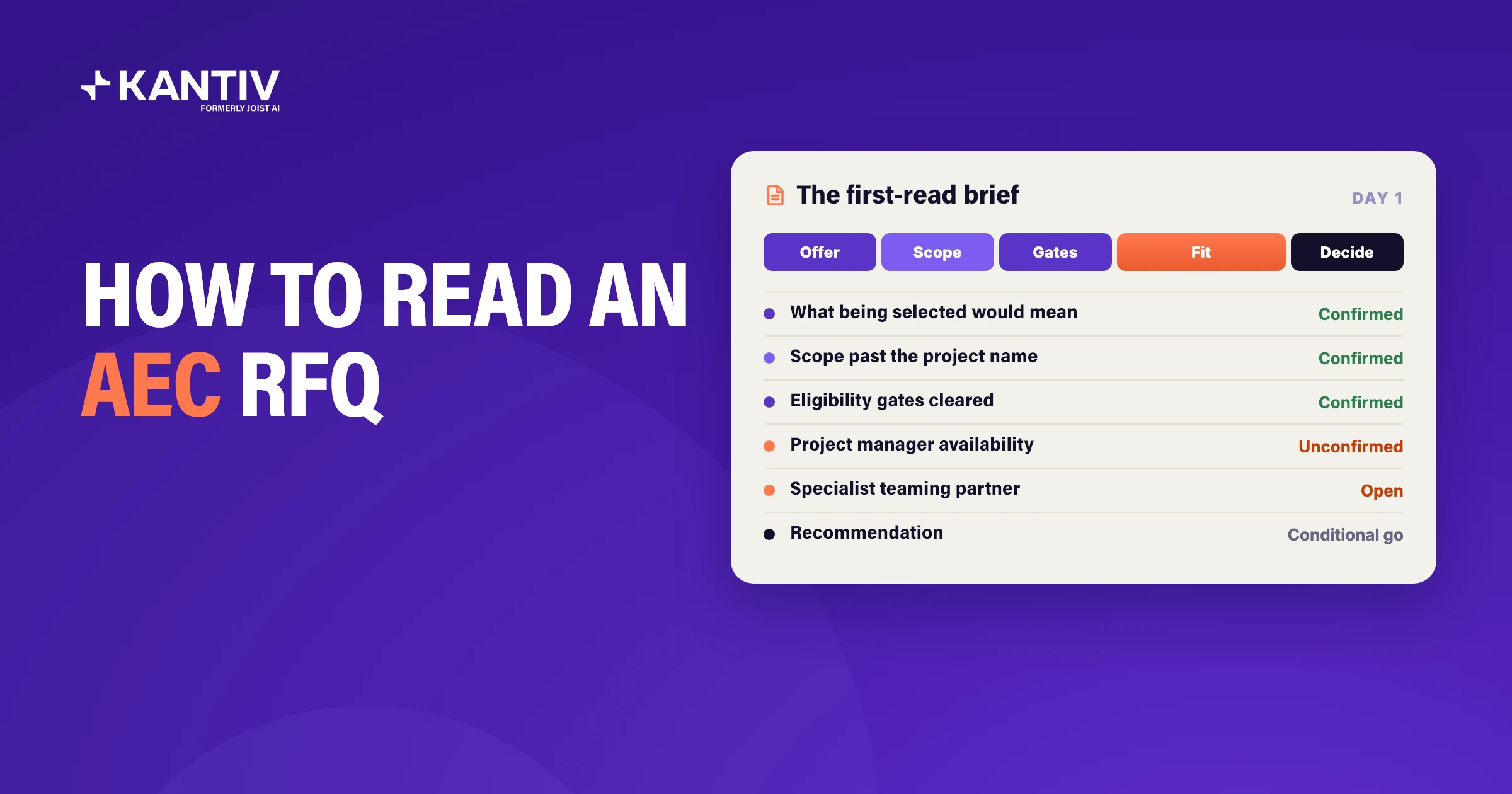
| Recommendation | Go, no-go, or conditional go, with conditions and decision owner |
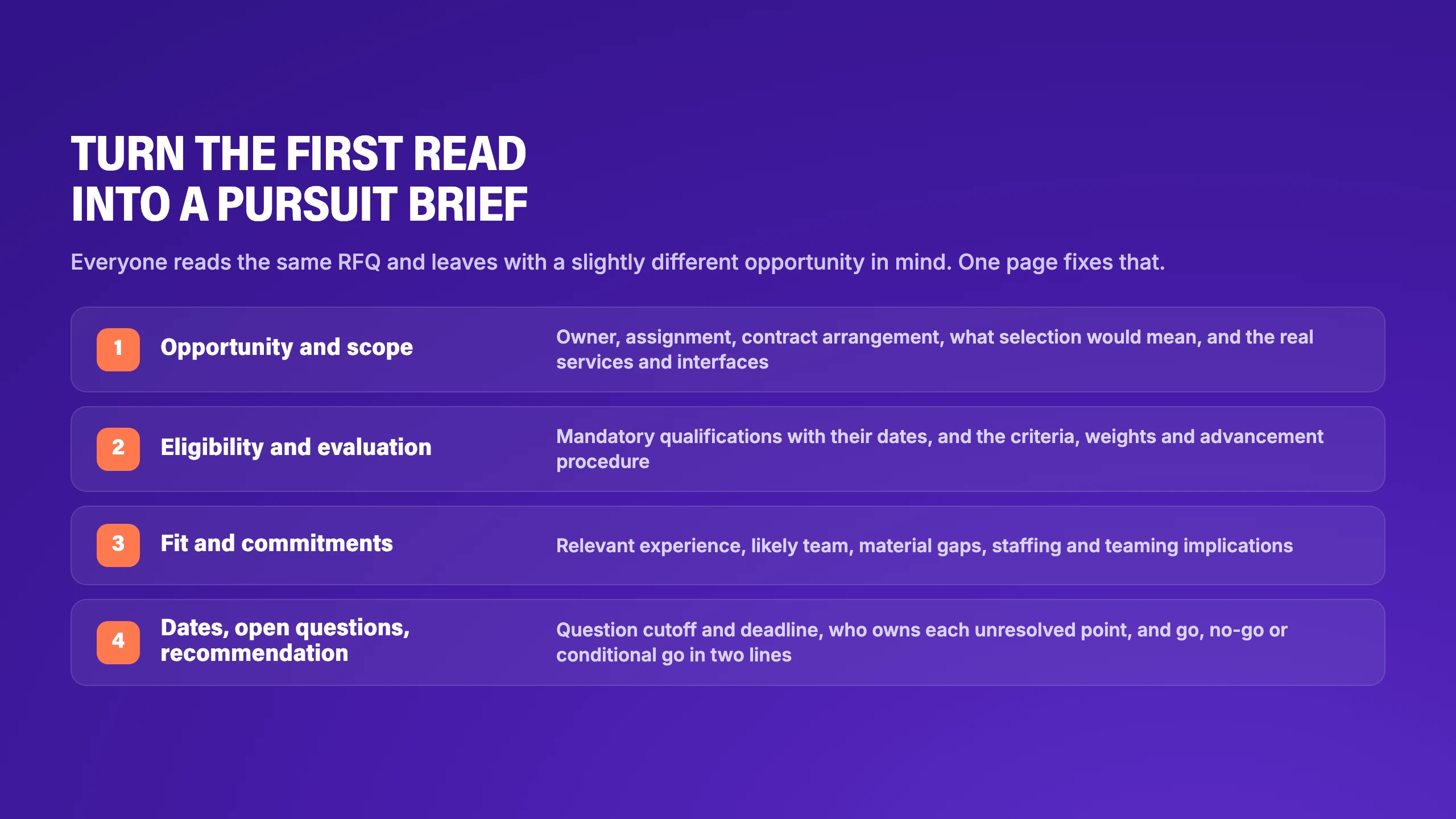
A recommendation could read:
“Conditional go. Two relevant renovation projects are available. Operations must confirm the proposed project manager’s availability, and the pursuit lead must secure the specialist partner before kickoff.”
Give each condition an internal due date. If it remains unresolved, return it to the decision-maker before committing further production time.
A small AEC firm without a dedicated proposal team told Kantiv that SOQ production consumed three weeks of nights and weekends. That is one firm’s experience, but it puts a tangible cost on the decision. The people doing that work deserve a clear commitment and an agreed plan.
Once approved, the brief becomes the kickoff document. Writers know which evidence to use, technical contributors know what to verify, and everyone works from the same understanding of the assignment.
Use Kantiv to connect RFQ requirements with your firm’s records
Much of the first read involves connecting the owner’s requirements to information inside the firm: comparable projects, relevant people, supporting records, and questions that still need an answer.
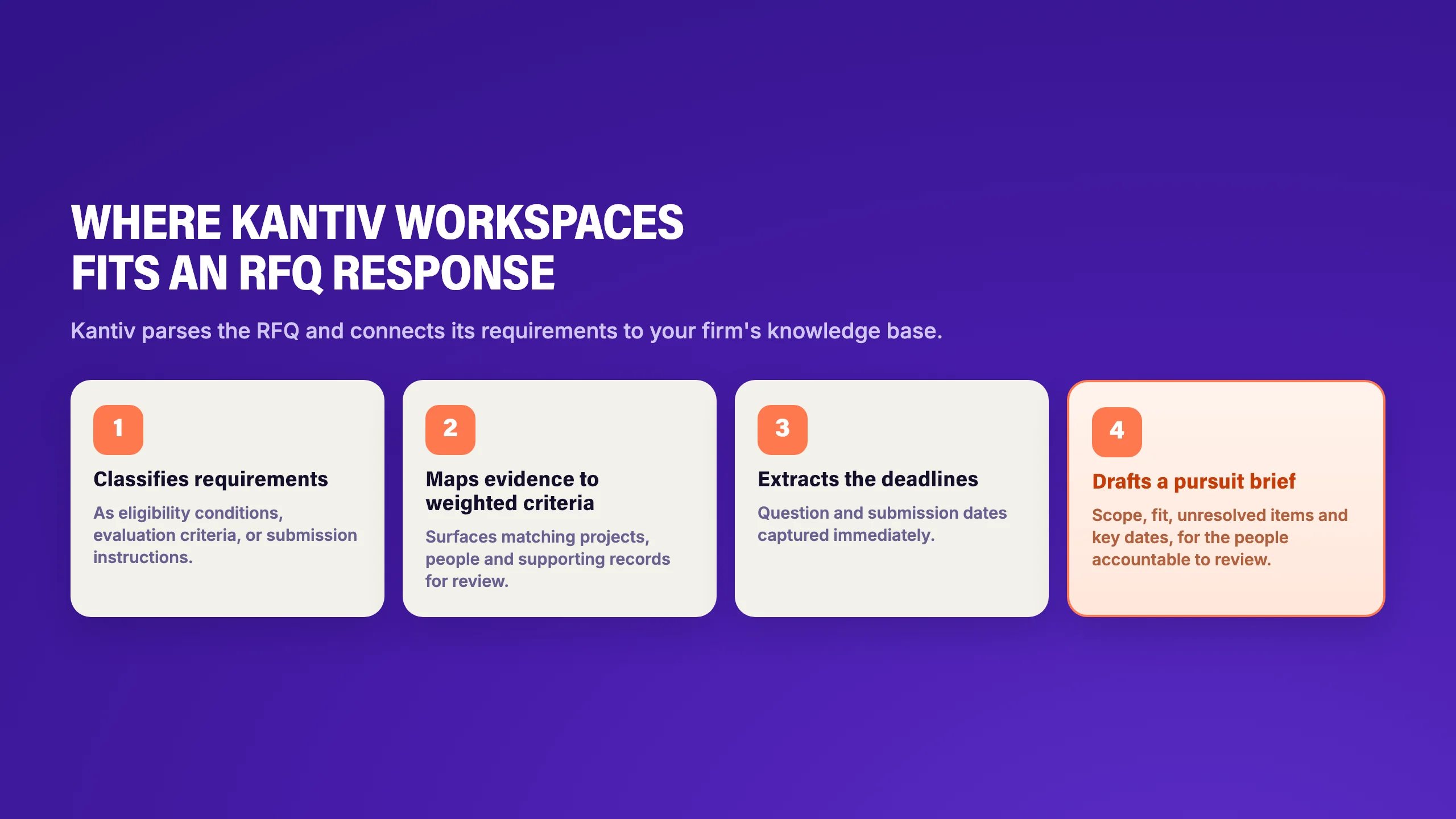
This is exactly the kind of work Kantiv Workspaces was built for. Kantiv parses the RFQ and connects its requirements to your firm’s knowledge base. It can:
- Classify requirements as eligibility conditions, evaluation criteria, or submission instructions.
- Map evidence to weighted criteria, surfacing matching projects, people, and supporting records for review.
- Extract question and submission deadlines so the team can capture them immediately.
- Draft a pursuit brief covering scope, fit, unresolved items, and key dates.
The team can then review the extracted requirements against the RFQ and investigate the suggested matches. Current availability, partner commitments, and the pursuit recommendation still need the people accountable for those decisions.
Underneath sits the Kantiv Knowledge Graph, which connects your projects, people and past pursuits so the recommendations come from work your firm has actually delivered. This is what makes the AI output trustworthy. Plus, source-linked citations make all its claims easy to verify. Together that adds up to less rework for you and your team.
One Kantiv user, having completed two full SOQs in Workspaces, reported becoming more efficient on the second. She was so convinced by the productivity gains, that she began coaching her own team.
Want to see how it works? Bring your next RFQ to a live demo. We'll run the first read in Workspaces together, from requirements to fit, and you'll leave with a pursuit brief for a live opportunity.
FAQs
What does RFQ stand for in construction?
RFQ can mean request for qualifications or request for quotation. A qualifications request asks about experience and capability, and fee comes later. A quotation request asks for pricing. The full title and the instructions tell you which one you're holding.
Does being shortlisted mean we've won the contract?
Shortlisting generally means advancing to another stage. Check the solicitation for remaining interviews, submissions, selection decisions, negotiations, and award steps.
Does joining an on-call pool guarantee work?
Check the agreement’s minimum commitment and assignment provisions. Pool membership and an advertised ceiling do not establish how much work an individual firm will receive.
Can we pursue an RFQ if a required qualification is missing?
Establish who must hold the qualification, when it is required, and whether the proposed team may satisfy it. Verify that it can be obtained in time before committing to the pursuit.
What should we do if the RFQ contradicts an attachment?
Record both passages, check any stated order of precedence, and request clarification through the authorized channel before the question deadline. Update the response to reflect official amendments or clarifications.
What is the difference between reading an RFQ and writing an SOQ?
The read establishes what the owner wants, how selection works, and whether your firm should pursue it. Writing the SOQ turns that understanding into the qualifications package the owner asked for.