Found the content on this page useful? Share it with your team!
The AEC RFP Process: 9 Steps to Plan, Build, and Submit a Stronger Proposal

.png)
Table of Contents
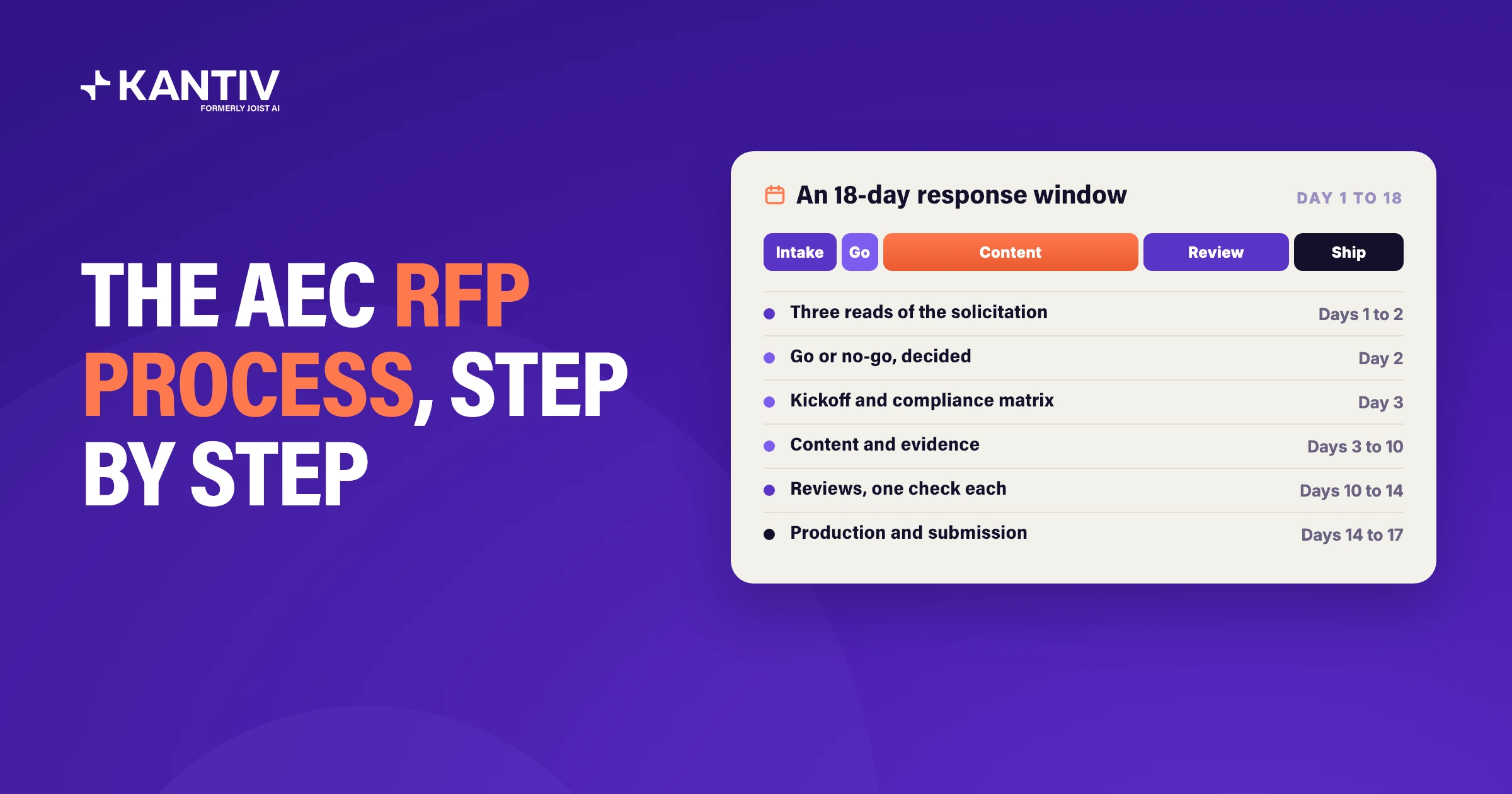
The AEC RFP process is the work an architecture, engineering, or construction firm undertakes to evaluate a Request for Proposals, prepare its response, and submit it according to the client’s requirements. It includes qualification, proposal planning, content development, review, production, and submission, supported by early client research and a post-pursuit debrief.
In practice, those activities rarely arrive in a tidy sequence.
One proposal team described finding a 25-page submission limit on page 27 of a 40-page RFQ. Someone had to catch the requirement, establish what counted toward the limit, and make sure everyone building the response knew about it.
Meanwhile, technical contributors have projects to deliver, the strongest project example may need updating and a photograph everyone remembers can take an afternoon to locate.
A workable process accounts for that work. It gives decisions and deliverables clear owners, makes requirements accessible, and leaves time to check the finished submission.
In this guide, we provide a practical framework for an AEC RFP process, that we’ve broken down into nine steps. So you can spend less time scrambling, and more time building proposals that win.
Activities overlap, and the solicitation determines which apply.
What are the steps of the AEC RFP process?
| Step | Primary owner | Output to be produced |
|---|---|---|
| 1. Pre-positioning | Business development lead | Client and opportunity brief |
| 2. Solicitation intake | Proposal manager | Requirements, deadlines, and clarification questions |
| 3. Go/no-go | Pursuit sponsor | Documented decision and resource commitment |
| 4. Proposal kickoff | Proposal manager and pursuit lead | Outline, assignments, and review schedule |
| 5. Content and evidence | Section owners and technical leads | Verified drafts, resumes, project examples, and images |
| 6. Proposal review | Proposal manager and designated reviewers | Resolved issues and recorded approvals |
| 7. Production and submission | Production lead and authorized submitter | Checked files and submission confirmation |
| 8. Shortlist interview, if required | Pursuit lead and proposed project manager | Rehearsed, project-specific presentation |
| 9. Debrief | Pursuit lead | Pursuit record and assigned improvements |
⚠️In a small firm, one person may hold several roles. Decision authority, review responsibilities, and backup coverage should still be explicit.
Step 1: Understand the client before the solicitation arrives
Strong pursuits start before the RFP is released. Pre-positioning gives your firm time to understand the client’s priorities, build relationships, and identify where your experience fits the project.
Shanthi Perera, a capture practitioner, explains why timing matters: "Developing an information advantage is best done before the RFP is released."
Once the solicitation is public, procurement rules may limit informal conversations with the client. Firms should use that earlier window to learn what’s driving the project, which challenges matter most, and how the client will evaluate potential partners. Is the owner concerned about keeping a facility operational during construction? Navigating a difficult permitting process? Delivering within a tight budget? Those details help your team choose relevant project examples and explain its approach.
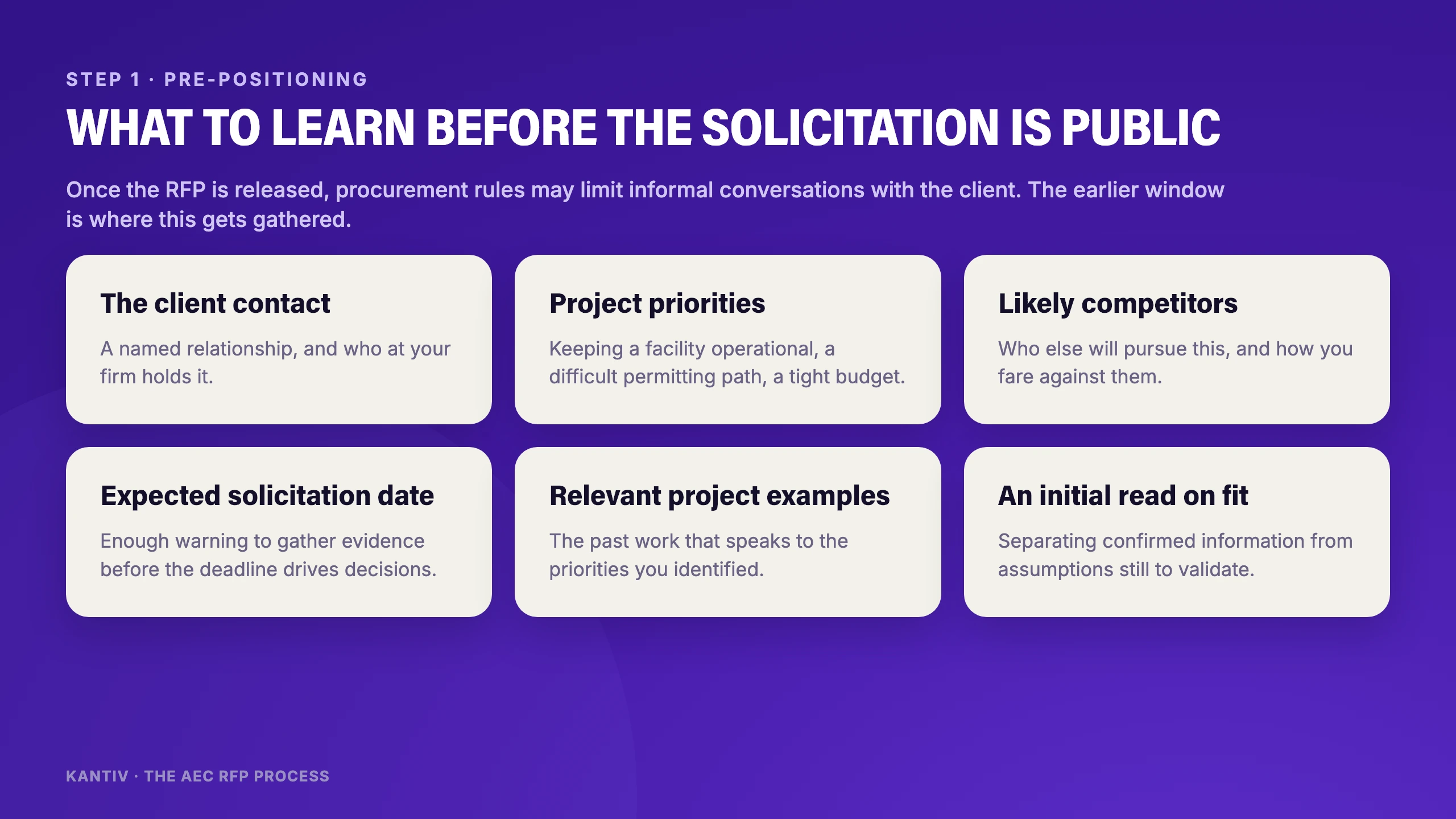
Critically, pre-positioning allows you to identify likely competitors and consider whether teaming with another firm would strengthen your qualifications. It also allows you to document what you learn, and distinguish confirmed information from assumptions your team still needs to validate.
Owner: Your business development lead, working with the principal who holds the client relationship.
What this phase produces: A documented client contact, project priorities, likely competitors, an expected solicitation date, relevant project examples, and an initial assessment of your firm’s fit, all recorded in your CRM or pursuit brief.
Advance warning gives marketing time to gather project evidence, update team resumes, and develop a proposal strategy before the deadline starts driving every decision. This ensures your team has a foundation to evaluate the opportunity and make an informed go/no-go decision when the RFP arrives.
Step 2: Extract RFP requirements and track every update
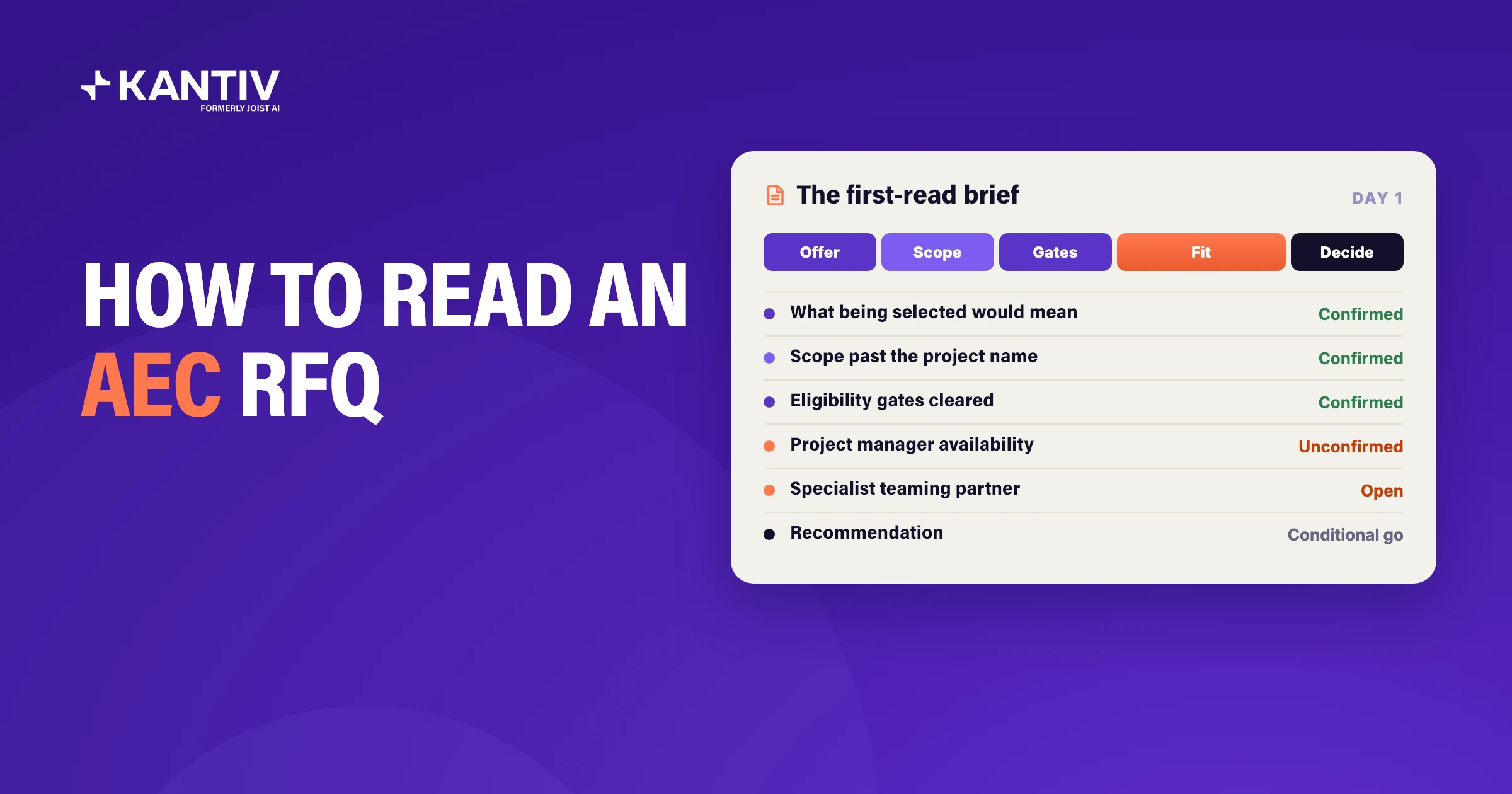
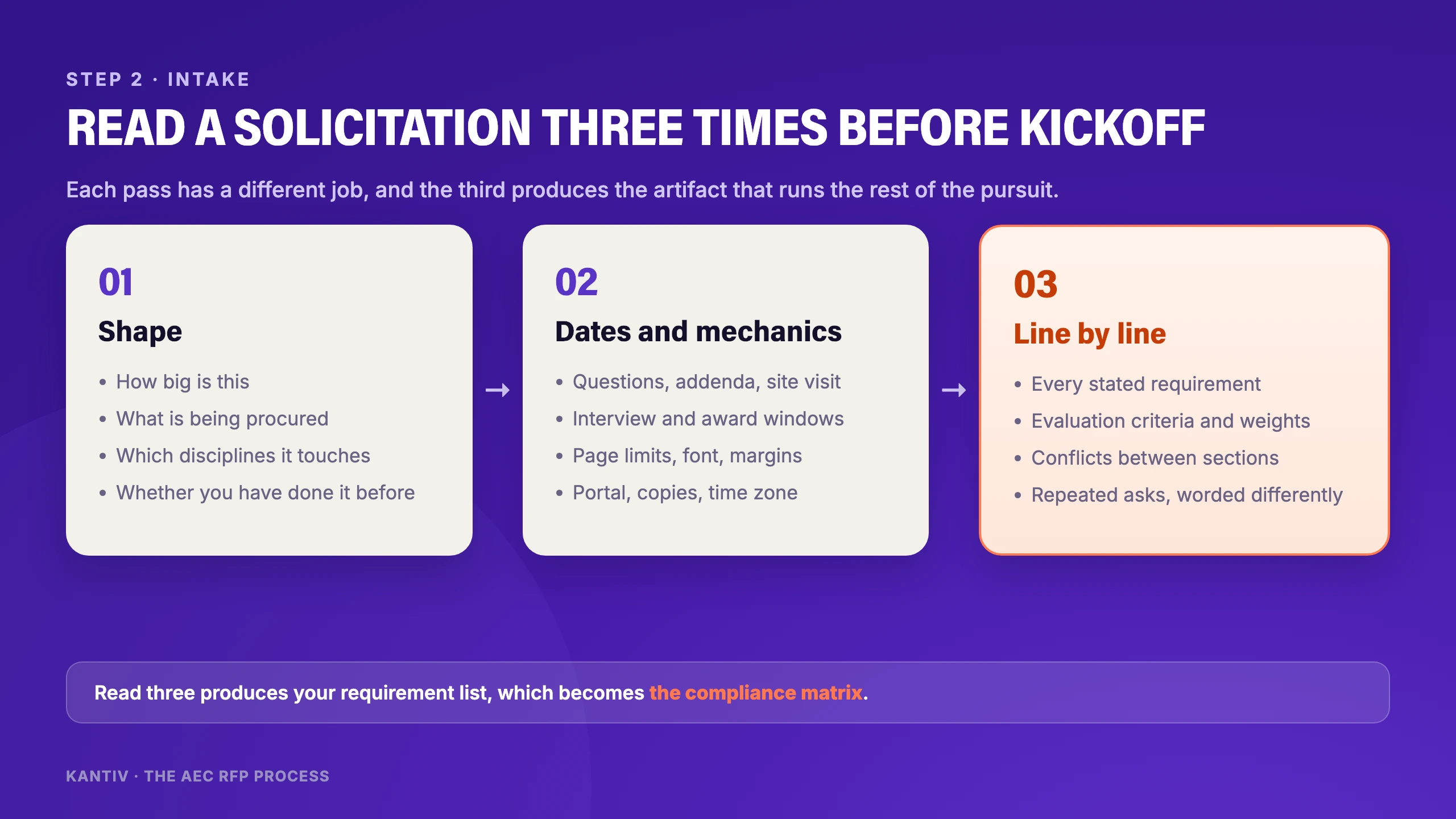
When the RFP arrives, your first task is to turn it into a clear set of requirements, deadlines, and decisions. We recommend reading it in three passes, each with a different purpose.
- Establish the opportunity’s basic fit. Identify scope, location, delivery method, required disciplines, minimum qualifications, and schedule. Flag potential disqualifiers before substantial proposal work begins.
- Capture the submission conditions. Record deadlines and time zones, mandatory meetings, page limits, forms, signatures, file formats, portal instructions, and separate fee submissions. Confirm whether covers, resumes, dividers, and appendices count toward the page limit. Test your portal access early, and assign someone to monitor addenda.
- Connect response instructions to evaluation criteria. Build a requirement list that records what you must answer, where it appears, and how it will be scored. Flag contradictions, repeated requests, and anything you can’t read cleanly.
In a 2026 benchmark, 49% of AEC respondents reported that an average request takes 6 to 10 days to complete. So early clarity is worth real effort, because unresolved requirements eat the time you’ll need for writing and review.
Use the gaps identified during intake to draft clarification questions, naming the ambiguity and the answer your team needs. Once you submit them through the authorized channel, track the client’s responses and any addenda against your requirement list. Keeping those updates alongside the original solicitation gives everyone a shared reference as the proposal develops.
💡Kantiv’s Workspaces can extract requirements, deadlines, and scope from an uploaded RFx. Use the output to support intake, then verify it against the solicitation and subsequent addenda.
Owner: Your proposal manager or marketing coordinator.
What this phase produces: A requirement list, submission calendar, initial evaluation map, clarifying questions, and a named owner for addenda.
Step 3: Make an evidence-based go/no-go decision
A go/no-go decision determines whether the opportunity deserves your firm’s proposal and delivery resources. We cover the criteria that predict AEC pursuit success in our guide to go/no-go in AEC.
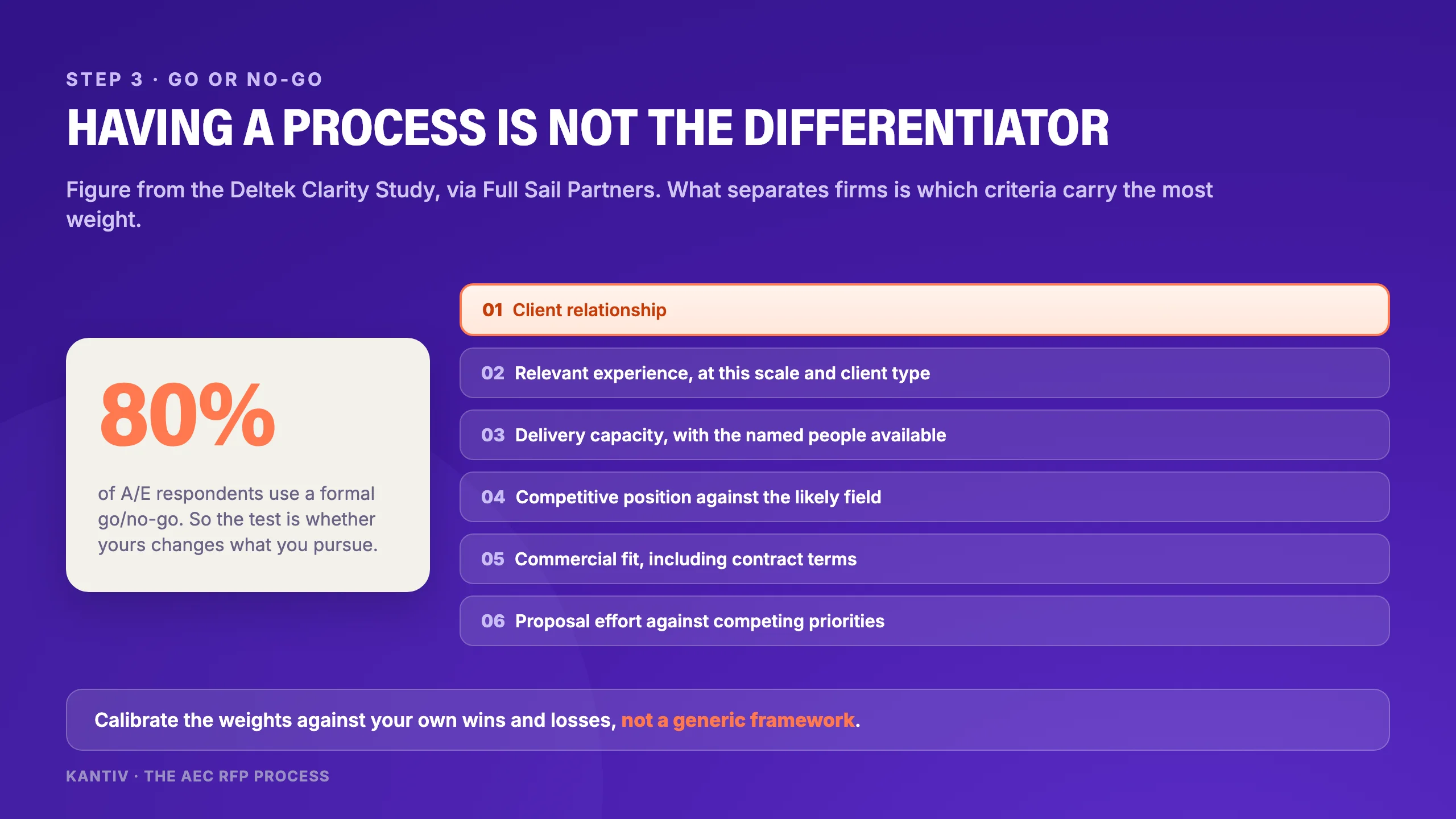
80% of A&E firms report a formal go/no-go process before committing to a pursuit. The bar is no longer whether or not you have a formal process; it’s whether it effectively and consistently enforces which work you pursue.
Hold the go/no-go decision early enough to influence staffing and workload. When running your go/no-go, assess the opportunity across six areas:
- client relationship,
- relevant experience
- competitive position
- delivery capacity
- commercial fit
- proposal effort and competing priorities
Ask questions that require evidence. Can you demonstrate the qualifications being scored? Is your proposed project manager actually available? Are the contract terms acceptable? Does a teaming partner cover a required discipline? What other pursuits would lose attention if this one proceeds?
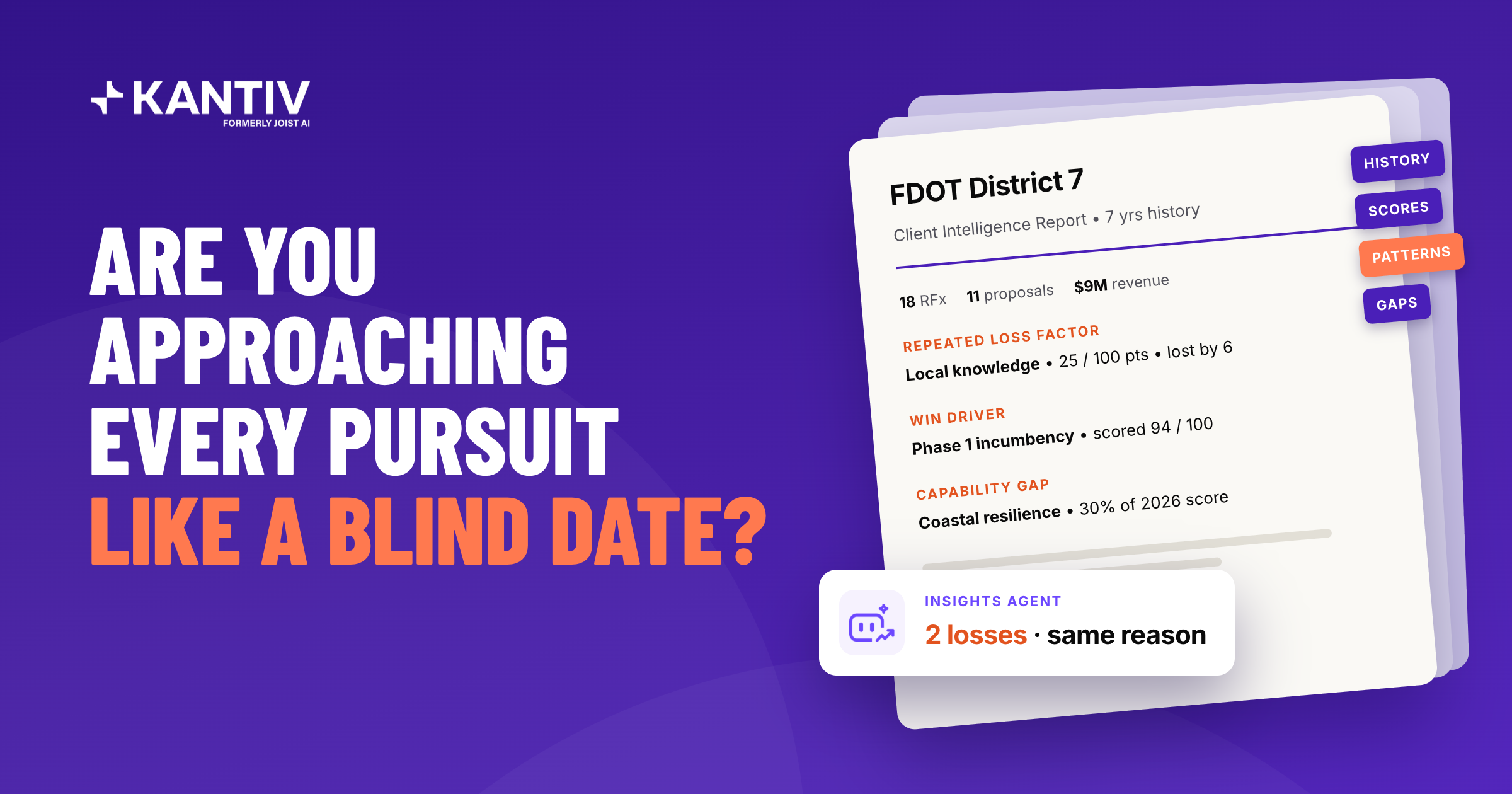
Make sure you use your own historical results to inform the discussion. Similar project wins, losses, margins, and client relationships are more useful than a principal’s confidence alone. Where you don’t know something, record the uncertainty rather than scoring it as a strength.
💡One customer used Kantiv’s go/no-go analysis on a live pursuit and shared the output with its reviewer group. That gave reviewers material to examine together before committing resources. Read more about how Kantiv’s Insights Agents remove the gruntwork and make this easier for you by gathering information from your past proposals and client interactions.
For an 21-day response window, firms should aim to make their decision within the first three-five days. Treat that as a planning target, adjusted for complexity and mandatory deadlines.
And if the go is conditional, firms should name the condition, its owner, and its deadline, and revisit it if the condition fails or if the scope changes materially.
Owner: The pursuit sponsor or principal authorized to commit resources.
What this phase produces: A recorded go, no-go, or conditional go, with rationale and a proposal resource commitment.
Step 4: Turn proposal kickoff into specific assignments
Kickoff turns your pursuit decision into a working plan. The main job here is getting your proposal manager, pursuit lead, technical lead, and section owners in one room to align on the client’s requirements and your team’s approach to answering them.
The same AEC benchmark study found that 74% of respondents involve 11 or more contributors in responses. With that many people involved, it’s vitally important that every assignment receives an owner, a deadline, and a clear definition of “done.” Clear assignments help coordinate that work alongside contributors’ other responsibilities. “John will handle the approach” leaves too much unresolved.
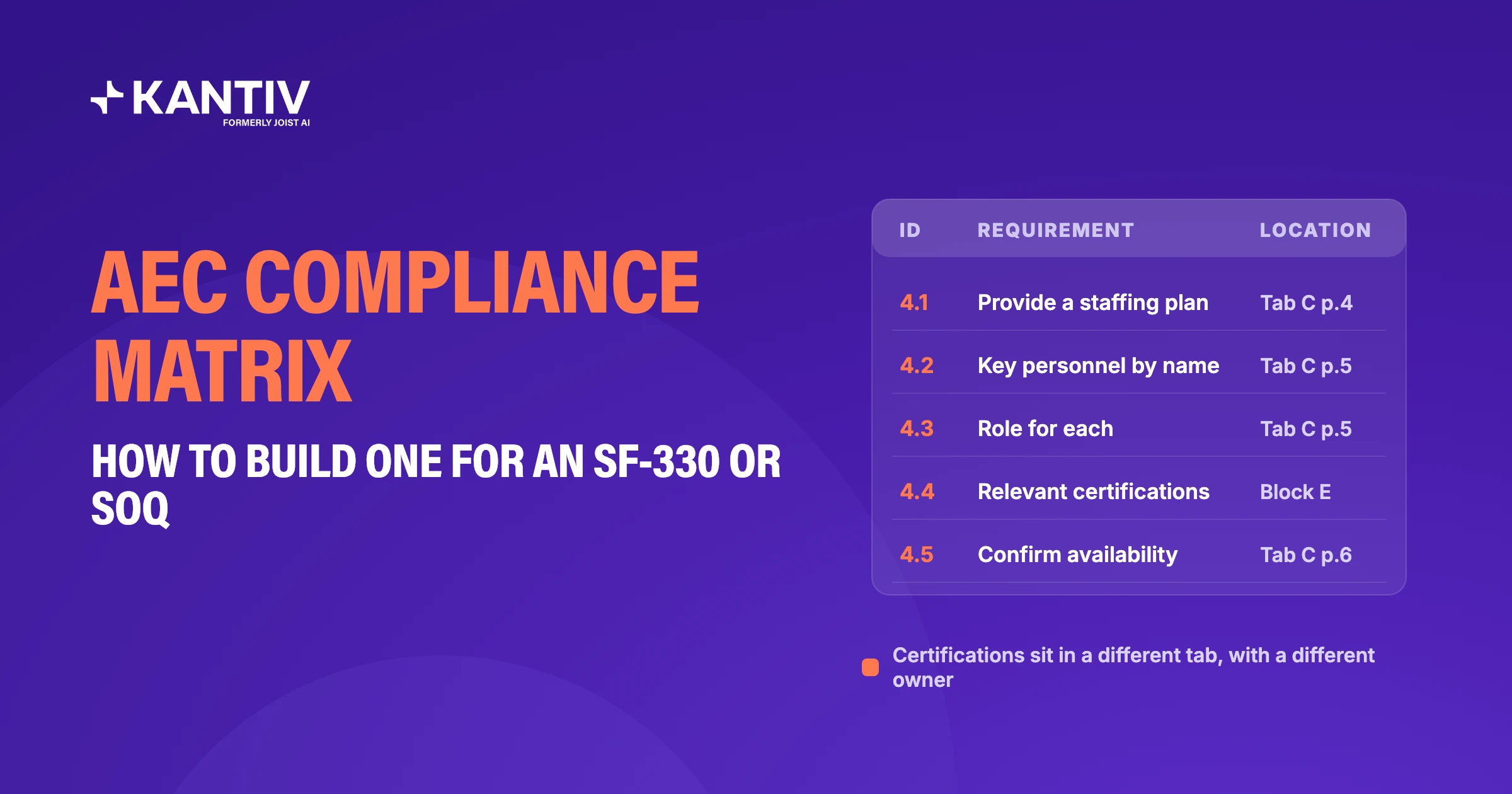
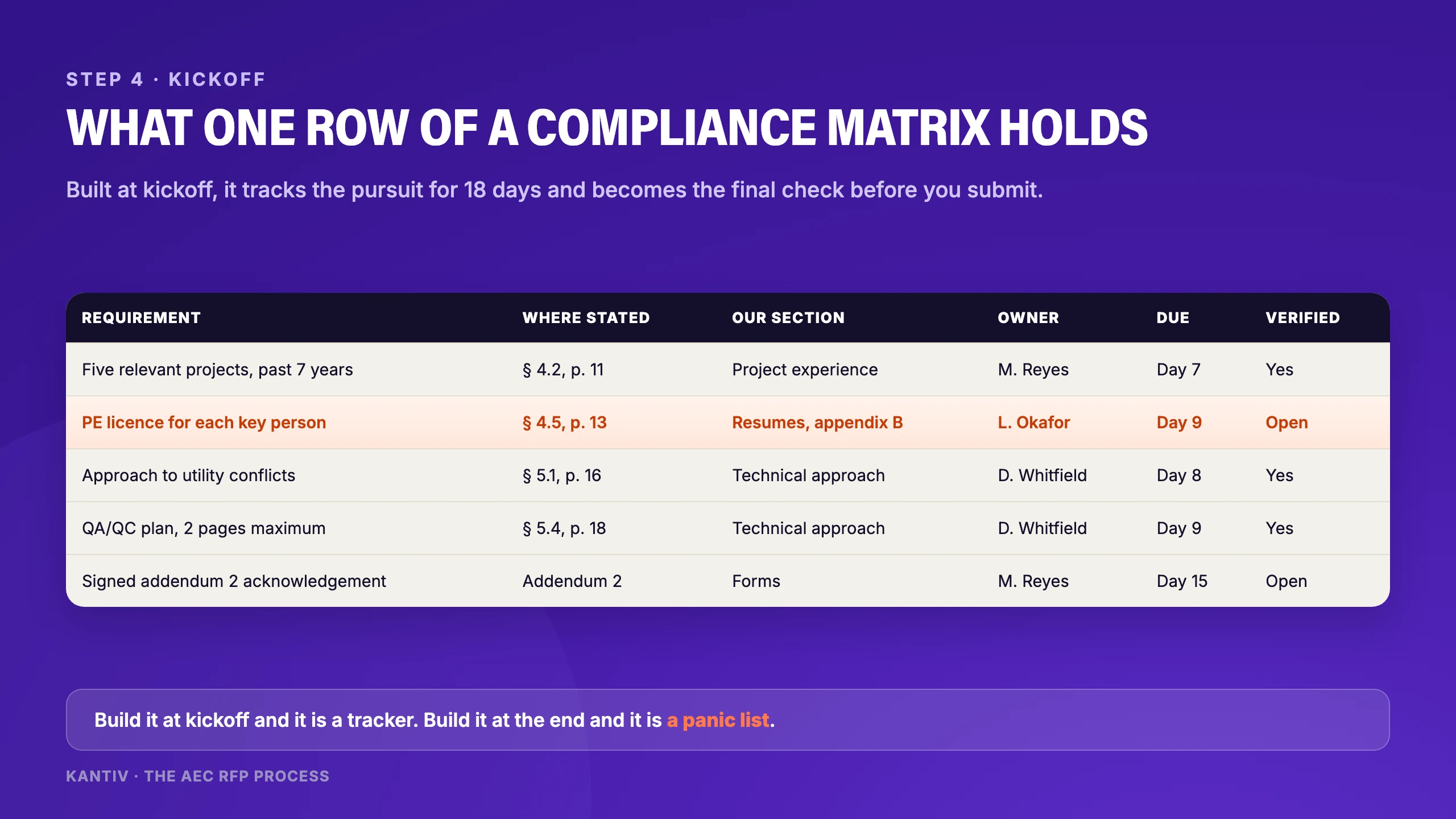
Build the compliance matrix from the intake record. For each requirement, include the solicitation reference i.e. source, where you plan to answer it i.e. response location, who writes it i.e. writer, when it’s due i.e. deadline, and whether anyone has checked it yet i.e. review status. Where the client published evaluation weights, record those as well, since they tell you which rows deserve the most effort. From that point, the matrix only earns its keep if it stays current, so an addendum that changes an instruction should change the matrix the same day.
Then, you agree on the proposal’s central arguments. Pick two or three win themes. Each should connect a client priority with a relevant strength and supporting evidence. An occupied hospital renovation might call for evidence of the proposed team’s experience maintaining clinical operations during construction.
With the themes settled, you can allocate the page count. Once mandatory section limits are satisfied, use evaluation priorities to guide the remaining space. That allocation then tells you what to go and gather: which graphics, project examples, and resumes need to be included in the first draft.
Close the meeting on dates: when drafts are due, when reviews run, who holds approval, and when you intend to submit. Contributors’ time should also be booked in the kickoff, while the schedule still has slack in it and before their week fills with billable work.
💡Kantiv’s Workspaces can bring the RFx, draft, compliance record, and collaborators together within a pursuit. It even allows you to assign tasks. The team still needs to agree who provides the evidence and who approves it.
Owner: Your proposal manager, with the pursuit lead responsible for strategy.
What this phase produces: A populated compliance matrix, agreed win themes, response outline, graphics plan, and named owners with deadlines.
Step 5: Build proposal content from verified evidence
Proposal writing starts with evidence rather than prose, because what makes your firm credible for a given RFP is the specific projects, people, and outcomes you present. The test for each is whether it answers a criterion the client published, not whether it happened to be in your last submission.
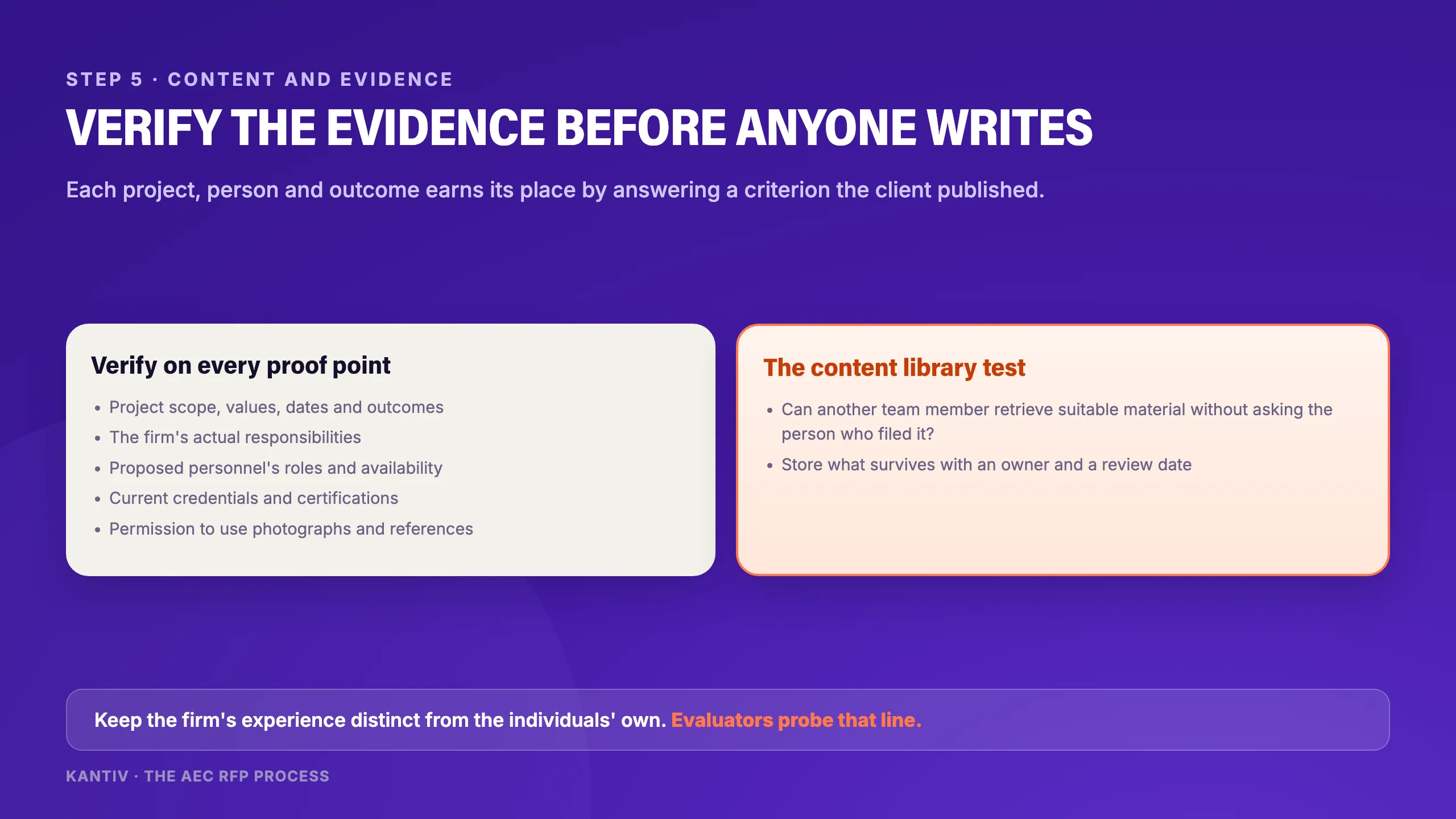
Gather projects, people, and outcomes that support the client’s criteria. Verify:
- Project scope, values, dates, and outcomes.
- The firm’s actual responsibilities.
- Proposed personnel’s roles and availability.
- Current credentials and certifications.
- Permission to use photographs and client references.
Take particular care to keep your firm’s experience distinct from the individuals’ own, since joint ventures and previous employers blur that line in ways an evaluator may well probe.
When technical input is missing, ask a narrow question. “How would we maintain emergency access during this phase?” gives a project manager a clearer assignment than “Please write the approach.”
Every major claim needs a proof point attached to it, whether that’s a comparable project, a team member’s role on it, a documented outcome, or a client willing to take the call. Visual evidence needs scrutiny too. Check which project an image depicts, what it demonstrates, and whether it is approved for use.
Anything that survives this process should be stored with an owner and a review date, so the next pursuit can reuse it without re-checking it.
A 2024 survey by OpenAsset found that 77% of respondents store existing proposal content in previous proposals, while only 36% report a searchable, tagged database. Reuse is normal; the challenge is finding current material and confirming that it supports the claim you want to make, which is the exact problem we describe in the AEC proposal content black hole.
A prospect team described the scramble when its sole proposal lead is unavailable. Historical content exists, but colleagues cannot find it quickly enough under deadline pressure. That is a useful test of a content library: can another team member retrieve suitable material without asking the person who filed it?
💡Kantiv’s Workspaces helps you get started by suggesting the appropriate evidence, so you don’t have to scramble. Image Intelligence makes it easy to find the right images, with 5 ways to search for an image, explicit tags for approved images and usage history for every image.
Owner: Section owners develop content; the proposal manager coordinates delivery and technical leads validate accuracy.
What this phase produces: Complete section drafts, relevant project examples, current resumes, verified facts, and suitable images supporting the response’s main claims.
Step 6: Review compliance, technical substance, and clarity
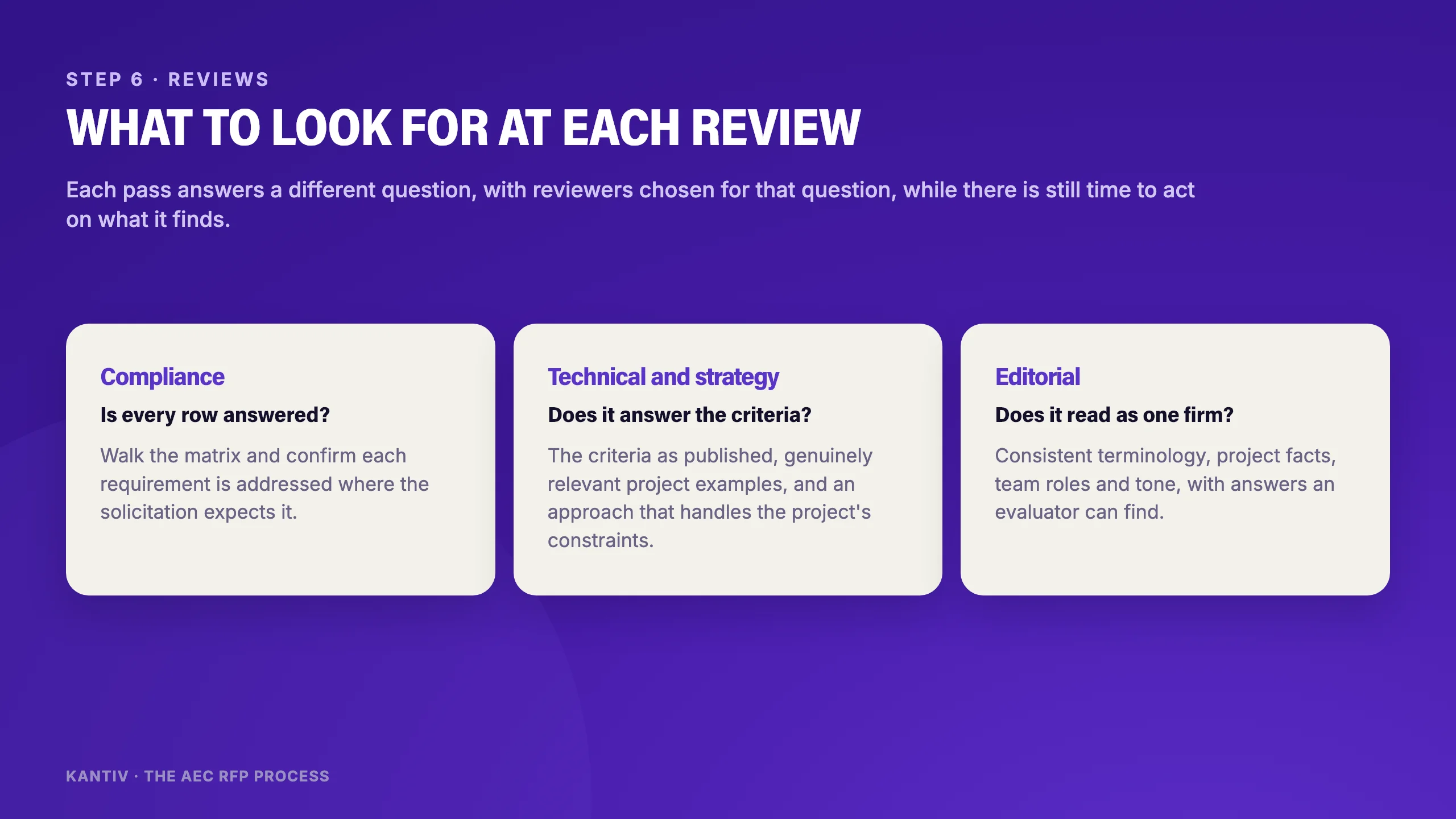
Reviews only help if they run while there’s still time to act, which is why they go in the calendar at kickoff. Each pass should answer a different question, with reviewers chosen for that question.
Compliance review: Start it while the draft is still taking shape. Walk every requirement against your matrix, forms and attachments included. Does the response address each requirement in the correct location? Are forms, attachments, and addendum instructions accounted for?
Technical and Strategy review: What you need to check here: Does the response address the criteria as published? Are your project examples genuinely relevant? Does the approach explain how your team will handle the project’s constraints?
Editorial review: An editorial pass then makes the whole thing read as one firm, reconciling the small contradictions that creep in when four people write four sections. It’s also the moment to make headings and graphics work for an evaluator who is hunting for specific answers. Ask: Are terminology, project facts, team roles, and tone consistent? Can an evaluator find the requested answers easily?
💡Did you know, Kantiv’s Brand Agents can help you easily and consistently apply your brand standards across proposals with the click of a button, and line everything up for you to approve or reject.
Make sure to keep one comment log throughout, with an owner and a disposition against every material issue, and route conflicting feedback to the pursuit lead rather than letting two reviewers negotiate it in the margins. Automated checks can carry some of this, but a named person should still verify the response before it goes.
💡Customers using Kantiv’s Workspaces describe its 3 step RFx analysis (including compliance checks) as an established and useful part of their workflow, where the platform identifies and flags requirements needing attention.
Owner: The proposal manager coordinates; technical, strategy, and compliance reviewers assess their respective areas.
What this phase produces: A reviewed response with material issues resolved and final approvals recorded.
Step 7: Check the designed document and final submission files
A customer’s observation about AI drafting captures a familiar production problem: getting to a Word document leaves substantial work for the person building the proposal in InDesign. Paragraph and character styles need attention. Images need resizing and placing. Captions, tables, resumes, and page limits affect how much content fits.
Start production while the draft develops. Set up templates, test representative pages, and involve the designer before every section reaches its maximum word count. Layout changes also deserve compliance review. Because during an edit, as paragraphs get shortened to fit, project examples can move, and a required detail can disappear.
Our tip: Generate the final files and inspect those, because layout shifts during export and linked graphics or fonts don’t always survive it.
Run the check while there is time to revise. Then inspect the exported submission files:
- Confirm page counts and required sections.
- Check for missing text, graphics, or font problems.
- Verify signatures, forms, and attachments.
- Confirm filenames, file sizes, and accepted formats.
- Recheck requirements affected by late edits.
💡The Kantiv InDesign plug-in lets teams access proposals created in Workspaces and drag them into the layout. It also checks the InDesign document against an RFx already analyzed in Kantiv’s web platform. Its report groups subsections as non-compliant, partially compliant, or compliant. Reviewers can filter findings, inspect feedback and references, and follow page links to the corresponding sections. The report can also be downloaded as a text file.
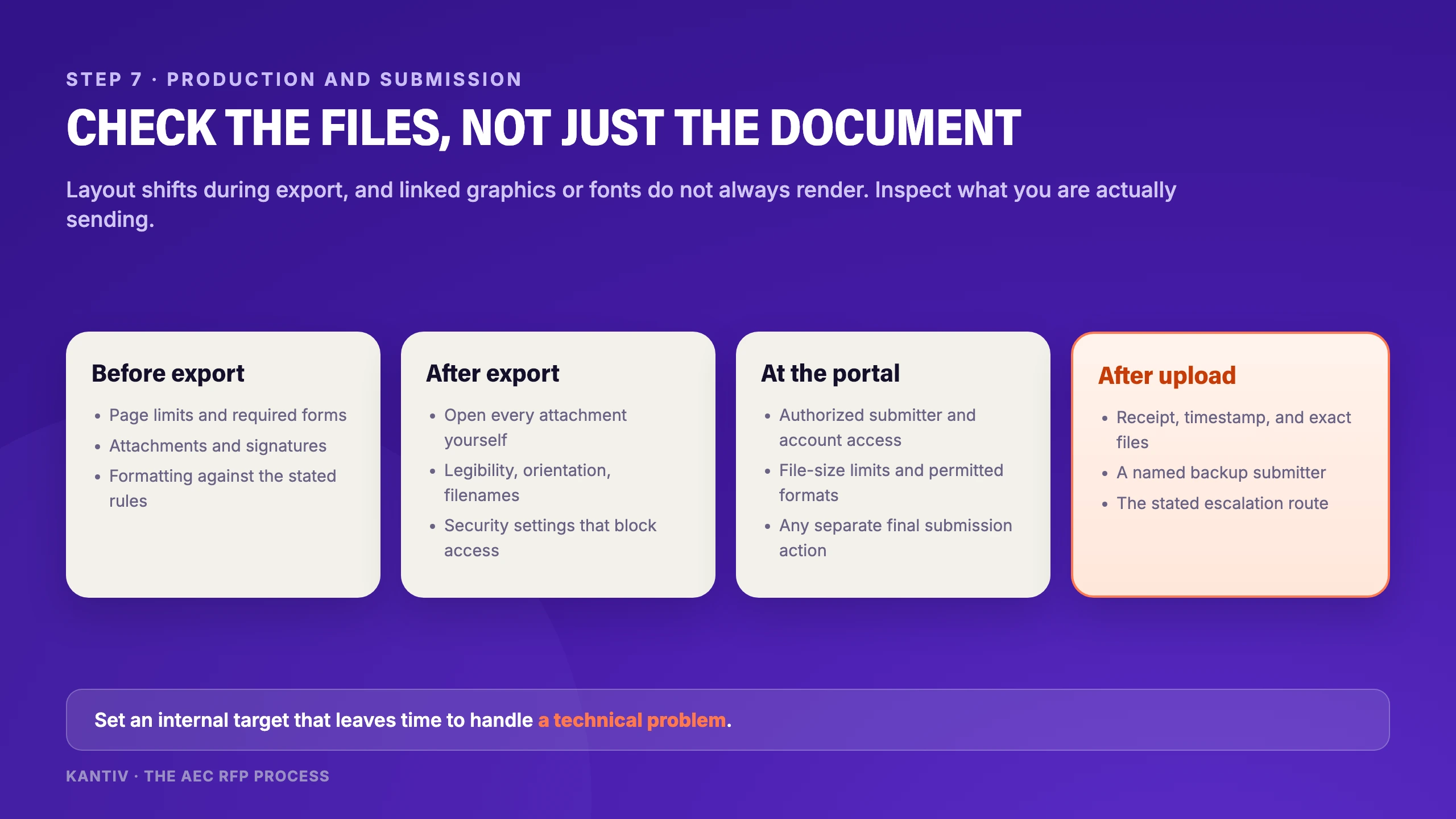
Set an internal submission target with room for upload or access problems. Name an authorized submitter and a backup.
After uploading, complete any separate submission action the portal requires. Save the confirmation, timestamp, and exact files submitted.
Owner: Your production lead, proposal manager or designated authorized submitter.
What this phase produces: A complete checked submission response, delivery confirmation, and an archived copy of exactly what the client received.
Step 8 (if applicable): Prepare the proposed team for the shortlist interview
Where the procurement includes a shortlist interview, it deserves to be run as its own step. The invitation is where that starts, since it sets the format, the duration, who may attend, what materials are permitted, and how the conversation will be scored.
The key to any shortlist interview is building your presentation around the project and questions the client still needs answered. Where the written proposal establishes your qualifications, the interview should make extremely clear how your team thinks, judges, and works together.
Project-specific scenarios keep the discussion concrete. On an occupied facility, that might mean walking through how the team would coordinate access or respond to a shutdown risk.
Give the proposed project manager and technical leads clear speaking roles. Rehearse transitions, follow-up questions, and how the team will respond when it needs to confirm a fact.
Use rehearsal to uncover weak answers. If the team cannot explain a proposed approach clearly, revise it before the interview.
💡You can prompt Kantiv Chat (or use pre-set prompts) to help prep your team for an upcoming interview. You can ask it to provide possible questions and coaching notes based on the RFP and previous proposals.
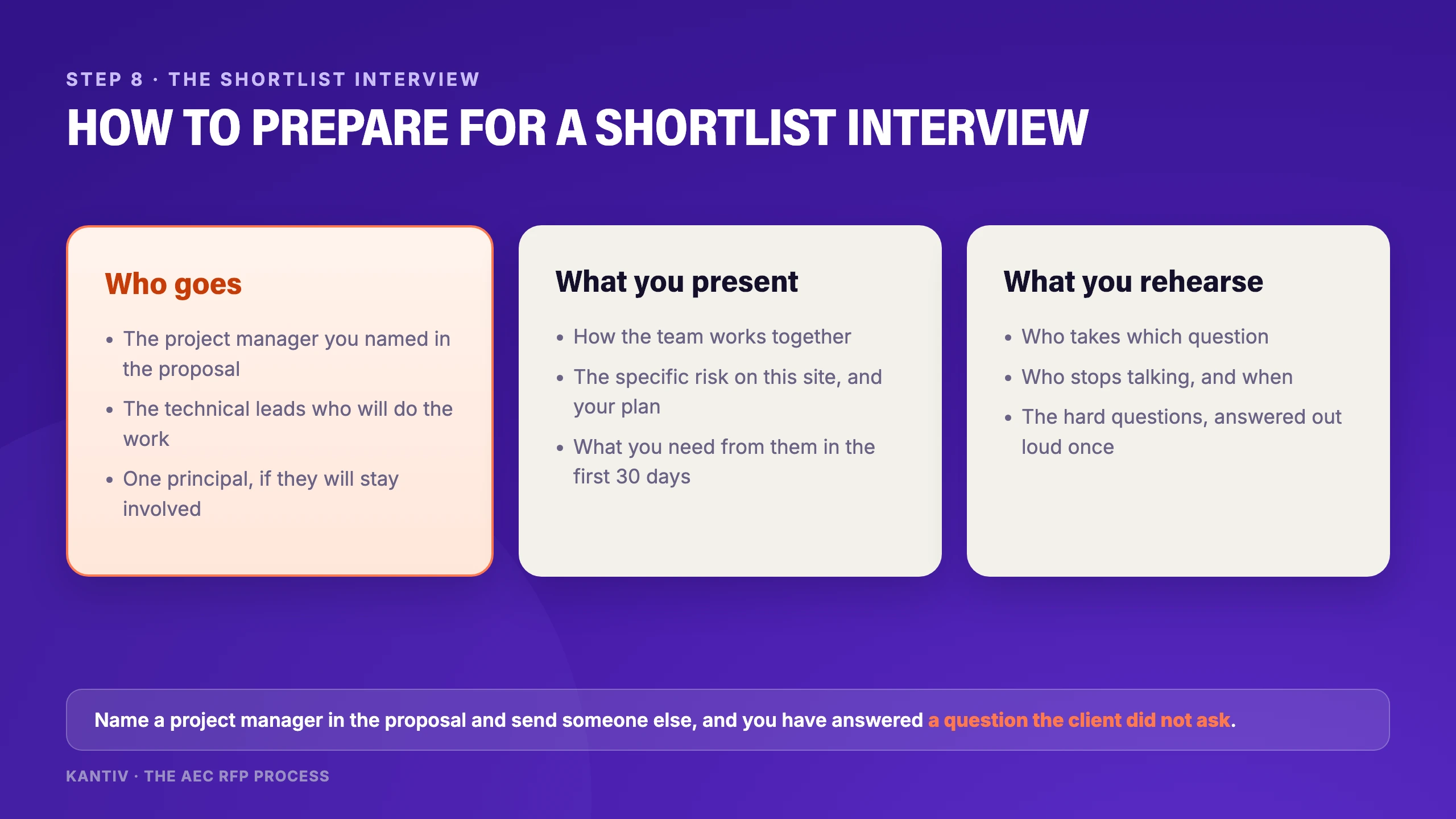
Owner: The pursuit lead, with the proposed project manager and interview team.
What this phase produces: A rehearsed, project-specific presentation, clear speaking roles, and a shared plan for answering difficult questions.
Step 9: Use the pursuit debrief to improve the next response
A good debrief or closeout produces changes your next pursuit can actually use. The best firms run their internal review immediately after submission or interview while it’s fresh, then add client feedback when the result lands.
The information that comes back in a debrief typically varies a lot, so be sure to record everything–scores, strengths and weaknesses–and keep it separate from your team’s interpretation of it. Then, review both the pursuit decision and the response:
- Did the opportunity fit the firm’s capabilities and capacity?
- Which evidence was difficult to obtain?
- Where did contributors lose time?
- What changed late?
- Which concerns surfaced during the interview?
- What should the next team do differently?
Assign improvements. A missing project record needs an owner. A recurring submission problem needs a process change. A useful technical explanation needs to become retrievable content.
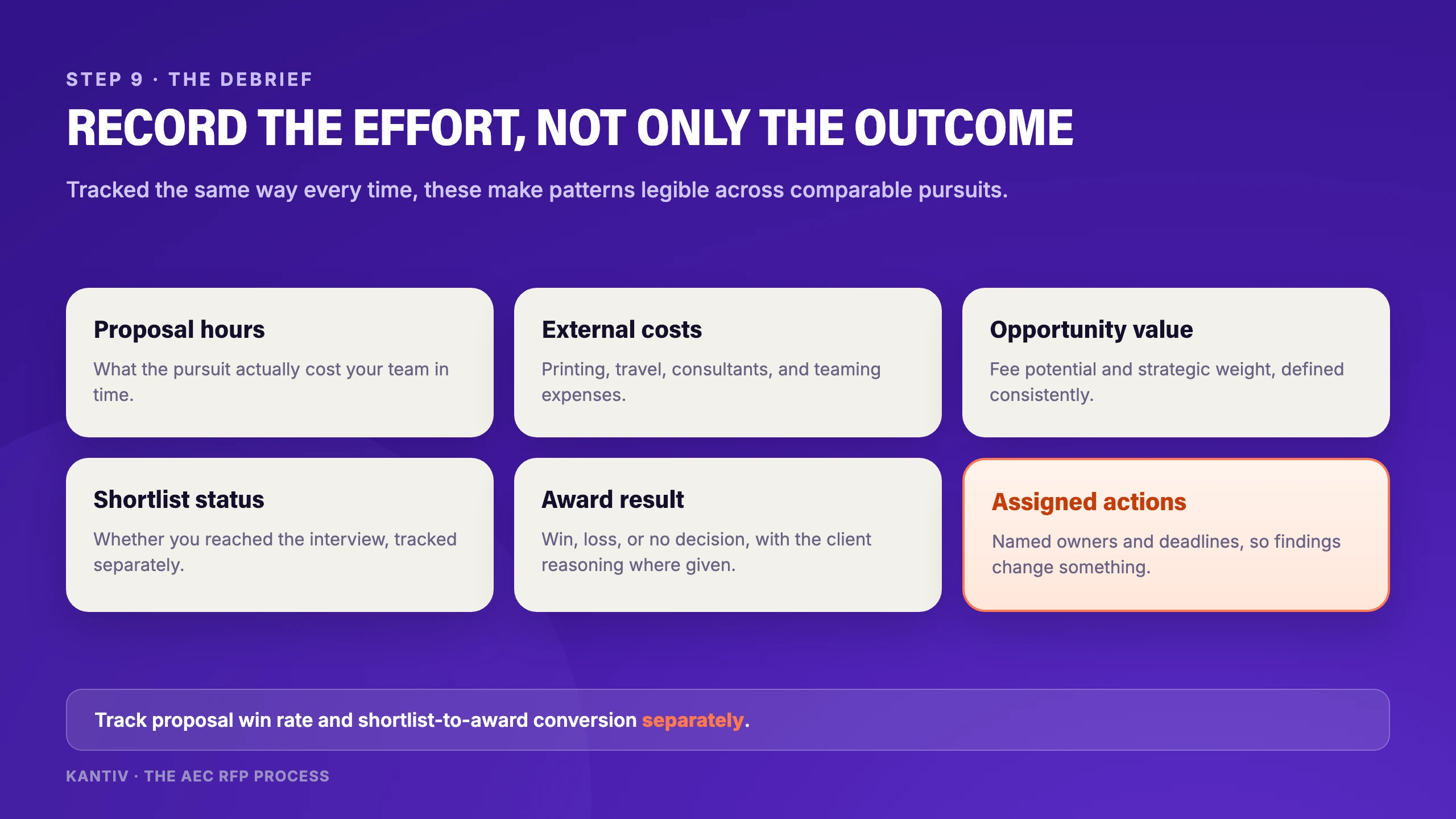
Capture the effort alongside the outcome, recording proposal hours, external costs, shortlist status, award result, and opportunity value the same way every time so the numbers stay comparable. Win rate and shortlist-to-award conversion should be held as separate figures, because an improvement in one step will otherwise mask a problem in the other.
Patterns tend to matter more than instances. A single loss may show you a fixable gap, but if, for instance, you’re experiencing repeated losses in one market point, you may need to change your qualification criteria. On a win, document the client’s stated reasons without assuming every proposal choice contributed equally.
None of this counts until the actions have named owners and deadlines against them, and until your content library and go/no-go framework carry whatever the findings warrant.
💡Kantiv’s Data Collection agents can help close the loop and follow up with SMEs to gather missing information, debriefs or context and the Kantiv platform synthesizes all of this information to make your next pursuit stronger.
Owner: The pursuit lead, supported by the proposal manager and business development team.
What this phase produces: A pursuit record, documented lessons, and assigned improvements that inform the next opportunity.
An example AEC proposal response schedule
This example assumes an 18-calendar-day response window. It is a planning illustration, not an industry standard. Adjust for weekends, holidays, mandatory meetings, contributor availability, and the solicitation.
| Day | Phase | Owner | Must be true by the end |
|---|---|---|---|
| Before day 1 | Pre-positioning | BD and principal | Client priorities known, solicitation expected |
| Days 1 to 2 | Intake and three reads | Proposal manager | Requirement list, submission calendar, questions drafted |
| Day 2 | Go/no-go | Pursuit sponsor | Decision recorded, resources committed |
| Day 3 | Kickoff | Proposal manager | Matrix populated, owners named, win themes agreed upon |
| Days 3 to 10 | Content and evidence gathering and drafting | Section owners | Every section drafted, every claim evidenced |
| Days 10 to 14 | Technical, strategy, and editorial reviews | Independent reviewers | Material issues resolved, approvals recorded |
| Days 14 to 17 | Production | Proposal manager | Formatted, forms signed, files named |
| Day 17 | Submission | Authorized submitter | Uploaded, confirmed, receipt saved |
| Throughout | Addenda monitoring and early compliance review | Proposal manager, compliance reviewer | Instructions current, matrix updated, Requirements tracked against the matrix |
| After submission | Internal debrief | Pursuit lead | Lessons captured, client feedback added later |
| If shortlisted | Shortlist interview | Pursuit lead | On the client's schedule, if required |
How to prepare for your next RFP
Every phase above assumes you can lay hands on what you need. Most of the time lost in a pursuit isn't spent writing; it's spent retrieving information. If you want to be ready for the next RFP, prepare these four things in advance:
- Resumes. They go stale fastest. Everyone you're likely to propose needs a current resume, with a project list reflecting what they've actually been doing lately and a clean line between their own experience and the firm's.
- Project records. Correct contract values, accurate dates, current certifications, and a photograph you have the rights to publish. These need validating rather than just collecting.
- Reusable material. Capability statements, safety records, methodology language, and the standard firm descriptions that turn up in some form in every submission.
- Your own pursuit history. Proposal hours, external costs, shortlist status, award result, and the value of the opportunity. Define those terms once and hold to them.
Choose one recent proposal and ask a colleague to find its approved project descriptions, current resumes, selected images, and submission requirements. Notice where they need help. Those points identify preparation work worth prioritizing.
Maintain reliable records for frequently cited projects, current resumes for commonly proposed staff, usable images with clear rights, and pursuit records that capture effort and results.
Kantiv supports this work through searchable firm knowledge, automatic tagging and data collection via Agents, Image Intelligence, and Workspaces. Chat makes all of this information usable. And during production, Kantiv Companion brings selected images and RFx compliance checks into InDesign.
One customer reported a 62% increase in proposal volume and credited Kantiv with helping its team handle workload it otherwise could not have managed.
If your proposal volume is growing, book a Kantiv demo to see where your team could save time on content retrieval, coordination, and compliance checks.
FAQs
What are the phases of an AEC RFP process?
Nine, running from pre-positioning before the solicitation exists, through intake, the go/no-go decision, kickoff, content and evidence, reviews, production and submission, the shortlist interview, and the debrief. Not every procurement includes all of them. An RFQ may stop at qualifications, and plenty of solicitations never reach an interview.
How long does an AEC firm have to respond to an RFP?
The solicitation sets it, and it varies by client and project type. The examples here use an 18-day window because it is a common shape for public work, but treat any schedule as a planning target rather than a standard.
Who should own the RFP process at an AEC firm?
Day to day, your proposal manager or marketing coordinator. The go/no-go belongs to a pursuit sponsor or principal with authority to commit resources, and the shortlist interview belongs to the pursuit lead.
What is a compliance matrix, and when should you build it?
It is a row for every requirement in the solicitation, carrying where that requirement is stated, which section of your response answers it, who writes it, when it is due, and whether anyone has verified it.
What is the difference between an RFP and an RFQ?
An RFQ asks for qualifications and usually comes earlier in the procurement, while an RFP asks how you would approach the work and often carries pricing. We cover the distinction properly in our guide to RFP vs RFQ.