Found the content on this page useful? Share it with your team!
AEC Statement of Qualifications: How to Make the Shortlist

.png)
Table of Contents
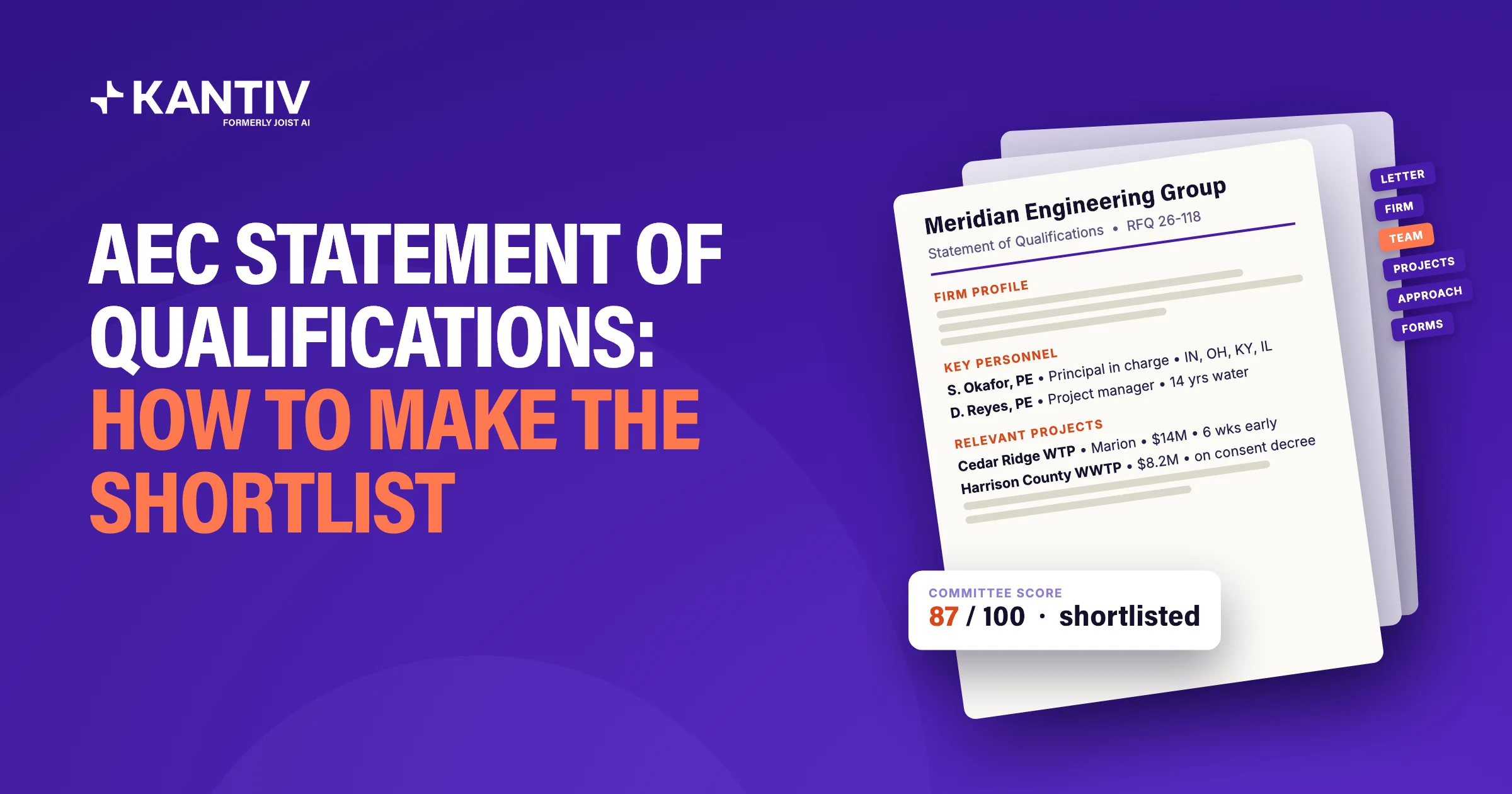
Quick scenario: A regional water authority publishes an RFQ for a $30M water treatment upgrade. Your firm has delivered four similar projects in the past. You have three weeks to respond, a published criteria table, and a 15-page limit.
To make the shortlist, you need a statement of qualifications (SOQ): a focused package that proves your firm and proposed team are qualified for this specific opportunity.
Most firms already have much of the proof somewhere within their project files, resumes, proposal archives, and business systems.
The challenge? Finding the right evidence from your institutional knowledge and shaping it into a response that an evaluator can score quickly.
In this guide, we'll walk you through what a statement of qualifications is in AEC, how owners commonly evaluate one, what belongs in each section, and how firms can keep the content current enough to do it again next month.
What is a statement of qualifications in AEC?
An SOQ is a qualifications package submitted in response to an RFQ or similar solicitation. A public owner uses it to evaluate which firms are qualified for the work and, in many procurement models, which firms should advance to interviews, discussions, or the next stage.
An SOQ commonly presents:
- Relevant projects and specialized experience
- The proposed team and each person’s role
- Technical qualifications and professional registrations
- Capacity and availability
- Past performance, references, and measurable outcomes
- Local knowledge, teaming, and required certifications when requested
- The firm’s approach to the project or known risks when the solicitation asks for it
The format is solicitation-specific. Many responses are searchable PDFs submitted through an online portal or email, but the RFQ controls the page limit, file requirements, appendices, forms, and delivery method.
Where your SOQ sits in the selection process
First, a moment to discuss the sequencing of how and when the SOQ arrives, because it shapes how you write. The sequence varies by owner and procurement method, but a common public-sector pattern is:
- An owner publishes an RFQ or qualifications-based solicitation.
- Firms submit their qualifications packages by the stated deadline and method.
- An evaluation panel or board scores the responses against the published criteria.
- The owner shortlists the number of firms stated in the solicitation.
- Shortlisted firms may then be asked for a fee proposal, an interview, or both. On federal Brooks Act procurements, fees are negotiated after qualifications-based selection; state and local rules vary.
- The owner proceeds according to the applicable procurement model.
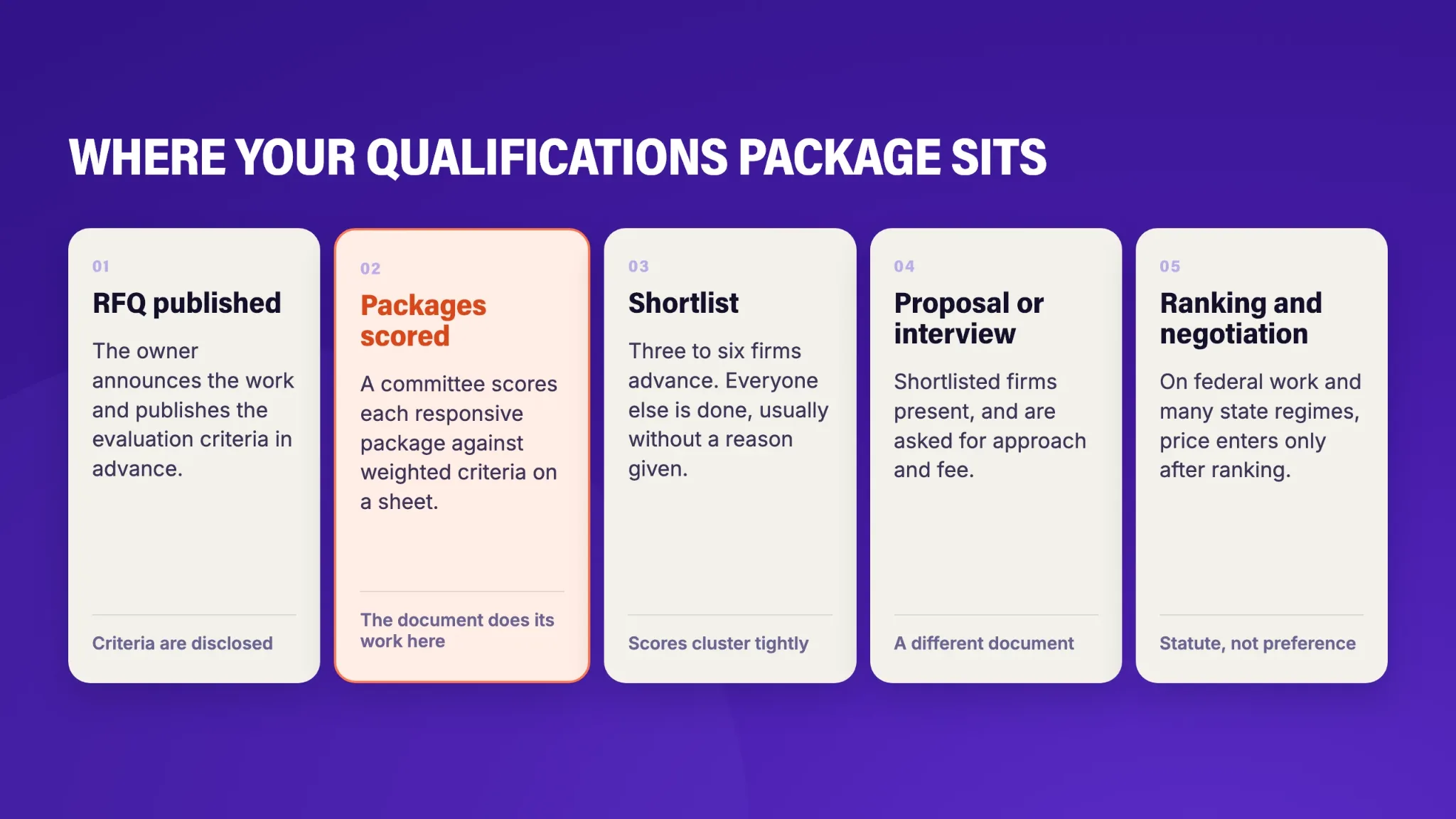
Because* winning* the work happens in the round after it, your qualifications package has one specific job: earning you the right to compete. And because it's read by people working through a stack against a scoring sheet, it pays to treat your SOQ as a compliance document that is also judged on quality and is easy to score.
How your statement of qualifications gets scored
The solicitation you receive publishes its own evaluation criteria, weights, page limits, and submission instructions. This functions as a literal roadmap to qualify your firm, so you should read it before anything, including this blog post. Treat it as your source of truth
Typically, a committee of evaluators scores your package against weighted criteria, listed in order of importance. On federal design work, those criteria are set by FAR 36.602-1, and most states run their own version of the same list.
While each RFQ is different, the shape is generally consistent enough to plan around. Many public AEC solicitations evaluate some combination of the following:
| Common criterion | What the evaluator is testing |
|---|---|
| Professional qualifications | Whether the proposed people have the registrations, credentials, and experience required for the work |
| Specialized experience and technical competence | Whether the firm has delivered similar scope, complexity, delivery method, and owner type |
| Capacity to perform | Whether the proposed team can staff the work now and sustain it through delivery |
| Past performance | Whether prior work demonstrates quality, schedule discipline, cost control, and client satisfaction |
| Location and local knowledge | Whether the team understands the jurisdiction, stakeholders, permitting environment, and operating context |
| Project understanding and approach | Whether the response identifies the project’s real risks and offers a credible way to manage them |
| Diversity, inclusion, or local participation | Whether the team satisfies solicitation-specific participation or workforce requirements |
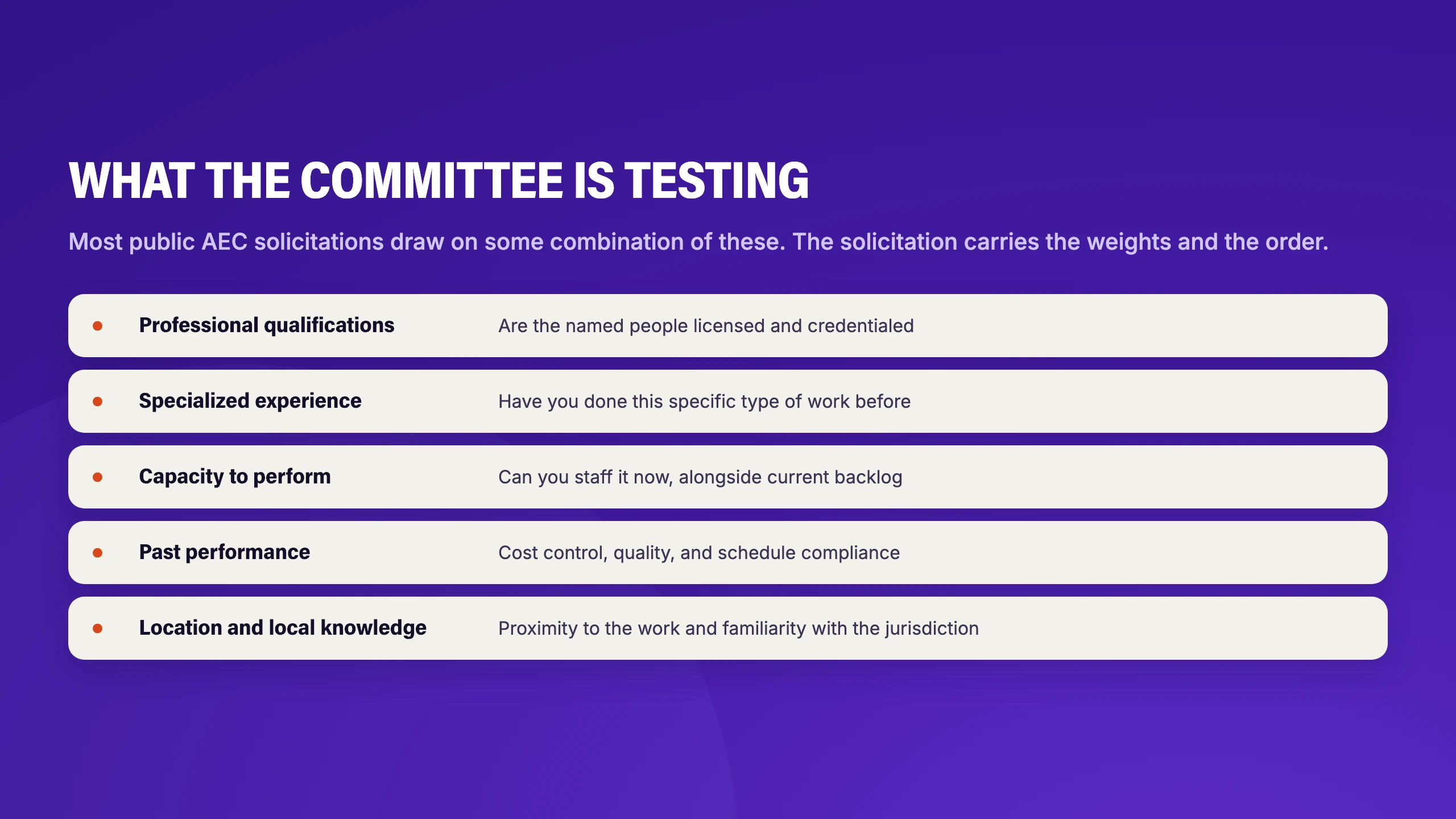
The criteria, weights, and order vary widely. So we recommend turning the owner’s evaluation rubric into a writing plan before drafting.
For each criterion, identify:
- Weight or points: how much it matters
- Evidence needed: the projects, people, credentials, or outcomes that prove it
- Source owner: who will find and verify that information internally
- Proposed section/page: where the evidence will appear in the SOQ
Example of that could look like:
Capacity to perform (criterion) → 20 points (weight) → current backlog + available project manager (evidence) → Operations (source) → Team/Capacity section, page 6 (section/page)
Most submitting firms are qualified. The practical advantage often comes from being more specific, more relevant, and easier to evaluate, not from making the broadest claims.
Compliance comes first
A strong SOQ can still fail if it misses a mandatory requirement. At kickoff and again before submission, confirm:
- Deadline, time zone, delivery method, and portal requirements
- Page limit and whether appendices, covers, resumes, or forms count
- Required forms, certifications, signatures, and acknowledgments
- File format, naming convention, bookmarks, page numbering, and accessibility requirements
- Prequalification or licensing status when required
- Entity eligibility and any joint-venture or teaming requirements
- Required small-business, DBE, MBE/WBE, local, or workforce commitments
- Addenda acknowledged and all questions answered
- Named personnel available and authorized to be proposed
Pro tip: Treat this as a pass/fail gate, not as a generic checklist. Some requirements are purely administrative; others affect responsiveness, eligibility, or scored qualifications. Use the solicitation’s language.
It also helps to have a colleague who didn't write the package do the second pass.
A note on how Kantiv helps here. Kantiv not only helps teams find the right project and personnel evidence, it also supports submission compliance: tracking required sections, forms, page limits, addenda, signatures, and source verification. It does not replace procurement review, but it can reduce avoidable misses before submission.
What belongs in an AEC statement of qualifications
We've covered where your package sits and how it's judged. So what actually goes in it?
The exact structure should follow the solicitation. But this can be a useful working outline:
| Section | What goes in it | Why it scores |
|---|---|---|
| Transmittal letter, if requested | One page. The solicitation number, the scope in the owner's own words, the named contact, and a signature from an officer authorized to bind the firm. | Establishes compliance and gives the evaluator a clear opening |
| Firm profile | Relevant services, registrations, prequalification status, office locations, and the office that will staff the work | Establishes eligibility and local delivery capability. Name the office doing the work, because evaluators weigh a local office that appears on the org chart differently from one that shows up on the project. |
| Team and key personnel | Each proposed person with their registration, role, project responsibilities and availability t, and the projects from your relevant list they personally delivered. | This is where professional qualifications get scored. A resume connected to a project in your own project list carries more weight than one that stands alone. |
| Organizational structure | Org chart, subconsultants, reporting lines, and decision rights | Shows who is accountable and how the team will operate |
| Relevant projects | Similar scope, owner type, delivery method, geography, value, dates, role, and measurable outcome | Supplies the evidence behind specialized experience |
| Approach and project understanding | Project-specific risks, stakeholder considerations, delivery plan, and mitigations | Demonstrates judgment rather than generic capability. The one section where you say something that isn't already in your record, which makes it the section where specificity shows most. |
| Capacity and availability | Current workload, named availability, continuity plan, and ability to meet milestones | Makes staffing claims credible |
| Past performance and references | Client outcomes, references where permitted, and relevant performance data | Reduces perceived delivery risk |
| Required forms and certifications | Certifications, affirmative action documentation, insurance, and anything the solicitation names. | Protects responsiveness and eligibility |
For every project claim, try to make the evidence checkable: exact role, scope, contract value, dates, delivery method, client type, location, outcome, and referenceability. Do not include a project merely because it is large; include it because it proves a scored criterion.
Make the evaluator’s job easy
Evaluators often work through multiple responses against a scoring sheet. Design for verification under time pressure:
- Mirror the solicitation’s headings and numbering.
- Put the highest-weighted evidence first, within the solicitation’s structure.
- Use consistent project and personnel names throughout.
- Connect each proposed person to the projects they personally delivered.
- Put outcomes next to claims rather than burying them in narrative.
- Use a one-page team/project snapshot when the solicitation allows it.
- Avoid unsupported superlatives such as “unmatched” or “best in class.”
- Make every required item findable without forcing the evaluator to hunt.
SF-330, the federal standard form
On federal design work, your qualifications package has a standard form, the SF-330. This form is distinct and has its own specifications, so if your firm pursues federal work, get used to filling these out.
Part I is the project-specific package. Part II is the firm-level form agencies keep on file. Importantly, the SF-330 carries constraints that shape how firms think about their entire qualifications library:
- Section F caps the relevant projects you may present, commonly at 10.
- Section E caps how many of those projects can appear under any one person, commonly at five.
- Section H is for additional information requested by the agency and may include project approach or other material not covered elsewhere.
These constraints are actually useful, because they force a decision about which evidence carries the submission. In essence, this is the same decision a strong state or municipal package makes: pick the projects that prove this particular scope.
To make sure your SOQ adheres to these constraints, work down the criteria table in order. If specialized experience carries the most weight, for example, and the scope is water treatment, a water treatment project you finished last year does more than a larger project in another sector. If locality is scored, a modest local project earns more than a flagship one four states away. If capacity is scored, lead with work delivered by people who are available now. And so on.
What changes by buyer type
Luckily, SF-330 doesn’t require a holistic content overhaul. The content stays largely the same across buyer types. The packaging does change, though, and does so meaningfully.
| Buyer | What is required | What changes |
|---|---|---|
| Federal design work | The SF-330, on a prescribed form with numbered sections and hard caps | Format is fixed, so your judgment goes into which evidence to select. Part II may already be on file with the agency. |
| State DOT and agency prequalification | A standing package that qualifies the firm by work category, renewed on the agency's cycle | It covers the firm for a category of work. Keep it current and you stay eligible for every pursuit in that category. |
| Municipal, institutional, and private | A free-form response shaped entirely by the RFQ's own criteria list | The criteria table is your outline. Mirroring its headings and numbering is what evaluators expect, and it makes scoring easy for them. |
Do not assume one agency’s prequalification category maps directly to another’s. Keep content organized around reusable facts (scope, role, delivery method, geography, outcomes, and credentials), then map those facts to each solicitation’s taxonomy.
For example: state prequalification categories often don't line up with each other. A firm prequalified for "bridge design" in one state may map onto "structures" in the next and "highway engineering" in a third, so the same services have to be re-filed against a different taxonomy each time. All the more reason to keep your content organized, and ready to deploy in these different use cases.
How to win more without chasing more
We’ve talked at length in this post about the baseline requirements to produce a strong qualifications package. Now, let’s talk about what our actual goals are.
The industry-wide picture is telling right now in AEC. Proposal volume across 900 firms rose 32% in a single year, while the median win rate fell slightly to 49%. Capture rate dropped to 44.4%. That is all to say: firms are submitting more, and they’re converting less.
So the goal isn’t just to produce a better qualifications package. It's to win more of the pursuits that make sense for your firm, while spending less time on the pursuits that don’t.
It’s hard to be selective if you don’t know exactly what proof you have to work with. Firms that can answer which of its 60 projects match a given scope with a given delivery method can make a real go/no-go call in an afternoon. Firms that can't, make decisions based on instinct, and often commit valuable time and resources to a pursuit before retrieving the right evidence.
To be more like the first type of firm, there are a few habits worth building:
- Keep project sheets current, one per project. Capture owner and owner type, contract value, delivery method, dates, the outcome with a number attached, a named reference, cleared photography. Write it at closeout, while the people who did the work still remember it.
- Map your people to the projects they delivered. Section E and Section F score together, and the SF-330's participation matrix exists to test that link. It also means any resume can be re-cut for a pursuit carrying the three most relevant projects on it.
- Run go/no-go against the scoring rubrix. If you can't name the projects that prove the top-weighted criterion, you've learned something in week one that you would otherwise learn in week three.
- Track capacity honestly. Record availability and expected workload, not just total headcount.
- Record why you won or lost. A shortlist decision you can explain carries to the next pursuit. The package itself doesn't.
- Version-control reusable content. Every value, date, title, credential, and outcome should have an owner and a last-verified date.
If you can consistently do all of the above, you’ll spend less time pulling information out of files, and more time on actual pursuit strategy.
How Kantiv can improve qualifications workflows
Being able to pull the right proof and knowledge out of your firm on the day a solicitation lands is key to winning the work. That’s exactly the job Kantiv was built for.
Kantiv structures your firm's projects, people, clients, and past pursuits into a Knowledge Graph so teams can search across the knowledge they already maintain. The value is not just retrieving a project sheet or resume; it is connecting the evidence, showing its context and provenance, and reducing the risk of using stale or contradictory claims.
Want to try it out? Book a demo to see it against your own project history.
FAQs
What is a statement of qualifications? For a design or construction firm, it's the qualifications package an owner requests through an RFQ to decide which firms make a shortlist. It presents the firm's relevant projects, the people who would deliver the work, and its capacity to take it on, scored against criteria the solicitation publishes in advance. Two other documents share the name: a California civil service job application, and a small business capability statement.
How is an SOQ different from an RFP response? An RFQ asks who you are and what you've done, and produces a shortlist. An RFP asks how you'd do this project and, usually, what it would cost. On federal design work and in states that mirror that model, price is separated from the qualifications stage entirely.
Is it the same as an SF-330? The SF-330 is the federal standard form for the same job. Part I is project-specific, Part II is the firm-level form agencies keep on file. State, municipal, and institutional owners usually ask for the same content without the form.
How long should an SOQ be? As long as the solicitation allows. Page limits are common and enforced, appendices are sometimes counted, and staying inside the limit keeps you in the scoring.
Which projects should I include when there's a cap? The ones that match the scored criteria, which usually means similar scope, similar owner type, similar delivery method, and staff who are still at the firm and available. Match to the criteria is what earns points.
Who actually reads an SOQ? Typically a small committee, often three to five people, working through a stack alongside their regular jobs, scoring against a sheet. Write for an evaluator finding and confirming things under time pressure.
What happens after the shortlist? Depending on the procurement, shortlisted firms may interview, present, participate in discussions, submit a technical proposal, negotiate fees, or proceed to another phase. The solicitation and governing procurement rules control the next step.