
Found the content on this page useful? Share it with your team!
RFP vs RFQ in AEC: Why Getting It Wrong Costs You The Shortlist

.png)
Table of Contents
Your principal leans over and says: "Can we add our project approach section here so they see how we would solve it?"
You are three days into an RFQ response. And just like that, a qualification submission starts turning into something else.
If you work in AEC marketing or business development, you have probably been in that room. The documents blur. The team moves fast. Someone drops a project approach section into an SOQ because it is sitting right there and it seems helpful. It is not. Not at this stage.
RFPs, RFQs, SOQs, RFIs: in everyday conversation, people treat them like variations on the same thing. They are not. Each one sits at a different point in the procurement sequence, asks for different evidence, and creates a different kind of risk when your team treats it like the wrong document.
The cost is not always obvious in the moment. But submitting the wrong content at the wrong phase can make an otherwise qualified firm look unresponsive, unfocused, or unprepared, costing you a shortlist position and erasing months of capture investment, relationship-building, and partner time that went in before the solicitation ever dropped.
RFP, RFQ, SOQ: understanding each RFx processes
The RFP vs RFQ distinction is not about complexity or length. They are phases in a sequence. The phase matters more than the level of detail.
Request for Information
The client or the agency is gathering information, trying to figure out the market: who is out there, what capacity exists, what delivery models firms use. Responding does not qualify your firm for anything directly. But for a target client, it shapes how they think about the landscape before the RFQ appears. Ignoring it because it does not count is a capture mistake.
Capture, in AEC, is the work your firm does before a solicitation is released: building relationships, understanding the client's priorities, and positioning your firm before the competition officially starts. The RFI is often your first real window into that.
RFQ (Request for Qualifications)
The RFQ is generally sent after the RFI phase closes, once the client has mapped the market and is ready to evaluate specific firms. It is the client's formal request for proof such as relevant experience, key personnel, past performance, and capacity. In a qualifications-based process, price is not the deciding factor here and should not be.
SOQ (Statement of Qualifications)
Your firm's response to the RFQ. The client issues the RFQ. You submit the SOQ. One is the question. The other is your answer. People use them interchangeably in conversation, but they are not the same object.
RFP (Request for Proposals)
The RFP is the document that solicits a project-specific proposal from shortlisted firms. This is where the response becomes project-specific: your understanding of the client's goals, technical approach, work plan, team roles, schedule, risk, quality management. For federal A-E work under QBS, fees are negotiated after selection, not before.
How the RFP process and RFQ sequence works
For most public-sector AEC work, the path looks like this.
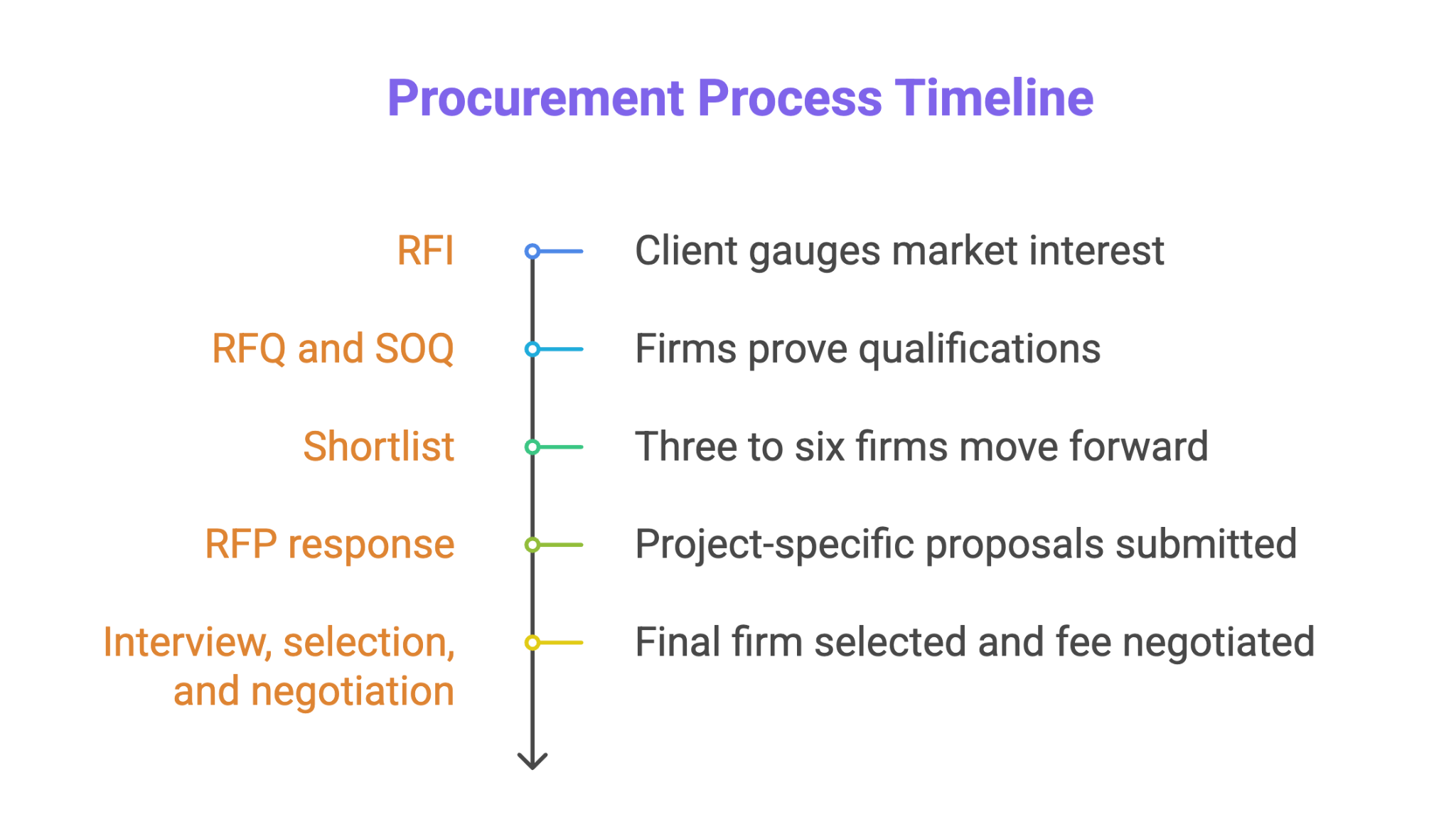
RFI: The client gauges market interest. Some agencies skip it entirely. For large or technically complex projects, it is more common. If the client matters to your firm, the RFI is worth your time.
RFQ and SOQ: The client asks firms to prove they are qualified. Your SOQ gets evaluated against published criteria: comparable project experience, key personnel, past performance, capacity. The evaluators are building a shortlist. Not picking a winner yet.
Shortlist: Usually three to six firms move forward.
RFP response: Now it gets project-specific. Two firms with nearly identical qualifications often get separated here, on specificity alone.
Interview, selection, and negotiation: In QBS-based federal work, the highest-ranked firm negotiates a fair and reasonable fee. If that falls apart, the client moves to the next firm.
Each phase has a job. The content of your response should match that job, not the one that comes next.
Why public-sector AEC separates qualifications from price
For federal architect-engineer services, this comes from the Brooks Act, a federal law passed in 1972 requiring government agencies to select A-E firms based on qualifications rather than price. The framework it established is reflected in FAR Subpart 36.6.
The logic holds up. A cheaper fee can produce higher total project costs if the work is poorly scoped, poorly coordinated, or misaligned with what the owner actually needs long-term. QBS puts demonstrated competence first, then negotiates a fair price with the most qualified firm.
For your team, the practical translation is this: keep fees, hourly rates, multipliers, and cost structures out of the SOQ unless the solicitation explicitly asks for them. Treat fee strategy as its own discipline, not something to fold into a qualifications response.
Private-sector clients often compress the sequence, asking for qualifications, approach, schedule, and fees in one document. That is their prerogative. But for public-sector AEC work, reading the solicitation's procurement model is not optional. It is the first thing you do.
What an SOQ is actually doing
An SOQ answers one question: is this firm qualified to do this type of work for this type of client?
It is mostly backward-looking. Past projects. Personnel credentials. References. Client history. Proof of capability. A proposal is forward-looking. It uses the project scope, client priorities, risk profile, and delivery constraints to make an argument about future performance.
That distinction should shape every page.
One marketing director described it this way: her team kept getting feedback that their SOQs felt heavy. After reviewing a few submissions, the problem was clear. Every SOQ had a full project execution narrative buried inside it. Evaluators were scoring qualifications criteria and having to dig through scope descriptions to find what they actually needed.
The team was not doing anything wrong exactly. They just did not understand what the evaluator was actually scoring. The fix was not better writing. It was understanding what belonged in the document and what did not.
If your SOQ reads like a project execution plan, that is the problem right there.
What belongs where
| Element | SOQ | Proposal |
|---|---|---|
| Firm overview and history | Yes, brief and relevant | Brief, only if it supports the project story |
| Relevant past projects | Yes, breadth and pattern | Yes, specific comparables |
| Key personnel resumes | Yes, credentials and relevance | Yes, role-specific fit for this project |
| Technical approach | Usually no | Yes |
| Project-specific understanding | Usually no | Yes |
| Fee or cost information | No for QBS unless requested | Depends on procurement |
| Client references | Yes | Sometimes |
| Project delivery methodology | Briefly, if requested | In depth |
The evaluator reading your SOQ is building a shortlist. A 40-page SOQ packed with scope narratives and project-specific org charts does not signal thoroughness. It signals that your team either did not read the solicitation carefully or does not understand what is being evaluated at this stage. Neither is a good look.
The mistakes that cost firms shortlist spots
Treating the SOQ like a proposal
The most common error, by a distance. Picture an evaluator working through a scoring matrix for twenty firms. They are looking for comparable project experience and key personnel credentials. Instead they find three pages on how your firm would manage the construction schedule. That content is not wrong. It is just in the wrong document, and now the evaluator has to excavate past it to find what they are actually scoring.
Skipping early market signals
For a target client, that is a missed capture window. RFI responses shape the procurement and put your firm in the client's awareness before the formal process opens. If you have never treated the RFI as a relationship-building tool, that is worth reconsidering.
Submitting generic SOQ content
An SOQ for a water authority pump station program should not feel assembled from transit and airport project sheets because those were easiest to find. Relevance is almost always a scored criterion. Evaluators notice when a firm is stretching.
Over-relying on firm reputation
Your firm might be well known. That still does not move the needle if the qualifications response does not map to what evaluators are scoring. They work from a matrix. They score what is on the page.
Misallocating pages to criteria weights
Most solicitations publish how heavily each criterion is weighted. If key personnel carry 40% of the score and your team gives that section half a page, the response is misallocated before anyone reads the prose. Those weights are your content brief. Use them.
Treating the shortlist as the finish line
The SOQ gets you into the room. The RFP, interview, and negotiation are where the pursuit is actually won.
What evaluators look for at each phase
At the RFI stage, evaluators are mapping the market. They want to know who is active, who has capacity, and what delivery questions they should be thinking about before the formal solicitation releases. A useful, credible response serves you here. A sales pitch does not.
The RFQ/SOQ stage is scoring-matrix work. Comparable project experience, key personnel qualifications, past performance, capacity. Your job is to score against those criteria, not to impress a general AEC audience. Two very different things.
RFP is notably more nuanced than the RFQ. It is no longer about whether you can do the work. It is "will this firm do this work well for us?" That is where firms with nearly identical qualifications get separated. Specificity wins. So does showing you have actually thought about this client's constraints, not just the project type.
How firms that win consistently approach it
They do not treat each phase as a disconnected writing sprint. They treat it as a connected sequence, and they start earlier than most.
At the RFI phase
At this phase, they participate when the client matters. They read the questions as signals. What is this owner uncertain about? What are they trying to figure out before they release the RFQ? That is intelligence. The firms that act on it show up to the SOQ phase with a head start.
At the RFQ/SOQ phase
At this phase, they build from organized data. Not from six project managers hunting through old folders the week before the deadline.
The SMPS Foundation's 2026 Emerging Trends research found that the next phase of AEC firm evolution will not be defined by new trends alone, but by how firms navigate the gap between awareness and execution.

One BD director put it plainly: the firms that consistently make shortlists are not always the most talented. They are the most prepared before the solicitation drops.
At the shortlist-to-RFP transition
At this stage, they treat the pre-proposal conference as intelligence gathering, not a calendar obligation. They ask questions that reveal they have already thought hard about the client's constraints. The proposal narrative starts before the full scramble begins.
At the RFP phase
In this phase, they write for the evaluator. What does this client care about most? What risk are they trying to avoid? What has gone wrong on similar projects, and what does this team's track record say about that?
The advantage across all phases is the same thing. Accessible institutional knowledge. And here is what most firms do not say out loud: they do not lose shortlist positions because they lack good projects. They lose them because the right projects are not findable when it counts. The comparable experience exists somewhere in the firm. The right personnel credentials are in someone's inbox. The past performance data is buried in a folder no one can locate at 11pm the night before submission.
That is the actual problem. Kantiv is built around it: a system that connects your firm's project history, personnel records, past performance, and pursuit data so it is organized and accessible before the solicitation drops, not reconstructed under deadline pressure.
Summing up
Your principal's instinct was not wrong. Showing how your firm thinks is often exactly what wins the work. The question is when to show it, and in which document.
RFPs, RFQs, SOQs, and RFIs are different instruments for different phases of a procurement sequence. Firms that understand the sequence compete differently. They do not over-write the SOQ. They do not ignore the RFI. They do not wait until the RFP drops to start understanding the client's priorities.
The underlying advantage is organized firm knowledge, a pursuit team that understands what each phase is asking for, and the discipline to respond with the right evidence at the right moment. The principal leaning over three days in is not the problem. Not knowing what belongs in the document is.
FAQs
What is the difference between an RFP and an RFQ in AEC?
An RFQ asks firms to prove they are qualified: relevant experience, key personnel, capacity, past performance. Your firm responds with an SOQ. An RFP comes later, usually issued to shortlisted firms, and asks for a project-specific proposal. Under QBS, fees are not part of the qualifications response. They are negotiated after the most qualified firm is selected.
What is the AEC procurement sequence?
For most public-sector work, it runs: RFI → RFQ/SOQ → shortlist → RFP → interview and proposal → selection → fee negotiation → award. Each phase evaluates something different. Submitting the wrong content for the wrong phase is one of the most common reasons qualified firms miss shortlist positions.
What is an SOQ in AEC?
Your firm's formal response to an RFQ. Relevant projects, personnel credentials, past performance, references, capacity. Its job is to prove you are qualified, not to preview how you would run the project. If the solicitation does not ask for a technical approach, leave it out.
What is the difference between an RFQ and an SOQ?
The client issues the RFQ. Your firm submits the SOQ. Some agencies use different labels: pre-qualification package, Phase 1 response. The purpose is the same: prove the firm is qualified before the proposal phase begins.
Can we include fee information in an SOQ?
For public-sector QBS work, generally no. Keep fees, rates, and multipliers out unless the solicitation explicitly asks. For private-sector clients, read the instructions carefully. Some owners want qualifications and fees together in one submission.
Do we have to respond to every RFI from target clients?
No. But if the client is strategically important, skipping the RFI is usually a mistake. It shapes the eventual procurement and gives your firm an early window to show relevant experience before the RFQ drops.
What is a typical SOQ page limit?
It varies. Federal procurements often set firm limits, and SF-330-based submissions have strict section requirements. When no limit is stated, let the evaluation criteria guide your page allocation. A focused, criteria-mapped SOQ almost always outperforms a bloated one.
What happens if the scope changes after we make the shortlist?
Reassess internally and contact the client through the approved procurement channel. A scope change can affect team composition, project fit, fee strategy, or your go/no-go call. Do not retrofit the original SOQ narrative into a changed RFP. Adjust the pursuit to match what the client actually needs now.