
Found the content on this page useful? Share it with your team!
SF 330: What Federal Evaluators Actually Score

.png)
Table of Contents

A GSA evaluator has 22 SF-330 submissions to review before her Thursday panel meeting. Eight minutes per submission. She has been doing this for nine years.
She can tell within 90 seconds whether Section F is going to score well because:
Most SF-330s are compliant. Very few are competitive.
Let’s dive in to understand the difference.
What is SF- 330
The Standard Form 330 (SF 330) is the federal government's required qualifications document for architecture and engineering firms pursuing professional services contracts. Issued by GSA and governed by FAR Part 36, it replaced the SF-254 and SF-255 in 2004. Every federal agency procuring architect-engineer services uses it: GSA, Army Corps of Engineers (USACE), NAVFAC, VA, NPS, EPA, DOT, and dozens of others.
The form is standardized. The evaluation criteria and weights vary by solicitation.
It operates under the Brooks Act (Public Law 92-582), which mandates qualifications-based selection (QBS) for federal AEC services. QBS means your firm is evaluated and shortlisted on qualifications before any price negotiation begins. The most qualified firm negotiates a fair fee. If that falls apart, the agency moves to the next.
It is used two ways. For standing qualifications or IDIQ vehicles, agencies use Part II only to maintain pre-qualified firm lists. For project-specific solicitations, they issue a combined Part I and Part II. Part II covers ongoing firm qualifications, updated at least annually. Part I covers the project-specific submission and must be tailored to every solicitation. Never submit a generic Part I. Agencies can tell immediately, and it costs you.
The SF-330 is a qualifications document, not a proposal. Fees are not included. Its entire function is to answer one question: is your firm qualified for this type of work?
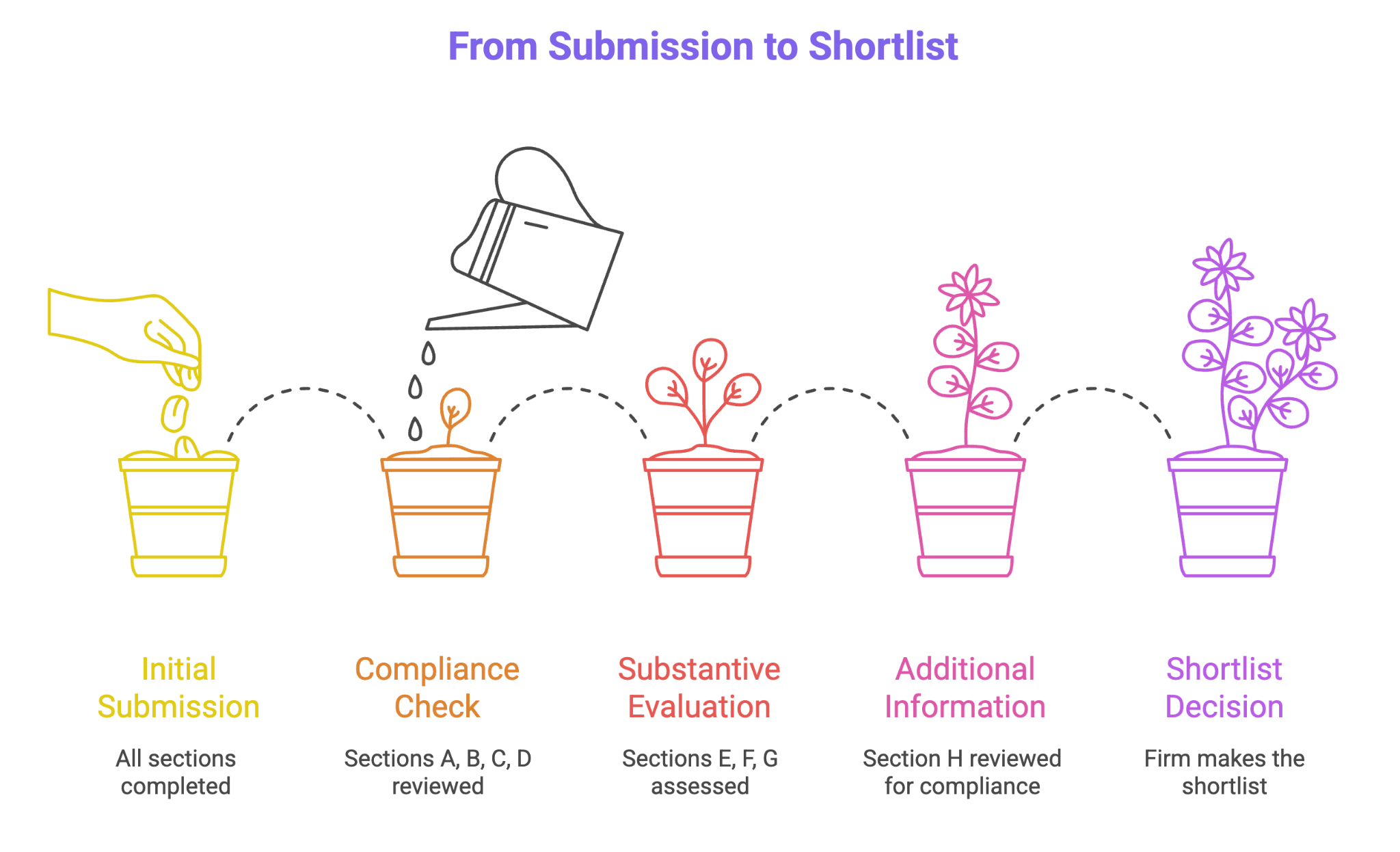
The seven sections and where scoring actually happens
Evaluators spend the overwhelming majority of their time on three sections: Section E (key personnel), Section F (relevant project examples), and Section G (key personnel participation). The others matter for compliance. These three determine whether your firm makes the shortlist.
Section A: Contract information
Project name, agency, solicitation number, submission date. Copy it directly from the solicitation. An error here signals carelessness before the evaluator has read a word of substance. Do not give them that opening.
Section B: Architect-engineer point of contact
Administrative. Use someone who can actually answer questions about the pursuit if the agency calls. A wrong number is an avoidable problem.
Section C: Team
Lists all firms involved, prime and subconsultants, with role, location, and small business status. Evaluators check whether your team covers all required disciplines and whether SB participation aligns with set-aside requirements. A team that does not address SB requirements either did not read the solicitation or is non-compliant.
Section D: Org chart
Evaluators spend 15 to 30 seconds here. Show the project manager at the top, key technical leads below, subconsultant relationships clearly. If they cannot understand who is responsible for delivery at a glance, that time is lost.
Section E: Tailored resumes of key members
One page per resume, five project examples per person maximum. Where the evaluation substantively begins. Most firms treat this as a biographical summary. Compliant. Not competitive.
Section F: Relevant project examples
Up to ten project examples, one page each. Where your firm wins or loses.
Section G: Personnel participation
A matrix connecting Section E personnel to Section F projects. Most teams fill this out wrong.
Section H: Additional information
Free-form: awards, certifications, QA/QC systems, safety records, and anything specifically requested in the solicitation. Read the solicitation before writing Section H. A common miss is past performance narrative. If the solicitation weights it at 25% and your Section H has one paragraph about quality management, you have conceded that criterion before the panel convenes.
Project experience: Where Section E goes wrong
Evaluators score two things in Section E: relevant experience and role match.
Relevant experience means has your proposed person done this type of work, at this scale, for this type of client. Role match means are you proposing them for a role they have actually performed, or are you leading with your most credentialed person because they look impressive on paper.
Your firm is not alone in over-relying on seniority as a proxy for qualification. It is the most common Section E mistake across the industry. A principal-in-charge with 30 years of experience but only five in the relevant discipline will score lower than a project manager with 12 focused sector years. Evaluators are scoring for the proposed role, not for general impressiveness.
They have seen firms propose principals to look credible, then staff the project with associates. They spot it quickly. Skepticism about rank-first resume selections is baked into every experienced evaluation panel.
Five things that move Section E scores:
- Lead with role-specific experience, not chronology. The first sentence of each resume should establish directly relevant credentials for the proposed role. Not a career arc. Not a firm introduction. Credentials for this role, on this contract type, now.
- Select project examples for role-specific participation. Your proposed project manager's five examples should all show project management leadership. Not the firm's portfolio with the PM listed somewhere on the team.
- Match proposed personnel to the solicitation's stated key personnel requirements exactly. If the solicitation requires a QA/QC Manager and your submission does not name one, you are non-compliant before the scoring starts.
- Include active registrations and licenses relevant to the project location. Pursuing work in Texas means noting Texas PE licensure explicitly. Evaluators check for jurisdictional compliance and notice when it is missing.
- Write to the evaluation criteria, not the resume template. If the solicitation lists LEED certification experience as a criterion, every relevant person's resume should address it directly. Do not assume evaluators will make the connection for you.
The Section F quality versus quantity problem
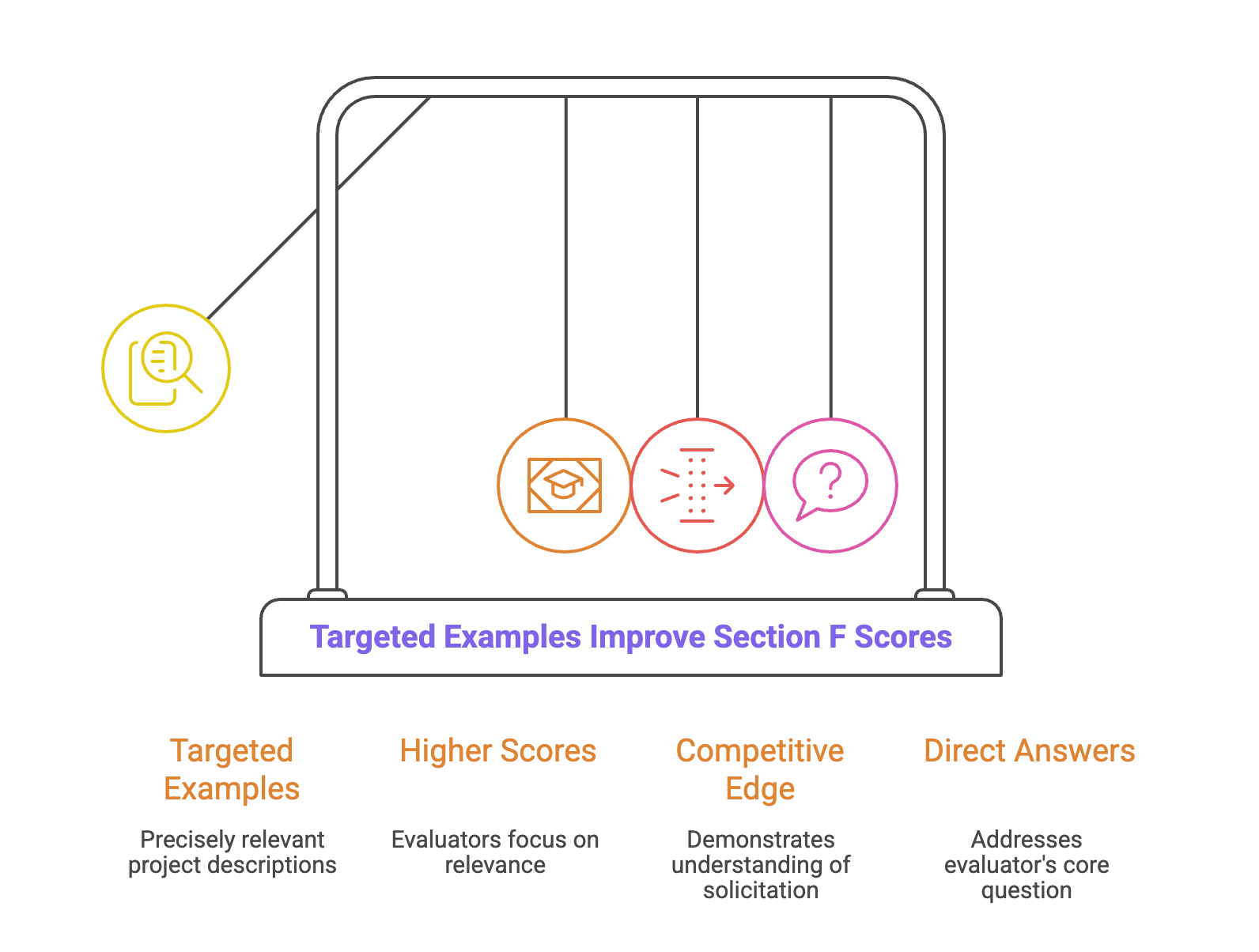
The page limit is ten projects. The instinct is to submit ten. The strategy is to submit the ten most relevant, which sometimes means fewer.
A Section F with eight precisely targeted examples will outscore one with ten generic ones. Evaluators are not scoring volume. A $500M airport terminal does not impress an evaluator procuring a $3M historic preservation study. It makes your firm look like it did not read the solicitation.
The competitive Section F project description has four components working together.
What the project was
A brief scope statement that establishes comparability with the solicitation: scope, scale, delivery method, client type. Not a brochure paragraph. The facts that make this project relevant to the one being pursued.
What made it challenging or comparable
The specific complexity or constraint that connects your past project to the current solicitation. This is the line most descriptions skip. It is also the line that separates compliant from competitive.
What your team specifically did
Active, specific description of your firm's role and contribution. Not "the firm provided design services." What design decisions were made, what problems your team solved, what your role was relative to the overall program.
What the outcome was
Schedule and budget performance, past performance data, or a specific measurable result the evaluator can point to.
The most common Section F error is describing the project instead of your firm's performance on it.
"The 200,000 SF mixed-use development included a 10-story residential tower and three levels of below-grade parking" tells an evaluator nothing about what your firm did or how well it did it.
"Our team designed a post-tensioned concrete transfer structure that resolved a 14-foot span conflict discovered during design development, delivering the project four weeks ahead of the client's phased opening deadline" tells them something they can score.
Write to one question: would your firm's experience from this project help you succeed on my contract? That is the question the evaluator is asking. Answer it directly.
Many solicitations also specify a recency window of five to seven years for project examples. Projects outside that window score poorly for past performance recency regardless of how strong the work was. If your most comparable project is older than the threshold, note what makes it relevant and supplement with more recent work even if it is less directly comparable.
How most teams fill out Section G wrong
The instinct: connect your proposed PM to all ten Section F projects to demonstrate their depth.
The result: evaluators see a pattern they have seen hundreds of times and assume the connections are overstated.
Evaluators trust specificity. They distrust omnipresence.
The competitive Section G shows your proposed PM directly leading six to eight projects where they were actually the project manager. Not "technical contributor." Not "team member." Project manager. It shows your lead engineer as engineer of record on the relevant technical projects, not listed as technical advisor. It uses honest role labels throughout: Project Manager, Technical Lead, Supporting Role.
Depth outscores breadth. Every time.
Some proposal teams have started using Section G as a go/no-go signal before committing to a pursuit. If your team cannot fill the matrix out credibly, your firm may not be as well positioned as leadership believes.
How federal evaluators score SF-330 submissions
Federal evaluation panels include three to five evaluators who score independently, then reconcile. The scoring language is standardized across agencies: Outstanding, Good, Acceptable, Marginal, or Unacceptable. Panel reconciliation surfaces where scores diverged before the group reaches consensus. The shortlist is typically the top three to six firms.
For most federal AEC procurements under FAR Part 36, evaluation weights run roughly as follows: professional qualifications of key personnel at 20 to 30%, specialized experience and technical competence at 25 to 35%, capacity to accomplish the work at 15 to 25%, past performance at 15 to 25%, and location as a variable that sometimes reaches 10 to 15% and is sometimes excluded entirely.
Your firm needs at least one or two criteria scoring Outstanding to make a competitive shortlist. Acceptable across the board rarely gets you there. That means identifying your strongest differentiators for this specific solicitation and concentrating your narrative there, not spreading effort evenly across all criteria.
The mistakes that cost firms shortlist spots
Most SF-330 mistakes are not made during writing. They are made before your team opens the form.
Submitting without reading the solicitation-specific instructions
Every solicitation customizes the SF-330 with its own format requirements, page limits, file specifications, and required content. Some require separate Part IIs from each sub consultant. Some require PPQs or CPARS as attachments. Treating it as a template to fill in rather than a form to respond to specifically means failing compliance checks before an evaluator reads a word.
Misaligned team composition
A proposed team that does not cover all scope disciplines signals your firm assembled it without reading the scope carefully. Particularly damaging in multi-discipline solicitations where sub-consultant selection should be strategic, not convenient.
Stale project examples
If your firm has not maintained its project library, you will find yourself pulling outdated Section F content that undersells current capability and scores poorly for past performance recency. Projects that were impressive seven years ago are not helping you today.
Unchecked client references
Evaluators contact references. A reference who is unreachable, does not remember the project clearly, or gives a lukewarm response can undercut an otherwise competitive submission. Confirm every proposed reference as willing and current before the proposal goes out. This step gets skipped more often than any other.
Misallocating pages to criteria weights
Your solicitation publishes the evaluation criteria and their weights. Spending four pages on firm history and half a page on key personnel when key personnel carry 40% of the score is a systematic points loss before a word of prose is read. Let the weights tell you where to spend your effort.
Why organized firm data wins more SF-330 competitions
The primary time cost in SF-330 assembly is not writing. It is retrieval.
Chasing project data from shared drives. Asking project managers to update resumes while actively billing to other jobs. Reconciling who actually worked on which projects in which roles. Verifying completion dates, contract values, and client contacts before they go to evaluators who will call those references.
One proposal coordinator at a mid-size civil and environmental firm put it plainly:
Every SF-330 started the same way. Two days of chasing before anyone wrote a word.
Project managers who did not have time. Contract values that did not match across systems. References nobody had confirmed in three years.
The firms that consistently make shortlists are not necessarily writing better Section F prose. They have better data. And because their data is accessible, they spend proposal effort on selection and strategy instead of archaeology.
When your project library is tagged by discipline, client type, sector, delivery method, and past performance outcomes, assembling Section F becomes a selection exercise. When your personnel records are current, Section E does not require chasing staff on active projects. When Section G mapping is driven by actual participation data rather than memory, it is accurate. And accurate Section G matrices are the ones evaluators trust.
This is the problem Kantiv is built around: your firm's project history, personnel records, past performance, and pursuit data organized and searchable before the solicitation drops. Surface the right project, the right person, and the right proof point in a few clicks rather than a Friday afternoon folder search. Assembly becomes strategy. Retrieval stops eating the week before every deadline.
Summing up
Go back to that GSA evaluator with 22 submissions and eight minutes per review. She is not reading for polish. She is reading for evidence she can score Outstanding against the criteria in front of her.
The SF-330 is a standardized form. It is not a standardized competition. Every solicitation has specific criteria, specific weights, and specific instructions that shape what a competitive submission looks like for that procurement.
Section F is where competitions are won or lost. Section E is where role match matters more than seniority. Section G is where honesty outperforms inflation. Section H is where most firms leave points on the table by not reading the solicitation carefully enough.
None of that requires a bigger team or more hours. It requires knowing what evaluators are actually scoring and having the data to back it up before the deadline hits.
FAQs
What is the SF-330 form used for in architecture and engineering context?
The Standard Form 330 (SF-330) is the federal government's required qualifications document for architecture and engineering firms pursuing professional services contracts. Issued by GSA and governed by FAR Part 36 (Public Law 92-582), it replaced the SF-254 and SF-255 in 2004. Required for federal A/E contracts under the Brooks Act and increasingly accepted by state and local agencies. Fees are not included. Its entire purpose is to answer one question: is your firm qualified for this type of work?
What is the difference between SF-330 Part I and Part II?
Part II covers your firm's ongoing qualifications for pre-qualification lists and IDIQs, updated at least annually. Part I covers the project-specific submission and must be tailored to each solicitation. Never reuse Part I as-is across submissions. Agencies identify generic responses immediately, and it significantly hurts your score.
What is Section F of the SF-330?
Section F contains up to ten project examples, one page each, demonstrating relevant experience, technical role, and past performance on comparable work. Evaluators score for relevance and specificity, not volume. The firms that score well write to one question: would your firm's experience from this project help you succeed on my contract?
How many project-examples should we include in Section F?
Up to ten, but relevance beats volume. Eight precisely targeted examples will outscore ten generic ones. Check the solicitation's recency window, typically five to seven years. Projects outside that window score poorly regardless of how strong the work was.
What do federal evaluators look for in Section E resumes?
Two things: relevant experience and role match. Has your proposed person done this type of work at this scale? Are you proposing them for a role they have actually performed? A project manager with 12 focused sector years will outscore a senior principal with impressive general credentials but thin relevance to the specific contract.
Why does Section G matter and how should we fill it out?
Section G connects your key personnel to your Section F project examples. Most teams inflate it by connecting everyone to every project. Evaluators distrust omnipresence and trust specificity. Show your proposed PM leading six to eight projects in a direct PM role, your lead engineer as engineer of record on the relevant technical work, and use honest role labels throughout. Depth outscores breadth every time.
How often should we update our SF-330 Part II?
At least annually for firms actively pursuing federal work, and immediately when key personnel change, major projects complete, or your firm structure shifts. A qualifications portfolio that gets older every month while competitors stay current is a liability you feel on every shortlist.
Where do firms submit SF-330 responses?
Federal SF-330 solicitations are posted on SAM.gov. Read the full synopsis before assembling your team. Submission methods, deadlines, and format requirements are all in there. The deadline is firm. Late submissions are not considered.