Found the content on this page useful? Share it with your team!
The 7 Best RFP Software Tools for AEC Firms (2026)

.png)
Table of Contents
Say the pursuit that decides your quarter is a qualifications package for a county water program, due in three weeks and scored by evaluators who weigh your project sheets and resumes before they read a line of your approach narrative. There's no 400-question portal form and no answer bank to mine. Everything you need to win it already sits somewhere in your firm. The problem is reaching all of it before the deadline runs out.
Here's the trap. The shortlist you'd assemble from the obvious names will be wrong for your firm, and not because those products are bad. Nearly every tool with a marketing budget in this category was built for a team that answers four hundred questions a quarter for procurement portals: security reviews, vendor questionnaires, sales RFPs. That team has a volume problem, and volume is what the software solves. Your problem is a different one. The evidence that wins your work exists, and you cannot reach it fast enough. No amount of answering speed fixes reaching.
So the category splits in a way the product pages never quite say out loud, and that split matters more to a firm doing qualifications-based selection than any feature list. This guide covers what RFP software actually contains, how to evaluate it when your proposals are SOQs and narrative Word documents, and where each of seven tools genuinely fits.
The two kinds of RFP software
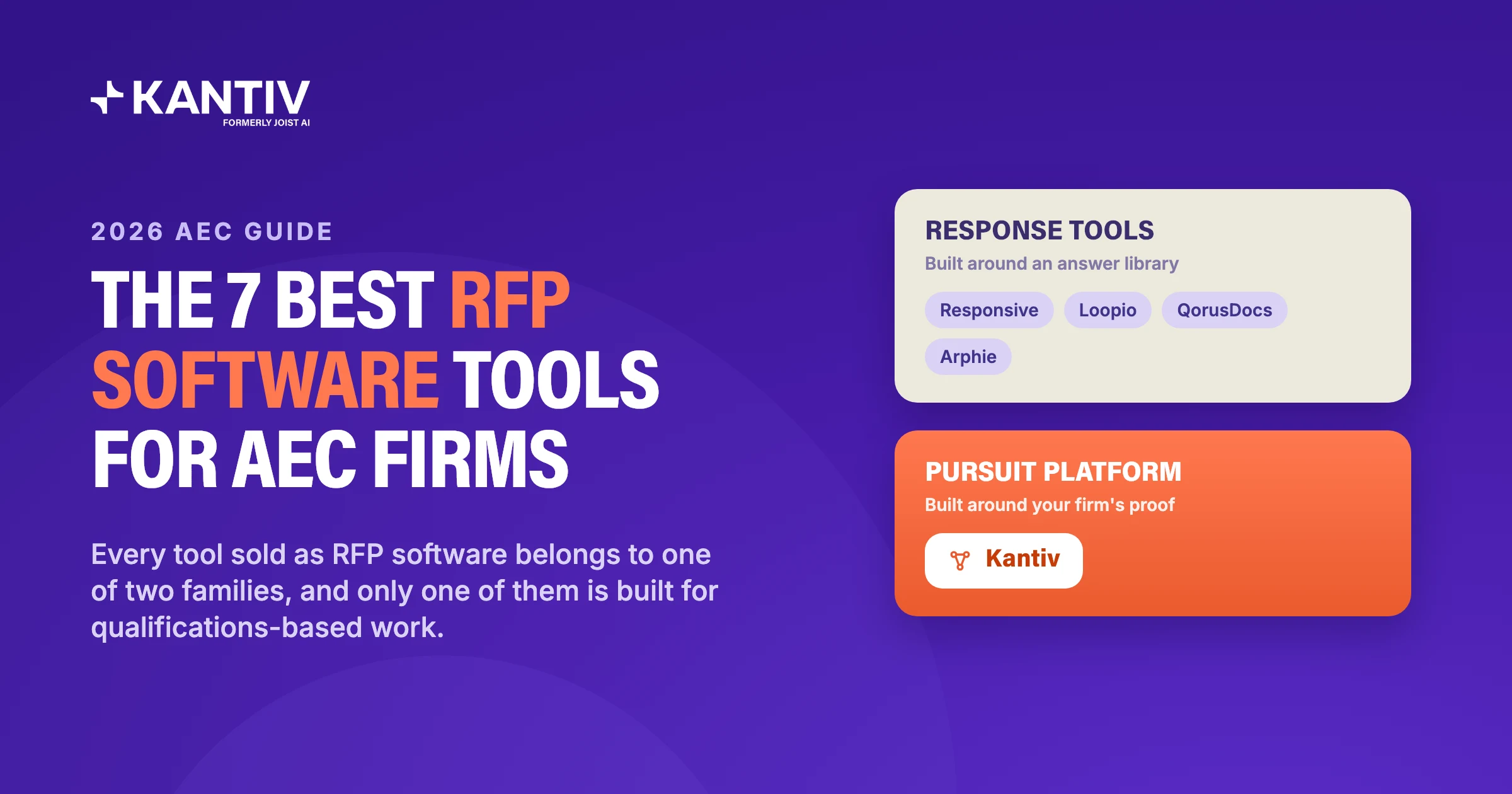
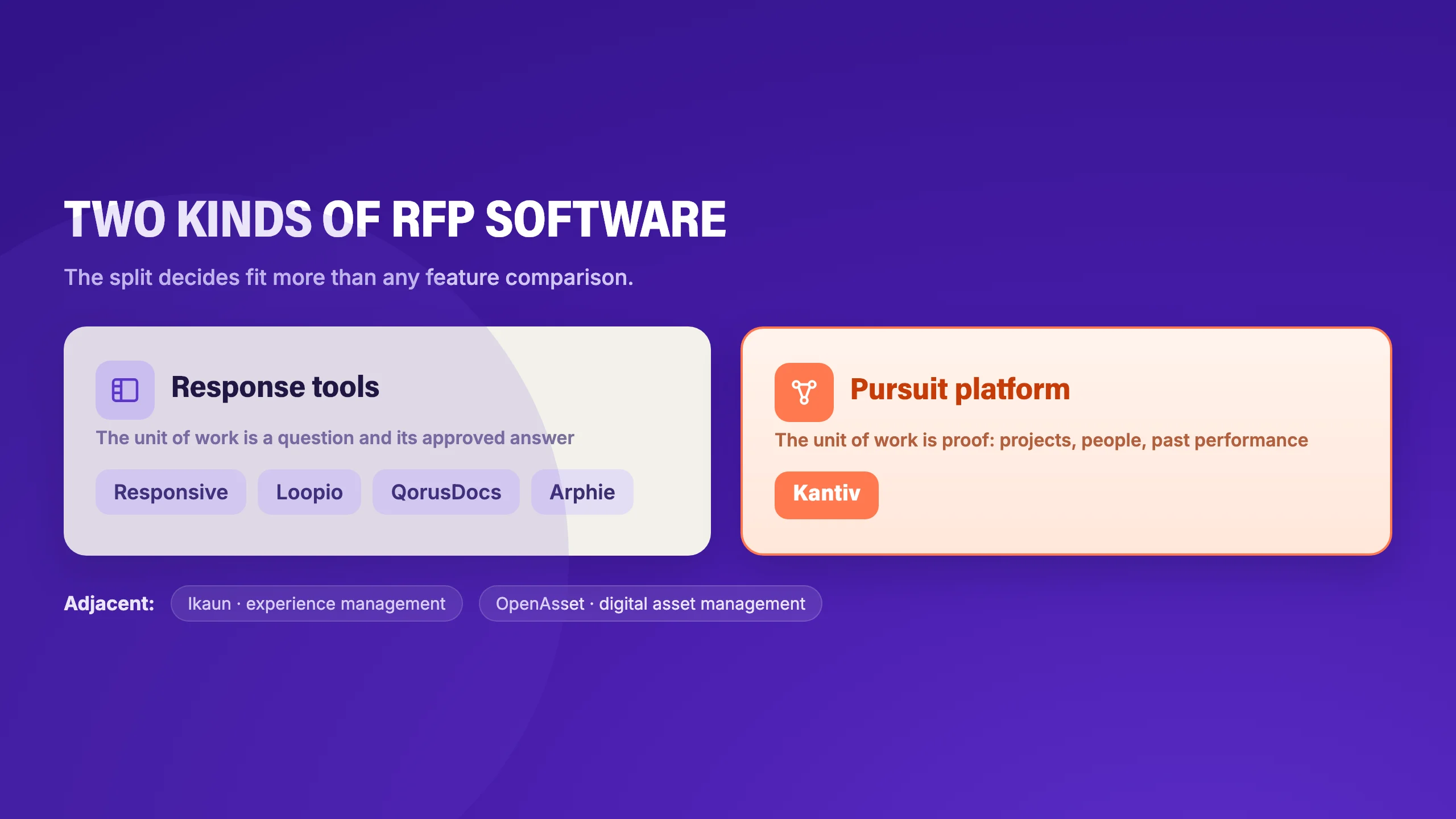
Every product sold as RFP software belongs to one of two families, and the split decides more than any feature comparison.
Response tools treat the question-and-answer pair as the unit of work. Responsive, Loopio, and QorusDocs all follow this model. You build a library of approved answers, the software matches incoming questions against it, subject-matter experts fill the gaps, and the response ships. It's a strong model for vendor questionnaires, security reviews, and sales RFPs, where the same few hundred questions recur with small variations. Most rfp management software and rfp automation products are this family wearing different labels.
Pursuit platforms treat proof as the unit of work, which for an AEC firm means projects, people, client history, and past performance. They exist because qualifications-based selection asks your firm a single question instead of four hundred: show us why you're the team for this job. You answer it with project sheets, resumes, and win themes, and none of that lives comfortably in an answer bank.
Neither family is wrong. They serve different procurement worlds, and the mismatch rarely shows up at the demo. It shows up a couple of pursuits later, once the tool has done its designed job well and the deadline scramble still hasn't moved. If your inbox is portal questionnaires, buy a response tool. If it's RFQs, SF-330s, and Word-format RFPs scored by a shortlist committee, the response model has nowhere to hold what you're actually selling.
How to evaluate RFP tools when the work is qualifications-based
Five questions sort this market faster than any feature sheet.
- What's the unit of work? If every demo screen shows a question list, your projects and people will live in the tool as text snippets. Snippets can't tell you which past work makes the case for this client and this scope.
- Where does the content come from? Some products expect you to build the answer library by hand before the software does anything useful. Others read what your firm already keeps in Deltek, SharePoint, and the image archive. The first route means a migration project before you see any value, and those hours come out of somebody's evenings.
- Who maintains it? Answer libraries decay without an owner, and the decay is invisible until a reviewer catches a three-year-old project description in a live proposal. Ask the vendor how many hours a month the library takes to keep current, and whose hours those are.
- Does it speak the AEC artifact set? SOQs, SF-330 forms, narrative Word RFPs, InDesign layouts. Products raised on portal questionnaires tend to struggle exactly here, and the struggle is well known inside the category even when it never reaches a feature page.
- Can you trace generated text to a source? AI drafting is table stakes in 2026, and grounded drafting is not. If a paragraph can't show where it came from, your senior reviewers have inherited a fact-checking job on top of the review they were already doing.
The 7 best RFP software tools for AEC firms, compared
| # | Tool | Family | Built around | Strongest fit |
|---|---|---|---|---|
| 1 | Kantiv (formerly Joist AI) | Pursuit platform | A knowledge graph of people, projects, clients, and pursuits | AEC firms winning qualifications-based work |
| 2 | Responsive | Response tool | Enterprise answer library and workflow | Enterprises with heavy questionnaire volume |
| 3 | Loopio | Response tool | Curated answer library | Mid-size teams with recurring Q&A responses |
| 4 | QorusDocs | Response tool | Microsoft 365 co-authoring | Firms that draft in Word and store in SharePoint |
| 5 | Ikaun | Experience management | Credentials and matter history | Large legal and professional-services firms |
| 6 | OpenAsset + Shred | DAM with proposal layer | File storage and organization for project assets | Firms whose measured bottleneck is finding files |
| 7 | Arphie | Response tool | AI agents drafting from connected source documents | Questionnaire teams betting on AI-native drafting |
1. Kantiv
Kantiv, formerly Joist AI, is a pursuit intelligence platform built for AEC firms, and the one entry here that starts from your firm's knowledge rather than an answer bank. The Kantiv Knowledge Graph structures institutional knowledge the way AEC firms actually work, connecting people, projects, clients, and pursuits instead of storing files. That structure is what makes the qualifications question answerable by software at all.
Getting knowledge in doesn't become anyone's second job. Past proposals, project profiles, resumes, and images flow in from SharePoint, Egnyte, and Deltek without a migration project. Response tools tend to create a librarian job nobody planned for, and this is the part of the design that avoids it.
Then it goes to work on the pursuit itself. When an RFx lands, Kantiv analyzes it and surfaces the most relevant past proposals, project profiles, people, and images for that pursuit. From there the pursuit runs as a sequence:
- Win Strategy identifies the past projects with the strongest proof points before drafting begins.
- First Draft structures the proposal around that relevant work, pulls content from the knowledge base with traceability, and integrates with InDesign for asset placement.
- Compliance Check validates the RFx requirements and flags anything unaddressed before submission.
- Feedback Loop captures the win or loss reasons back into the graph when the pursuit closes, so every pursuit strengthens the next one.

Every output traces back to a source your firm actually owns, which is the difference between AI drafting you can ship and AI drafting you have to police.
It helps to be clear about the limits, too. Kantiv isn't built for high-volume security questionnaires or a sales team's RFP factory; if that's the workload, a response tool fits better. Pricing is by quote, scoped to the firm, and the pricing and ROI calculator models the return in recovered pursuit hours before you ever talk to sales.
Strongest fit. AEC firms that win on qualifications and want go/no-go, drafting, and compliance running on verified firm knowledge. Mortenson, one of the largest general contractors in the industry, reports saving 8 to 10 hours per week on proposal activities.
2. Responsive
Responsive, formerly RFPIO, is the biggest name in response management and the tool most generic comparisons crown. For its designed job, that's fair. It carries one of the deepest answer library and workflow feature sets in the family, a genuinely strong search engine, and the largest customer base in the category by a wide margin.
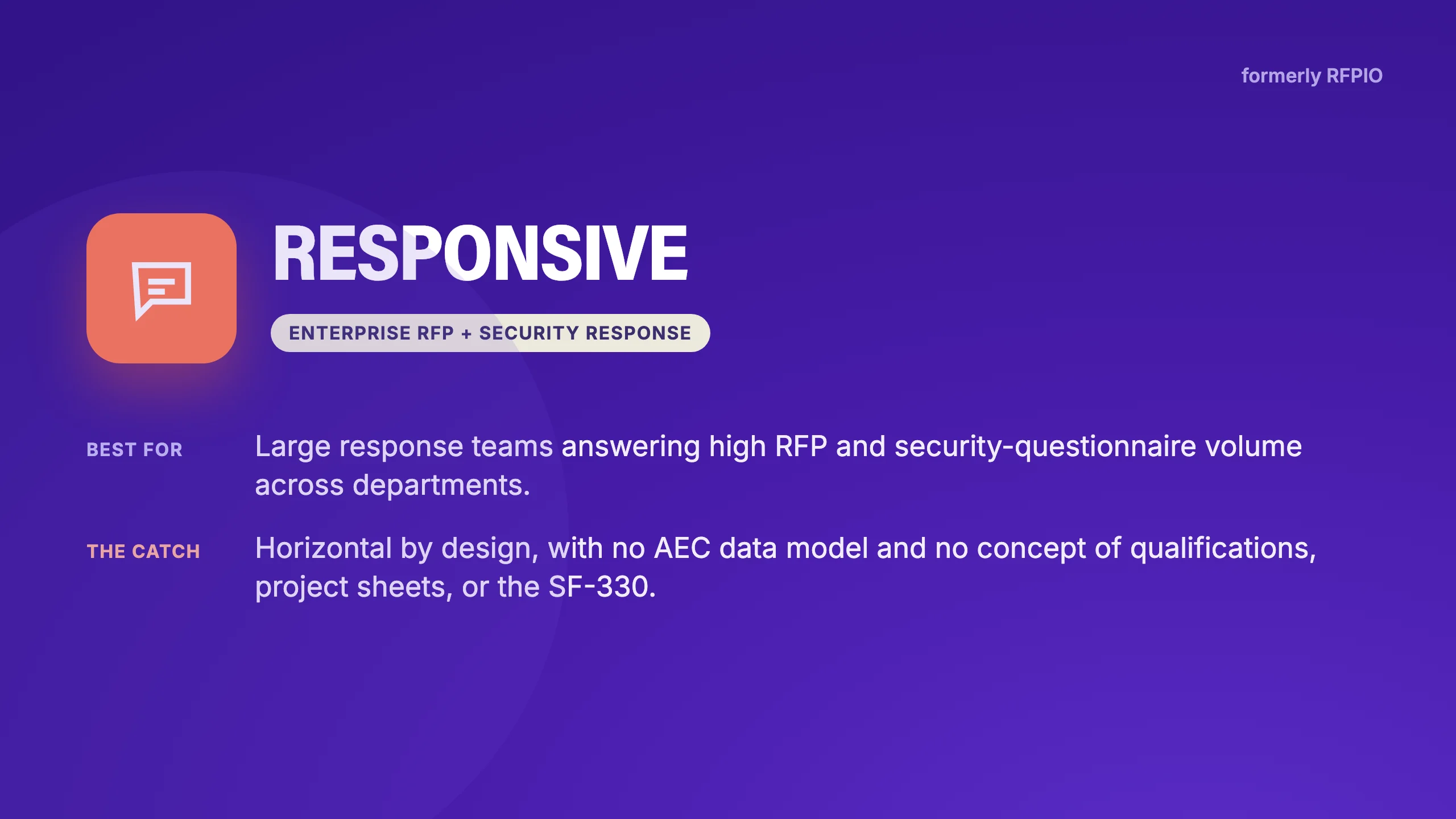
Look at who that customer base is, though, before you look at the feature list. It's software, finance, and consulting teams working portal questionnaires, and the product is shaped around them. Hand it a Word-formatted RFP, which is the AEC default, and you are working against the grain of how Responsive was built. This is not a secret inside the category; it comes up unprompted from the people running it:
"Typical RFPs that are formatted in Word are challenging to run via RFPIO. We struggle with this... We have yet to master the template."
Two other things worth walking into a demo already knowing. The AI's output needs review every time, which eats a real share of the productivity you're buying. And AI plus advanced analytics can land as paid add-ons on a contract that was already enterprise-grade, so get the full number before you compare it to anything.
Strongest fit. Enterprises with genuine questionnaire volume, a named library owner, and few narrative proposals.
3. Loopio
Loopio is the other name every response-tool shortlist ends up carrying: a curated answer library with a clean interface and a close-the-loop workflow for keeping answers fresh. For questionnaire work it earns the affection it gets, and teams doing that work at volume recover serious hours with it.
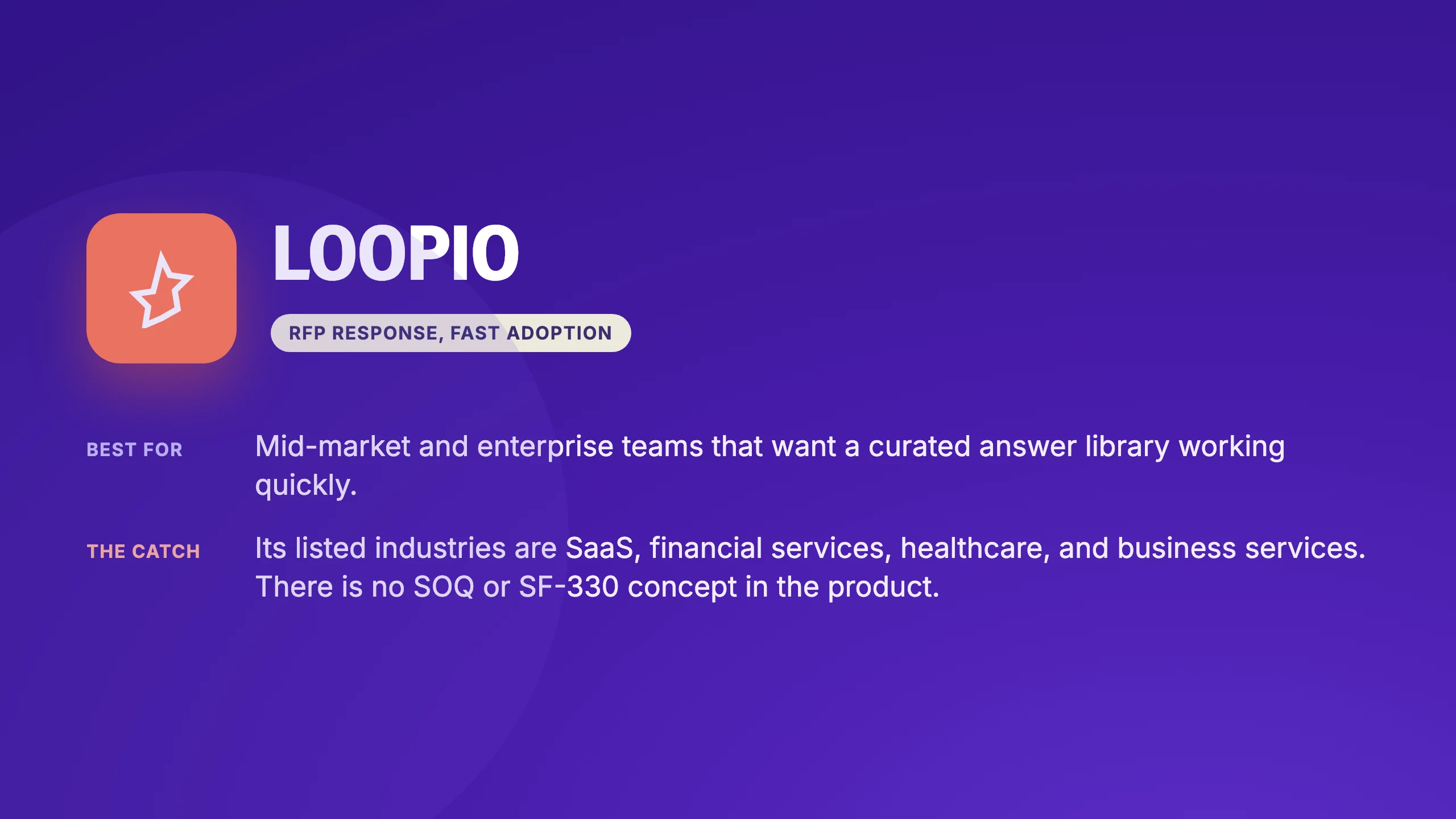
The model is honest about what it is, a library you curate. That's also its ceiling. Keeping the repository current takes sustained discipline and hands-on work, and anything genuinely tailored still gets finished outside the tool. Its home market is SaaS, financial services, healthcare, and business services, and the product reflects that: no SOQ or SF-330 concept, no InDesign path, and your projects and people existing only as text inside answers.
Strongest fit. Mid-size teams with recurring Q&A responses and someone accountable for the library.
4. QorusDocs
QorusDocs is proposal automation that lives inside Microsoft 365, with co-authoring in Word and PowerPoint, content in SharePoint, and its QPilot AI drafting layer on top. Its ProposalHub package is aimed at professional services, AEC included. If your firm drafts in Word, stores everything in SharePoint, and has no appetite for moving either, this is the shortest distance between where you are now and faster assembly.
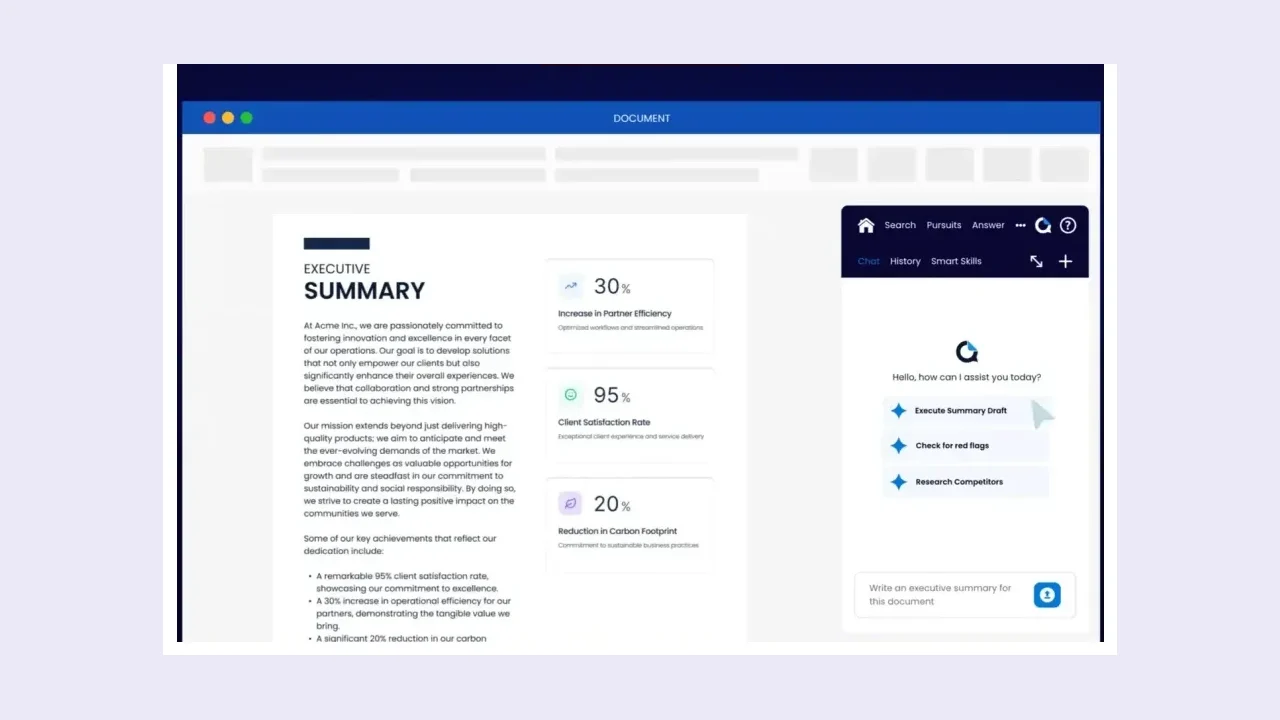
Understand what that buys you, though. The content model underneath is still a snippet library, so what it genuinely speeds up is putting a document together inside tools your team already knows. Finding the right proof to put in that document is still a manual hunt, and the qualifications problem stays yours to solve by hand. Day to day, expect slow file previews, colleagues without seats who can't pull content themselves, no real search inside the knowledge libraries, and the habit of inserting a whole document just to delete the parts you didn't want. Even people who like it flag a prompting learning curve and an opaque reporting area.
Strongest fit. Word-native services firms that want faster assembly inside the Microsoft stack they already govern.
5. Ikaun
Ikaun pairs proposal automation with experience management and markets to legal and AEC. Conceptually it sits closer to qualifications work than the response tools do, since experience, credentials, and matter history are its native objects. It sells firmwide licensing rather than per-seat pricing and deploys as a managed, white-glove implementation.
Here's the part you have to weigh. Ikaun has limited AEC track record compared to law firms, the thin trail that does exist predates the product's current positioning entirely, and the AEC logos are a short list next to a long one of law firms. That tells you where the workflows got polished. None of it is disqualifying, but it does mean every capability claim you're weighing traces back to the vendor, and the only real diligence available to you is reference calls with firms that look like yours. Ask for them early and ask for more than two. Its own AEC materials put full rollout at nine months for Arup and six for GHD, so the "proposals in hours" outcome sits on the far side of most of a year.
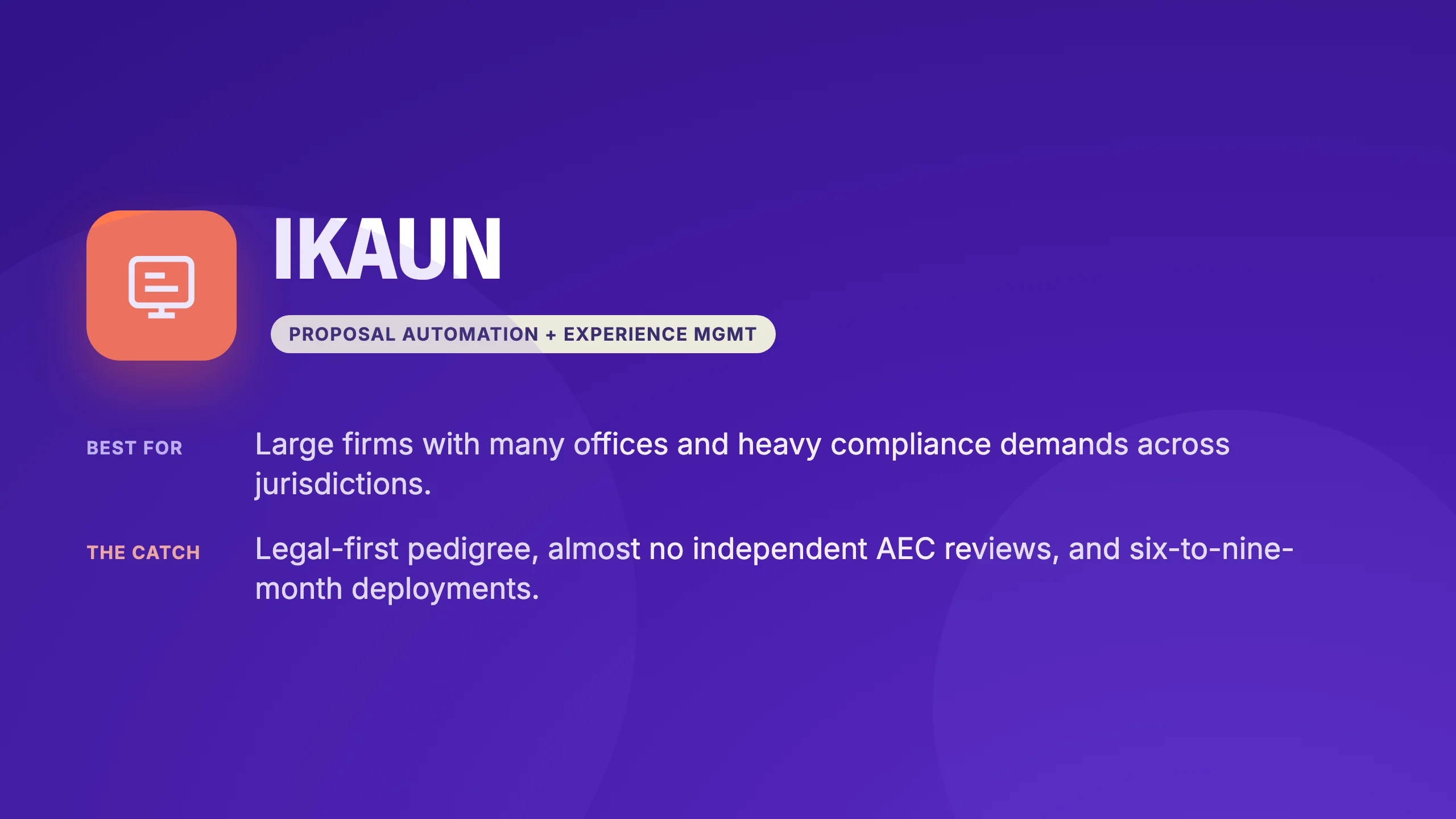
Strongest fit. Large, multi-office professional firms comfortable with managed deployments and vendor-led implementations.
6. OpenAsset + Shred
OpenAsset is the AEC industry's established digital asset manager, with Shred as its newer AI proposal layer. It belongs in this comparison because imagery is a real AEC proposal bottleneck and nothing else here treats photography as a first-class object. If finding project photography is your measured pain, it does that job at depth and it does it better than anything on this list.
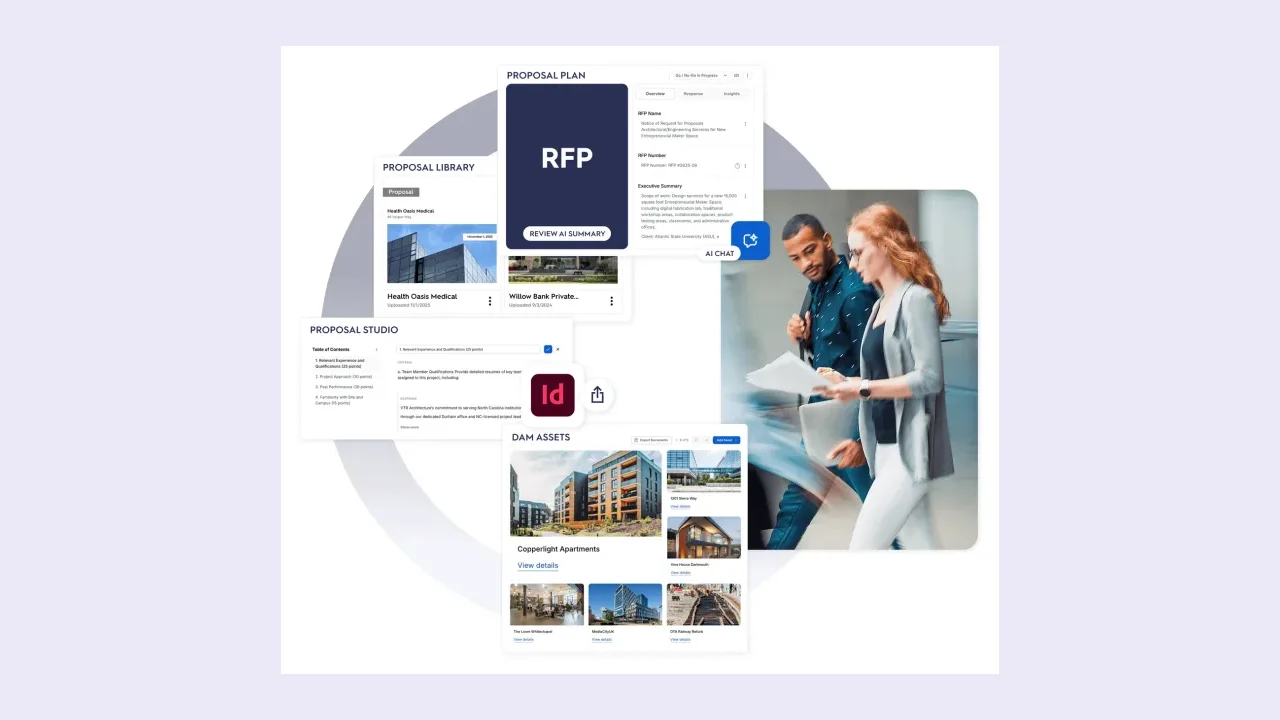
The gap opens when the pursuit needs more than the photo. A DAM is organized around the asset, so it can tell you every image from the Willow Creek treatment plant, and it cannot tell you that Willow Creek is your strongest proof for this county's program, that the PM who delivered it is available, or that two of the three references the evaluator will call came off that job. Those aren't image questions. They're questions about how your people, projects, and past performance connect, and an asset library has no place to hold a relationship. So the proposal layer sitting on top inherits its foundation: it reasons from assets, which means it can assemble a document quickly and still leave the argument for you to build.
Two more things to price in. Its AI search runs on a generic model and its own guidance points you back to traditional keywords for specialized terms. And search quality tracks tagging discipline, which means somebody on your team owns that taxonomy for as long as you own the tool, including through deadline season when tagging is the first thing to go.
Strongest fit. Firms whose bottleneck is project imagery, buying a DAM on purpose and staffing the tagging.
7. Arphie
Arphie is the AI-native newcomer in this category, and its site describes knowledge agents for go-to-market teams that draft RFP and questionnaire responses from connected sources like SharePoint, Google Drive, and Confluence, with answer sources and confidence scores shown for review. That design is a real answer to the library-upkeep problem the older response tools carry. But the buyers it names are sales, security, and investor relations teams, and nothing in it speaks to qualifications packages or the AEC artifact set. It's also young enough that there's no independent track record to lean on, so weight reference calls over the demo.
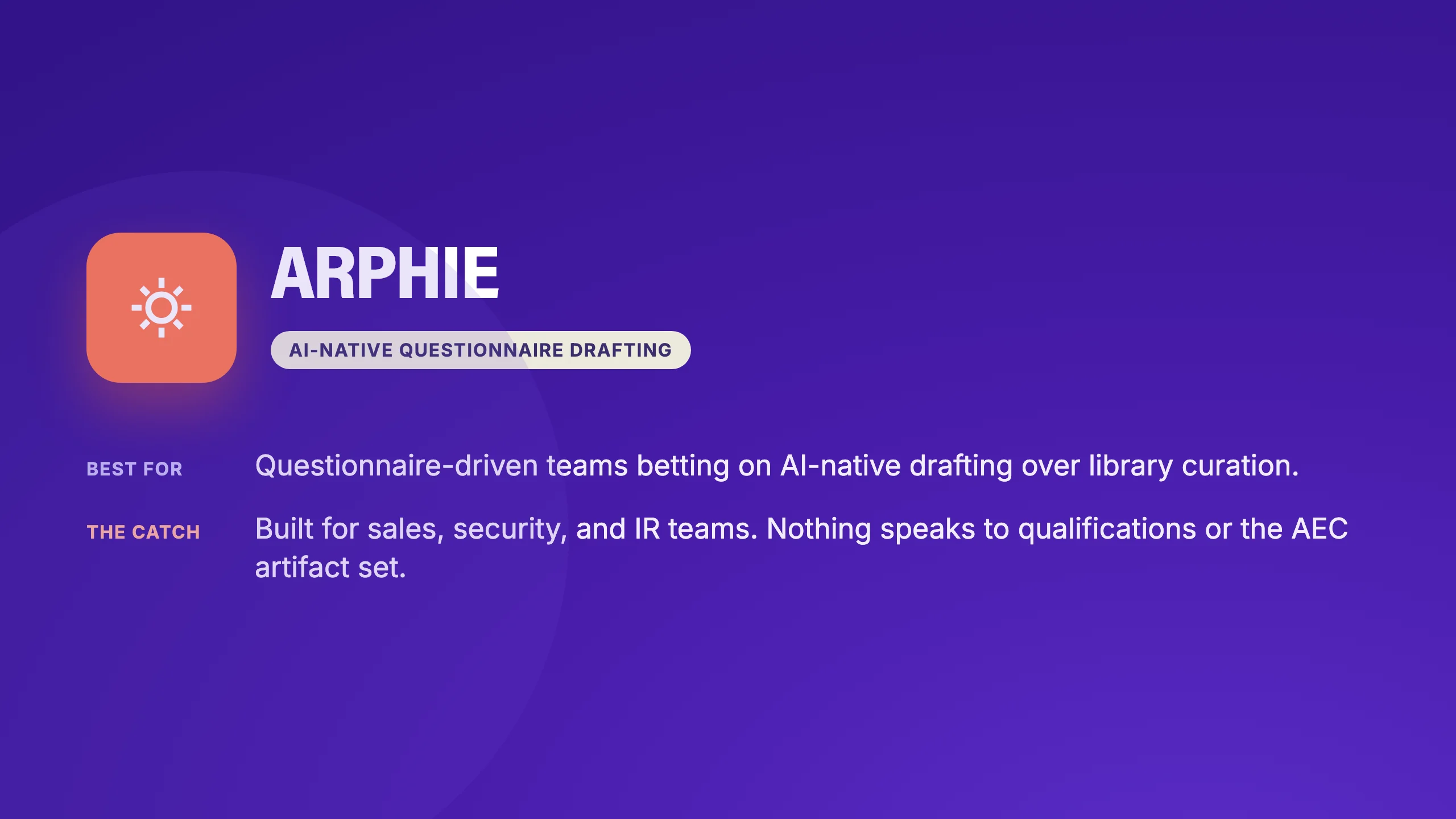
Strongest fit. Questionnaire-driven teams that would rather bet on AI-native drafting than on library curation.
Two questions that settle your shortlist
You don't need to compare seven products. You need to answer two questions in order, and the second one only matters once the first is settled.
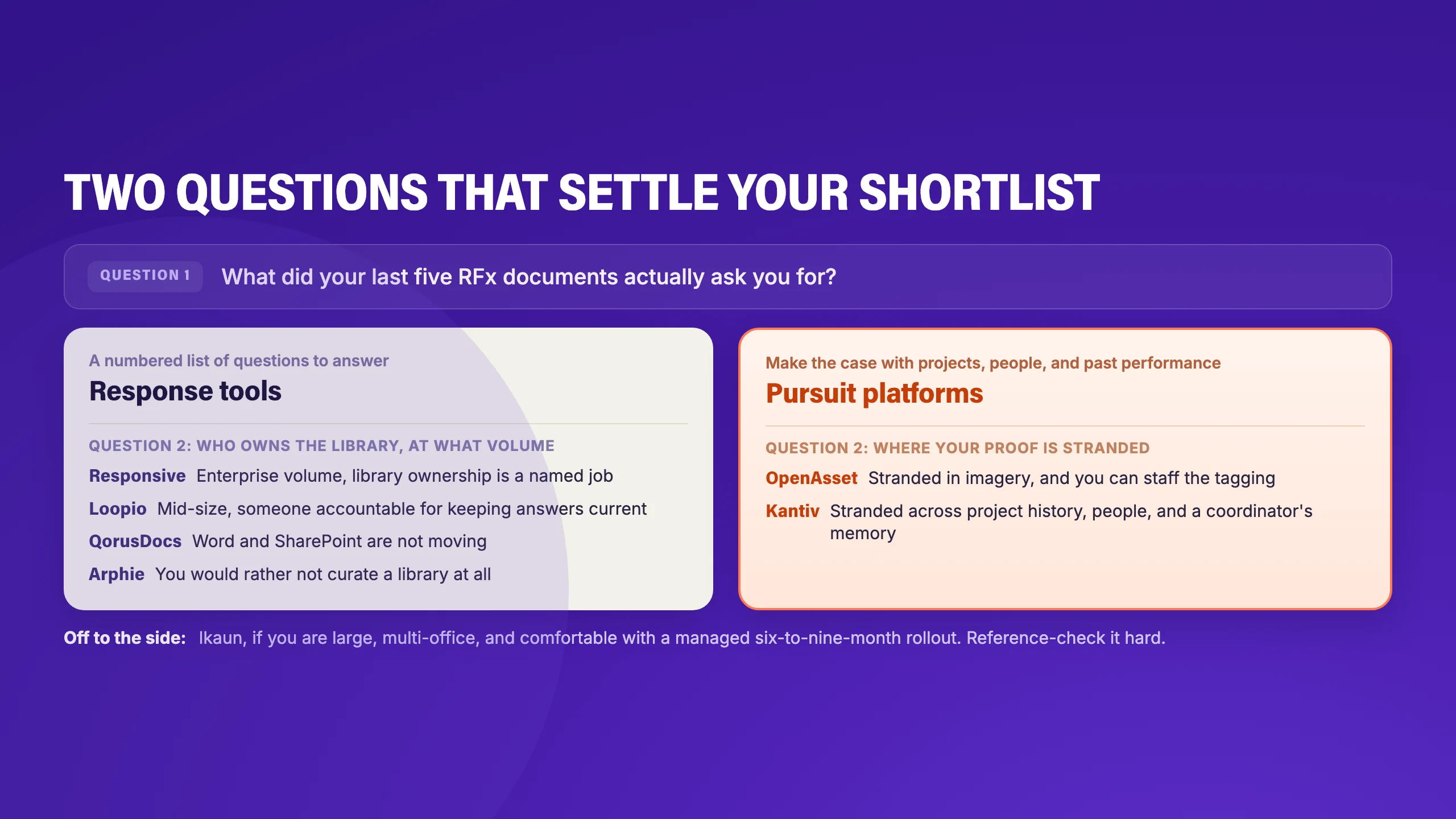
First, count the questions. Pull the last five RFx documents your firm responded to and look at what they asked for. If most of them handed you a numbered list to answer, you're a response-tool buyer, and the rest of this is about which one. If most of them asked you to make a case out of projects, people, and past performance, then no answer library can hold what you're actually selling, and you're looking at a pursuit platform whatever the shortlist you started with said.
Then name what breaks first. If you're in the response family, the deciding variable is who owns the library and how much volume you're pushing through it. Responsive if the volume is enterprise and the owner is a named job. Loopio if you're mid-size and someone is genuinely accountable for keeping answers current. QorusDocs if Word and SharePoint aren't moving and you want the shortest path from here. Arphie if you'd rather bet on drafting from connected sources than on curating a library at all.
If you're in the pursuit family, the deciding variable is where your proof is stranded. When it's stranded in imagery and you can staff the tagging, a DAM is the honest buy. When it's stranded across your project history, your people, and eleven years of a coordinator's memory, you need something that maps your people, past projects, and historical performance into a structured knowledge graph, and only one family of product does.
And if you're large, multi-office, and comfortable letting a vendor run a six-to-nine-month rollout, Ikaun is the managed option to reference-check hard.
Why AEC firms choose Kantiv
Look back at that list and the category split from the top of the page reappears. Six of the seven tools assume your problem is producing responses faster. For most AEC firms the problem sits a layer deeper. The proof that wins pursuits is scattered across Deltek, SharePoint, old InDesign packages, and the memory of a coordinator who's been there eleven years. Speeding up assembly on top of scattered proof doesn't help, because the draft still gets built from whatever proof somebody could reach in a hurry rather than the proof that would have won the job.
Kantiv works at that layer.
Kantiv maps your people, past projects, and historical performance into a structured knowledge graph, so the next RFP starts from what the firm already knows rather than from what somebody can dig up before the deadline. More than 200 AEC teams run their pursuits this way, with over $2.4B in proposal value submitted through Kantiv, which measures proposal builds at 75% faster across its customer base. The common thread among them is neither size nor market. They win on qualifications, and they got tired of their best evidence sitting unreachable at deadline.
Want to try it? Book a demo and bring a live RFx.
FAQs
What is RFP software?
It's software for producing responses to RFPs and other RFx documents, and the label covers two families. Response tools manage a library of approved answers for questionnaire-style RFPs. Pursuit platforms structure a firm's projects, people, and past performance for qualifications-based selection. Most comparisons in this category only cover the first family.
What's the best RFP software for AEC firms?
For qualifications-based work, Kantiv, because it's the only option here built on an AEC pursuit data model with traceable firm knowledge underneath. For questionnaire-heavy workloads, Responsive at enterprise scale or Loopio at mid-size are the credible response tools, provided someone owns the answer library.
What's the difference between RFP software and RFP response software?
In practice, nothing. Both labels describe the same response-tool family, built around a library of approved answers. The distinction that actually changes your shortlist isn't in the name, it's whether the product is organized around answers or around your firm's proof.
How much does RFP software cost?
Almost no vendor in this category publishes full pricing, so expect quote-based deals scoped to seats and modules, and budget for the add-ons that show up at the enterprise response tools, where AI and analytics can cost extra. Factor the hidden line item too, the staff hours that keep an answer library current. For the pursuit side, Kantiv's ROI calculator models return in recovered hours per pursuit.
Do AI RFP tools actually write the proposal?
They write drafts, and the drafts are only as good as what grounds them. Across the response tools, generated answers need line-by-line review before anything ships, and that review is where a good share of the advertised time savings goes. The distinction worth shopping on is whether an AI RFP tool drafts from the open internet or from your firm's verified work. Kantiv drafts only from your firm's own knowledge, with each claim traceable to its source. Either way, your senior people still hold the red pen.
Can RFP software handle an SF-330 or an SOQ?
Only if the product has a data model for the things those documents are made of: project profiles, key personnel, past performance, and the relationships between them. A tool built around question-and-answer pairs can store SF-330 text, but it can't assemble the people-project matrix the form is actually asking for. Check this specifically in any demo, with one of your own forms.
What's the difference between RFP software and RFP response software?
Mostly market history. The two labels get used interchangeably, and where they differ, RFP response software is the narrower one: it grew out of questionnaire response management, while proposal management software grew out of document assembly. For AEC buyers the real dividing line runs elsewhere, between products built around answers and products built around your firm's proof. Buy on that line rather than on the label.
See what your next pursuit looks like when it starts from your firm's knowledge. Book a demo and bring a real RFP your team just answered.
Disclaimer: This comparison was prepared by Kantiv based on publicly available product information and documentation at the time of review. Product features, pricing, plans, and availability may change and may vary by configuration. While we strive to keep this information accurate and current, this comparison may not reflect all available product details. For the most current information, please consult each vendor directly.