Found the content on this page useful? Share it with your team!
Agentic AI vs. Generative AI: Which One Does Your Proposal Shop Actually Need?

.png)
Table of Contents
I sat in on a call recently where a marketing director at a top 100 ENR firm proudly told us her team had "gone agentic." Curious, I asked what that actually looked like for them on a Tuesday afternoon.
She described a shared Claude project folder where three coordinators took turns generating paragraphs. That isn't agentic AI—that is generative AI with shared context. Useful? Absolutely. An agent? Not even close.
In the AEC industry, vocabulary has sprinted roughly 18 months ahead of reality. And that confusion can cost real money in both directions: where some are overpaying (buying expensive "agentic solutions" for tasks a basic $20/month chat interface handles fine) or underdelivering (attempting to run mission-critical pursuit workflows through a basic chat window never engineered to complete complex, multi-step tasks).
To make sure you’re not erring on either side, let's run through a quick overview of the difference between AI and AI Agents (or Generative AI vs Agentic AI) in the context of your day-to-day work.
Generative vs Agentic AI, side by side
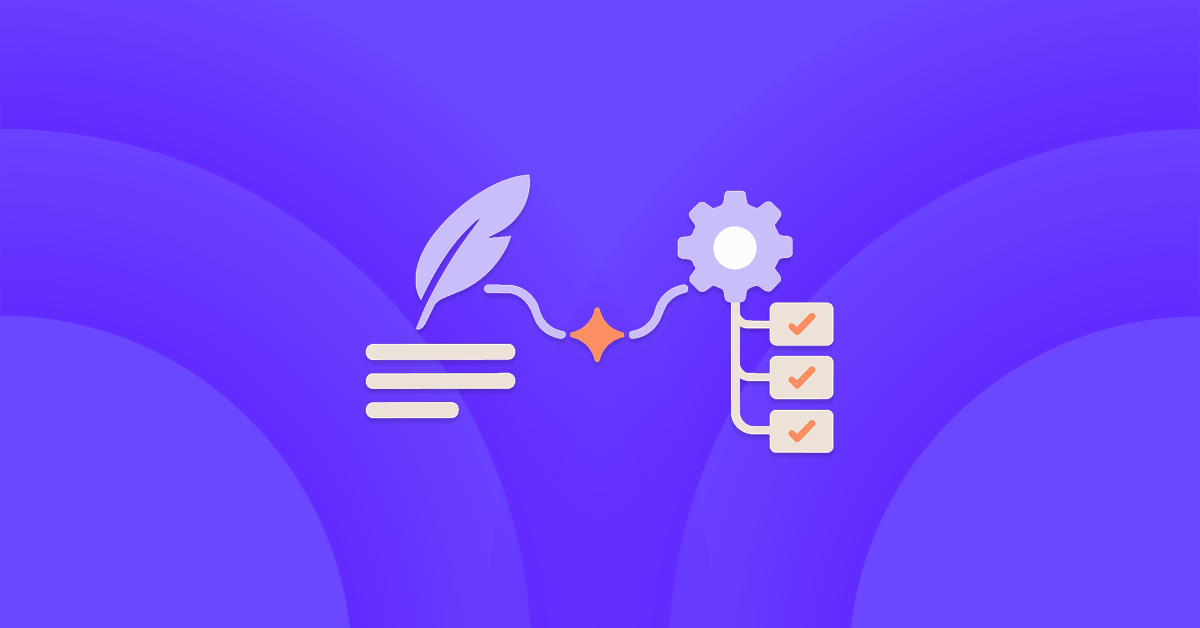
The true distinction between Generative AI and Agentic AI is what it delivers. Generative AI delivers content. Agentic AI completes multi-step workflows to deliver outcomes.
Most of what's being sold right now falls somewhere between those two columns, and a comparison table won't tell you which side a specific tool leans toward. That takes watching for four characteristics and three behaviours, plus the horizontal-to-vertical market landscape. You can read more on these in our field guide to AI agents.
This piece takes the question after that one. Assuming you can tell the two apart, which of your workflows actually warrants an agent, and what should you refuse to sign for?
3 AEC-specific Examples: Generative vs. Agentic Workflows
Every truly agentic workflow ends at a human spending time on a decision instead of manual assembly. As a strategist should.
If your IT department insists Microsoft Copilot can already handle these agentic workflows out of the box, share our breakdown on what it actually takes to build pursuit agents on Copilot.
Decision Guide: Which Tool Do You Actually Need?
- Use Generative AI if you need a One-Off Answer: Quick rewrites, initial outlines, or summarization of a single document. Rule of thumb: Don't build an agent for something you only do twice a year.
- Use Agentic AI if you need a Repeatable Workflow: Requirement extraction, experience matching, CRM field verification, and closeout tagging. Rule of thumb: If you can write an SOP for a junior coordinator, an agent can run it.
- Keep a Human in the Loop if you need Judgment or Accountability: Go/No-Go decisions, win strategies, fee structures, and final client-facing submittals. An agent assembles evidence in 10 minutes instead of 10 hours—the final decision always stays human.
The Hidden Cost: Token Consumption
An IT leader at a national engineering firm summarized the issue clearly: "Our cost modeling blew up because we weren't just paying flat software fees—we were paying unmanaged API token usage behind the scenes."
If an agentic system gets stuck in a loop trying to solve an ambiguous task, a four-minute routine job can turn into a forty-minute compute drain. Ask every vendor, and every internal builder, whether runs have hard caps and what happens when one is hit. That’s something to keep in mind.
The Reality Check: "Agent Washing" and Data Readiness
Industry analysts note that while hundreds of vendors market "agentic AI," only a fraction offer autonomous execution, tool integration, and verification loops. The rest have simply rebranded chatbots and RPA scripts. This gap creates a major split in industry adoption:
- High Ambition: 59% of AECO firms plan to deploy agentic workflows short-term.
- High Risk: 40%+ of agentic AI initiatives are projected to fail by 2027 due to poor data and cost overruns.
The underlying cause of failed deployments in AEC is rarely the AI model itself, but poor underlying data quality. If your data isn't structured, your agents can't drive outcomes—they just automate error creation at scale.
Standardizing AI for Pursuit Operations: what you require, whether you build or buy AI agents for pursuits
We put together five requirements, and the question that tests each one. Take them into your next demo, or apply the same list to anything your IT group proposes building in-house.
- Firm-specific knowledge. What does this know about our firm that it didn't know on day one? If the answer is "it reads your SharePoint," you're buying a very good assistant. That may be the right purchase. Price it that way.
- Transparent citations, with exception-based review. Where did this fee number come from, and when was it last verified? Every match and every metric should open to a source record. And the system should flag low-confidence fields for you rather than turning your coordinators into full-document proofreaders.
- Stopping conditions and hard cost caps. What is the definition of done, what are the approval points, and what's the token ceiling per run? An agent without a stopping condition is a runaway process with a monthly bill.
- Native production workflows. Where does the output land? A Word draft, or a laid-out, page-limit-compliant, brand-compliant submission. Only one of those ends the 11 p.m. formatting work.
- A named maintenance process. Who retests this when the model changes underneath it, and how often? If the answer is a person's name rather than a process, you've found part of Gartner's 40 percent.
Building for outcomes with Kantiv
You don't need AI for the sake of having AI. You need specific, reliable outcomes: faster submission times, higher proposal quality, and zero 11 p.m. formatting fire drills.
Achieving those outcomes requires a foundation built on verified data and strict guardrails. That’s why we built Kantiv's around the five requirements above. Every match traces back to a verified source, execution stops where you cap it, and the work lands directly in your InDesign templates ready for review.
If you’re looking to gain a true competitive advantage next year, think about how you can start cleaning data so you can automate real pursuit outcomes. If you want help with structuring your data without the manual work that goes into it, we’ve got something cooking.
Book a demo with Kantiv to see what other types of outcomes we can drive on your team's real proposal workflows.
FAQs
What is the main difference between generative and agentic AI?
Generative AI creates content on demand: you prompt it, it produces text, images, or code. Agentic AI takes action autonomously. It can plan multi-step workflows, use tools, and make decisions with minimal human input. Think of generative AI as your drafting software (it draws what you tell it) and agentic AI as a project manager that coordinates tasks across systems on its own.
What are examples of agentic AI?
AI that autonomously monitors a jobsite schedule, flags conflicts, reprices change orders, and emails the GC, all from a single instruction. Other examples: AI coding agents that debug across files, AI assistants that book meetings and follow up, or AI that crawls plan sets to generate quantity takeoffs and then pushes them into your estimating software without step-by-step prompting.
Is ChatGPT agentic AI or generative AI?
Primarily generative. ChatGPT generates responses to prompts. However, OpenAI has been layering agentic capabilities on top: plugins, web browsing, code execution, and "operator" features that let it take actions across websites and now even create custom agents. So it's a generative foundation with growing agentic features. Most users still interact with it generatively.
What are the four types of generative AI?
There isn't one universally agreed-upon list of "four types," but the most commonly referenced categories are:
- Text generation — LLMs like Claude, ChatGPT (reports, specs, RFIs)
- Image generation — DALL·E, Midjourder, Stable Diffusion (renderings, concept visuals)
- Code generation — Copilot, Claude Code (scripts, automation, custom tools)
- Audio/video generation — Sora, ElevenLabs (voiceovers, walkthrough videos)


.png)