Found the content on this page useful? Share it with your team!
How to Write a Winning AEC Capability Statement

.png)
Table of Contents
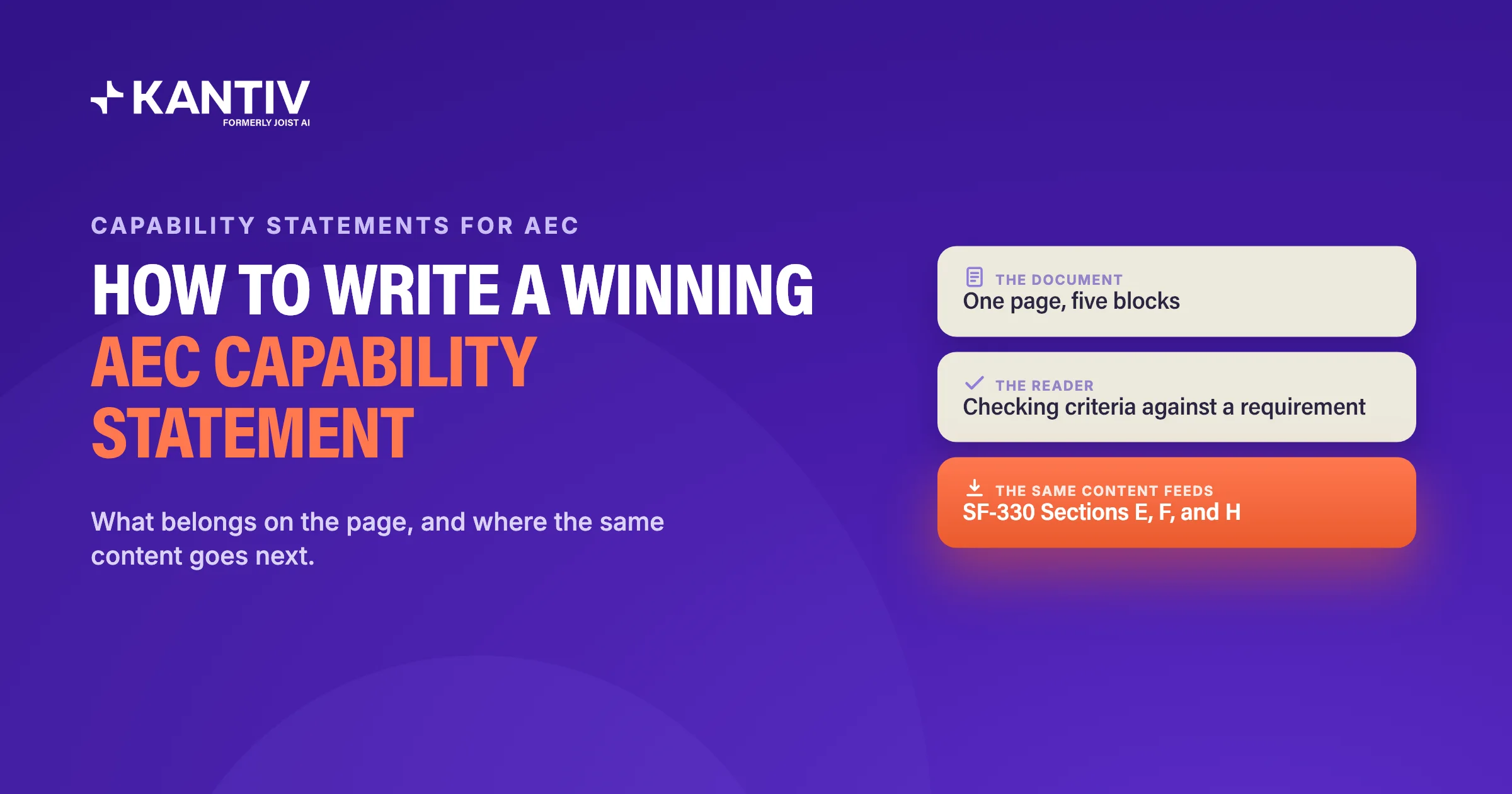
Picture this. A municipal project manager likes your firm. She wants to send work your way. She asks for one thing first: "Just send over your capability statement."
Simple enough. One problem: it’s due Friday, and the closest thing anyone at your firm can piece together is a one-pager from 2022 with two retired principals on it.
Every AEC (Architecture, Engineering, or Construction) marketer has lived some version of this. It’s not fun. So let’s talk about the fix.
A capability statement is a one-page summary of what your firm does, and the evidence that it can deliver: core competencies, past performance, differentiators, and the registration data public buyers need. For an AEC firm, a capability statement is the front door to public and institutional work. You’ve probably heard it referred to as "a resume for your business.” That’s not wholly incorrect, but the description doesn’t quite do justice to how critical and nuanced it is for firms.
In this guide, we’ll walk you through exactly what a capability statement is, why it’s important, and how to write a capability statement that wins more of the right pursuits for your firm.
What is an AEC capability statement?
A capability statement is the one-page document your firm sends when a buyer wants to know what you have built before any formal procurement has started. It is typically a one page PDF, and carries your firm's own project photography.
Where firms send statement of qualifications in response to published RFQs, they send capability statements in response to people: a contracting officer doing market research, a program manager who got your name from a colleague, or a prime putting a team together for a project they have not won yet. There is no solicitation, published evaluation criteria, or deadline beyond the one the person asking gave you.
In AEC, capability statement move through a predictable set of hands:
- Handed over at an industry day or a conference.
- Emailed when an agency asks for one before adding your firm to a bidders list.
- Attached to a prequalification packet for a state DOT, a transit authority, or a school district.
- Sent to a prime assembling a team for a project it is chasing.
- Filed in an agency's market research record, where it sits until a need matches it.
Broadly speaking, a capability statement should show what you do, the proof you have done it, and what separates you from competing firms. Sounds simple enough, but AEC capability statements look a bit different from their counterparts in federal contracting and professional services. We’ll walk through how that manifests in the actual structure; but first, let’s be specific about why a statement is not just a resume.
Why a capability statement is not just a resume
Capability statements are indeed like resumes, with one key difference: a resume is a persuasive document. It competes in a stack, and its job is to win you an interview.
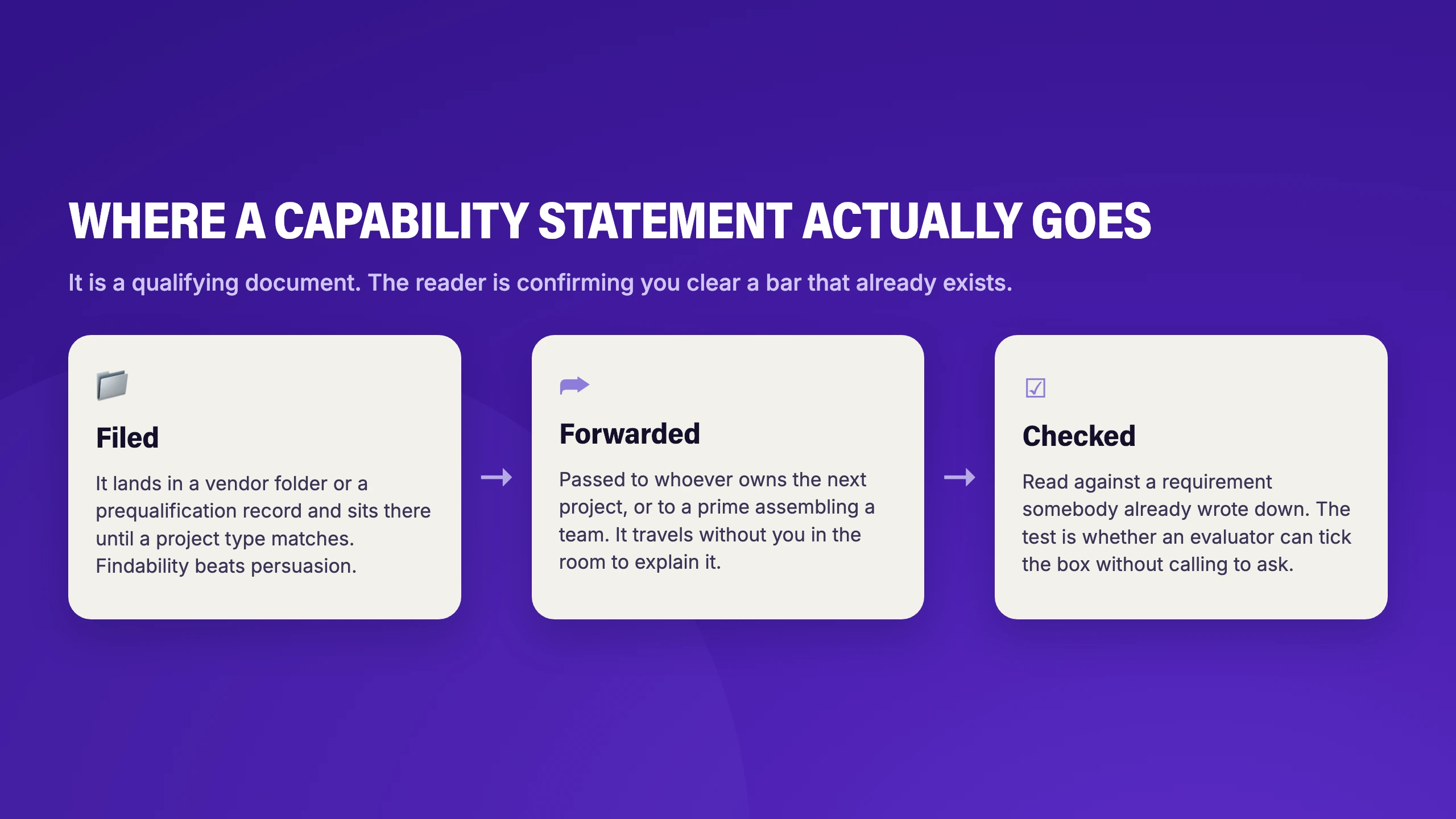
Capability statements don’t do that. They get filed in a vendor folder, forwarded to whomever owns the project, or checked against criteria a contracting officer already wrote down. It's a qualifying document. Its job is to confirm you clear the bar to take on the work.
Why does that matter? If you're writing to persuade, you reach for adjectives and a firm history. If you're writing to qualify, you reach for the specific facts an evaluator needs in order to confirm you meet the criteria.
On the federal side, your capability statement becomes an input to the agency's market research file, which is a documented record with a paper trail. In set-aside decisions, it becomes evidence for the Rule of Two under FAR 19.502-2: whether two or more capable small businesses are likely to submit offers at a fair market price. Under FAR, market research has to address not only the existence of firms that might respond, but their capability to perform.
You can read that standard in how evaluators write about qualifications generally. In one protest decision, an agency's evaluation of key personnel recorded that the firm "does not specifically note that the personnel listed are actually available or merely prospective employees."
In another consensus report evaluators faulted a submission because "each implementation plan included the same boilerplate paragraphs." and because the firm "simply repeats this statement without any additional information" from the solicitation itself.
Those are proposal evaluations rather than capability statement reviews, but the habit of mind is identical: an evaluator writes down what they could not confirm.
In AEC, the fact that the capability statement leads into the RFP is of particular importance. One proposal manager of 17 years, writing in r/govcon, put it plainly:
"Most proposals are won before the RFP is released... Most of the Proposals I won are proposals that had great Capture Management over a prolonged period (over a year) in which we strategically aligned our capabilities, solution, and team to be ready to go prior to the RFP drop."
The capability statement is often the first artifact in that year. If you want a quick litmus test on whether or not your firm is “ready to go,” ask yourself this: could an evaluator holding a specific requirement confirm you meet it without asking you a question?
We’ve talked at a high level about what AEC capability statements should contain. Let’s dig a bit deeper.
What belongs in an AEC capability statement
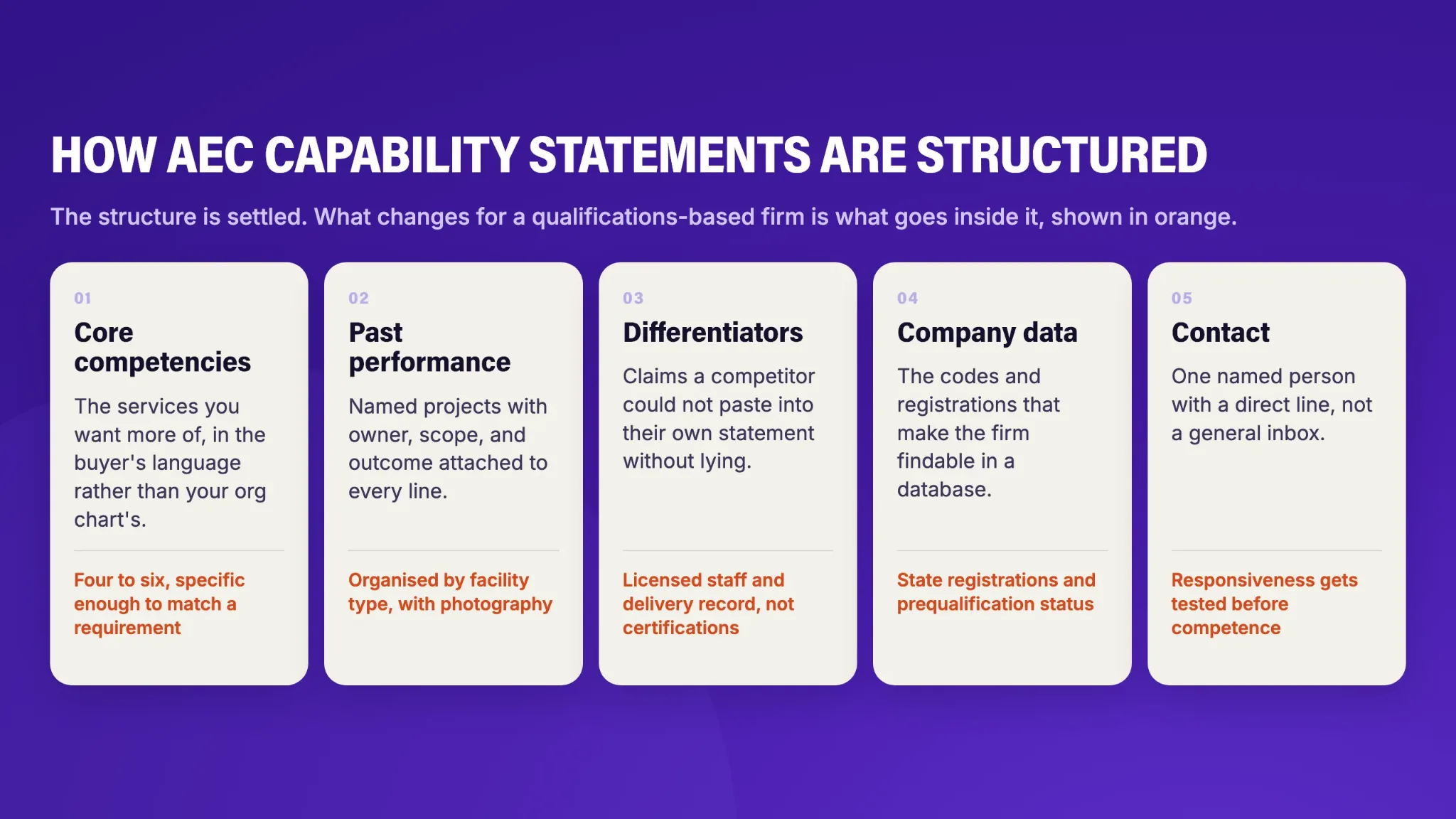
In the AEC industry, this is the general consensus on how a capability statement should be structured.:
- Core competencies. The services you want more of, stated in the buyer's language (not your own).
- Past performance. Named projects with owner, scope, and outcome.
- Differentiators. Claims a competitor couldn't paste into their own statement.
- Company data. Codes, registrations, and certifications that make the firm findable in a database.
- Contact. One named person with a direct line.
If you're already wondering how all of that fits on one page, it doesn't. Not all at once, anyway. It fits because you cut to the reader. We'll get to the cut list below.
First, a caution. Most of the public know-how on this topic describes commodity vendors selling products to federal buyers. As an AEC firm pursuing qualifications-based work, your past performance, differentiators, and company data is going to look a lot different.
| What most capability statements need | What an AEC evaluator also looks for |
|---|---|
| NAICS codes, CAGE, UEI, SAM registration | State professional registrations, and which states |
| Years in business, corporation type | Licensed professionals on staff, by discipline |
| Past performance with contract numbers | Project experience by facility type, with photography |
| Socioeconomic certifications | Prequalification status with the relevant agency or DOT |
| Staff clearances | Delivery methods the firm has actually completed work under |
For AEC firms, your buyer publishes the rubric defining what should be contained in each these sections. FAR 36.602-1 names the criteria evaluation boards used for federal design work, and most states have enacted their own versions of the Brooks Act that FAR section implements. You should treat that criteria as a content spec for your page.
In public design work,* knowledge of the locality* means that your past performance should lead with the projects nearest the work–named by county, agency, or market–instead of merely opening with your largest job. Past performance means cost control, quality, and schedule, so every project line should carry an outcome: finished three months early, 2% under budget, zero design-attributable change orders, etc.
An example of an AEC capability statement
Here's what that looks like assembled. This one is pitched at a municipal utility.
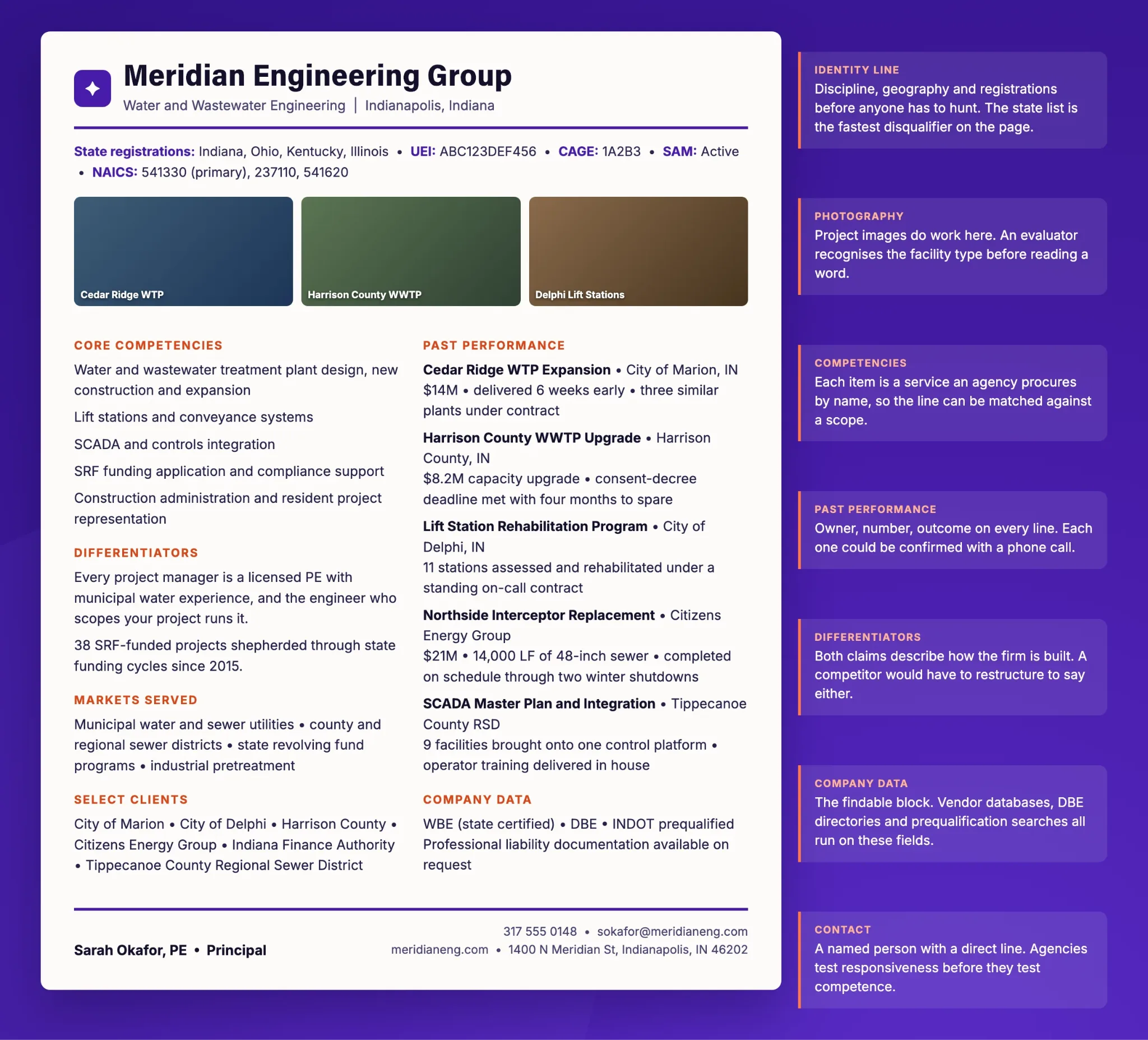
| The block, as written | Why it works |
|---|---|
| Meridian Engineering Group | Water and Wastewater Engineering | Indianapolis, Indiana. State registrations: IN, OH, KY, IL | UEI: ABC123DEF456 | CAGE: 1A2B3 | SAM: Active | Identity, discipline, geography, and registrations before anyone has to hunt. The state list sits at the top because it's the fastest disqualifier. |
| Core competencies. Water and wastewater treatment plant design (new construction and expansion); lift stations and conveyance systems; SCADA and controls integration; SRF funding application and compliance support; construction administration and resident project representation. | Services this firm wants more of, phrased the way a utility director would describe the need. Funding support is on the list because for municipal water work the money question arrives before the design question. |
| Past performance. Cedar Ridge WTP Expansion, City of Marion: $14M, delivered 6 weeks early, three similar plants currently under contract. Harrison County WWTP Upgrade: $8.2M capacity upgrade, consent-decree deadline met with four months to spare. Lift Station Rehabilitation Program, City of Delphi: 11 stations assessed and rehabilitated under a standing on-call contract. | Every line carries an owner, a number, and an outcome, which means every line could be verified with a phone call. Adjectives don't meet that standard. |
| Differentiators. Every Meridian PM is a licensed PE with municipal water experience, and the engineer who scopes your project runs it. 38 SRF-funded projects shepherded through state funding cycles since 2015. | Neither line survives being pasted into a competitor's statement, which is the whole job of this block. |
| Company data. NAICS: 541330 (primary), 237110, 541620 | Certifications: WBE (state), DBE | INDOT prequalified | Professional liability documentation available on request. | The boring block is the findable block. Vendor databases, DBE directories, and prequalification searches all run on these fields. |
| Contact. Sarah Okafor, PE, Principal | direct line | email | A named person with a direct line. Agencies test responsiveness before they test competence. |
Now let's take the two blocks that decide the page.
Competencies and differentiators (the blocks that carry the statement)
Core competencies and differentiators are where writing to the stated criteria pays off. They decide more than the rest of the page combined, and consequently, fail more often.
Core competencies fail when firms write them too broad to be checkable. For example: "Full-service civil engineering" is a fine description. But it doesn’t give the reviewer much they can match to a requirement.
Compare it to the second one below:
| Core competency line | How an evaluator reads it |
|---|---|
| Full-service civil engineering and planning services for public and private clients. | Nothing here matches a requirement. An evaluator scanning for water treatment experience cannot confirm you have any. |
| Water and wastewater treatment plant design, lift stations and conveyance, SCADA and controls integration, and SRF funding application support. | Every item is a service an agency procures by name, so the line can be matched against a scope. |
The second gives the agency a much cleaner understanding of what your firm is actually qualified to do.
Differentiators answer the question that lands after you've qualified: why you, and not the other three firms that also cleared the bar. The strongest differentiators name something about how your firm is built or staffed that a competitor would have to restructure to claim.
Notice the difference between these two:
| Differentiator line | How an evaluator reads it |
|---|---|
| Certified WBE firm with a proven track record and a commitment to client service. | Thousands of firms hold the same certification and would claim the same track record. It separates nobody. |
| Every project manager is a licensed PE with municipal water experience, and the engineer who scopes your project runs it. 38 SRF-funded projects through state funding cycles since 2015. | A firm that staffs differently cannot claim the first, and a firm without the funding record cannot claim the second. |
Test every differentiator you write the same way: could a competitor paste it into their own statement without embellishing? If they could, yours isn’t strong enough.
Company data, the block that gets you found
Company data is what buyers run searches against. It's what lands you in a vendor database, a DBE directory or a prequalification list, and it's how a contracting officer confirms you're eligible before reading a word of your prose.
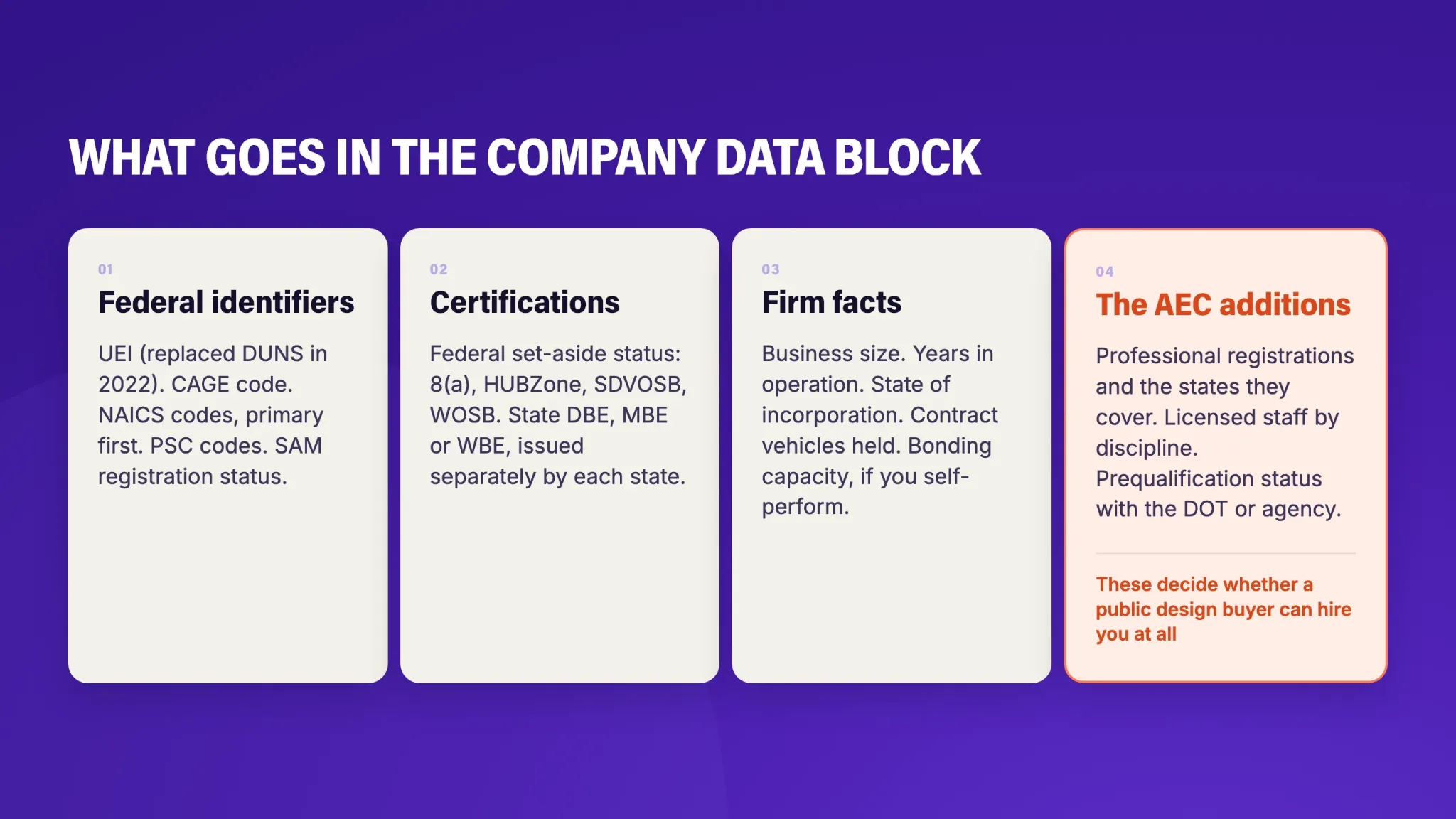
Here is the full set, grouped. Pay close attention to the last group, because it decides whether a public design buyer can hire you at all.
- Federal identifiers. UEI, the Unique Entity ID that replaced DUNS in 2022. CAGE code. NAICS codes, primary first. PSC codes. SAM registration status.
- Certifications. Federal set-aside status: 8(a), HUBZone, SDVOSB, WOSB.DBE, a federal program under 49 CFR Part 26 that each state administers through its own certification program and directory. Plus any state or local MBE/WBE certifications, which do run on each jurisdiction's own standards.
- Firm facts. Business size, years in operation, state of incorporation, contract vehicles held such as a GSA schedule or an IDIQ, and bonding capacity for firms that self-perform construction.
- The AEC additions. Professional registrations and the states they cover. Licensed staff by discipline. Prequalification status with the relevant DOT or agency. These decide whether a public design buyer can hire you at all, and most general capability statement guides skip them entirely.
As we mentioned before, that can sound like a lot for one page. But not every reader needs every piece. Here's the cut list, by who's holding it:
| Reader | Keep | Cut first |
|---|---|---|
| Federal contracting officer | UEI, CAGE, NAICS, set-aside certifications, SAM status | Firm history, awards, memberships |
| State DOT | Prequalification category and status, state registrations, on-call and task-order experience | Federal codes, clearances |
| County or municipality | Local and adjacent project experience, named references, funding-program familiarity | Federal codes, unrelated sectors |
| K-12 district | Occupied-campus and phasing experience, referendum or bond program work | Federal codes, breadth |
| Transit authority | FTA-funded project experience, rail and station or bus facility work, DBE goal attainment, multi-agency coordination | Unrelated sectors |
| University | Campus standards familiarity, facility-type depth, design review experience | Socioeconomic data they don't score |
| Prime looking for a teaming partner | Discipline depth, certifications that fill their goals, geography | Breadth, bonding, general capability language |
Certification requirements change with the buyer too. A federal 8(a) designation does nothing for a state DOT, which certifies DBE firms through its own program office, directory, and registration calendar. The Texas, Ohio, and Indiana Departments of Transportation each prequalify firms separately, on separate calendars. A firm working across state lines carries a different status in every one of them, and the statement has to reflect this.
Where your capability statement lives
Simply put: your capability statement lives wherever your buyer does. If yours lives only on your website, it might as well be furniture. The copies in circulation do the real work:
- Your SAM profile, current and complete, because federal buyers and primes both search it by code and by service term.
- Agency small-business offices, where these are the currency of the conversation.
- State DOT prequalification portals and DBE directories, where the subconsultant version works year-round.
- Sources sought and RFI responses. Attach it every time, and read the notice first, because these often state a page limit and a format.
- Primes assembling teams, before a specific pursuit exists. When the RFQ drops, teams form in days from the files already on hand.
- Industry days and matchmaking events, printed, in the hands of whoever's going.
One practical note: most of these are now read as a PDF attachment on a phone, uploaded into a vendor portal, or parsed by software before a person sees them. Which means your statement should exist primarily as live text rather than a flattened image, with a filename that identifies your firm rather than "capstatementfinalv4", and a layout that survives being read at half size.
Your statement feeds your SF-330 and SOQ
All of the work above is real work; but none of it is single-use.
The SF-330 is the federal government's standard A/E qualifications form. Section E carries resumes for key personnel, Section F carries relevant projects, and Section H carries the approach. Each one draws on the same underlying material as your capability statement: the same people, the same projects, the same outcomes, at different lengths and in a prescribed order. State, municipal and institutional owners ask for the same material again in a statement of qualifications.
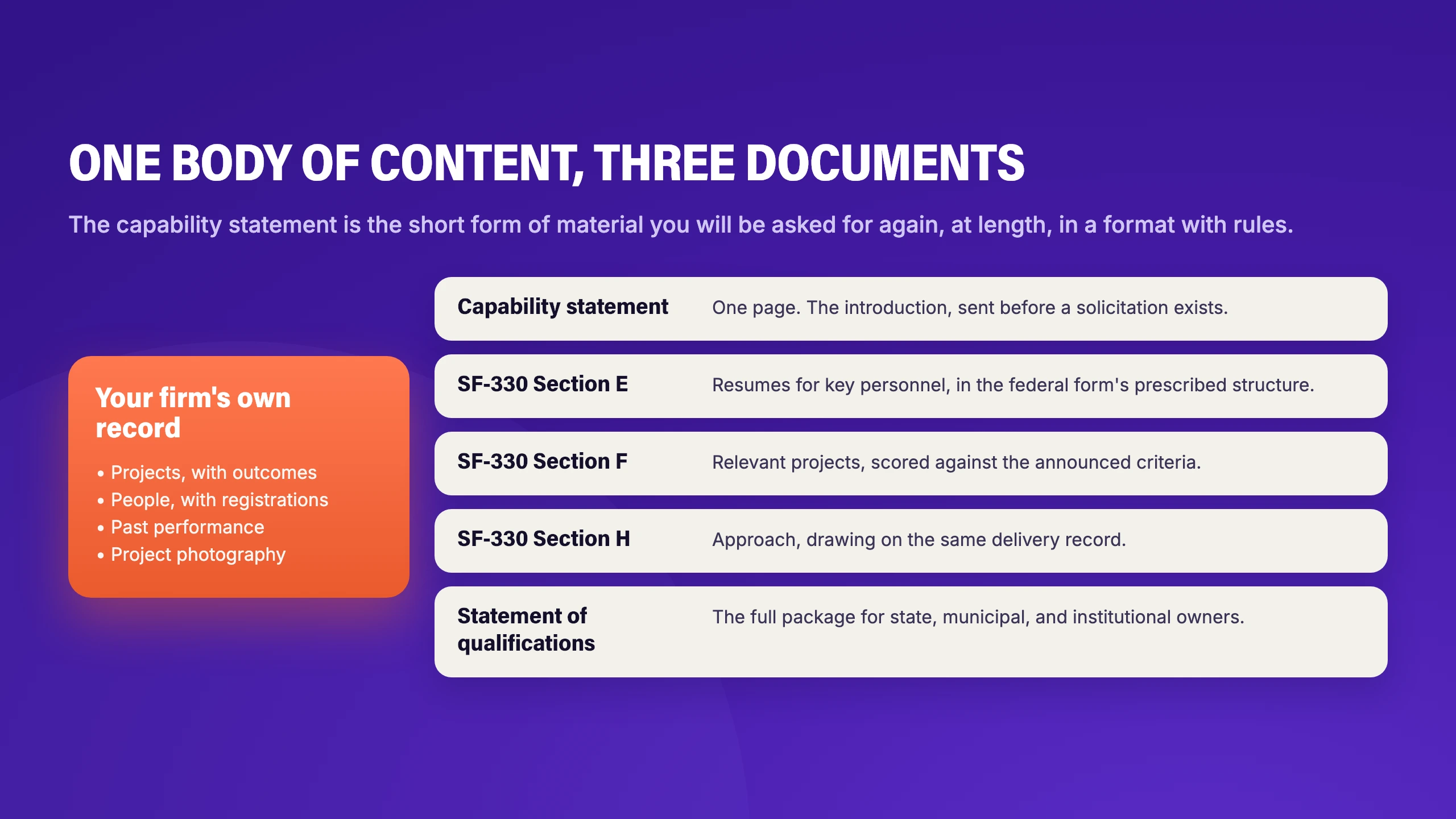
The documents are different views of one body of firm content. This creates a ripple effect you can observe at any firm: the ones that produce a tailored capability statement in an hour can also assemble a clean SF-330. The ones rebuilding from scratch every time struggle across the board.
Keeping the versions true
The standard advice to make several tailored versions of your capability statement is easier to give than to follow. Each version is another document a marketing coordinator has to keep accurate, and the items that typically go out of date are predictable:
- A project completes, and the line that said "under construction" is now a finished project with an outcome worth stating.
- A person leaves, and the licensed PE anchoring your differentiator is a competitor's licensed PE.
- A certification or prequalification lapses, which turns a qualifying fact into a disqualifying one.
In an ideal world, capability statements, methodology language, safety records, firm history, resumes, and project descriptions should all be current before the next pursuit starts. In practice, they live across shared drives, old proposals, InDesign files, local folders, and a coordinator's memory.
The number of versions you can carry often comes down to how well the content underneath them is organized. If it's organized, 10 is easy. If it isn't, one is already too many.
Your capability statement should be an assembly job, not a research project
If there’s one discipline we’ve been cornering throughout this post, it’s retrieval. The writing itself might take an afternoon. Finding the verified contract value, current resume, confirmed prequalification status, and photograph of the right project can take days.
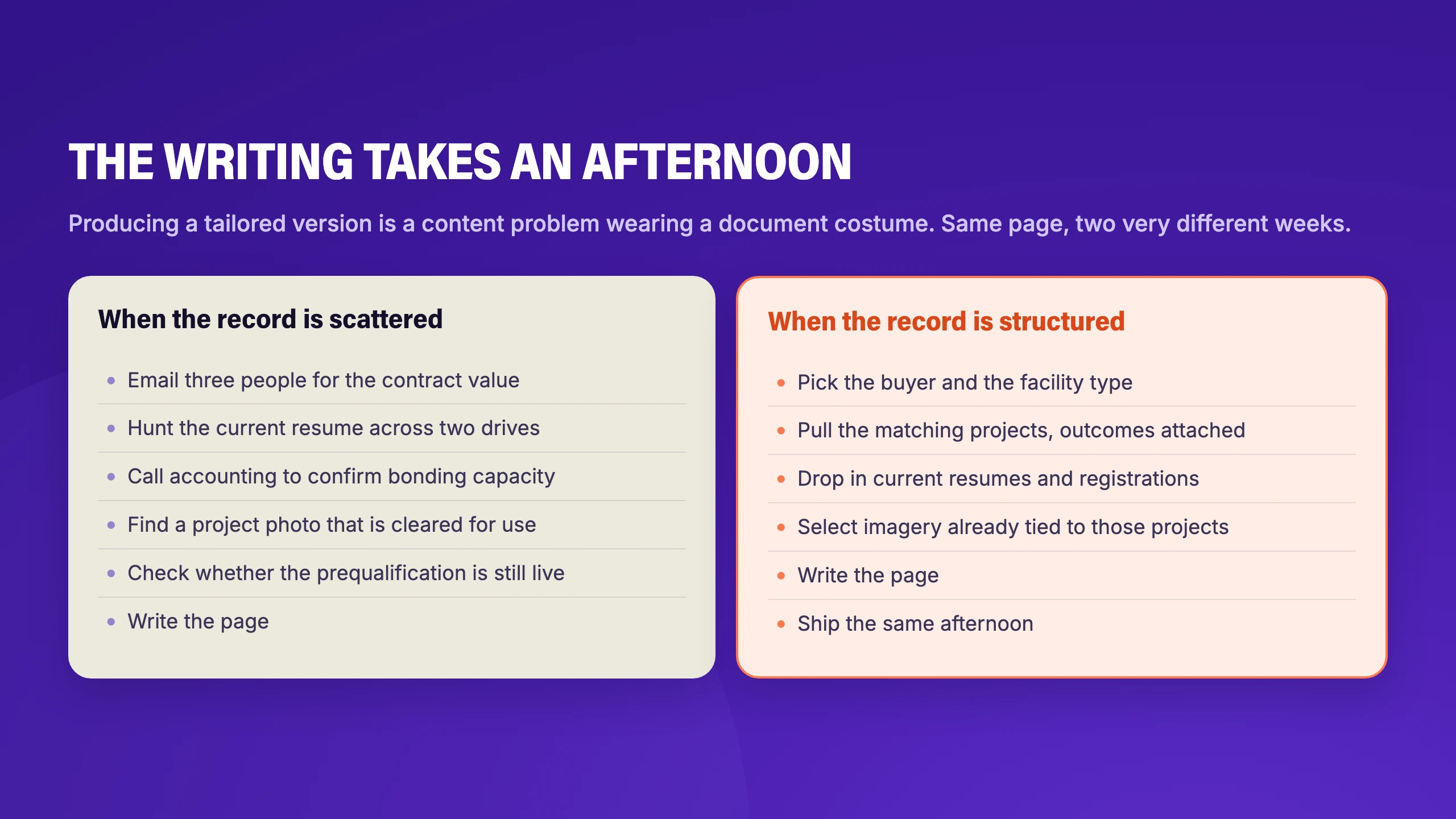
Grounding the writing in your firm’s institutional knowledge is exactly the job Kantiv was built for. It structures a firm's projects and past pursuits into a record the team can search, so the record builds from the work the firm is already doing.
With that in place, a tailored capability statement stops being a research project. The projects, outcomes, resumes and registrations are in one place and current, so the work is down to picking the right ones for this buyer.
Book a demo to see it against your own project history.
FAQs
How do I write a capability statement? Start from the buyer rather than the firm. Identify who's reading it and what they buy, choose the competencies that match, pull the projects that resemble the work with owners and outcomes attached, write the differentiators last from the pattern the proof shows, and fit it on one page.
What is the difference between a capability statement, an SOQ, and an SF-330? The capability statement is the one-page introduction, sent proactively or on request. A statement of qualifications is the full package a shortlist decision gets made on, often 10 times the length. The SF-330 is the federal government's standard A/E qualifications form, with a prescribed structure and scored sections. Each is built from the same underlying firm content.
Is there a required federal format? No single mandated format exists, which is why the guides contradict each other on length and section order. The real constraint is whatever the specific solicitation or sources sought notice says, so read that first.
What if I have no federal past performance yet? Use the relevant work you do have and say what it was. Commercial, state, municipal, or subconsultant experience on a similar facility type is more useful to an evaluator than an empty section or a padded one, and a named subconsultant role on a comparable project is legitimate past performance.
How many versions should we maintain? As many as you can keep accurate, which depends entirely on how well the source content is organized. Review quarterly at minimum, and treat a completed project, a departure, and a lapsed certification as events that trigger an update rather than waiting for the calendar.
Does it need to be designed? It needs to be readable at half size on a phone, in live text rather than a flattened image, with a real hierarchy. Beyond that, design helps and doesn't substitute for the content being checkable.