Found the content on this page useful? Share it with your team!
The Brooks Act: How Federal A-E Selection Works, and What It Asks of Your Qualifications


Table of Contents
A federal A-E synopsis lands while you’re finishing another submission, and your principal wants to pursue it before you’ve checked whether the firm’s experience fits. There’s already a fee in mind, but you’re still piecing together what the proposed project manager actually did on the project listed in Section E.
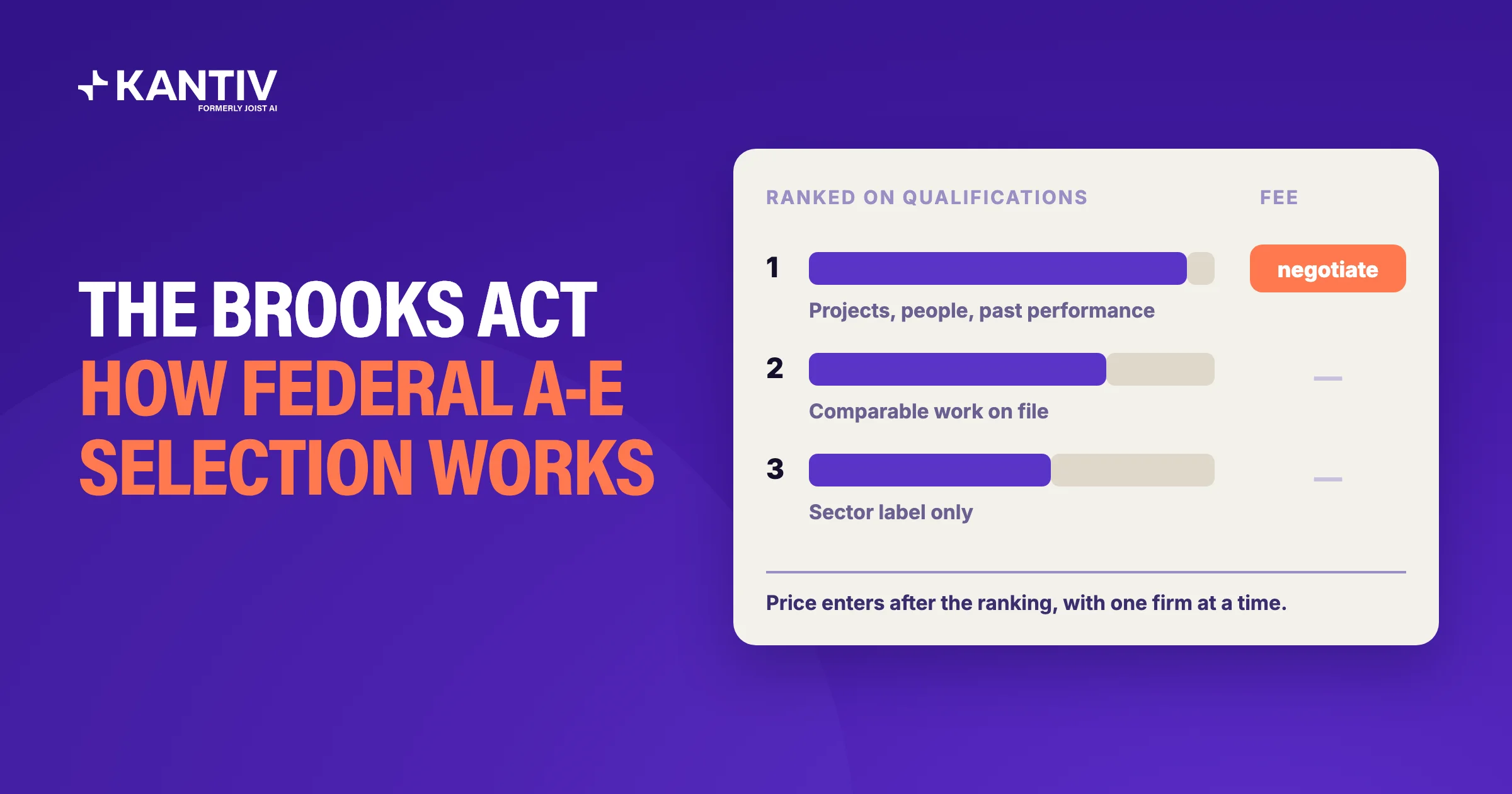
Under the Brooks Act, that unfinished qualifications record deserves more attention than the fee, because the agency ranks your qualifications before scope and price reach the negotiating table. Preparing that record in advance helps your team make the ranked list.
In this guide, we’ll cover what the Brooks Act is, what the selection process looks like, how to match your evidence to the agency's criteria, and how to keep your qualifications records current so you can be ready before the next synopsis lands.
What is the Brooks Act?
The Brooks Act sets the federal framework for selecting A-E firms on demonstrated competence and qualifications, then negotiating a fair and reasonable price. The policy comes from 40 U.S.C. 1101, and the negotiation runs in ranked order, starting with the most highly qualified firm. Fee is discussed only after ranking.
Codified FAR Subpart 36.6 carries the selection procedures, and FAR 36.601-3(b) directs A-E selection through that subpart rather than the solicitation and source selection procedures in Parts 13, 14 and 15. That’s why an A-E synopsis asks for an SF 330 instead of a priced proposal, and it’s why the agency’s own instructions are the correct document to follow.
Those procedures cover the federal work we discuss in this post. Many states have mini-Brooks Acts, but you can’t assume federal procedures carry over to state and local pursuits, and construction contracts follow different FAR Part 36 subparts than A-E selection.
Even on federal work, some agencies have adopted the FAR overhaul’s model deviations, so familiar section numbers may no longer match the text your agency is using. Before treating a FAR provision as the operating instruction, check the overhaul section near the end of this guide.
When does price enter Brooks Act selection?
Price is excluded from the qualifications competition. GAO’s explanation of the process has negotiations beginning with the most preferred firm after ranking, but selection for negotiation does not guarantee an award. The agency and your firm still have to agree on the work and a fair and reasonable price before there’s an award.
That separation shapes how you respond to a qualifications request. Your cost-control record helps establish qualifications, but the fee your principal has in mind belongs in negotiation.
| Informs qualifications ranking | Belongs in subsequent negotiation |
|---|---|
| Past performance on cost control | Proposed fee for the assignment |
| Relevant personnel experience | Level of effort and labor mix |
| Demonstrated technical competence | Scope assumptions and subcontracting arrangements |
For instance, evidence of managing design changes within an owner’s budget shows what your firm can do, but it doesn’t price the next assignment.
That later price discussion needs its own preparation, and the SF 330 won’t cover it. Have scope assumptions, a level of effort, labor mix, and proposed subcontracting arrangements ready for the day negotiations open. Codified FAR 36.606 names the extent of subcontracting as a negotiation topic.
If the agency and the firm can’t agree, the same provision requires a final proposal revision before the agency terminates negotiations and moves to the next firm. Negotiations follow the ranking one firm at a time. The ranked firms aren’t bidding fees against one another. If talks fail with every selected firm, the selection authority can direct the board to recommend more firms.
From public synopsis to negotiated award
Everything starts with the public synopsis, which describes the assignment and how to respond. The GAO Evergreen JV decision describes it as functioning like a solicitation, so answer every instruction as you would a solicitation. Provide the requested SF 330 material and supporting information exactly as the synopsis and its amendments ask, and keep watching the amendments until you submit. An amendment arriving halfway through can change what belongs in the response.
Your response isn’t the only thing the agency reads. Under 40 U.S.C. 1103 it also evaluates the current qualifications statements and performance data on file with the agency. So confirm that your SF 330 Part II and CPARS records support this pursuit.
Each stage asks the pursuit team for something different.
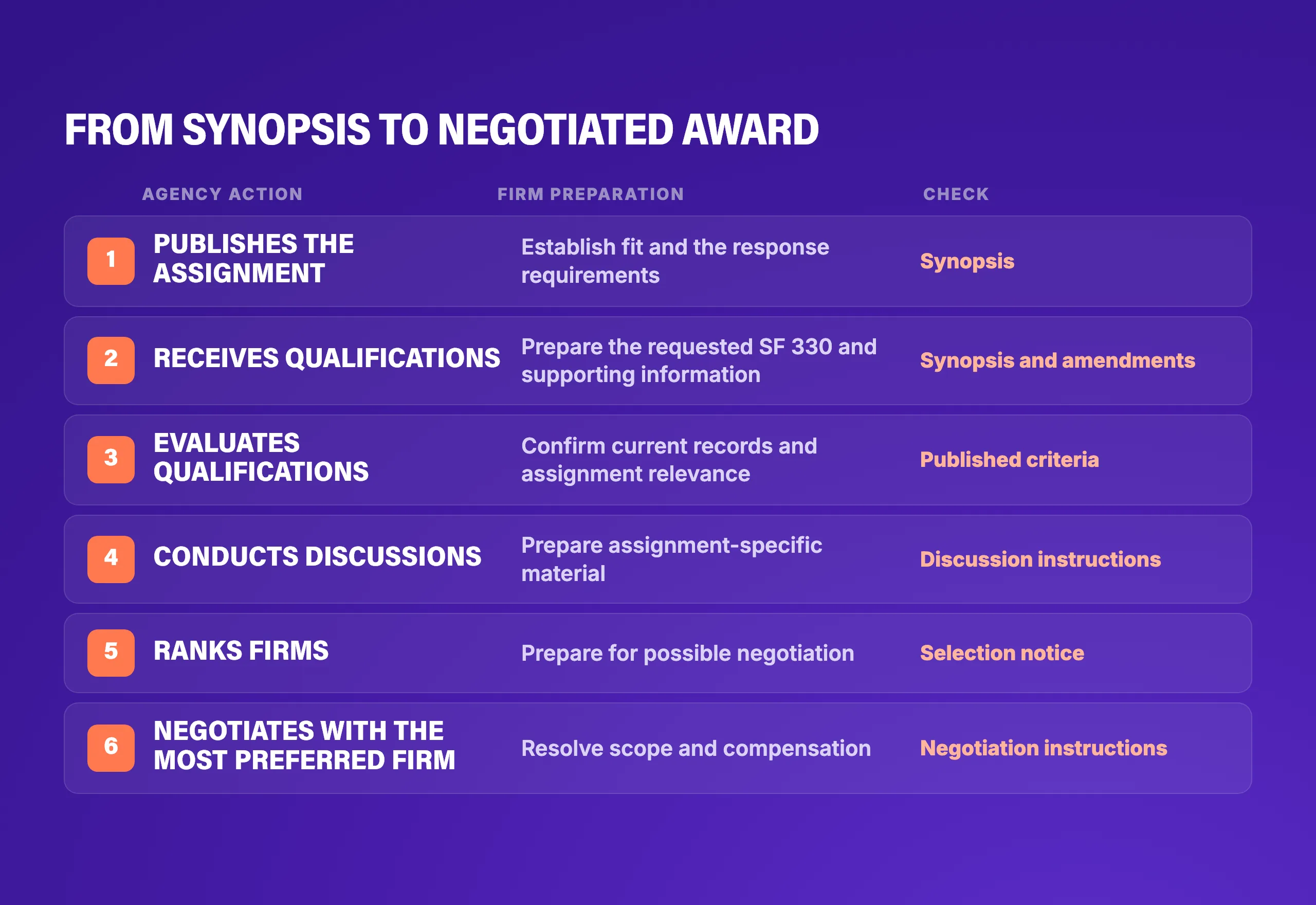
This sequence asks your team to stay ready as the agency moves from evaluating qualifications to discussing the assignment and, eventually, negotiating scope and compensation. That means looking beyond the submission deadline, especially to discussions. Plan your discussions before you submit.
The Brooks Act requires discussions with at least three firms, then selection of at least three firms, in order of preference, as most highly qualified. Three is the minimum, so don’t assume the slate will contain exactly that number.
Once firms are ranked, negotiation begins with the most preferred firm and moves to the next firm when those talks end without agreement.
Capture the agency’s stated submission, discussion, and negotiation requirements in your pursuit record as you go. Discussion format and scheduling may differ by agency and procurement, so write them down where the whole team can see them.
What qualifications does the agency evaluate?
Meeting the agency’s procedural requirements is only the starting point. Ranking turns on evidence that your firm qualifies for the assignment. And on its own, a sector label doesn’t count as evidence. “Hospital experience,” for instance, may look relevant, but that label alone doesn’t show whether the project involved the services and constraints the synopsis describes.
Codified FAR 36.602-1 provides a reference point for identifying the qualifications that matter, but agencies may add or adjust criteria, and an adopted overhaul deviation may change which procedural text applies. So start with the actual synopsis to see what the agency requires.
Those published criteria tell you how to organize project and team qualifications and what evidence to assemble behind each one.
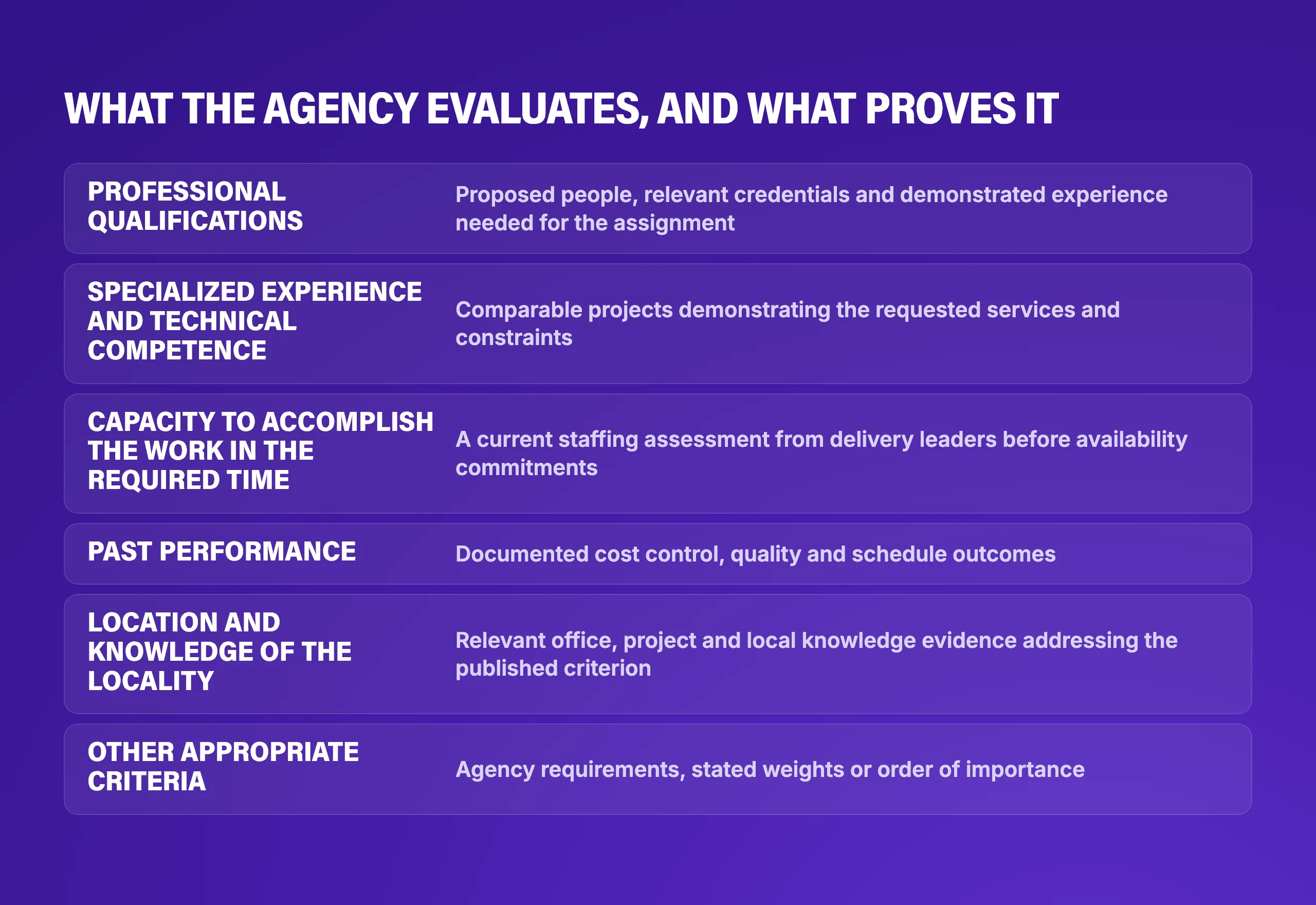
Assembling evidence means checking it. An old proposal may say a project finished on schedule, and under deadline it’s tempting to carry that line forward, but the proposal manager still has to check the project record. Repeated copy isn’t proof.
Check what the evidence actually demonstrates, too. Your nearby office can address the published location criterion, but proximity can’t substitute for qualifications. The published criteria don’t necessarily carry equal weight, so weigh that location advantage against the agency’s stated priorities.
Build an evidence map before drafting
With the priorities clear, read your project descriptions the way the board will. Your strongest water project won’t prove the qualification if its description never gets to rehabilitation phasing, shutdown coordination, or what the proposed engineer actually did inside the operating facility.
Those gaps belong in your go/no-go decision. If you find you have thin experience coverage or unconfirmed partner commitments, for instance, these are good reasons to revisit the pursuit before anyone starts writing the proposal.
An evidence map makes those gaps visible before drafting starts. Take the below operating-facility map as an example:
| Evaluation criterion | Proposed evidence | Supporting record | Verifier | Unresolved question | Response location |
|---|---|---|---|---|---|
| Specialized experience and technical competence | Phasing plan for [project name] | Phasing plan | Project manager | Which services did firm perform? | Section F |
| Professional qualifications | Engineer’s shutdown coordination | Meeting records | Proposed engineer | What was engineer’s contribution? | Sections E and G, as requested |
| Capacity | Proposed engineer’s availability | Staffing forecast | Principal | Is availability confirmed? | Section H, as instructed |
You’ll want to pick the projects for your map from the requested scope and constraints, then read the synopsis alongside the form so you can see where your personnel and projects connect across Sections E, F, G and H, where requested.
As you map each requirement to supporting evidence, keep a separate compliance matrix for submission instructions, forms, signatures, and delivery requirements. Both matter, but a verified signature still doesn’t establish the engineer’s role.
💡Pro tip: To help assemble this evidence, Kantiv, formerly Joist AI, is a pursuit intelligence platform whose Knowledge Graph helps teams find relevant projects, people and supporting material, link selected records to a pursuit workspace and develop source-grounded drafts, including tailored first drafts and resumes informed by synopsis requirements.
Prepare for discussions around the assignment
The same evidence map carries into the discussions 40 U.S.C. 1103 requires. Start with the agency’s instructions, because a presentation, an interview, and an additional written response each ask your technical leads to prepare differently.
A well-made preparation sheet connects constraints and published criteria to the questions you expect. For each question, name the speaker and the experience and records behind the answer. Each technical lead needs to explain their own project contributions, so check their accounts against the records before rehearsing. If resumes, project descriptions and discussion material disagree, practice can stall while your team sorts out who did what.
Once the accounts agree, practice alternatives and tradeoffs. Your proposed project manager might walk through how the team would investigate shutdown constraints before committing to phasing, with a verified past project behind the judgment. Stay inside the agency’s request and the technical leads’ real experience, so every rehearsed answer traces to a real project.
💡Pro tip: To support that practice, shared prompts in Kantiv chat help teams anticipate agency questions, find connections between projects and people, and tailor responses from firm records. Technical leads verify answers and supply judgment. At Mortenson, Proposal Manager Jen Orthaus says Kantiv lets the team "show up differently in the proposal process, not just as information gatherers, but as strategists."
Keep qualifications records ready between pursuits
Good preparation depends on records that stay current between pursuits. If an engineer takes on new responsibilities but their personnel record doesn’t change, your proposal manager has to piece together project roles from old emails when the next synopsis arrives.
The same records go into the standing qualifications file some agencies keep. Under codified FAR 36.603, a firm that wants to be considered for an agency's A-E work files an SF 330 Part II with the appropriate agency office, and Part I when applicable. GSA removed that section under its overhaul deviation and other agencies may follow, so check the agency's current filing instructions before you file.
The annual review in FAR 36.603 is the agency's job, not yours. The offices that keep those files have to review and update each one at least once a year, and they can discard material that hasn't been updated in three years if it is no longer pertinent. Nothing in that section sets an annual filing deadline for your firm.
What FAR 36.603 does say is that those offices should encourage firms to update their SF 330 Part II every year. USACE goes a step further for firms holding one of its IDIQ contracts. EP 715-1-7 (January 2026), paragraph 2-9.e, says the contracting office asks for the update around the anniversary of the base contract award.
Scheduled reviews aren’t enough on their own. Your proposal manager can coordinate checks, but technical leads know personnel credentials and project roles, while project managers can confirm reference details and performance evidence. So update the records whenever something material changes. One BD leader told us she starts updating project descriptions and resumes six months ahead of a recompete so nothing has to be reconstructed when the synopsis arrives.
Task orders under an A-E IDIQ run on their own rules, as covered in our guide to IDIQ. Whether another full SF 330 is required depends on the contract’s task-order instructions.
What has the FAR Part 36 overhaul changed?
Last updated November 5, 2026.
It’s important to keep in mind that the FAR reference your team usually reaches for may no longer be the text governing a pursuit. GSA class deviation RFO-2025-36, dated July 22, 2025, implements the Part 36 model deviation for GSA procurements, so your team still needs to check other agencies’ adoption and instructions.
Under the deviation, Part 36 runs in three stages, covering pre-solicitation, evaluation and award, and post-award. GSA removed the A-E evaluation criteria (36.602-1) and qualifications-file rules (36.603), and the Brooks Act’s statutory qualifications-first process remains. The table below compares familiar references with the agency’s applicable text.
| Codified reference or requirement | Change under GSA deviation | What to verify |
|---|---|---|
| Part 36 organization | Reorganized around acquisition stages | Older references against applicable text |
| 36.602-1 evaluation provisions | Specific provisions removed | Criteria published in synopsis |
| 36.603 qualifications-file provisions | Specific provisions removed | Current agency filing instructions |
| Construction prime’s own-force requirement (ordinarily at least 12%) | Removed | Applicable subcontracting restrictions |
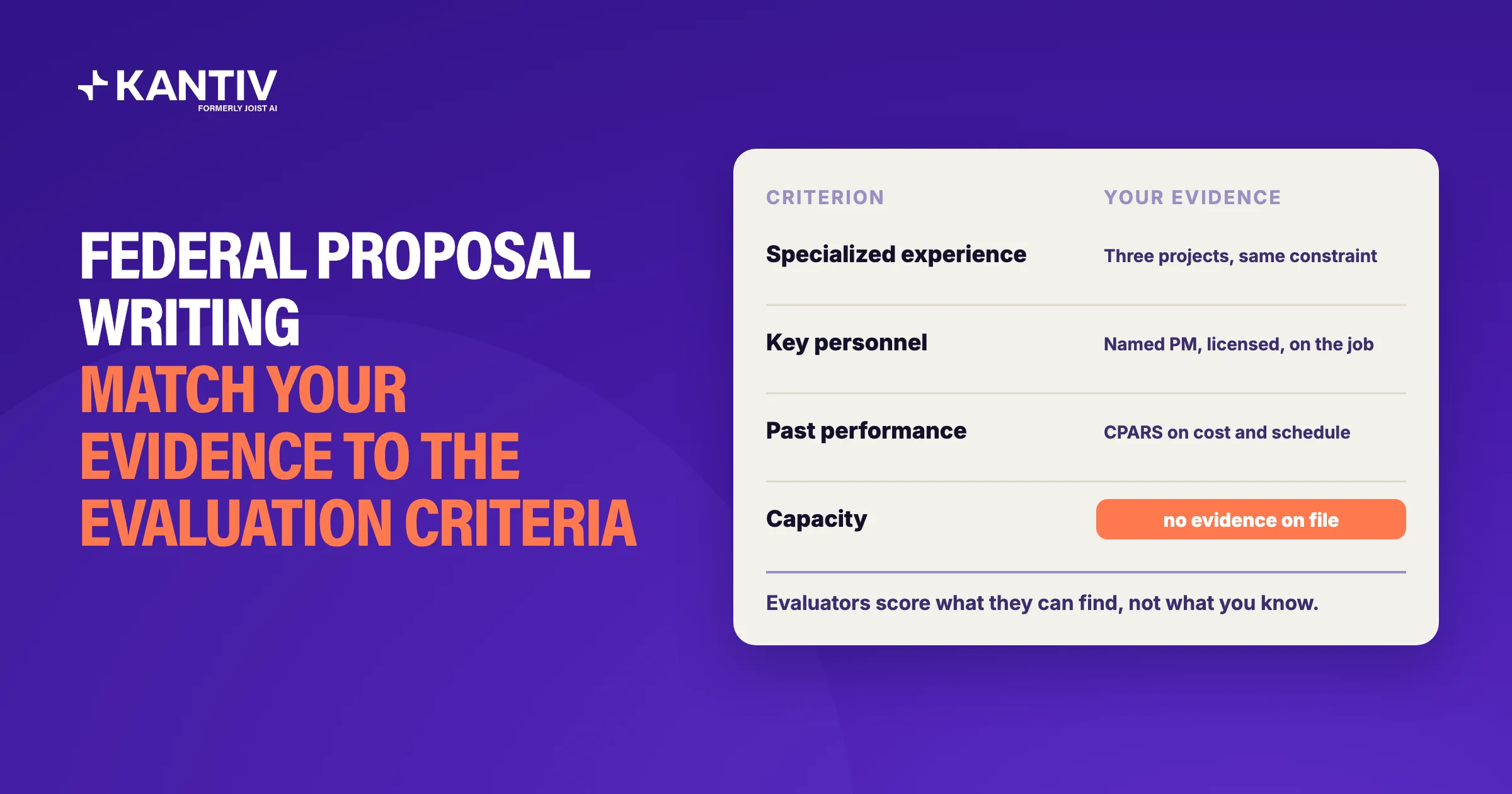
Capacity shows why the comparison matters. Under the GSA deviation, the 36.602-1 criteria no longer apply to GSA procurements, so “capacity to accomplish the work in the required time” is no longer a listed criterion there. The SF 330 has no dedicated capacity section, so address it where the synopsis directs (often Section H).
The 12% requirement shown as removed in the table is the construction prime’s own-force requirement, lifted under the GSA deviation. It isn’t an A-E selection criterion, and its removal doesn’t mean subcontracting restrictions in general went away.
A good rule of thumb: Keep proposed text separate from effective text. The proposed Part 36 rule (FAR Case 2026-010) was published September 18, 2026. Comments closed October 19. It is not final. So check the official rulemaking page at drafting and again at publication.
For the pursuit in front of you, start with the synopsis and the deviations it cites, then check current agency guidance through the FAR overhaul hub. If a question is still open, ask it through the authorized channel before the team commits to a procedure on an assumption.
Prepare for Brooks Act selection with evidence you can support
Once your team has checked the applicable agency procedures, it needs records that show how the firm meets the synopsis’s published criteria. Your principal may know why the firm belongs on the slate, but the evaluation board works from the project and personnel records in front of it, and reputation doesn’t fill the gaps in them.
Searching old proposals and assembling records by hand leaves seller-doers less time to judge whether the firm’s experience actually fits the pursuit. This gets harder still when familiar FAR references no longer match the agency’s text or filing instructions.
Kantiv was built for exactly this problem. Kantiv’s Knowledge Graph helps your team find relevant projects, people and supporting material and link selected records to a pursuit workspace. Using the synopsis as a starting point, Kantiv helps draft responses based on firm records, so technical leads have evidence to assess against the published criteria.
Want to try it? Book a demo, bring a live synopsis, and see how Kantiv can help your team build a better qualifications response.
FAQs
Does the Brooks Act require selection of the lowest-priced firm?
No. Firms are ranked on demonstrated competence and qualifications against the published criteria, with price excluded from ranking. The agency then negotiates fair and reasonable compensation with the highest-ranked firm. A lower fee doesn’t move another firm ahead during qualifications evaluation.
What is the difference between the Brooks Act and FAR 36.6?
The Brooks Act is the statute. FAR 36.6 is the set of procedures that implements it. That distinction matters when familiar FAR provisions change or disappear under an applicable deviation. Your team still needs to check the agency’s governing text and the synopsis for the pursuit.
What happens if the highest-ranked firm and agency cannot agree on a fee?
If the agency cannot negotiate fair and reasonable compensation with the highest-ranked firm, it formally terminates those negotiations and proceeds to the next-ranked selected firm. Ranking first puts your firm first in line for negotiation. It doesn’t establish an award or guarantee agreement on compensation.
Did the FAR overhaul remove qualifications-based selection?
No. The reorganization removes implementing detail while retaining the Brooks Act’s statutory qualifications-first process. GSA’s Part 36 deviation changes familiar provisions, but other agencies’ adoption and instructions need checking. A proposed rule or closed comment period doesn’t establish that a final rule has taken effect.
Does each A-E task order require a new SF 330?
There isn’t a universal requirement to prepare a new SF 330 for every A-E task order; the IDIQ post covers how task orders are assigned. The contract’s task-order instructions and applicable agency procedures govern what your firm needs to provide. Annual qualifications updates are a separate matter; they don’t establish the submission requirements for each order.