Found the content on this page useful? Share it with your team!
Federal Proposal Writing for AEC Firms: How to Match Your Evidence to the Evaluation Criteria


Table of Contents
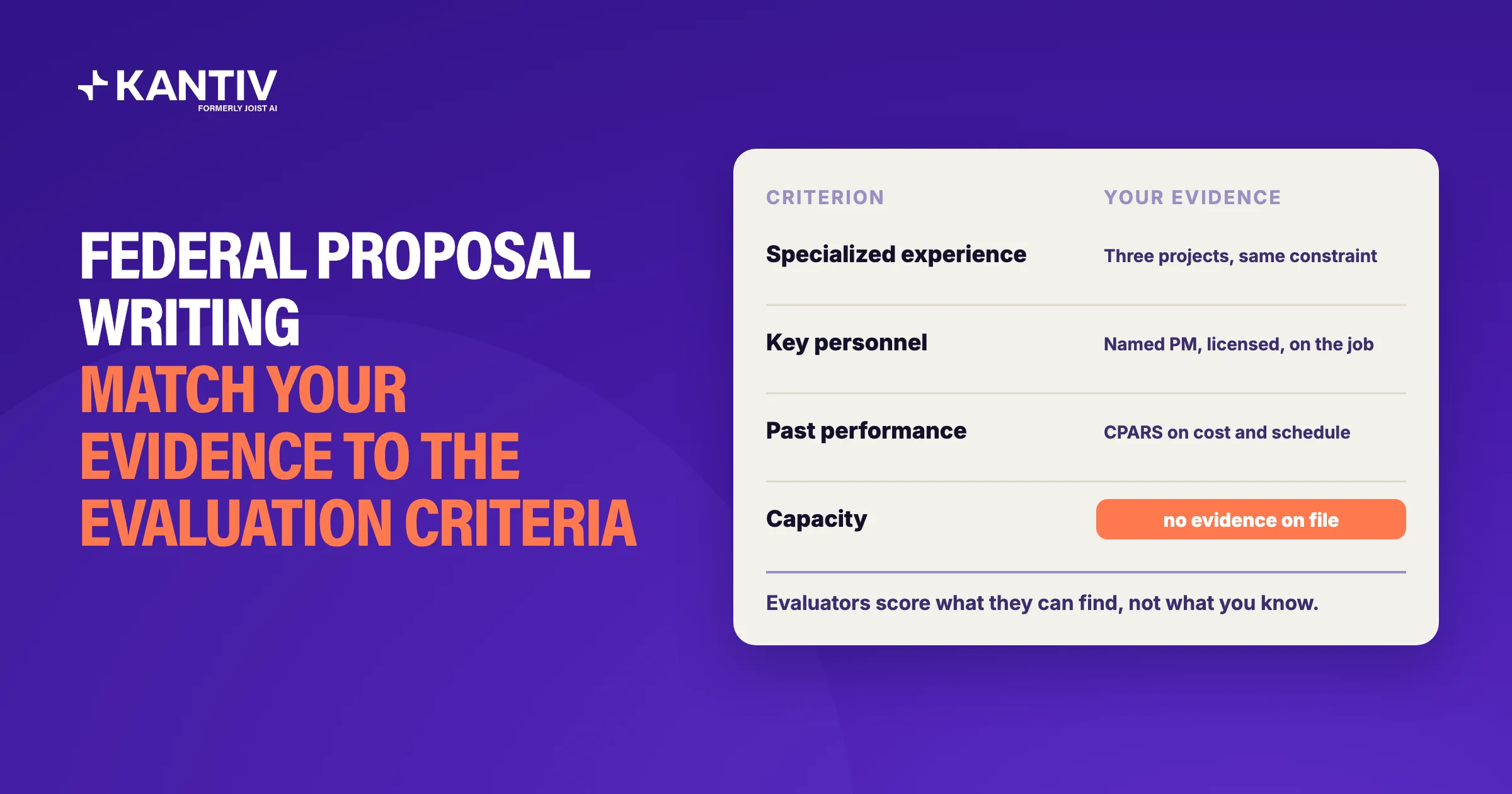
Another proposal is due this week, and your proposal manager has project descriptions open beside a new agency notice. The experience looks relevant, so reusing those descriptions makes sense. But the notice asks for evidence that your firm can handle concurrent assignments, and the old response barely references that.
Federal evaluators score submissions against stated criteria. So even an accurate project description can result in you losing points because it leaves the agency’s capacity question unanswered if it doesn’t address concurrent assignments.
Polished prose won’t supply that missing evidence, either. Your principal may know the people are available, but the evaluator has only the proposal in front of them. The response needs to explain that availability, rather than leave the evaluator to infer it from completed projects.
Making that connection between your qualifications and the agency’s questions is one of the core tasks in federal proposal writing. In this guide, we walk through federal proposal writing for A-E qualifications submissions, including how A-E selection differs from construction procurement, and how evaluation criteria shape the evidence your team presents.
What is federal proposal writing?
Federal proposal writing means preparing a response to a federal agency’s stated requirements and evaluation criteria. For an A-E pursuit, that commonly means a qualifications submission using the SF 330. Choosing which projects deserve space in this standard form is already an argument about the firm’s qualifications.
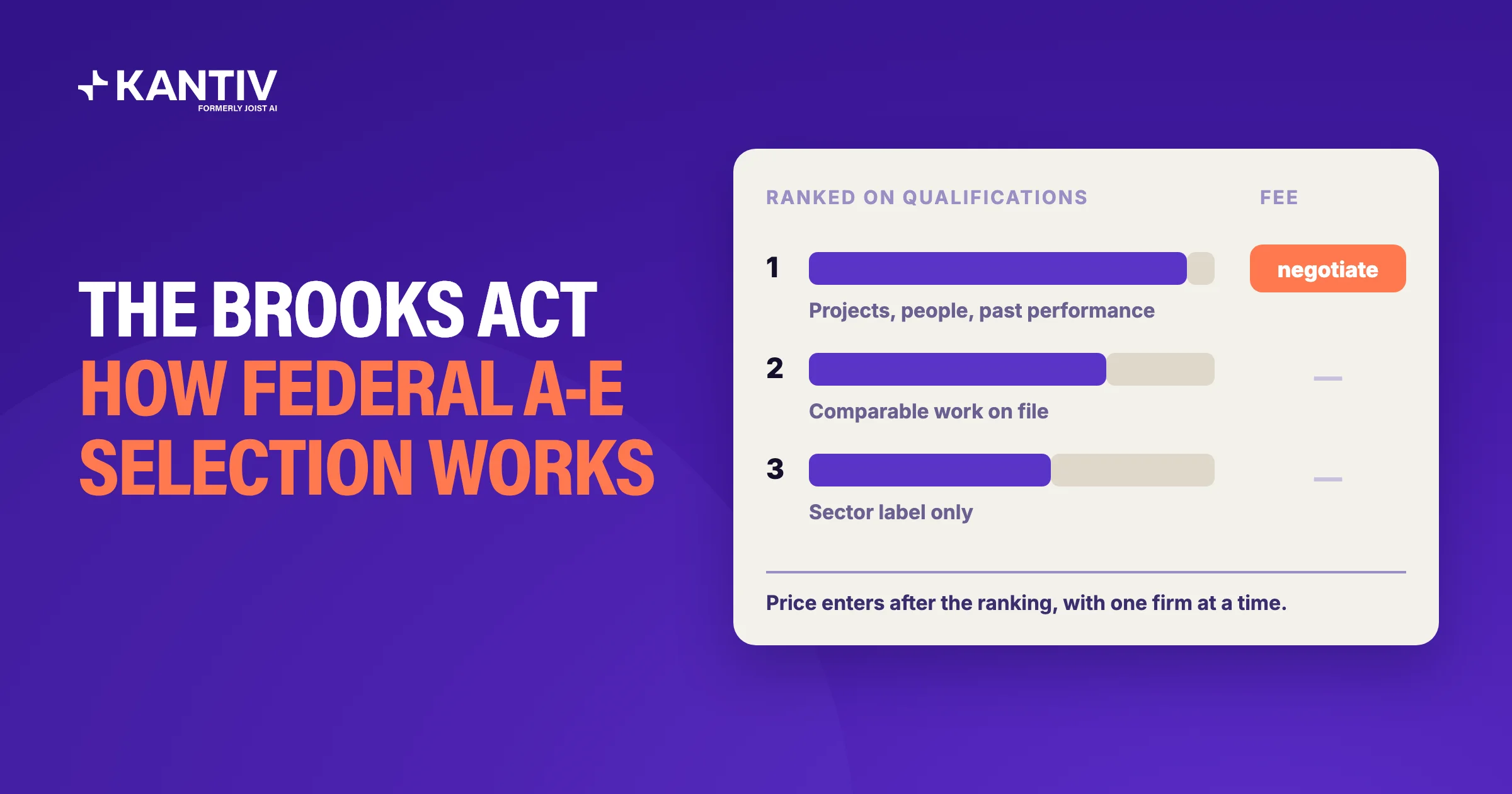
That emphasis on qualifications reflects how federal A-E services are selected. Selection follows a qualifications-based process, while construction typically considers price alongside technical factors. Your team needs to establish that distinction before opening an old proposal, because an A-E approach won’t fit every public pursuit.
Keep in mind: once you’ve established the approach, that old proposal may still offer good material. A private-client narrative about keeping an occupied facility operating during renovation, for instance, might explain your team’s phasing decisions beautifully. But it belongs in the proposal only if those phasing decisions answer the agency’s published criteria.
Your principal’s favorite project faces the same test. Size and prominence can carry a client presentation, but they don’t, by themselves, make the team's fit clear. Even when the principal has already picked the cover image, the proposal manager still needs to explain how that project’s experience connects to what the agency will evaluate.
To establish that connection, start with the procurement type, requested submission, evaluation criteria, and submission instructions. Together, they give you a basis for explaining why a passage belongs, or why an impressive project has to go. The previous draft supplies material, but the agency’s requirements determine what survives.
How does federal A-E selection differ from construction procurement?
Confirming the procurement type matters even if your principal already has a fee in mind before the team has chosen projects for the SF 330. As we’ve specified, A-E submissions begin with qualifications. Price enters at negotiation, as GAO’s explanation of the process in McKissack-URS describes.
To apply that distinction to your pursuit, confirm how the solicitation treats qualifications and price.
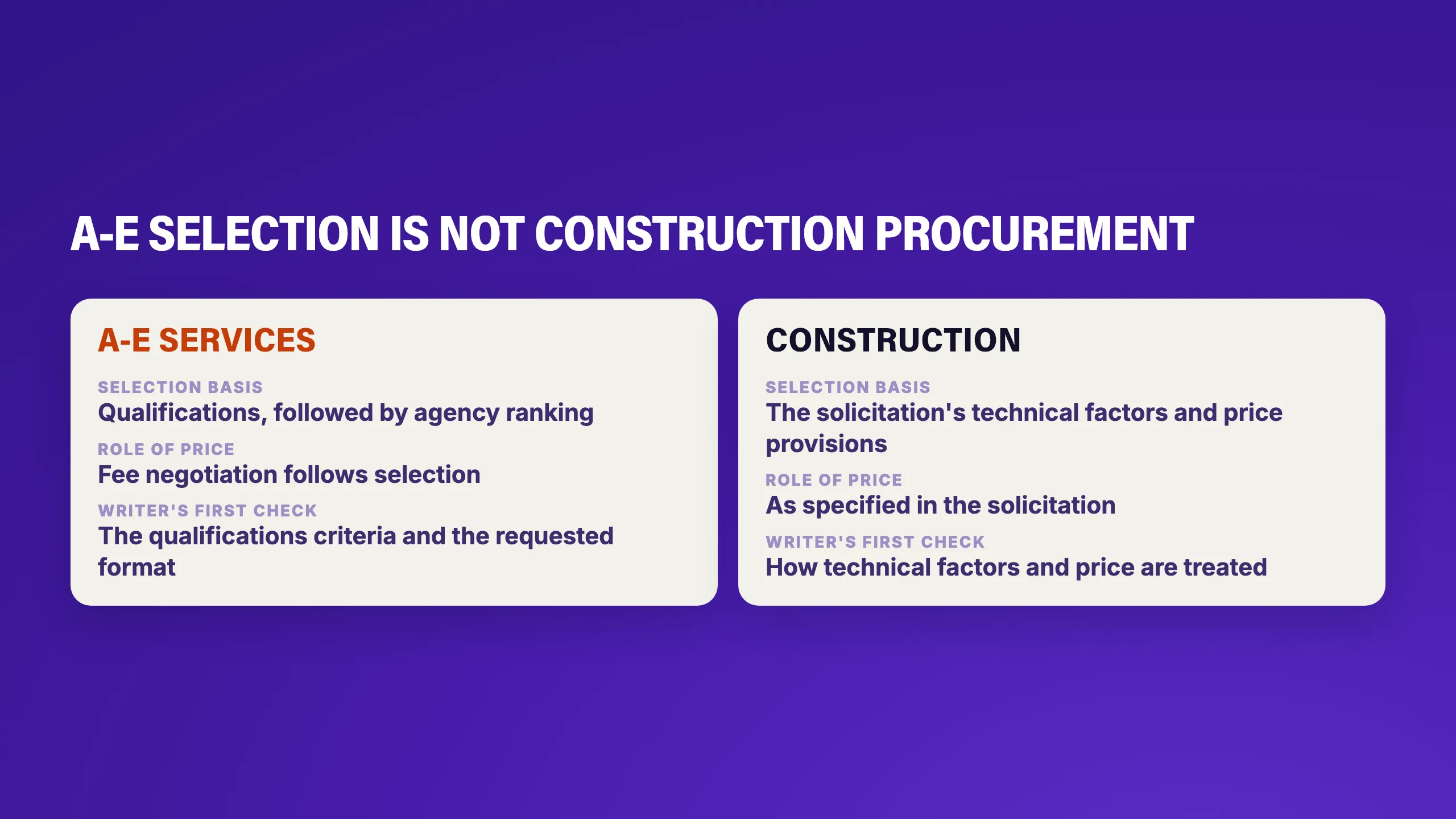
For construction pursuits, start with the solicitation’s treatment of technical factors and price. The A-E sequence doesn’t apply simply because the buyer is a federal agency. Being able to distinguish a qualifications request from a priced proposal tells your team what response to build before drafting begins.
Once you’ve confirmed the A-E approach, the central task is to prove relevant competence, past performance, and capacity in the format the agency requests. This requires more than just demonstrating relevant experience. Your principal’s preferred project manager may have the right background, for instance, but already be assigned to a project that runs at the same time as this one.
Raise that conflict, and any other evidence gaps, in your go/no-go decision before you commit pursuit resources. Otherwise, your team is committing effort before establishing whether your project manager can do the work.
Turn the evaluation criteria into an evidence plan
Capacity is one of several criteria your team needs to prove. A familiar criterion can carry unfamiliar weight, and each agency decides how much each criterion counts. The traditionally listed FAR A-E selection criteria cover the following areas:
- Professional qualifications
- Specialized experience and technical competence
- Capacity
- Past performance on cost, quality and schedule
- Location and local knowledge, provided applying that criterion leaves an appropriate number of qualified firms given the project’s nature and size
- Other appropriate criteria.
Some agencies apply their own requirements, so the Brooks Act framework needs to be read alongside the agency’s applicable requirements.
Those agency requirements aren’t just a set of rules; they establish the priorities for your response. In the Jacobs Engineering decision, for instance, the National Guard Bureau ranked professional qualifications ahead of specialized experience, capacity, past performance, and location. That order belonged to that procurement, so it shouldn’t become your team’s default, but it illustrates how priorities need to carry into drafting.
To do that, make sure you record the order in which the agency lists its evaluation criteria, as well as any published weights. That record helps your team translate evaluation criteria into evidence assignments before project selection hardens around the last proposal’s contents.
Take a capacity criterion as an example. Before the firm claims it can handle concurrent assignments, the evidence plan might record the following:
| Agency wording | Relative importance | Supporting people or projects | Source record | Response location | Unresolved gap |
|---|---|---|---|---|---|
| “Capacity to accomplish multiple concurrent task orders” | 3rd of 5 (criteria listed in descending order) | PM Jane Ortiz, PE; lead mechanical engineer Raj Patel, PE | Q1–Q4 staffing forecast | Section H, para 2 | Has Jane’s office director confirmed she’s available from Q2? |
| Same criterion | 3rd of 5 | Jane’s current VA clinic project (design ends March) | Project commitment schedule | Section H, para 3 | Does the VA clinic’s construction phase overlap with the first task order? |
| Same criterion | 3rd of 5 | Principal-in-charge Mark Chen; backup PM Lisa Gray | Management coverage plan | Section H, para 4 and the Section D org chart | Has Lisa been approved as backup PM? |
*illustrative example
With those records assembled, the proposal manager can draft once the principal confirms availability and coverage. Until then, the capacity claim still has an unanswered staffing question behind it.
Alongside those evidence assignments, submission instructions belong in the compliance matrix as well. Your team needs to check both, because a correctly formatted capacity narrative can still leave the evaluator without evidence of available personnel. Meeting the instructions and substantiating the claim need to be separate checks.
Select projects that demonstrate relevant performance
With the evidence assignments in place, it’s time to select projects that prove the criteria. A sector match may look persuasive on a project sheet, for example, but if your firm’s role was smaller than the headline suggests, the agency has little to go on. Scope, constraints, dates and your firm’s actual role help establish how much of that fit holds up.
Here’s the difference on the page. Let’s say the agency’s criterion is specialized experience in occupied healthcare facilities. A project sheet usually says something like “prime designer for the renovation of an operating hospital, completed on schedule.”
Written to the criterion, it should read: “prime designer for a phased renovation that kept the hospital’s surgical and imaging floors in service, with our team leading the phasing plan and the infection-control coordination with the owner’s facilities group.”
Notice the difference? The first names a project. The second actually answers the criterion.
The difference between naming a project and proving fit matters even more for past performance. What your firm did establishes experience. Showing how it controlled cost, delivered quality and met schedules requires evidence that an impressive project description won’t necessarily contain.
When choosing your evidence, consider private work alongside government assignments. The FAR criteria include government and private-industry past performance, though the solicitation determines whether a private example qualifies. Federal pedigree shouldn’t win by default, because your private assignment may offer stronger evidence of the work being requested.
💡Pro tip: To find that evidence, Kantiv, formerly Joist AI, combines its Knowledge Graph with search to help locate the projects and people that support each claim. Benesch uses Kantiv for team bios, collateral and case studies. People still verify project facts, qualifications and relevance to the criteria.
Finally, before a project goes in, confirm from the source records what your firm did, who did it, and what the outcome was. Unconfirmed outcomes should remain out of the draft until your technical lead confirms them.
Capacity needs a staffing explanation
Just as project claims need verification, staffing commitments need confirmation. Your proposal manager may have names in boxes while office leaders are still negotiating who can spare those people. The chart alone says nothing about their workload.
Whether your response needs a capacity explanation depends on the agency’s notice. Under the FAR overhaul, capacity is no longer a listed criterion, and the SF 330 doesn’t ask about it directly.
If the notice asks about capacity, show how your proposed team maps to the roles the agency listed. Say who does what and who reports to whom, and state that their availability has been confirmed by someone with the authority to commit them. Where it affects coverage, mention their other current assignments, how much management attention the work gets, and any support from other offices. An IDIQ contract raises the same question on every task order. A name in a box under the project manager doesn't prove the person is available.
The 2022 Accura Engineering decision, which predates the overhaul, shows why that distinction matters. NASA questioned part-time key-personnel engagement and reduced the capacity score from 18 to 14 out of 20. GAO found that concern reasonable and denied the protest. NASA also questioned task order managers marked “TBD” on the chart. (GAO treated that argument as abandoned because Accura didn’t answer NASA’s rebuttal in its comments on the agency report.)
The concern about part-time engagement didn’t mean part-time personnel were generally disqualified. The question was whether that staffing could meet that procurement’s demands.
To answer that question consistently, check your resumes, project descriptions, personnel-by-project matrix (SF 330 Section G), and staffing narrative together. If those documents assign someone conflicting roles (Jane is the project manager on page 4 but the QA reviewer on page 9), they leave the agency with competing accounts of who’ll do the work. Resolve those conflicts with your principal or staffing lead before submission commits your firm to the assignments.
The SF 330 organizes the evidence
The SF 330 has two parts. Part I presents contract-specific qualifications; Part II presents general qualifications. FAR 36.603 used to direct agencies to review their qualifications files every year and to encourage firms to submit an updated Part II annually. The FAR overhaul removed that section, but a current Part II is still worth keeping because agencies use it to decide which firms to invite. That upkeep matters, but it doesn't settle which qualifications belong in your response to this contract.
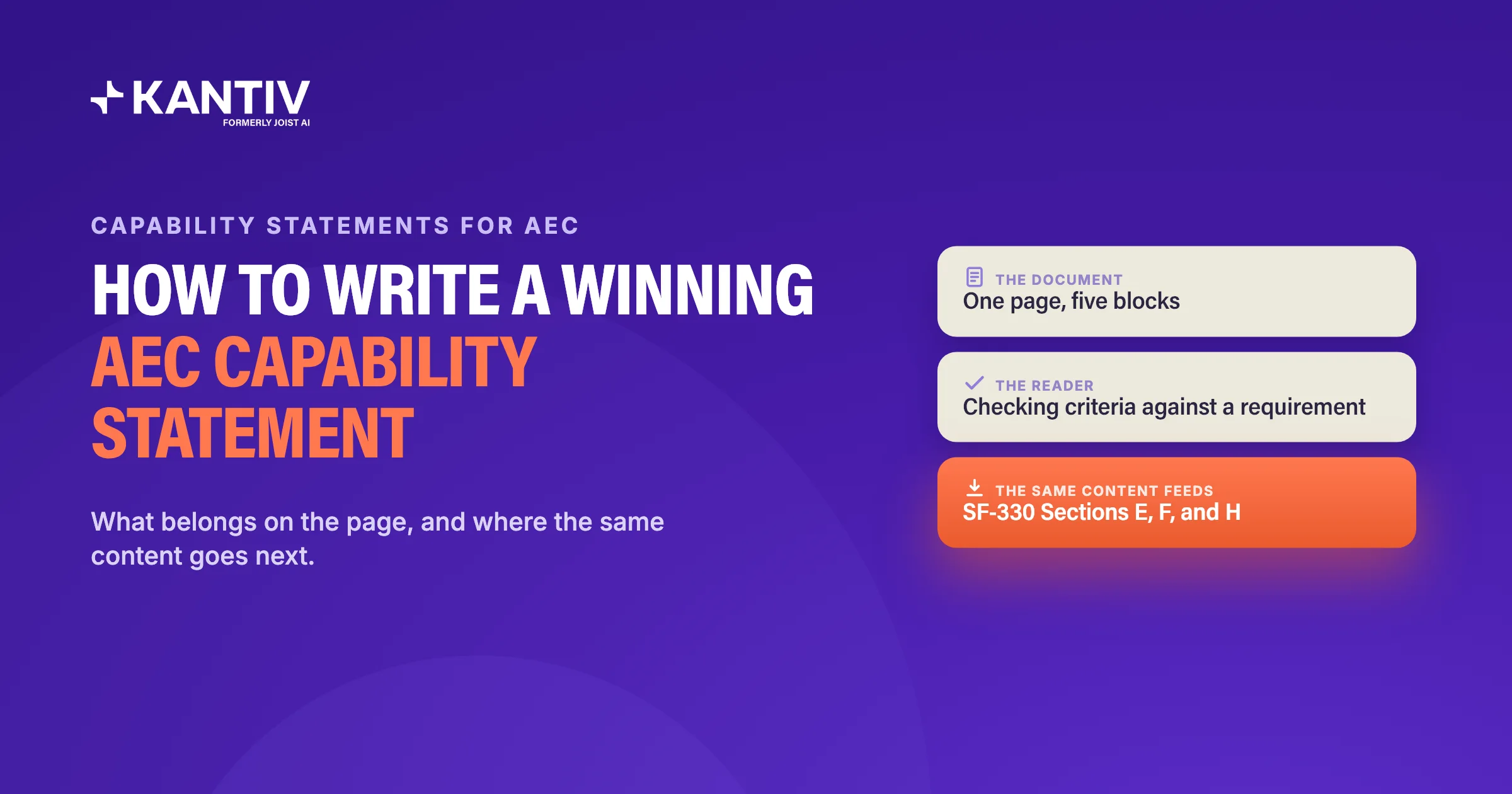
For your contract-specific response, the SF 330 instructions give Sections E through H distinct jobs, and these sections need to support one another. Section E establishes individual qualifications, F describes relevant projects, G connects people to projects, and H addresses requested additional information. When a resume doesn't explain the person’s contribution to a project in F, a checked box in G leaves the proposal manager chasing evidence that should already be on the page.
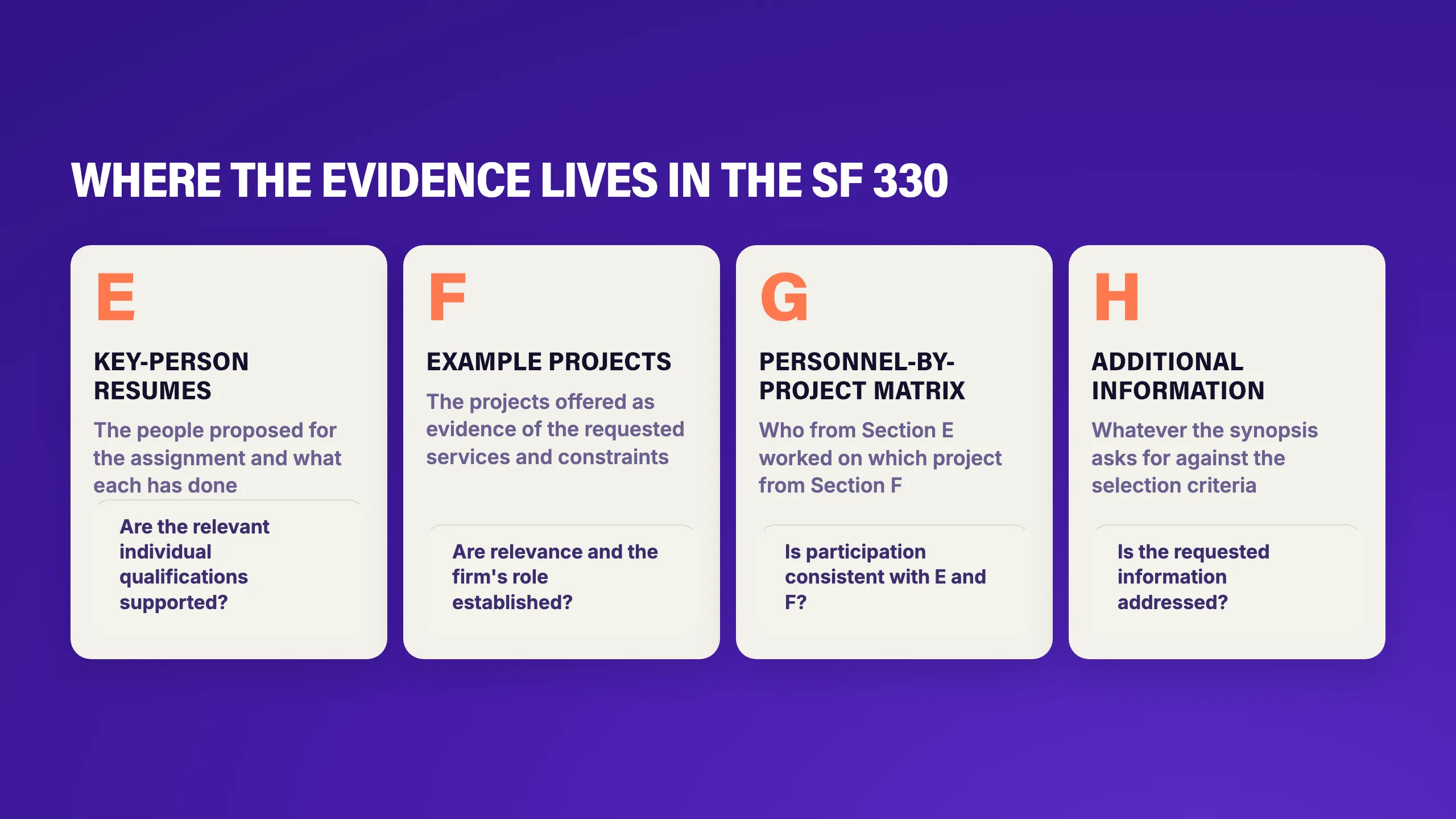
The consistency checks from the previous section can expose gaps as well as conflicting assignments. A resume last updated in 2023, for instance, can leave out the assignment that makes your key person relevant. If you include that project in Section F, the resume in Section E needs to explain the person’s contribution so the connection is clear.
Before selecting those projects, check the agency’s instructions. Section F requests 10 example projects unless the agency specifies otherwise. The form itself sets no page limits, but the agency may impose them.
To establish those working constraints, read the synopsis and applicable amendments alongside the form. And check out our full guide on SF 330 if you need help assembling the required qualifications.
Check the response against the criteria and instructions
Once you’ve confirmed the agency’s instructions, you’ll need to check that the response supports every evaluation criterion. A polished project description can look relevant, but it may not fully demonstrate what the agency requested. For each criterion, your proposal manager needs to identify the passage that addresses it and the evidence that supports it.
That evidence also needs a factual check. Have your technical or pursuit lead confirm project scope, individual contributions, staffing availability, and all claimed outcomes, even after your principal approves the wording.
This is especially true if you used AI to draft. One BD leader at an engineering firm put it this way to us:
“There’s an art to an SF 330. I want to see what AI is saying is important to go in that block, and where did it get that information.”
💡Pro tip: Within a pursuit workspace, Kantiv helps check a draft against requirements. People still review the findings and verify accuracy, staffing and technical approach. One proposal manager at a customer firm completed two full SOQs using Kantiv Workspaces, reported becoming more proficient on the second, and then began coaching her own team.
Once all claims are checked, give the assembled files the same scrutiny. Strong qualifications won’t make up for a missing signature, an exceeded page limit, or a missed delivery requirement, so check required forms and file format too. As part of that check, reconcile any relevant amendments with your evidence plan and compliance matrix. If your team still can’t resolve an interpretation, submit questions to the contracting officer by the notice’s question deadline.
After submission, keep the evidence plan, approved source material, and final response together so the next pursuit team can assess what’s reusable and what needs updating. For anything that needs updating, name an owner so the next team knows who is responsible.
Make federal proposal writing an evidence task
In AEC, federal proposal writing means showing how your qualifications answer the agency’s criteria. A familiar project and a principal’s approval of polished wording can still leave that question unanswered. Answering them takes evidence, not another wording edit.
Kantiv was built to help AEC teams close that gap. It combines its Knowledge Graph with search to help find the projects and people that support your claims. Within a pursuit workspace, it helps check your draft against requirements so your team can address gaps before submission. Your proposal manager and technical leads still review the findings and verify project facts, qualifications, relevance to the criteria, staffing, and technical approach.
Book a demo, bring a live federal RFx, and see how Kantiv can help your team win more pursuits.
FAQs
How is federal A-E proposal writing different from construction proposal writing?
Federal A-E qualifications submissions center on the firm’s qualifications for the advertised services under QBS. Construction proposals follow the procurement’s own evaluation and pricing requirements. That distinction affects which evidence earns space, so a construction proposal template needs substantial reconsideration before it becomes the starting point for an A-E response.
What do federal agencies evaluate in an A-E qualifications submission?
The agency evaluates qualifications against the published selection criteria. Your response needs evidence that addresses those criteria, with relevant projects and individual qualifications supported where requested. Sections E through H help organize that evidence, but completing the form doesn’t establish that the proposed team meets the agency’s needs.
Can private-sector projects support a federal A-E submission?
Private-sector projects can support a federal A-E submission when they meet the notice’s requirements and demonstrate relevant qualifications. The project description needs to establish the work performed and your firm’s role. A recognizable client name may not explain whether the assignment supports the specific qualification the agency requested.
Who sets SF 330 page limits?
The SF 330 itself sets no page limits; the agency may impose them. The synopsis or solicitation and applicable amendments establish the limits your team needs to follow. Section F requests 10 example projects unless the agency specifies otherwise, so that instruction also needs checking before project selection.
Can AI help check a federal proposal before submission?
Within a pursuit workspace, Kantiv, formerly Joist AI, helps check a draft against requirements. People still review the findings and verify accuracy, staffing and technical approach. A compliance check can help flag content for attention; the proposal manager and technical leads must confirm that the response’s evidence supports its claims.