
Found the content on this page useful? Share it with your team!
Go No Go (no-go): How AEC Firms That Win More Make the Decision

.png)
Table of Contents

Let’s say, in the last quarter, your firm pursued 18 opportunities, and you won 5.
The post-mortem conversation probably focused on the 13 that didn't convert: the writing, the team, the competition. It should have started three months earlier, at the moment you decided to pursue each of them.
Go/no-go determines where your proposal team's capacity goes, which client relationships you invest in, and over time, what your firm is known for. Done well, it improves win rates by concentrating effort on pursuits where you have a genuine advantage. Done poorly, or treated as a formality, it spreads capacity across too many long shots and burns out the people doing the work.
Most AEC firms have a go/no-go process. Most of those processes don't change what they pursue.
How it works
A go/no-go decision is a structured call on whether a specific pursuit is worth your firm's time and resources, made before significant proposal work begins. It should happen at multiple points: when an opportunity is first identified, when the formal solicitation drops, after shortlisting, before full proposal commitment, and after a significant scope change mid-pursuit. One conversation at RFP release isn't a process. It's a checkpoint.
Six questions should anchor every go/no-go conversation.
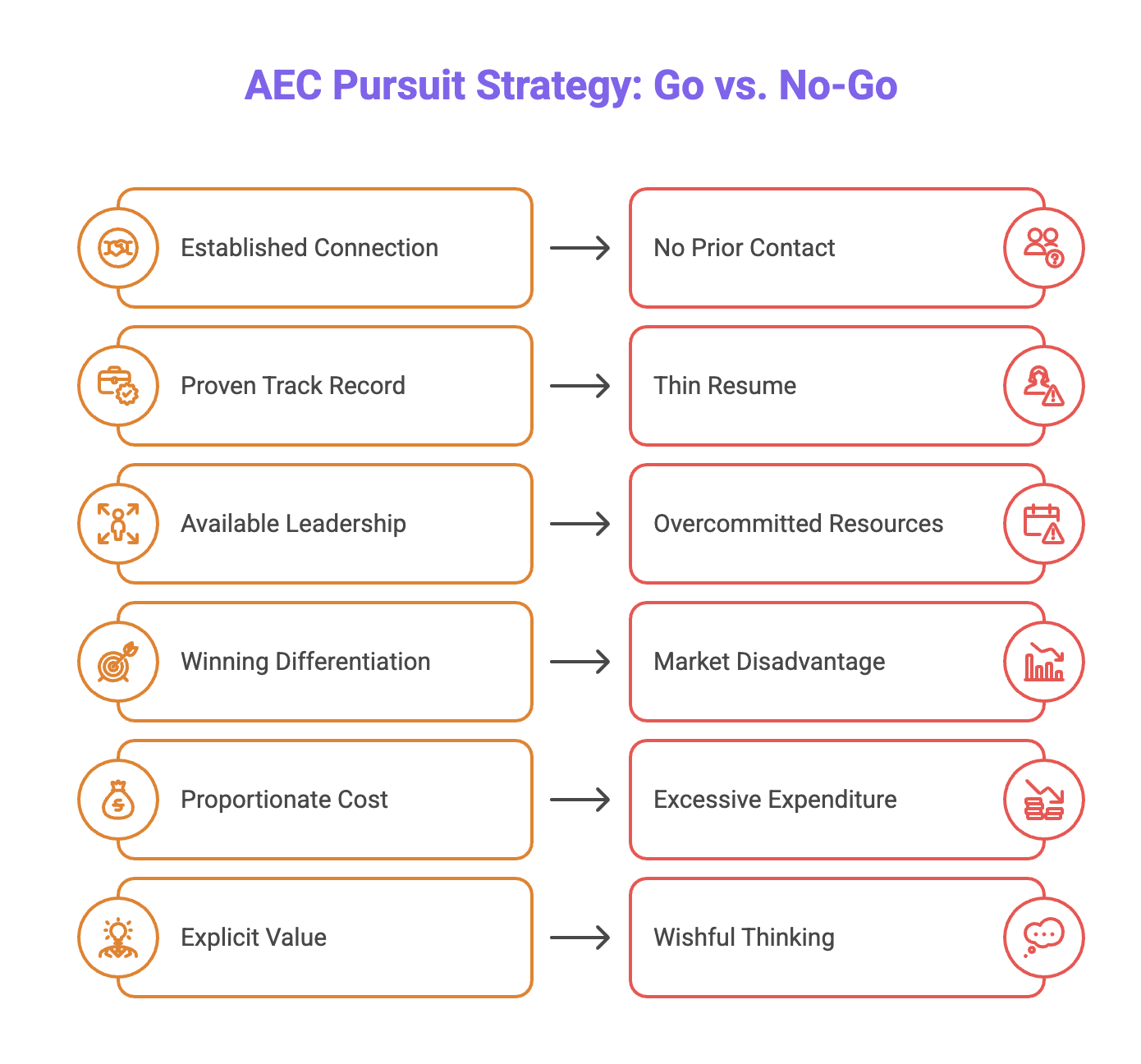
Do we have a relationship with the decision-maker or someone on the evaluation panel?
In AEC, relationships drive selection. Firms that win consistently are rarely strangers to their clients. If you're responding with no prior contact and no specific reason the client would think of your firm, your win probability is materially lower than the field average regardless of qualifications.
Have we done this type of work before, at this scale, for this type of client?
Relevant experience is the primary selection criterion in most AEC procurement. Proposing on a project type, scale, or client sector where your resume is thin means asking evaluators to take a risk on your firm. That's a legitimate strategic play sometimes. But it requires a named reason beyond capability.
Can we resource it with the right people, at the right time?
Not "do we have enough staff in aggregate," but who specifically would lead this project and are they genuinely available? The firm that proposes an overcommitted project manager and delivers with a substitute damages the next pursuit with that client more than a clean no-go would have.
Who are the likely competitors, and do we win when they're in the field?
If two firms win 80% of healthcare projects in your region and you're not one of them, pursuing a healthcare project against them without a specific differentiation strategy means your proposal investment is mostly funding someone else's shortlist appearance.
What's the full pursuit cost proportionate to the opportunity?
SF-330s for large federal IDIQ vehicles take significant team time. Full proposals for complex projects can run $20,000 to $80,000 in staff hours. Is the contract value, fee potential, and strategic importance proportionate to that investment?
What does winning this build beyond the fee?
A new client relationship, a new sector credential, a geographic footprint. These are legitimate reasons to pursue at lower win probability, but the reason should be explicit, not assumed. Implicit strategic rationale is how wishful thinking gets labeled as strategy.
What goes wrong in no-go strategy?
The mechanics aren't the hard part: a checklist, a meeting, a scoring sheet. The hard part is organizational: getting the right people in the room with the right information, and empowering someone to say no.
The decision happens after the commitment is already made.
You know this moment. The go/no-go meeting is scheduled, but the pursuit coordinator has already drafted section headers, the project manager is mentally committed, and the principal is excited. Nobody wants to be the one who kills it now. Sunk-cost dynamics are real. Go/no-go decisions are retroactive approvals wearing a process costume.
Gut-feel passes as judgment.
"I feel good about our relationship with this client." That's a data point, not a criterion. The problem is that relationship confidence is unevenly distributed. The principal who has had lunch with the client once a year feels much better about the relationship than the pursuit coordinator who will execute the response with minimal inside intelligence. Gut-feel go/no-go consistently favors optimism.
Recency bias fills the pipeline with shiny objects.
A large, high-profile project that just dropped gets pursuit energy even when a firm's win profile doesn't fit. A smaller, precisely targeted project that doesn't generate conference-room excitement gets passed over. AEC BD pipelines run on shiny-object bias. It's expensive.
Nobody has the authority to say no.
In many firms, the go/no-go decision is nominally made by committee but practically made by the most senior or most enthusiastic person in the room, who also has the most optimistic view of win probability. When the VP of BD and the firm's leading technical expert both want to pursue, who overrides them? If the answer is "nobody," you don't have a go/no-go process. You have a go process with extra steps.
Historical data goes unconsumed.
The firm has won and lost hundreds of pursuits. That history is the clearest signal about which opportunity profiles predict wins. But it's almost never in the room when the go/no-go conversation happens, because those conversations are often forward-looking when they should be informed by looking back.
What the win rate data actually shows
Industry research from SMPS and AEC-focused BD consultants consistently places average win rates for professional services firms in the 20 to 35% range for formally pursued opportunities. The range is wide because firm behavior at the go/no-go stage is the dominant variable.
Firms that pursue everything cluster at the low end. They submit more proposals and win fewer because each pursuit gets less attention, lower proposal quality, and less strategic targeting.
Firms that are selective, passing on 40 to 50% of identified opportunities and concentrating resources on highest-probability pursuits, cluster at the top.
The math is direct. A firm with 30 proposal-team-months of annual capacity that pursues 60 opportunities gives each pursuit half a month of effort. The same firm pursuing 30 opportunities gives each a full month. Higher-quality proposals win at higher rates. More selective go/no-go directly improves win rate by improving proposal investment per pursuit.
Go/no-go discipline isn't about limiting growth. It's about ensuring the growth you pursue is growth you can actually win.
The 8 criteria that actually predict AEC pursuit success
Generic frameworks give you criteria like "budget fit" and "technical capability" that could apply to any professional services context. These eight are AEC-specific and predictive.
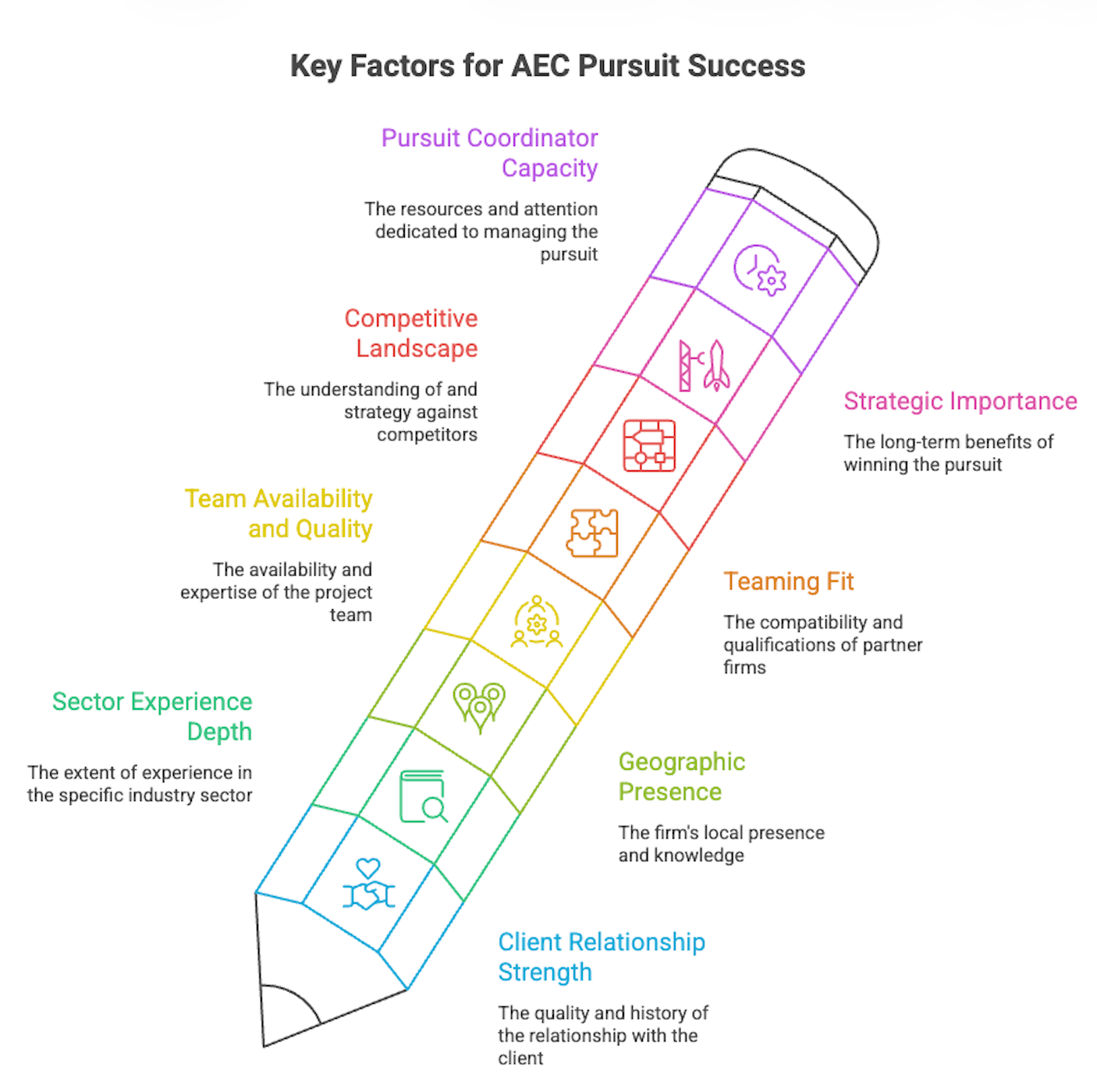
1. Client relationship strength (weight: 20 to 30%)
Not "do we know them" but "have we worked with them, does someone at our firm have a direct relationship with an evaluator, and do they view us positively?" Quantify it: cold (no prior contact), warm (one previous project or meeting), hot (ongoing relationship, repeat work, decision-maker knows your principal by name). A warm or hot relationship is the single strongest predictor of win probability in AEC.
2. Sector experience depth (15 to 20%)
How many directly comparable projects does your firm have in this specific sector, at similar scale, with similar technical complexity? A firm with 40 K-12 education projects is operating in its lane. A firm with three is making a credential argument. Score yourself honestly against what the shortlist will likely include.
3. Geographic presence and local knowledge (10 to 15%)
Many public-sector clients prioritize firms with local office presence, local project history, and knowledge of local codes, community context, and jurisdiction-specific requirements. Particularly important for municipal and state-level procurement.
4. Team availability and quality (15 to 20%)
Is the best-qualified person for this project actually available to lead it, or are they committed to other active projects? High relationship strength can compensate for below-average sector depth. A weak team rarely can.
5. Teaming fit (10%)
If the pursuit requires partners, are your proposed partners genuinely qualified? Do they bring relationships or credentials you don't have? A strong teaming arrangement can offset weaker sector experience. A weak team exposes capability gaps evaluators will notice.
6. Competitive landscape (10 to 15%)
Who are the other likely shortlisted firms? Do you win when you compete against them? If a specific firm dominates a particular sector or client type in your market, you need a specific, articulable reason why you can displace them. Confidence alone isn't one.
7. Strategic importance beyond the fee (variable)
Does winning this pursuit build something: a new client relationship, a new sector credential, a reference project in a new geography? Legitimate grounds for pursuing lower-probability opportunities, but it must be explicit and documented, not assumed and rationalized after the fact.
8. Pursuit coordinator capacity (10%)
Underweighted in most frameworks. Who is going to run this pursuit, and what else are they running right now? Proposal quality directly correlates with the capacity and attention of the team executing it. Pursuing six RFPs simultaneously with a two-person marketing team produces six mediocre proposals.
How to build a scorecard calibrated to your actual win history
A go/no-go scorecard is useful only if the weights reflect your firm's actual win profile. Not a generic industry average. Not a framework borrowed from another firm's BD deck.
The basic structure: assign each criterion a weight totaling 100, score each criterion for the specific opportunity on a 1 to 5 scale, multiply weight by score, and sum to a total. Establish thresholds: go (70% or above of maximum), conditional go (50 to 70% with named conditions), no-go (below 50%). Document every override.
The calibration step is what most firms skip. Go back through the last two to three years of formally pursued opportunities. Score each win against your criteria. Score each loss the same way. The criteria and weights that best separate wins from losses are the ones your scorecard should emphasize.
This exercise surfaces two things consistently.
First, some criteria that feel strategically important don't actually predict wins for your firm. "Scope fit" is frequently in this category. Firms regularly win pursuits that seem outside their comfort zone when relationship strength is high enough. High relationship strength can compensate for below-average sector depth. The reverse is rarely true.
Second, one or two criteria are much stronger predictors than the others. For most AEC firms, client relationship strength is so dominant it should carry 25 to 35% of the total score, because without a warm relationship, win probability is consistently low regardless of every other factor. If your current scorecard weights relationship and sector experience equally, your calibration will likely change that.
No-go evaluation: who can actually say no?
A go/no-go scorecard without organizational authority behind the "no" is an elaborate suggestion box.
The most common failure mode: decided by a committee, but in practice the most senior or most enthusiastic voice determines the outcome. Principals who want revenue, technical leads who want interesting project types, and BD directors who want pipeline activity all have structural incentives to say go. The proposal team, who will execute the work and has the most realistic view of capacity and competitive position, often has the least authority in the room.
Effective go/no-go authority has two characteristics.
The decision-maker has access to relevant data: win rate by client type, prior relationship history, competitive performance, staff availability.
Someone is accountable for the no's, and that accountability is measured over time. If your firm passes on 30% of identified opportunities and win rate improves, the model is working. If it doesn't change, you're probably saying no to the wrong things. Without measurement, the authority to say no is theoretical.
Sector history and client history as input
The single most underused go/no-go input is structured historical pursuit data at the sector and client level.
Your firm has pursued dozens or hundreds of projects. Each has a sector, a client type, a delivery method, an outcome, and often a post-pursuit debrief. Analyzed in aggregate, this history reveals which sectors and client types you win in, at what rate, and why, which project scales align with your strongest performance, whether your relationship with specific clients has strengthened or weakened over time, and which teaming arrangements correlate with wins.
Most AEC firms don't analyze this systematically. The data exists in CRM entries, proposal folders, and spreadsheets that individual marketing directors maintain personally. But it's rarely structured well enough to query with confidence.
When a firm can answer "what's our win rate on municipal water treatment projects in the Mountain West over the last five years?" and "who were the specific clients where we won?", go/no-go conversations become evidence-based.
The scorecard gets calibrated against real outcomes. Relationship strength gets quantified. Competitive patterns become visible.
That's where go/no-go stops being a gut call and starts being a discipline.
When to override the scorecard, and the risks of doing so
Scorecards are heuristics, not laws. There are legitimate reasons to pursue opportunities that score below your threshold.
Relationship entry: A pursuit where you'll likely lose but will deepen a relationship worth investing in for future work. Explicit, documented, finite.
Sector expansion: A deliberate push into a new market where early losses are the acknowledged cost of credential-building. This should be a named strategy with a timeline, not a habitual rationalization.
Capacity management: In a low-pipeline period, a pursuit that probably won't win keeps the team current and active. Legitimate, but don't let it crowd out the team when a high-probability opportunity needs resources.
Competitive blocking: Pursuing to prevent a competitor from building an uncontested relationship with a key client. A real strategic play in certain markets.
All of these are legitimate. The discipline is in naming them: "we're pursuing this because X, even though our go/no-go score says otherwise." Overrides that are named and documented preserve the integrity of the process. Overrides that are habitual and undocumented erode it.
Institutional knowledge as the primary input to respond
The firms that pull ahead aren't necessarily smarter or better resourced. They've structured their pursuit history so it's queryable. So that when a new opportunity lands, the go/no-go conversation starts with evidence rather than optimism.
When a firm's institutional knowledge is captured, structured, and searchable, tagged by client, sector, project type, relationship depth, team composition, and outcome, go/no-go conversations shift from "I think we have a good shot here" to "here's what our actual history says about this type of opportunity, this client type, and this competitive environment."

Summing up
Go/no-go is the highest-leverage decision in AEC business development. Not because the framework is complicated. Because the organizational dynamics are.
The right criteria, consistently applied, with real authority behind the no, changes what a firm pursues. And changing what a firm pursues is the fastest path to improving win rates.
The firms winning at the top of the range aren't writing better proposals. They're writing fewer of them, and making sure the ones they write are the ones they can actually win.
FAQs
What criteria should an AEC go/no-go decision include?
The eight criteria that most reliably predict AEC pursuit success are: client relationship strength (20 to 30%), sector experience depth (15 to 20%), geographic presence (10 to 15%), team availability and quality (15 to 20%), teaming fit (10%), competitive landscape (10 to 15%), strategic importance beyond the fee (variable), and pursuit coordinator capacity (10%). Relationship strength consistently outweighs all other criteria. Weight your scorecard against your actual win history, not generic industry averages.
What is a realistic AEC win rate?
Industry research consistently places average win rates for AEC professional services firms in the 20 to 35% range for formally pursued opportunities. Firms at the low end pursue indiscriminately. Firms at the top are selective, passing on 40 to 50% of identified opportunities. For firms with disciplined go/no-go and organized pursuit data, sustained win rates of 35 to 50% on formally pursued opportunities are achievable. The fastest way to move the number is not to write better proposals. It's to pursue fewer, better-matched ones.
How early should you decide in the procurement cycle?
As early as possible. A preliminary assessment at the RFI stage, a formal review when the solicitation drops, and a final review before full proposal commitment are the minimum touchpoints for significant pursuits. Go/no-go decisions made after substantial prep work has already started are usually rationalizations, not decisions.
What do you do when a firm principal wants to pursue something that scores poorly?
Require that they name the strategic rationale explicitly and document it. If the process has no mechanism for documented overrides, it will be gamed informally. Making overrides visible and reviewing them quarterly, to see whether the rationale was validated by outcome, creates accountability over time. Without documentation, the authority to say no exists only on paper.
Should firms track the no-go task, not just wins and losses?
Yes, and this is where most firms leave the most value. Tracking them with scoring rationale lets you analyze whether your calls were validated. Did the firm that won do so convincingly? Was the procurement cancelled? It also lets you improve your scoring model over time. A model you never audit against outcomes doesn't improve.
What's the difference between a go/no-go process that works and one that doesn't?
Organizational authority and evidence quality. A process where the most senior person in the room determines the outcome regardless of the scorecard isn't a process. It's a formality. A process where decisions are made against structured historical data, actual win rates by sector, client type, and competitive environment, is what separates the firms at the top of the win-rate range from the ones wondering why they're not there.