Found the content on this page useful? Share it with your team!
Institutional Knowledge: What It Means for AEC Proposal Teams

.png)
Table of Contents

Imagine your most experienced proposal coordinator just gave notice. She has been with the firm for 12 years. She knows which project examples work for municipal water clients, which principals send resume updates on time, which approach narrative won the last civil infrastructure shortlist, and which teaming partners should never be invited back.
When she leaves, what leaves isn't just productivity. It's 12 years of institutional knowledge your firm has been using as a competitive advantage without ever putting it into a system.
In AEC, institutional knowledge is the accumulated project history, client context, proposal judgment, and pursuit learning that lives in project descriptions, resumes, SOQs, shortlist debriefs, and the unofficial memory of the people who know where the strongest answer lives.
When that knowledge stays in people's heads, every departure becomes a pursuit risk.
What is institutional knowledge?
Institutional knowledge in AEC is the firm-specific knowledge that helps marketing, BD, and proposal teams turn past work into stronger future pursuits.
It starts with project history, not just that the firm completed a wastewater treatment plant, courthouse renovation, or hospital expansion, but which details matter for which evaluator. The schedule constraint. The occupied facility issue. The agency relationship. The team composition. The phrasing that made the experience feel relevant instead of recycled.
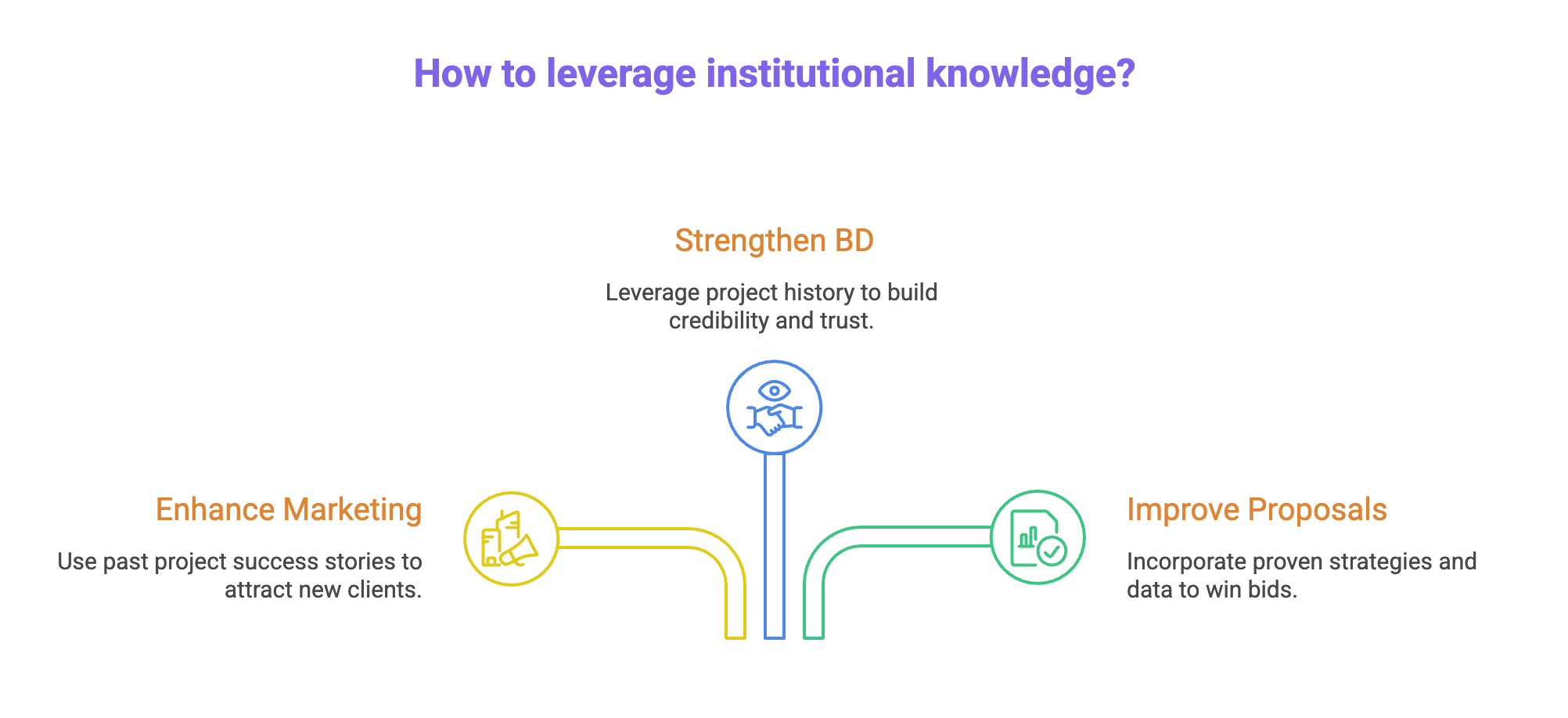
Behind every project is client context. Who has worked with this owner before? What did they care about last time? Which delivery approach made them nervous? Which principal has real trust with them? What did the debrief say after the last shortlist?
AEC firms carry two kinds of institutional knowledge. Explicit knowledge is the kind you can write down, such as, project descriptions, approved narratives, resume content, debrief notes. Tacit knowledge is harder to capture: the judgment a senior proposal coordinator builds over a decade of shortlists, the instinct a BD director has about a client's real priorities, the unwritten standard for what makes a project example strong enough to lead with. Most firms are reasonably good at storing explicit knowledge. The tacit kind walks out when people do.
Running alongside both is proposal pattern knowledge: the accumulated learning about what works. Which project examples tend to shortlist for higher education work? Which resumes consistently pass federal review? Which win themes sound strong in kickoff but fall apart when the proof isn't there? Which boilerplate section keeps getting rewritten because nobody trusts it?
And underneath all of it is people expertise. The seller-doer who knows why a project succeeded. The marketing manager who remembers which paragraph was approved by legal. The coordinator who knows the difference between the current bio and the one that keeps showing up in old folders.
That knowledge makes a proposal feel specific.
Without it, the team can still produce a document. It just starts from memory, folder searches, and late-night Slack messages instead of the best of what the firm already knows.
The deep smarts problem
Most firms already have the knowledge they need. The problem is where it lives, which is usually spread across:
A coordinator's inbox. Old proposal PDFs nobody can search well. A principal's memory because she has been with the firm since 1998. A SharePoint folder last organized in 2019. An InDesign file from the last shortlist. A resume a project manager sent by email but never added to the official bio. A debrief note someone saved after a loss but never connected to the next go/no-go conversation.
AEC firms often mistake this for a content storage problem. They're only seeing the first layer. The harder problem is connection.
- Can the team connect a project to the people who worked on it, the client it served, the delivery method used, the proposal it appeared in, and the outcome it helped produce?
- Can a new proposal coordinator find the strongest project narrative without knowing which office wrote it?
- Can a BD lead see what the firm learned from the last three similar pursuits before deciding whether to chase this one?
If the answer is no, the firm has a deep smarts problem. The firm's institutional knowledge exists, but knowledge sharing across the organization isn't currently facilitated.
This is where knowledge sharing breaks down. Each team member holds a piece of the firm's pursuit history, but the sharing stops there as it rarely moves into a form the next person can use. Organizational learning requires more than access. It requires sharing that's structured around how pursuit teams work: a loss debrief connected to the next go/no-go, a winning narrative connected to the market it belongs to, a new coordinator able to find what the last one knew without asking three people first.
How it's absence hurts pursuits
When institutional knowledge walks out with a senior hire, the effect doesn't usually show up as one obvious failure. It shows up as drift.
The first few pursuits still go out. The team is talented and scrappy. They find a prior proposal, copy the closest project description, ask a principal to fill the gaps, and get the response submitted.
But the work gets less sharp. The project examples become more generic because nobody remembers which details mattered. The resume updates take longer because the person who knew the true source of truth is gone. The proposal manager asks more people more questions and still feels less certain. The team starts using whatever content is easiest to find, not whatever content is strongest for the evaluator.
That is how shortlist quality slips before anyone can prove why. Most firms only realize how much knowledge transfer has failed when the next pursuit exposes the gap, like a project example nobody can verify, a client relationship nobody can explain, a compliance section copied from three proposals back because nobody knew which version was current.
From our experience, a significant departure means most firms should expect a 6 to 12 month ramp before the replacement fully understands the firm's pursuit history, content library, principal habits, client context, and unwritten standards. During that ramp, pursuit quality can dip even when the team is working hard.
The issue isn't effort. It's context. Proposal teams don't win by producing more words. They win by choosing the right proof for the right evaluator at the right moment. That choice depends on institutional knowledge.
Why old proposal libraries don't solve the problem
A PDF can show what the firm submitted. It can't explain why that example was chosen, whether the team shortlisted, which paragraph the client liked, which project detail later proved outdated, or whether the same answer should be used again.
That missing layer is where proposal teams spend the most energy.
The last healthcare proposal isn't enough. The team needs to know which healthcare project is the best match for an occupied renovation: the current project sheet, the latest photography, the PM's actual role, the safety record, the owner reference, and the narrative that has already been approved. Whether the same client has seen this example three times.
Whether a teaming partner looked good on paper but underperformed in delivery. Whether the principal who appears in the org chart is actually available.
None of that lives reliably in a static proposal archive.
That is why so many firms have thousands of pages of past proposal content and still start from scratch. The content exists. The judgment around the content didn't get captured.
The four pillars of this explicit knowledge
Most AEC firms should think about institutional knowledge in four pursuit-specific categories.
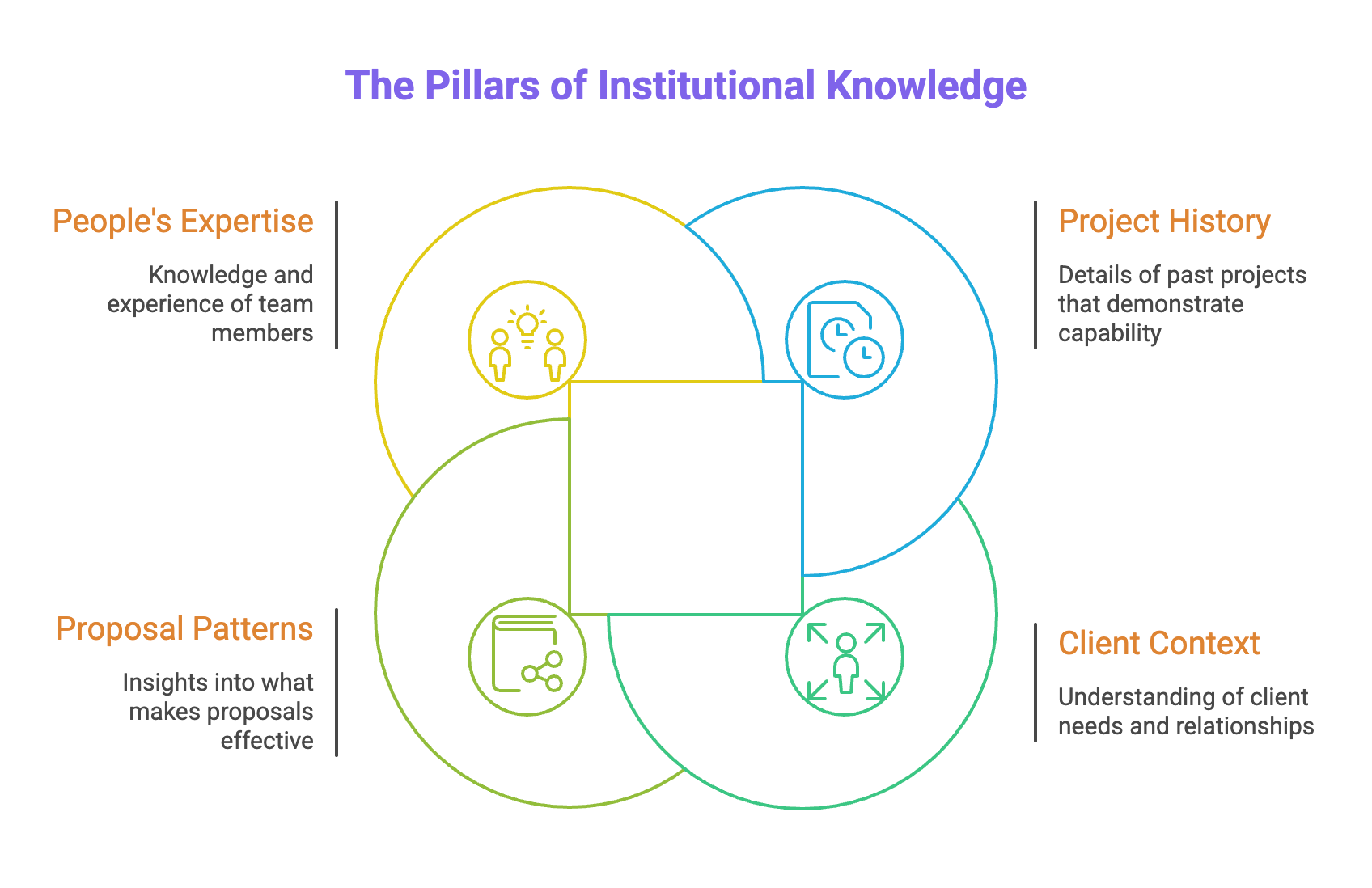
1. Project proof
Project proof is the evidence that your firm can do the work in front of the client. It includes project descriptions, metrics, outcomes, delivery methods, team roles, constraints, awards, owner references, and lessons learned. It also includes the more subtle judgment proposal teams use every day: which project is relevant enough, recent enough, comparable enough, and strong enough to carry the claim.
Generic project history isn't enough. The same transportation project may be framed differently for a state DOT, a city public works department, and a private developer. The proof doesn't change. The story does.
2. Client and pursuit context
Client context tells the team how to position the pursuit. It includes relationship history, prior feedback, known preferences, political dynamics, procurement patterns, evaluation criteria, and what the client has rewarded before. In public work, it might include how an agency scores past performance or how much they value local presence. In private work, it might include which stakeholder cares most about speed, cost certainty, design quality, or disruption risk.
Capture becomes real here. A proposal written without client context often sounds polished but interchangeable.
3. Proposal patterns
Proposal patterns are the firm's accumulated learning about what works. Which SOQ structure shortlists for this market? Which executive summary opening tends to land? Which compliance issues keep creating late rework? Which boilerplate sections are safe to reuse, and which ones should be rewritten every time?
Strong proposal teams build these patterns through repetition. Weak systems let the patterns disappear after each deadline.
4. People expertise
AEC proposals are built on people. The right resume can matter as much as the right project. The right principal can change how a client reads the whole response. The right seller-doer can bring the technical credibility a proposal needs, if the team can get their input before the final review.
People expertise includes formal data, such as titles, licenses, years of experience, project roles, and certifications. It also includes informal knowledge: who writes clearly, who needs chasing, who has the strongest agency relationship, who should be protected from overuse, and who has experience that never made it into their official bio.
That informal knowledge is often the first thing lost when a senior marketer leaves.
How your firm's knowledge sharing shapes pursuits
The strongest proposal teams don't wait until the RFP drops to start learning. They use institutional knowledge at every stage of the pursuit, because they realize that institutional knowledge helps employees improve their decision-making.
Before go/no-go: they ask whether the firm has the right proof, the right people, the right client relationship, and the right story to compete. They don't treat every opportunity as equal because they know proposal capacity is finite.
During capture: they look at what worked with similar clients, which project examples fit, which differentiators are real, and which risks need to be answered before the client asks.
During writing: they don't pull a generic project sheet because it is easy to find. They choose the proof that helps the evaluator score the response.
After submission, they capture what happened: shortlist, interview, award, loss, feedback, content reused, gaps found, questions the team couldn't answer, and what should change next time.
That last step is where most firms fall short. Every pursuit teaches the firm something. For many AEC firms, the lesson dies when the deadline passes.
Knowledge capture: What to capture in the first place?
If a long-tenured coordinator, proposal manager, BD director, or principal is leaving, don't ask them for a generic transition document. Ask for pursuit intelligence.
Start with the work they know best.
- Which project examples are strongest by market sector?
- Which descriptions are approved, current, and written in the firm's voice?
- Which resumes need urgent cleanup?
- Which principals are reliable contributors, and which ones need earlier deadlines?
- Which clients have history the next team needs to know?
- Which old proposals should never be reused because the information is stale?
- Which teaming partners performed well, and which ones created risk?
- Which shortlist debriefs changed how the firm should pursue similar work?
- Which phrases, proof points, or technical approach sections consistently show up in the firm's strongest responses?
Knowledge transfer works best when it's specific. The goal isn't to document everything someone knows. Effective knowledge capture means structured sharing: projects tied to outcomes, resumes tied to real roles, client history tied to what it means for the next pursuit. A generic transition document rarely survives contact with a live RFP. What the next person needs is specific enough to act on before the deadline, not after they've spent six months relearning what the firm already knew.
How to tell if your firm is relying on memory
The signs are usually quiet until they aren't.
- A new proposal coordinator can't build a relevant project shortlist without asking three people.
- Project descriptions get copied from old proposals because nobody knows which one is current.
- Resume updates live in email threads.
- Go/no-go meetings depend more on who is in the room than what the firm has learned from similar pursuits. A principal's departure creates panic about client history.
It shows that a firm that never prioritized documenting institutional knowledge systematically. Not because the team didn't care, but because every deadline made documentation feel like tomorrow's problem. Tomorrow compounds.
The clearest signal is the question that opens almost every pursuit kickoff:
"Didn't we do something like this before?"
The firm knows the answer exists somewhere. It just can't reach it in time.
How to make the organizational learning useful
Institutional knowledge, in other words, a knowledge repository only works if it reflects how institutional pursuit teams actually think, organized around projects, clients, people, pursuits, and outcomes, not file type or upload date. Institutional knowledge structured this way compounds. Every pursuit adds to the firm's institutional record. Every shortlist, every loss, every approved narrative improves the quality of sharing across the next response. The institutional value isn't in storage, but rather in sharing it when the RFx lands.
The system has to answer the questions pursuit teams actually ask:
- Which projects prove we can do this work?
- Which people have the right experience?
- What have we submitted to this client before?
- What did we learn from the last similar pursuit?
- Which content is approved and current?
- Which proof supports this win theme?
- Which gaps should change the go/no-go decision?
When institutional knowledge is organized this way, the proposal team starts from evidence instead of memory.
Where Kantiv fits
Kantiv is the pursuit intelligence platform built for AEC marketing and business development teams. The platform captures, structures, and surfaces firm knowledge across projects, people, clients, and pursuits so marketing teams can start every pursuit on verified data, not memory.
It connects the knowledge underneath the proposal: relevant project proof, current personnel experience, approved narratives, client context, past pursuit outcomes, and the lessons that should improve the next response.
The proposal team still brings judgment. Kantiv gives that judgment better ground.
Summing up
Institutional knowledge in AEC is the accumulated pursuit advantage your firm has earned through years of projects, clients, proposals, relationships, losses, shortlists, and wins. When that knowledge lives in people's heads, every departure weakens the next pursuit. When it lives in a system, every pursuit makes the next one stronger.
The knowledge that wins proposals is specific: which project, which framing, which personnel, which proof, for which evaluator. For most AEC firms, that knowledge exists. It just isn't captured where the proposal team can use it.
See how Kantiv helps AEC firms turn institutional knowledge into pursuit intelligence their teams can trust before the next RFP lands.
FAQ
What is institutional knowledge?
Institutional knowledge is the accumulated knowledge a firm depends on to operate, make decisions, and repeat what works. In AEC, institutional knowledge includes project history, client context, proposal patterns, personnel expertise, and pursuit lessons. It's the knowledge that tells a proposal team which proof to use, how to frame it, and what the firm has learned from similar work.
What is institutional knowledge in AEC?
Institutional knowledge in AEC is the firm-specific pursuit knowledge that helps marketing, BD, and proposal teams win work. It includes project examples, resumes, client history, prior proposals, shortlist feedback, go/no-go context, seller-doer expertise, teaming partner history, and lessons from past pursuits. It matters because AEC proposals depend on specific proof, not generic claims.
Where does institutional knowledge usually live in AEC firms?
At many AEC firms, institutional knowledge lives in inboxes, old proposal PDFs, SharePoint folders, CRM notes, InDesign files, spreadsheets, and people's heads. The issue usually isn't that the firm lacks knowledge. The issue is that the knowledge isn't connected to projects, people, clients, pursuits, and outcomes in a way proposal teams can use quickly.
How do AEC firms lose institutional knowledge?
AEC firms lose institutional knowledge when senior proposal staff, principals, project managers, or BD leaders leave before their knowledge is captured. They also lose it when pursuit lessons aren't documented after submission, when resumes aren't kept current, and when project narratives stay buried in old proposal files instead of becoming reusable firm knowledge.
How can AEC firms capture institutional knowledge?
AEC firms can capture institutional knowledge by structuring it around the pursuit workflow: projects, people, clients, proposals, outcomes, and lessons learned. Start with the knowledge proposal teams need most often, such as approved project descriptions, current resumes, client history, shortlist feedback, teaming partner performance, and proven approach narratives. Then make it searchable and connected.
What is the difference between institutional knowledge and pursuit intelligence?
Institutional knowledge is what the firm has learned. Pursuit intelligence is that knowledge organized for decisions before, during, and after a pursuit. Institutional knowledge may live in people's heads or old files. Pursuit intelligence connects it to the current RFP, client, team, proof points, and go/no-go decision so the proposal team can act on it.