Found the content on this page useful? Share it with your team!
5 Loopio Alternatives for AEC Firms (2026)

.png)
Table of Contents
If you're shopping for a Loopio alternative, odds are you already use Loopio. Loopio’s broad platform covers RFPs, security questionnaires, DDQs, and general proposals with AI that drafts from your approved content. It claims to autofill most of a standard RFP in minutes.
Where it stops working is for work based on qualifications. When your firm goes after an SOQ, nobody hands you a list of standard questions to autofill. They want to know that you've done this before, you’ve done it well, and that you’re qualified to win the pursuit. A content library can't hold that, no matter how good the retrieval, because projects, people, and client relationships are more complex than a single stored answer.
So AEC firms end up looking elsewhere for one of two different reasons.
- Some outgrow it at the job it was built for. Questionnaire volume climbs, the content library needs constant upkeep, every export needs cleanup, and none of it speaks AEC.
- Others realize answering questions was never the real problem. Winning a pursuit takes the right past projects, the people who delivered them, and proof that the two belong together on this job.
If your firm wins work through qualifications, include Kantiv in your evaluation list. Formerly called Joist AI, Kantiv is a pursuit intelligence platform built on your firm's people, projects, clients, and past performance rather than a content library. If your workload genuinely is security questionnaires and sales RFPs at volume, there are a few other solutions worth evaluating as well.
Before any of that, though, let’s clarify what Loopio does do well. If that’s what you need, great! You’re all set. If not, perhaps it’s time to consider a switch. What Loopio does well: response automation software built around a curated content library. RFPs, security questionnaires, and general proposals all run through it, with AI that matches incoming questions against approved content and can autofill most of a standard RFP in seconds.
Teams answering hundreds of questionnaire questions a month get real hours back.
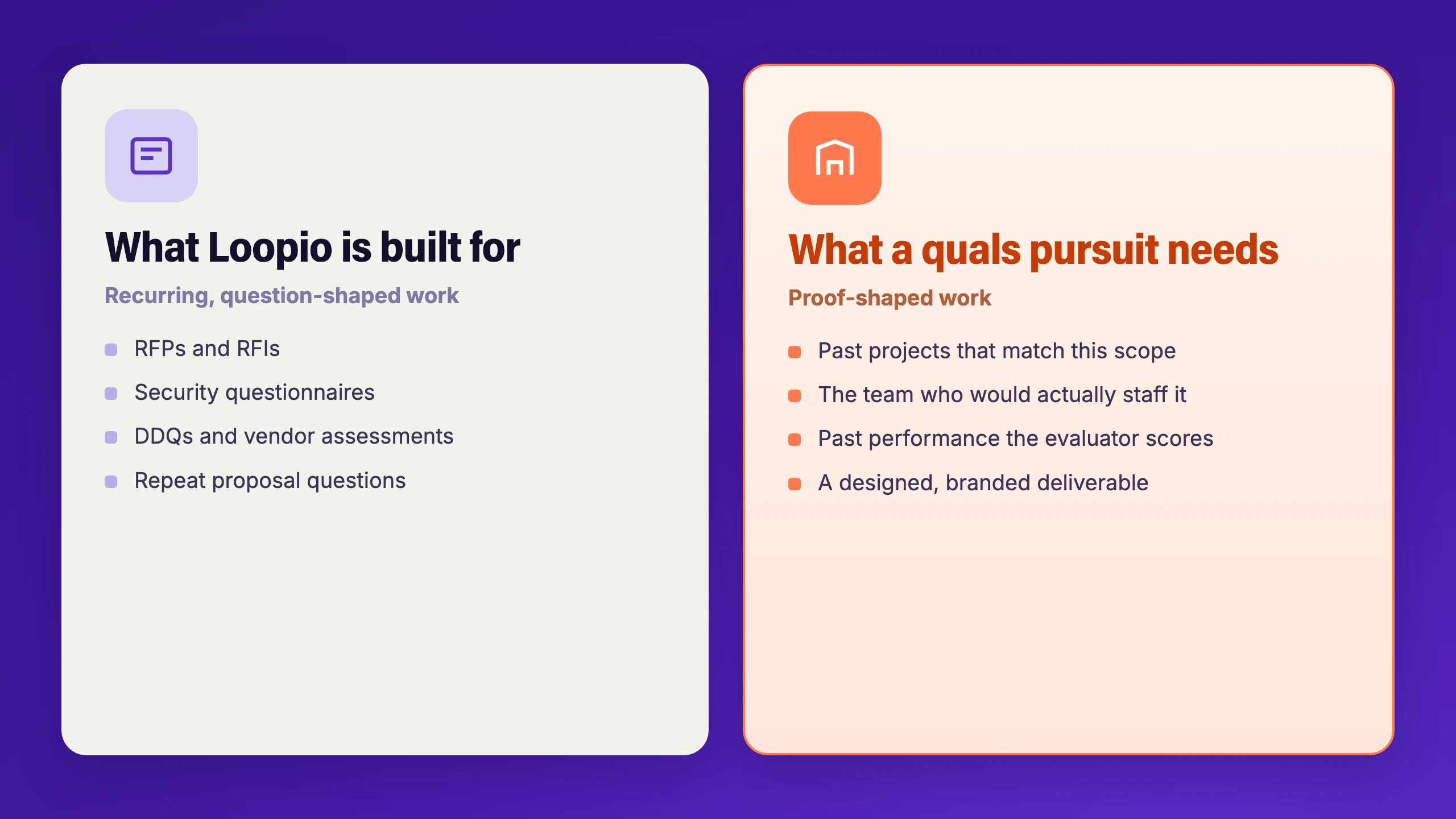
If that’s your workload, Loopio was built precisely for your use case, and the shape of the tool is at least correct. But whether it actually solves your problem comes down to whether someone on your team genuinely owns the library. That's a real job: writing the canonical answer to every recurring question, tagging it so search finds it, and retiring the one still carrying last year's EMR.
That’s the functionality, but how do you know if Loopio is even right for your vertical and business model? Loopio isn’t purpose-built for AEC. Look at their existing customer base. Most of their customers sit in technology, financial services, and healthcare. And so, Loopio does not have native, out-of-the-box support optimized for the federal SF-330 or any other AEC-specific formats.
And lastly, however wide the library's reach, it holds everything as content to retrieve, and is not truly a living knowledge base of your firm.
Why AEC firms outgrow Loopio
Here are a few of the ways Loopio does not fully meet the needs of AEC firms pursuing qualifications-based work.
- The library tax. Everything depends on a hand-maintained library with a named owner. Most teams end up budgeting a slice of somebody's week just to keep content current. When the person that’s responsible for that library leaves, the content gradually becomes out of date, and someone only notices when the tool gives an outdated answer. Like the proverbial frog in the pot, the change will happen so slowly that nobody will notice it until a stale answer reaches a client.
- The AI gap. Loopio's AI drafting draws a recurring complaint that suggested answers miss or need heavy rework. A thin library is generic, and generic inputs produce generic drafts.
- The export grind. Reformatting the document after export can be a significant pain point. It’s one thing to reformat a web form. It’s another to reformat a designed, branded document like the kinds of proposals that AEC marketers produce. Your busiest proposal coordinators just don’t have time for that, and your pursuit tool shouldn’t make that headache necessary.
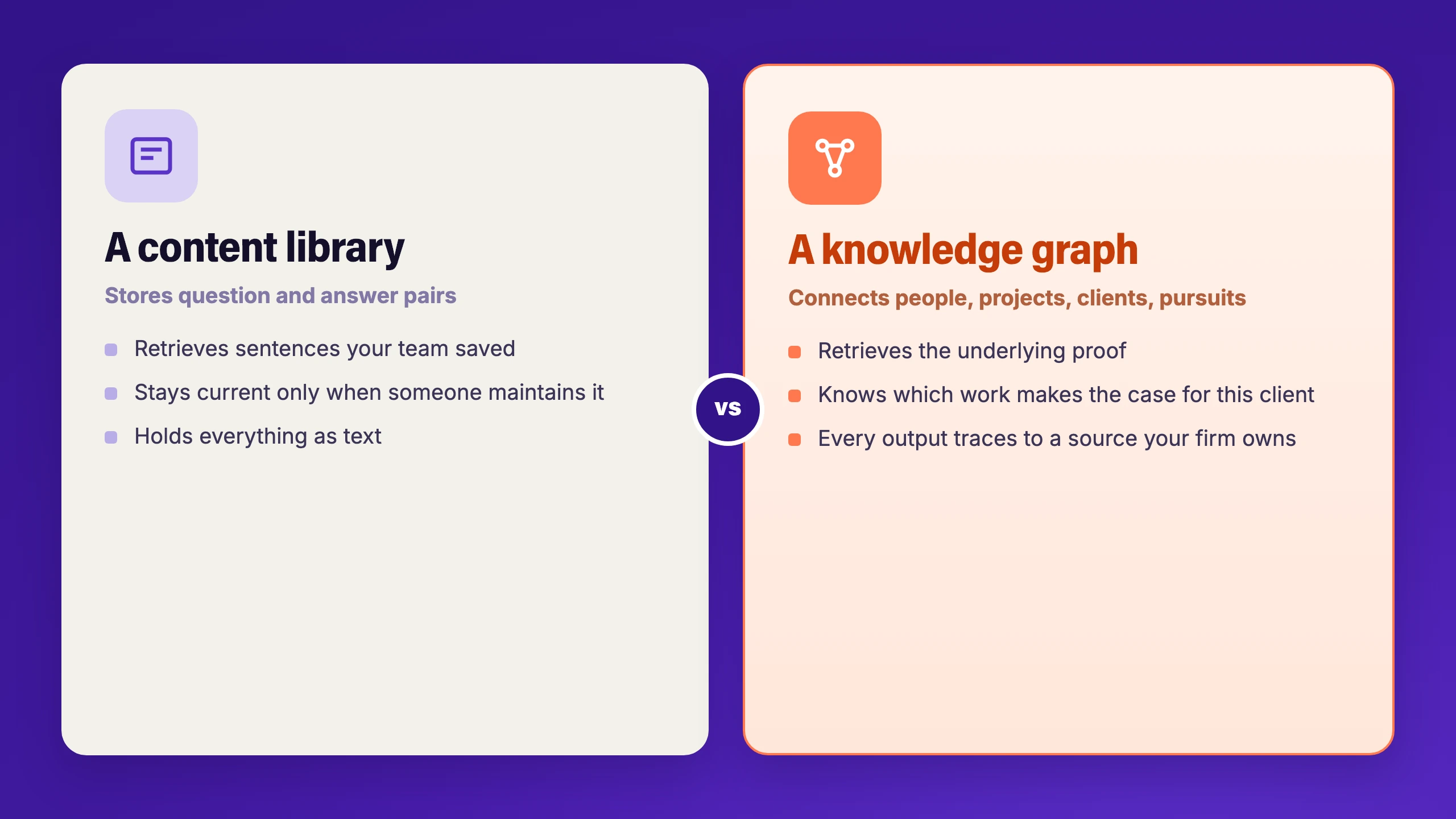
Questionnaires have answers, so content libraries serve them well.
Pursuits, on the other hand, make arguments. They need the specific projects that prove you've done this work, the project manager whose resume fits this scope, and the client history that shapes the win themes. That material cannot be fit in as question-and-answer pairs.
What to look for in an alternative
If your core job-to-be-done is a questionnaire, the top criteria you should evaluate are library health, answer accuracy, and workflow fit.
For AEC work based on qualifications, the criteria are a bit different. Proposal teams are often mandated to “figure AI out” alongside their day jobs, and choosing the wrong tool can be costly.
Here are a few questions you should ask of any alternative you evaluate.
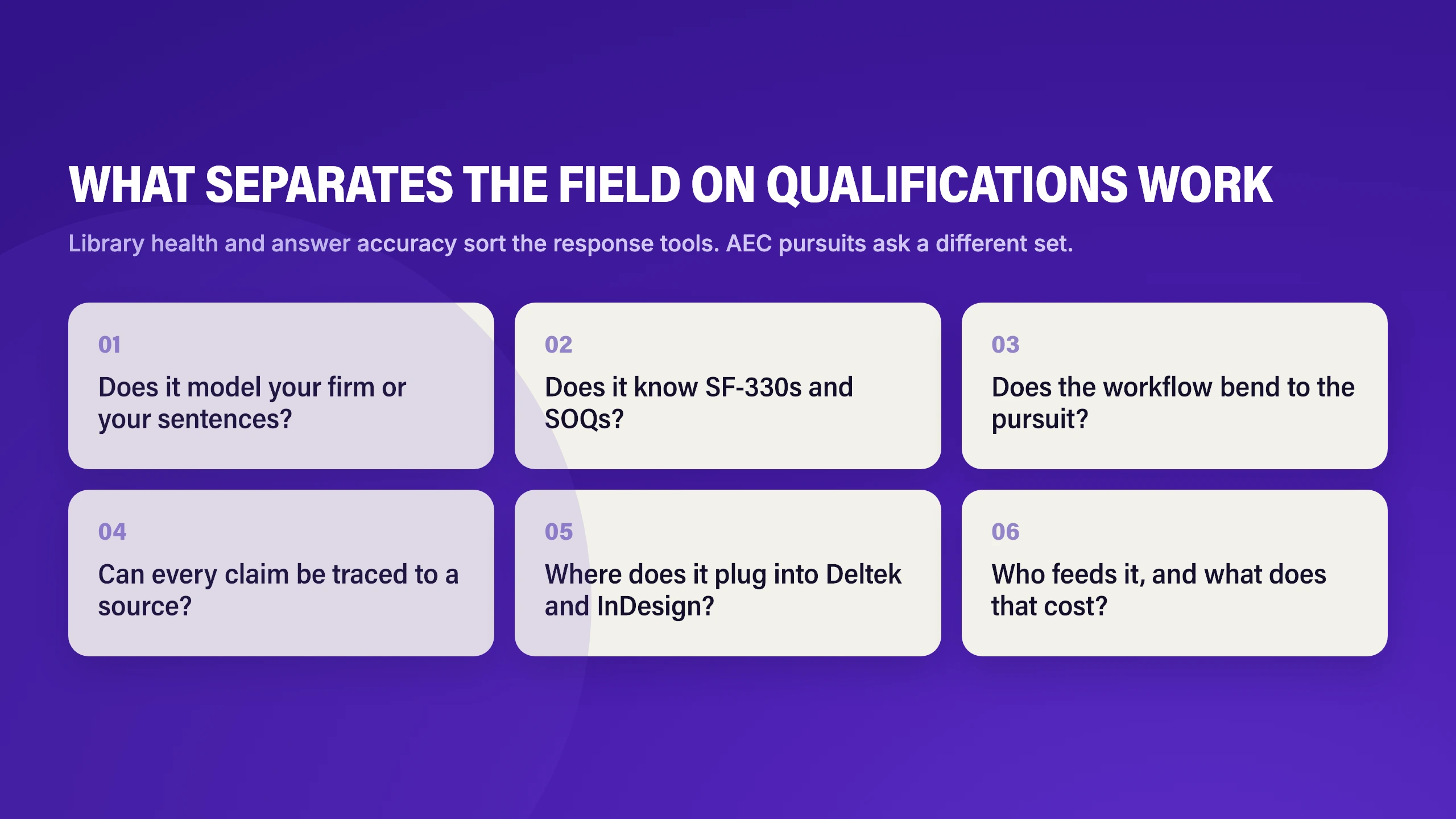
- Does it model your firm or your sentences? People, projects, clients, and pursuits become connected records in an AEC data model. A response library holds text.
- Does it know AEC deliverables? SF-330s, SOQs, and shortlist prep are structured, repeatable formats. If the vendor has never heard of Section F, you will likely be hand-building.
- Does the workflow bend to the pursuit? Response tools assume a clean assign, review, approve sequence. A pursuit rarely runs that way: scopes shift, principals change the strategy in week two, and the team needs to move between analysis, drafting, and compliance without restarting the path.
- Can every claim be traced? Evaluators score what is on the page, and principals will ask where a number came from. Grounding in proprietary sources beats confident text generation.
- Where does it plug in? Your content lives in Deltek, SharePoint, and InDesign. You need an alternative that plays nicely with that stack.
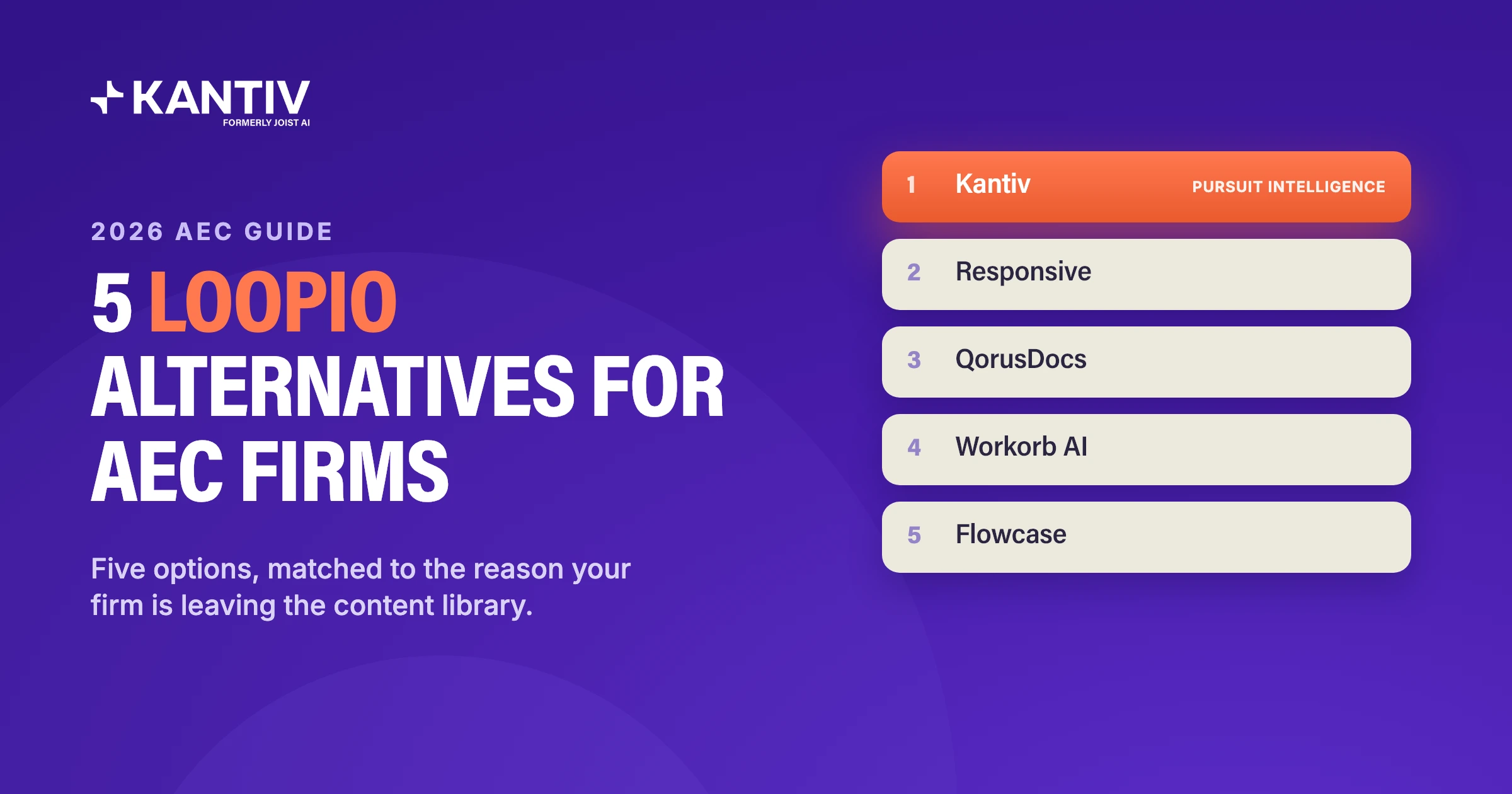
The top 5 Loopio alternatives, at a glance
| # | Tool | Category | Built for | The catch |
|---|---|---|---|---|
| 1 | Kantiv | Pursuit intelligence | AEC firms winning qualifications based work | Not a questionnaire tool; wrong buy if DDQs are the job |
| 2 | Responsive (formerly RFPIO) | RFP response management | Enterprise response teams with heavy interdepartmental volume | Claims the same initial draft range as Loopio; still has an AEC data model gap |
| 3 | QorusDocs | Proposal management | Microsoft centered teams with a dedicated AEC push | SharePoint-tethered; needs a taxonomy owner |
| 4 | Workorb AI | AEC pursuit platform | AEC firms wanting integrated process and governance across proposals and BD | AEC-native breadth; integration depth and source traceability worth testing on a live pursuit |
| 5 | Flowcase (formerly CV Partner) | Resume, CV, and SF-330 management | Firms fixing the resume and credential problem specifically | People and credentials only, not the full pursuit |
1. Kantiv
Kantiv is a pursuit intelligence platform that maps your firm's people, past projects, and historical performance into a structured Knowledge Graph, so the next pursuit starts from what the firm already knows.
How is this different from a content library? A library returns the sentences your team saved. Kantiv returns the proof underneath them: the project that fits this scope, the person who delivered it, and what the client said at closeout.
Getting that knowledge in is not a migration project. Content flows in from SharePoint, Egnyte, Deltek, and Unanet.
When an RFx lands, Kantiv analyzes it and surfaces the most relevant knowledge from your firm's history. From there, the team works in whatever order the pursuit demands. Before any drafting begins, a win strategy shows which past projects make the strongest case for this client and scope. The first draft builds from those projects with every claim traceable to a source the firm owns, and assets drag straight into InDesign. Finally, a compliance check runs against every requirement before submission, while there is still time to fix what it finds.
More than 200 AEC teams run their pursuits this way, and Mortenson reports saving 8 to 10 hours per week on proposal activities.
Kantiv is built for firms winning work on qualifications. For a deeper breakdown on how Kantiv compares, check out our feature-by-feature comparison.
2. Responsive (formerly RFPIO)
Responsive (formerly RFPIO) is the like-for-like swap. It runs the same content library play as Loopio at a bigger scale: one library serving bid teams, sales, InfoSec, and investor relations, with the permissions and analytics that sprawl demands. It claims the same first draft and requirements triage range Loopio does.
Responsive is a good option for teams that have outgrown Loopio's capacity. Go in clear eyed, though. On the AI, a verified reviewer put the limit plainly:
"The AI capabilities are still immature, and the generated answers always need to be reviewed."
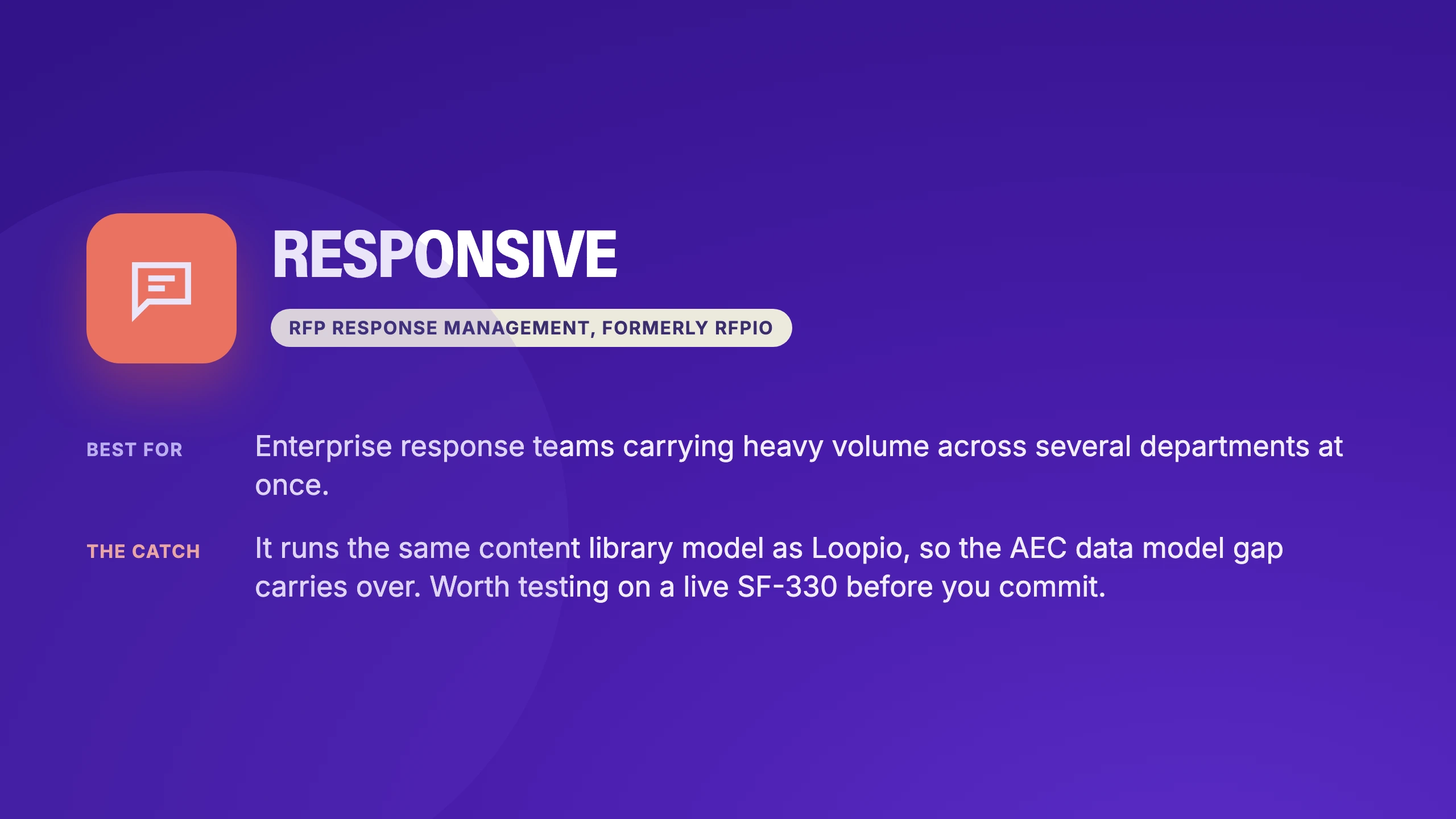
The rest of the picture echoes Loopio. The library still needs a dedicated owner, and teams have described hitting learning curves when they came back to it after a few months. Whatever the AI drafts, it drafts from text in that library rather than from a project, a person, or a client record. And the AEC gap is the same as Loopio’s. This is not to knock the product on questionnaires, where it is genuinely strong.
3. QorusDocs
QorusDocs is the option for firms standardized on Microsoft. It lives inside Word, PowerPoint, Outlook, Teams, and SharePoint, assembling proposal documents from your existing content library, which makes it attractive to IT conservative firms already committed to Microsoft 365.
QorusDocs also runs a dedicated AEC solutions page, so it's worth a look if Microsoft native workflows matter more to your team than an AEC data model. Proposal teams that author in Word all day will feel at home immediately.
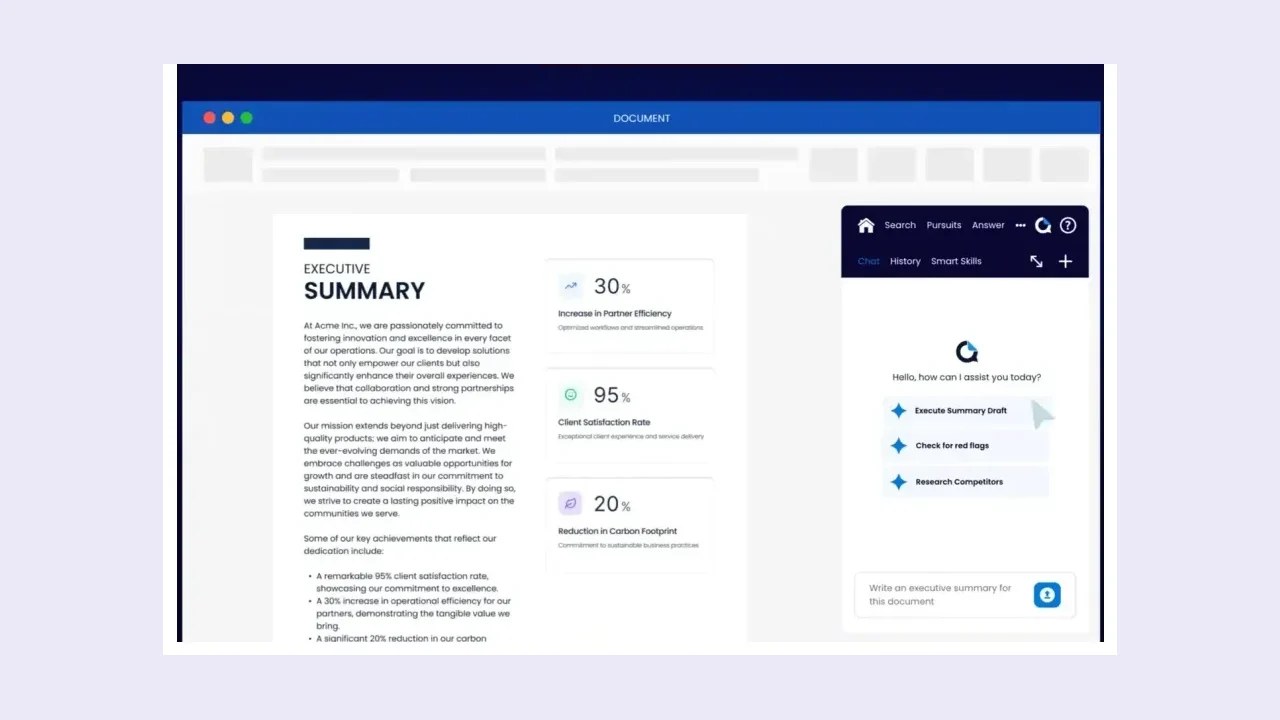
The tradeoffs come from the same architecture. Slow file previews. Colleagues without a license who can't pull content themselves. Knowledge libraries you can't really search. And a taxonomy project standing between you and any value at all.
Budget for that last one.
Underneath, it is a document assembly engine built on Microsoft's stack, and how deeply it models AEC project experience, resumes and qualifications is the thing to test on a live pursuit.
What QorusDocs speeds up is putting a document together inside tools your team already knows. Finding the right proof to put in that document is still a manual hunt. And any productivity figures QorusDocs publishes about that speedup are the vendor's own, worth asking to see independently before you build a business case on them.
4. Workorb AI
Workorb AI positions itself as an AEC-focused platform spanning proposals, documents, knowledge, and broader business development. It’s built around a guided process rather than a library you search. Its pitch is traceable drafting, governance, and an audit trail running from qualification and go/no-go through drafting, review, and submission. It’s aimed at firms that want the workflow built in rather than assembled by prompting a general purpose AI.
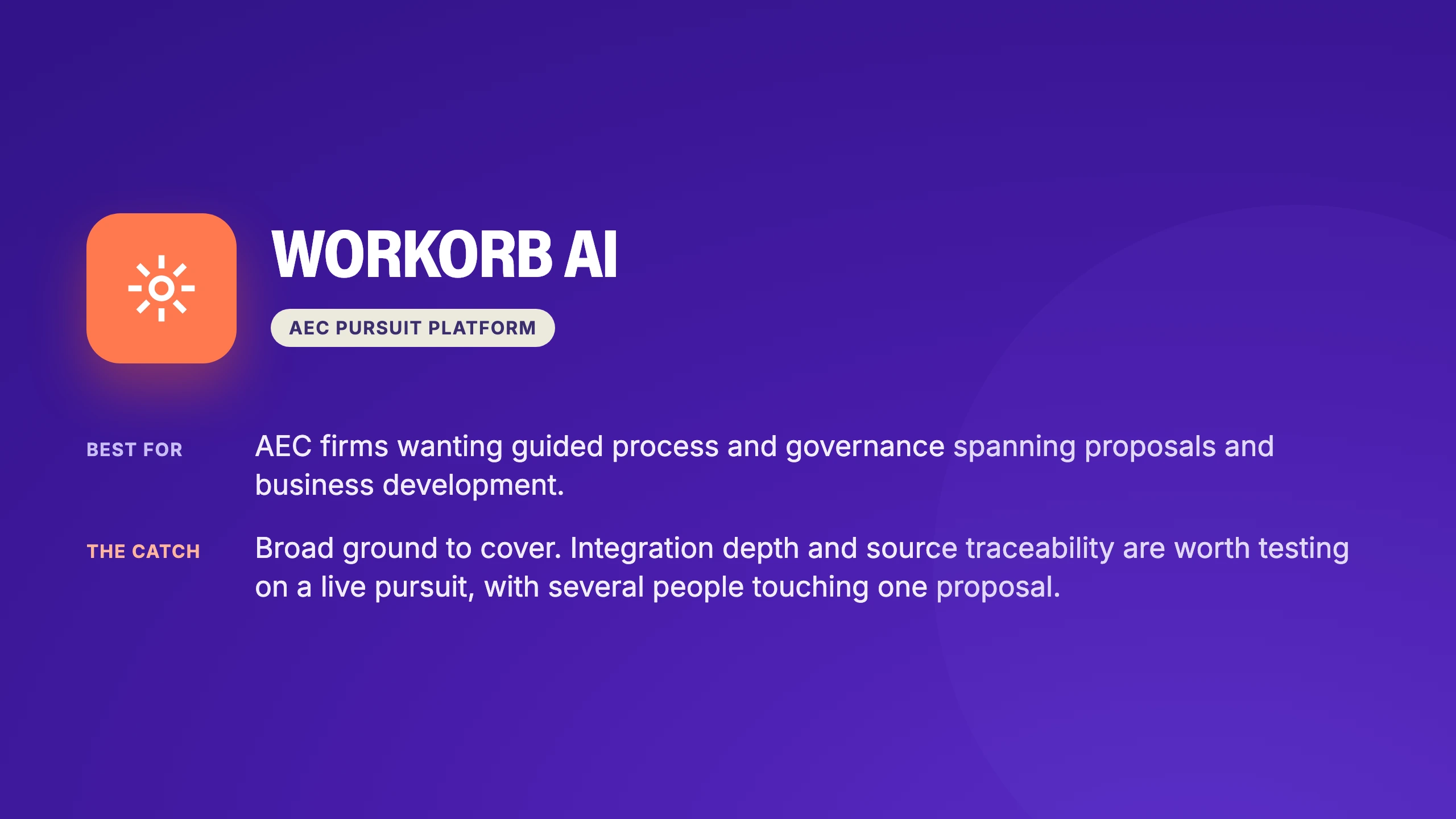
That breadth is also what's worth testing before you buy it. Ask which integrations are live, how much cleanup your own knowledge base needs before the system is trustworthy, and whether source traceability holds once several people have touched a proposal.
One platform spanning proposals, documents, knowledge, relationships, and BD is covering a lot of ground. Test whether the breadth stays deep where your firm works: the qualifications-based pursuit.
5. Flowcase (formerly CV Partner)
Flowcase is the focused specialist. It manages resumes, CVs, and case study content for bid teams, with explicit AEC templates and SF-330 formatting built in. This is a differentiator over a generic resume tool. It has strong traction in professional services and growing use in AEC, where firms adopt it to escape resume chaos in Word and SharePoint. For that one job it earns affection, and formatting a CV drops from half an hour of fiddling to about a minute.
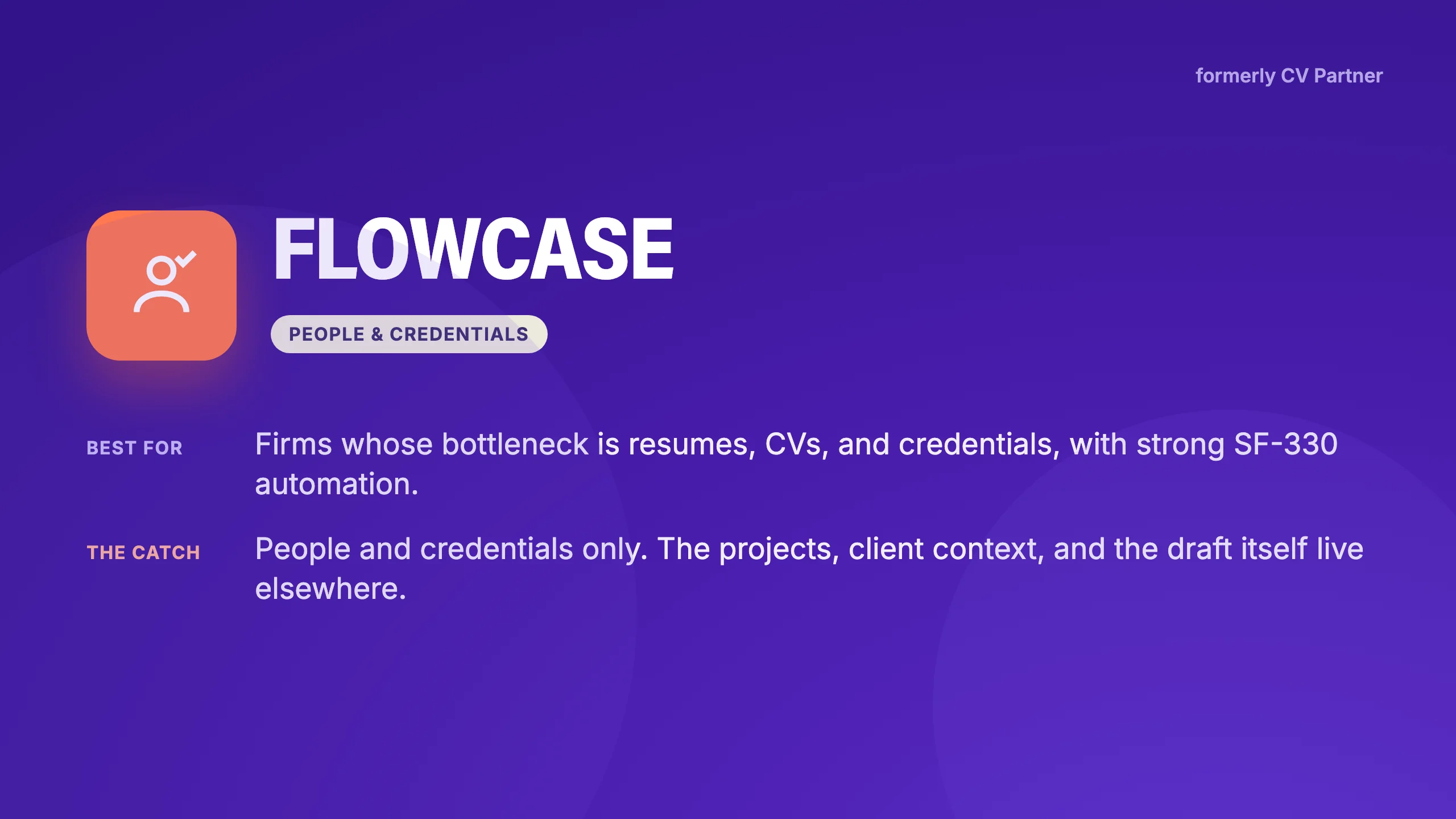
Some limitations: CRM integration is limited today, and architecture firms specifically raise structuring project sheets as a rough edge. Ask whether it reaches upstream into go/no-go, client context, and win theme development, or stays at resumes and case studies. It’s also worth checking how the per seat pricing holds up once you add the occasional contributors an AEC pursuit pulls in beyond the marketing team.
Flowcase solves the people and credentials slice of the pursuit well. The projects, the client context, the win themes, and the draft itself are still somewhere else.
Choosing the right Loopio alternative for your firm
If you’re still not sure which solution fits your firm best, here’s a pro tip: audit your last three proposals before you demo anything.
Skip the feature matrix and start with your own record. Pull the last three proposals your team shipped and account for where the hours went, honestly, in rough blocks.
If most of the hours went to answering questions, finding the approved language, routing it for review, and getting it back, then a stronger response tool is the right buy:
- Responsive if the constraint is volume and you need one library serving several departments.
- QorusDocs if your firm is committed to Microsoft and wants the shortest path from where it already works.
If most of the hours went to hunting proof, chasing a project manager for a resume, digging for the specific projects that fit this client, and rebuilding a project sheet somebody already built last spring, then a response tool may not address the underlying knowledge-retrieval problem.
Those hours went to reaching your own knowledge, which is exactly what Kantiv is built to do.
Workorb AI takes a different route into the same territory, leaning on guided process and governance rather than a knowledge graph, and it's worth a demo on that basis if a structured, permissioned workflow matters more to your team than how the knowledge underneath it gets modeled.
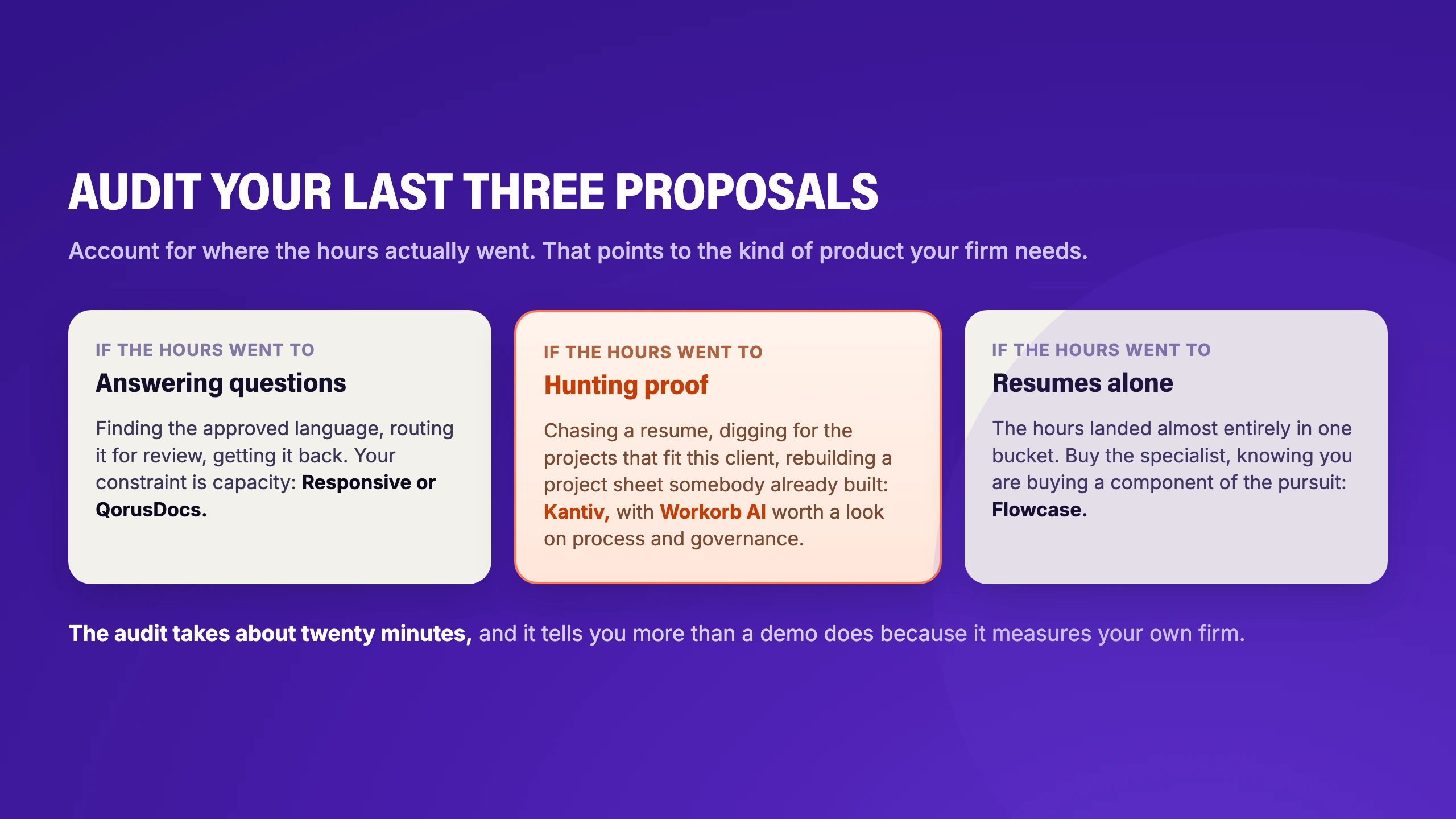
And if the hours went almost entirely into one bucket, resumes and credentials, demo Flowcase, and be honest with yourself that you are addressing just that one component of the pursuit.
The audit takes twenty minutes and it is more useful than looking at features in a vacuum, because it takes into account how your firm works IRL.
Why AEC firms are switching to Kantiv
Generally speaking, the firms that end up switching to Kantiv aren’t just looking for a better answer library. They need a different kind of tool altogether. After running the audit above, they find that most hours were lost when reaching their own work: which three projects prove this scope, who delivered them, what the client said at closeout two years ago.
That is the work Kantiv is built for. It maps people, projects, clients, and pursuits into a structured Knowledge Graph, so when an RFx lands, the relevant proof surfaces instead of being hunted down. The first draft arrives sourced, the compliance check runs before submission rather than after, and each closeout feeds back in, so the library builds itself out of work the firm was doing anyway, without someone assigned to keep it current on top of their real job.
More than 200 AEC teams now run their pursuits this way, and Mortenson reports saving 8 to 10 hours a week on proposal activities. If your last three proposals went the way most do, bring one of them to a demo and see what starting from your own knowledge looks like.
FAQs
What is Loopio used for?
Loopio is response automation software built around a curated content library. Teams use it to answer RFPs, security questionnaires, DDQs, and general proposals from a shared store of approved content, with AI that drafts a first pass automatically, mostly in technology, financial services, and insurance.
Who are the main Loopio competitors?
In Loopio's own category, the main competitors are Responsive (formerly RFPIO) and QorusDocs. For AEC firms building AEC-native pursuit software instead of a response library, the field includes Kantiv and Workorb AI, though they take different approaches. Kantiv on a knowledge graph of your firm's people and projects, Workorb on a more guided, process-driven model. Kantiv competes specifically as a pursuit intelligence platform, built on the firm's people, projects, and past performance instead of a stored answer library.
Can Loopio handle SF-330s and SOQs?
Not natively. Loopio's data model is a library of question-and-answer content, so SF-330 sections, project sheets, and qualifications packages have nowhere native to live. Teams that try it for this work export the content and assemble the final proposal in Word or InDesign. Firms with heavy SF-330 volume should evaluate AEC-native tooling instead.
How much does Loopio cost?
Loopio's pricing is quote-based, set per deployment, with annual contracts varying widely by seats and extras. Responsive, QorusDocs, Workorb, and Kantiv all quote per deployment too, so compare on fit first, and make total cost a demo question for every vendor, including the staff time your library or knowledge base needs to stay current. That line item is the one that never appears on the quote.
Is there a free Loopio alternative?
Not a credible one for this work. Everything in this category is quote-based enterprise software, and the closest thing to a free option is what most firms are already doing: a shared drive of past proposals plus somebody's memory. That is the arrangement that produces the deadline scramble, so treat "free" as the cost of the hours it consumes.
What do AEC firms use instead of Loopio?
Firms with genuine questionnaire volume stay in the response category with tools like Responsive. Firms that win work through qualifications-based selection use Kantiv, alongside their existing Deltek, Unanet, and SharePoint stack. It surfaces the firm's most relevant projects, people, and past performance for each pursuit and assembles sourced, compliance-checked first drafts from them.
This comparison was prepared by Kantiv based on publicly available product information and documentation at the time of review. Product features, pricing, plans, and availability may change and may vary by configuration. While we strive to keep this information accurate and current, this comparison may not reflect all available product details. For the most current information, please consult each vendor directly.