Found the content on this page useful? Share it with your team!
The Compounding Marketer: Restructuring Your Firm’s Intelligence Engine


Table of Contents
As leaders in the AEC industry, we regularly make the case for integrated delivery. We tell clients that disconnected handoffs waste money, leak knowledge, and dilute quality.
Then we accept those same disconnected handoffs inside our own marketing operations.
An engineer invents a brilliant site solution on a Thursday, but it stays trapped in the field. A business developer uncovers an owner’s deepest risk concern over lunch, but the takeaway stays in their inbox. Two weeks later, a talented marketer sits in front of a blank screen at 9:00 PM, forced to guess what will win the room.
This is clearly a systems problem, not a talent one. Today, the typical AEC pursuit burns 70% of its hours on mechanical assembly—re-chopping resumes, reformatting cut sheets, and manually mapping compliance matrices against dense RFPs. That leaves barely 30% for actual win strategy and storytelling.
When we treat our most strategic minds as an administrative assembly line, their hard-won knowledge goes cold the second a bid is uploaded. To fix this, leadership must fundamentally rethink how we support and scale marketing's work.
The Premise: AI Visibility and the Need for Context
AI is already changing our industry from the outside in. According to Forrester, 94% of business buyers now use generative AI as a primary research source. Evaluators and owner's reps are querying frontier models to vet contractors long before an RFQ drops. What those systems can find becomes another influence on the firm’s first impression.
That gives the knowledge trapped inside your firm a second cost. It is unavailable to the next pursuit team, and it never becomes the public evidence that helps a prospective client understand why your firm belongs on the shortlist.
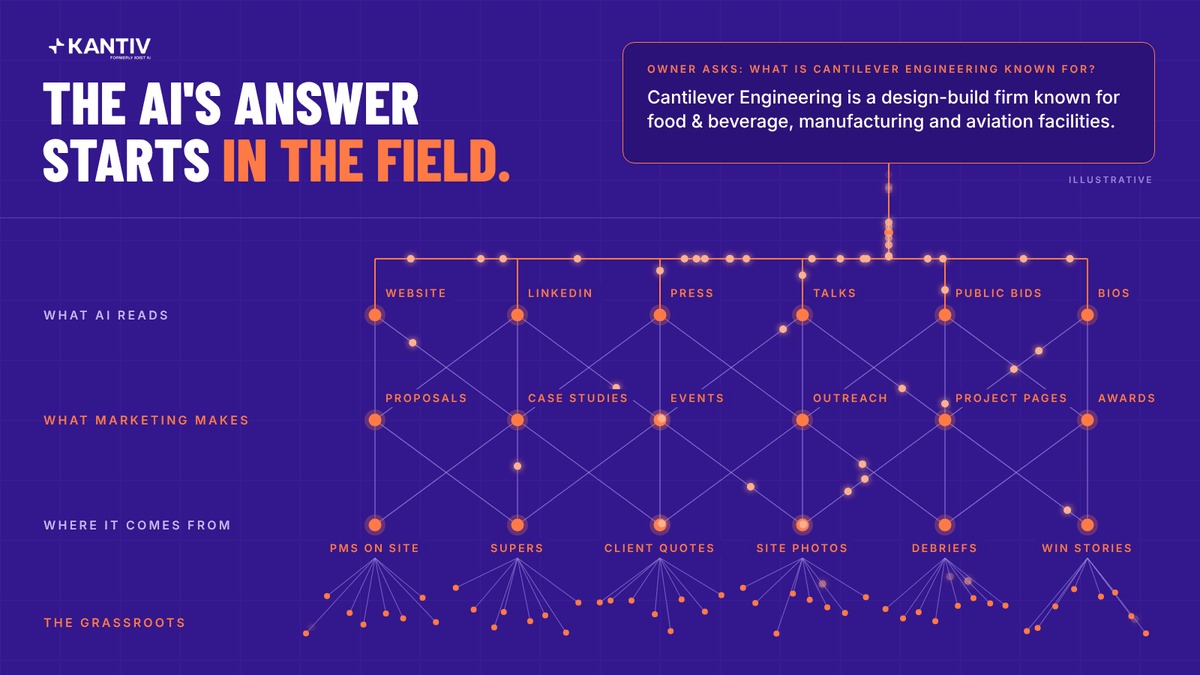
A project team’s difficult decision can become a compelling case study. A client conversation can sharpen a market perspective. A debrief can change how the firm explains its approach. But only if those insights reach the people responsible for putting them to work.
To shape that narrative, we must give our marketers the two biggest gifts technology can offer: time and context.
The Big Change: Shifting to Systems Thinking
Whenever new technology arrives, it is easy to fixate on the software. But look at the pace of change: IBM puts the half-life of a technical skill at just 2.5 years, and the World Economic Forum expects 39% of core job skills to change by 2030. If you focus on optimizing specific tools, you will always be playing catch-up.
The tools are just the means to an end; what actually needs to change is how knowledge reaches marketing—and how marketing’s work feeds back into the firm.
That is the practical meaning of systems thinking here. A proposal still has to go out on Friday. But the work behind it should leave something useful for the next team: a verified project story, a clearer understanding of an owner, a better way to explain an approach, or a lesson that changes the next pursuit decision.
Tools will change. Those assets can keep growing in value. And to truly compound your firm's impact, marketing must move away from a linear mindset and step into systems thinking:
| The Linear Mindset | The Compounding Mindset (Systems Thinking) | |
|---|---|---|
| Focus | What is due Friday at 5:00 PM. | Meeting this deadline while building assets for the next 10 pursuits. |
| Output | A finished deliverable stored in a pursuit folder. | Reusable, structured institutional knowledge. |
| Method | Doing all the manual assembly yourself. | Directing systems to handle assembly and reviewing the result. |
| Pacing | Waiting for the RFP to drop. | Shaping the owner's perception before procurement. |
| Measurement | Tracking just whether we won or lost. | Capturing why we won or lost, and using it to improve the next pursuit. |
The Three Layers That Compound
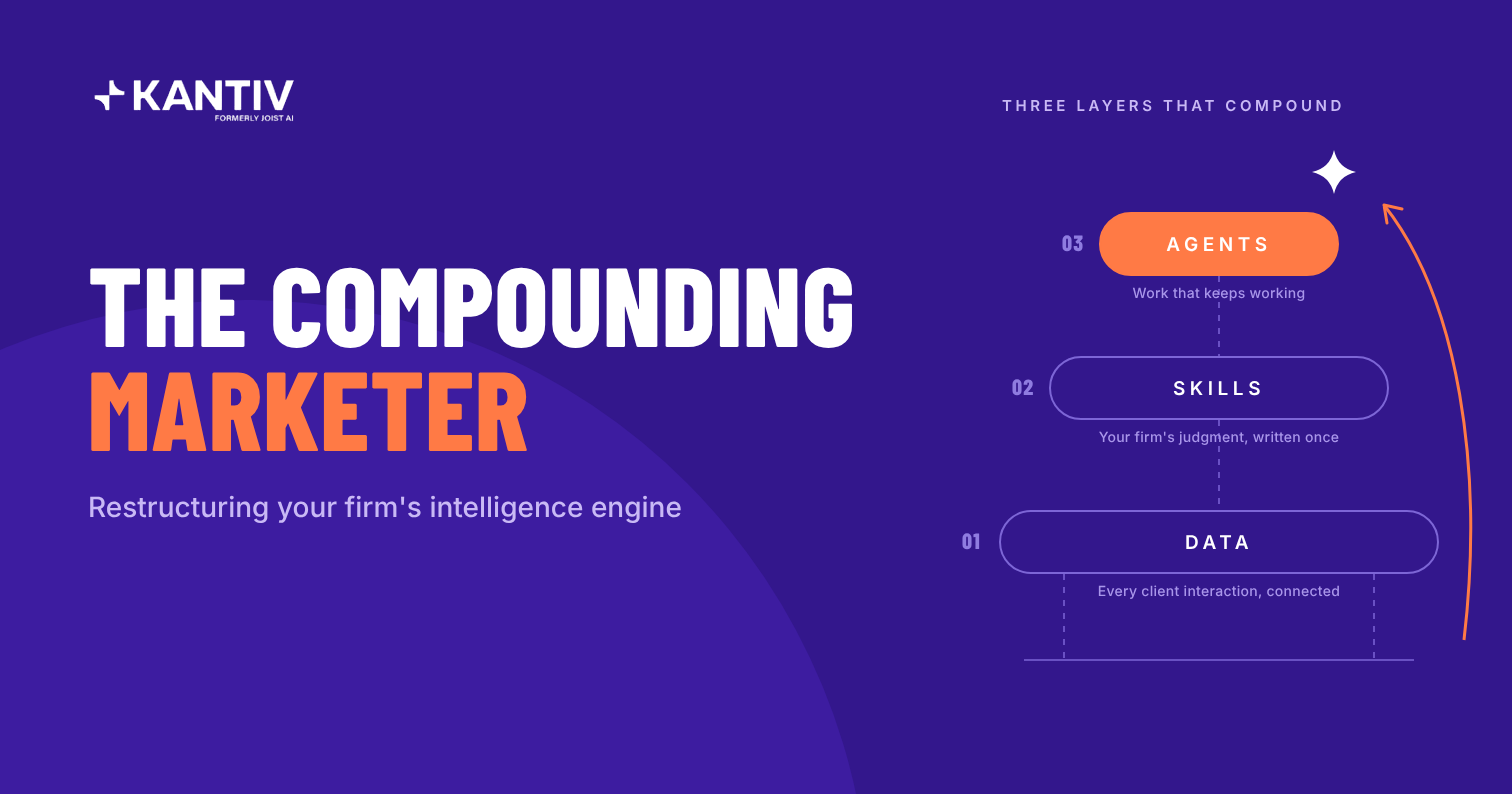
To invert the 70/30 split—reclaiming both time and context—you must structure your marketing work into three compounding layers:
- Data (The Context Foundation): Data means far more than CRM fields and win rates. It includes the interactions that explain how your firm works and what your clients care about: the site visit, the conference conversation, the debrief, and the email thread where an owner told you what drove their decision. Connected together, these interactions become the context a future pursuit team can draw from.
Connecting the information is only the beginning. The next team needs to find it, trust it, and know whether it is current. That takes AI-ready data: consistent classifications, clear sources, and a way to capture what the project team learned before everyone moves on. - Skills (Documented Judgement): A skill is a reusable set of instructions and examples that documents how your firm approaches a particular task. That might be how you frame the safety section, select supporting projects, or build an executive summary around an owner’s priorities.
The value lies in capturing the reasoning behind a strong response. What should the writer look for? Which claims need evidence? What makes an example relevant to this pursuit? Every win and debrief can sharpen those instructions for the next pursuit.
Your brand guide is a practical place to start. Document which client concerns you lead with, what evidence a claim requires, and how you explain a recommendation. Those brand guidelines give people and AI specific decisions to follow, so the firm’s judgment carries into the next draft. - Agents (Work That Keeps Working): We have gone from asking AI questions to giving it assignments. An agent can watch for published procurement signals, keep an eye on a competitor, and have a first-pass pursuit kit ready the moment you say “go.”
That kit becomes more useful when the agent can draw on current firm data and documented instructions. It can assemble relevant project examples, staff qualifications, client history, and an initial compliance outline for the team to evaluate.
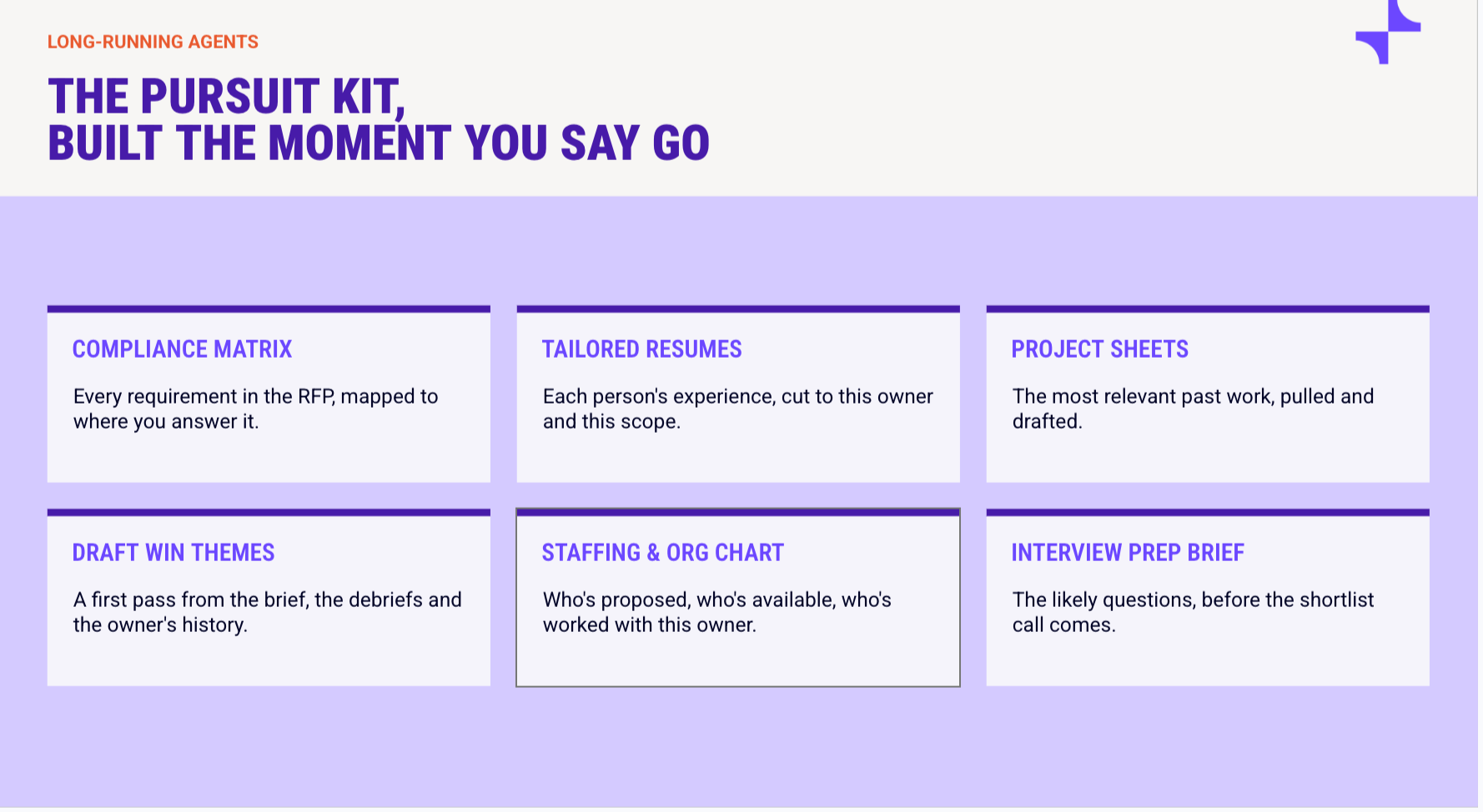
Systems thinking means AI operates ahead of your team, so people start from 70% done instead of zero.
The layers reinforce one another. Better data gives the agent stronger material. Documented judgment guides how it uses that material. Human review identifies corrections and lessons that improve the next assignment.
The Marketer as Editor-in-Chief
If agents are drafting the baseline pursuit kit, what is left for the marketer? More than you might think, and it is the most valuable part of the job, in my opinion.
Your marketers step into the role of Editor-in-Chief. Agents draft; your human experts decide what is true, what is safe, and what goes out the door. That responsibility has three parts:
- Choosing the story: A relevant project match is a starting point. The marketer still needs to decide why that experience matters to this owner, which concern the response should address first, and where the firm has enough evidence to make a persuasive claim. More available content makes this judgment more valuable. Someone has to decide what earns its place.
- Protecting Integrity & Risk: The Editor-in-Chief is responsible for catching invented past performance claims before a client does. They are the gatekeepers ensuring that NDAs and sensitive client data stay where they belong. They also navigate each owner’s requirements for AI use, including disclosure and submission rules. A polished draft still needs someone accountable for its accuracy, permissions, and relevance.
- Owning AI Visibility: Marketing also needs to consider how the firm’s public content represents its expertise to AI-assisted buyers. Are the project stories specific? Are the outcomes supported? Does the content explain how the firm makes decisions? The same evidence that strengthens a proposal can strengthen a case study, a market page, or a technical article—when it is appropriate and approved for publication. Capturing knowledge once gives marketing more opportunities to put it to work.
Why Marketing Must Own the Engine
AI without your firm’s context has little basis for explaining why your team is the right choice. Your project history, client relationships, and delivery lessons give it something specific to work with.
Marketing should own the pursuit feedback loop because its work depends on connecting those perspectives. Business Development contributes relationship context. Project teams contribute delivery experience. Technical leaders contribute judgment. Marketing turns those inputs into a relevant, supported case for the client.
Ownership does not mean asking marketing to collect and maintain everything alone. Leadership must make contributing knowledge part of how the firm works, with clear responsibility across functions. Otherwise, the intelligence engine becomes another administrative task on the same overloaded team.
When that responsibility is shared, each pursuit can leave the firm with more than a submitted proposal. It can leave better project records, clearer client insight, stronger examples, and a more informed approach to the next opportunity.
That is an advantage competitors cannot reproduce simply by buying the same software. They would need the experience—and the system for learning from it.
Start Monday: Pick Exactly One
Transforming your marketing department into a compounding intelligence engine does not require a sweeping transformation initiative. It needs one move.
Challenge your marketing and pursuit leaders to pick just one of these to start this coming Monday:

- Teach it once: Take the thing only you know how to do and turn it into a skill the team can reuse.
- Let it run: Stand up a single always-on agent—an RFQ watch, a competitor watch, or a resume refresh.
- Connect two dots: Link two places where your interactions live today so they stop being strangers.
Pick one. Give someone responsibility for it. Then test it on the next pursuit: did the team start with something it would otherwise have had to rediscover?
That is where compounding begins. The engineer’s Thursday breakthrough becomes evidence the next team can use. The owner’s concern becomes context for the next conversation. The debrief changes how the firm approaches the next opportunity.
And the marketer at 9:00 PM starts with the firm’s experience already in front of them, with time to decide what matters.