Found the content on this page useful? Share it with your team!
The 7 Best AI Proposal Software Tools for AEC Firms: What They Automate and What They Cannot

.png)
Table of Contents
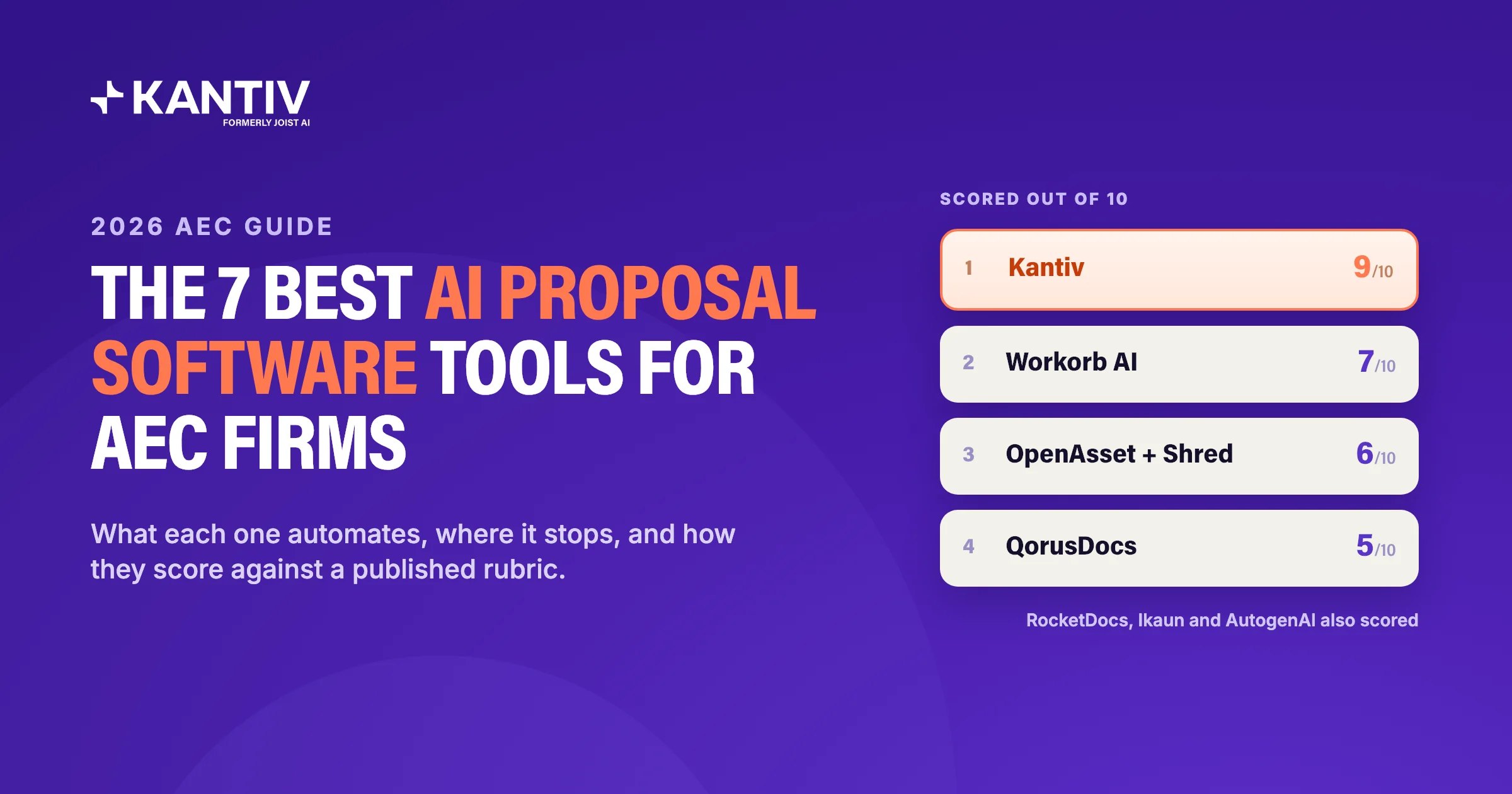
Most AI proposal software was built for a B2B salesperson sending a priced quote, tracking open rates, and collecting an e-signature. None of that describes how an Architecture, Engineering, and Construction (AEC) firm wins work.
When you're chasing public sector work (as you often are in this industry), there's often no price negotiation at all upfront. The price sealed in an envelope or not part of the evaluation. A committee just scores your submission against a checklist. And you can get disqualified over something like a wrong margin size or a missing certification, before anyone even reads how good your actual approach is.
Because generic AI proposal software isn't built for these strict qualifications, current AI tools aren't actually reducing late nights for AEC proposal teams. The hour saved on drafting prose just gets absorbed by chasing a project manager for an updated resume or manually verifying a PE license before the deadline.
Speed is rarely the true constraint in AEC proposals; the deadline is fixed, and a response goes out regardless. What determines whether you win is whether your submission is compliant, compelling, and complete, and whether your software can surface the right project history and team credentials under pressure.
The tools below are the ones AEC firms shortlist. Each is genuinely strong in some areas and falls short in others. What matters is picking the one that fits how your firm actually wins work.
Where AI proposal tools diverge for AEC firms
Proposals in this industry come in two shapes.
Priced sales proposals support a commercial buying process: they typically include scope and pricing, move through stakeholder review, and end in an agreement or e-signature.
Scored qualification-based proposals are where many AEC firms compete: SOQs, SF-330s, and public agency RFP solicitations evaluated against stated qualifications and technical criteria. Price may be negotiated later, weighted separately, or excluded from the first evaluation round.
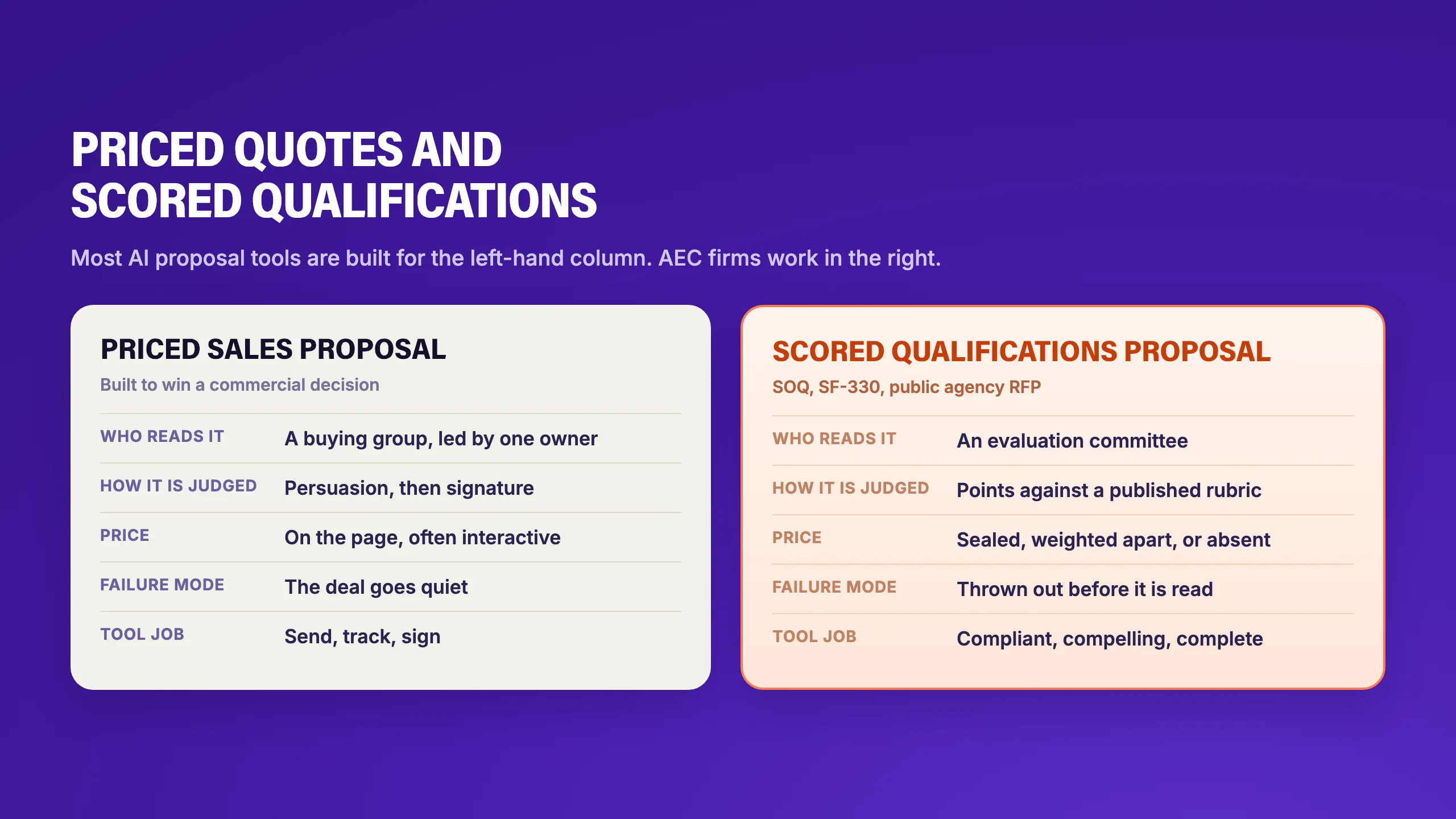
As most AEC marketers and pursuit managers know, a good part of the feature list on a generic proposal tool is dead weight in that second world. Interactive pricing tables, CPQ, and engagement tracking that tells you the prospect opened page four twice, do nothing when the reader is an evaluation committee working through a scoring sheet in a conference room.
Worse: a fast generic draft doesn't just fail to help, it costs you. Evaluators score how well you answered this solicitation, and boilerplate that reads like everyone else's loses points a blank page wouldn't have.
The people on the receiving end can already tell, and SMPS research found the same thing: proposal teams can easily identify AI-written submissions. Stephanie Richardson Parker, a capture and proposal lead in federal contracting, described what came back from her own teaming partners:
Last year, I worked with a few teaming partners... they sent me their 'technical approach' that was literally ChatGPT rewording the SOW back to me. Zero strategy. Zero understanding of the customer... Just... AI slop dressed up as a proposal.
If a teaming partner spots it in a document written to help them win, an evaluation committee reading six responses in an afternoon will spot it too. So the real question for a demo isn't how fast a tool writes. It's what it writes from, and whether it can show you where each claim came from.
Experienced proposal people have already worked this out. The recurring theme in r/govcon is that the output is only as good as what you feed it. Hand a model nothing about your past performance and the draft that comes back is generic.
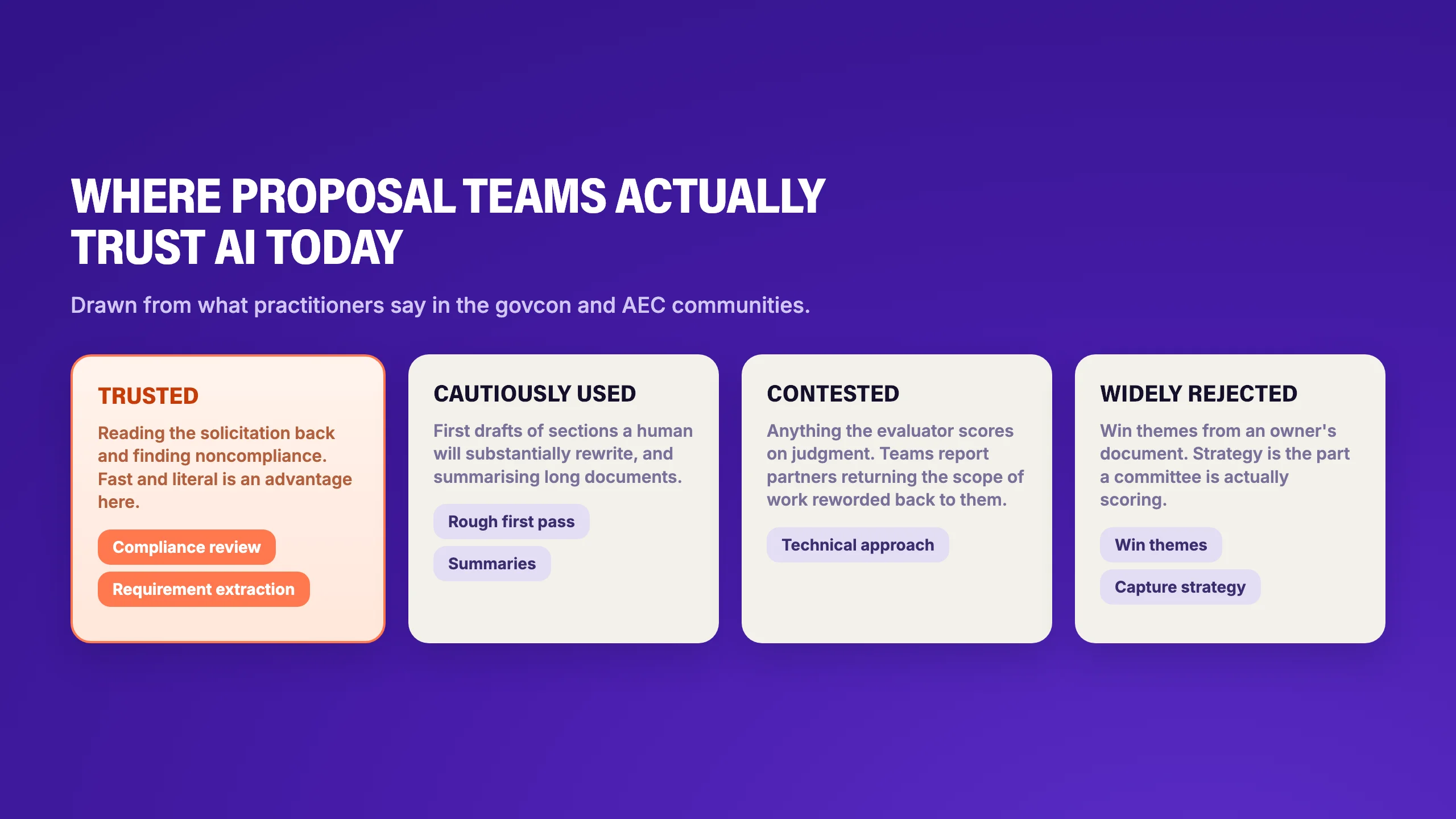
That's not a reason to write these tools off entirely, though. They still earn their place on work that rewards being fast and literal (like checking a finished response against the solicitation for anything left unaddressed).
For the mechanics of how these tools handle grounding, hallucination and data handling, we covered that separately in AI trust and AI proposal software for AEC.
How we scored these tools
We scored each tool 0 to 5 on every criterion below (giving a raw mark out of 50) which was then expressed on a 10-point scale. The raw marks and reasoning behind each score sit in the individual entries.
- Grounding. Can every claim in the output be traced back to a document your firm owns?
- AEC data model. Does it natively understand project sheets, resumes with registrations, past performance and imagery, rather than generic documents?
- Pre-draft support. Does it do anything useful before somebody opens a blank page?
- Compliance checking. Does it catch unaddressed requirements before submission? Compliance here means the solicitation's own rules, not a security certification.
- Relationship intelligence. Does it know which of your people and past projects are the best fit for this pursuit?
- Time to first usable draft. How long before it returns something you would put in front of a client?
- Integration breadth. How many of the systems your content already lives in can it draw from?
- Verifiable track record. How much independently checkable deployment history is there?
- Security and compliance. What is independently certified, and where does your firm's content actually go? Certifications like SOC 2, ISO 27001 and CMMC, plus whether customer data is processed by third-party AI providers.
- Image intelligence. Can it tag project photography automatically, tell you which images have already run, and find the gaps in your visual coverage by market?
One caveat: these scores measure fit for qualifications-based AEC work, which is what this guide is about. A low mark is not a claim that a product is “bad.” It just might not a good fit for the stated use case.
| Criterion | Kantiv | Workorb AI | OpenAsset + Shred | QorusDocs | RocketDocs | Ikaun | AutogenAI |
|---|---|---|---|---|---|---|---|
| Grounding | 5 | 4 | 3 | 3 | 4 | 3 | 2 |
| AEC data model | 5 | 5 | 4 | 1 | 1 | 2 | 1 |
| Pre-draft support | 5 | 2 | 2 | 2 | 2 | 3 | 4 |
| Compliance checking | 5 | 4 | 3 | 2 | 3 | 1 | 2 |
| Relationship intelligence | 5 | 3 | 1 | 1 | 1 | 3 | 1 |
| Time to first usable draft | 4 | 4 | 3 | 4 | 2 | 2 | 4 |
| Integration breadth | 3 | 5 | 3 | 4 | 2 | 2 | 2 |
| Verifiable track record | 2 | 2 | 4 | 4 | 5 | 3 | 4 |
| Security and compliance | 4 | 4 | 3 | 3 | 5 | 2 | 5 |
| Image intelligence | 5 | 2 | 5 | 1 | 1 | 2 | 1 |
| Score | 9/10 | 7/10 | 6/10 | 5/10 | 5/10 | 5/10 | 5/10 |
1. Kantiv, 9/10
Kantiv (formerly Joist AI) exists so a firm can start a pursuit already knowing which of its projects and people make the strongest case. It is a pursuit intelligence platform: it holds what your firm has done, who did it, and how it turned out, in a form the team can use under deadline.
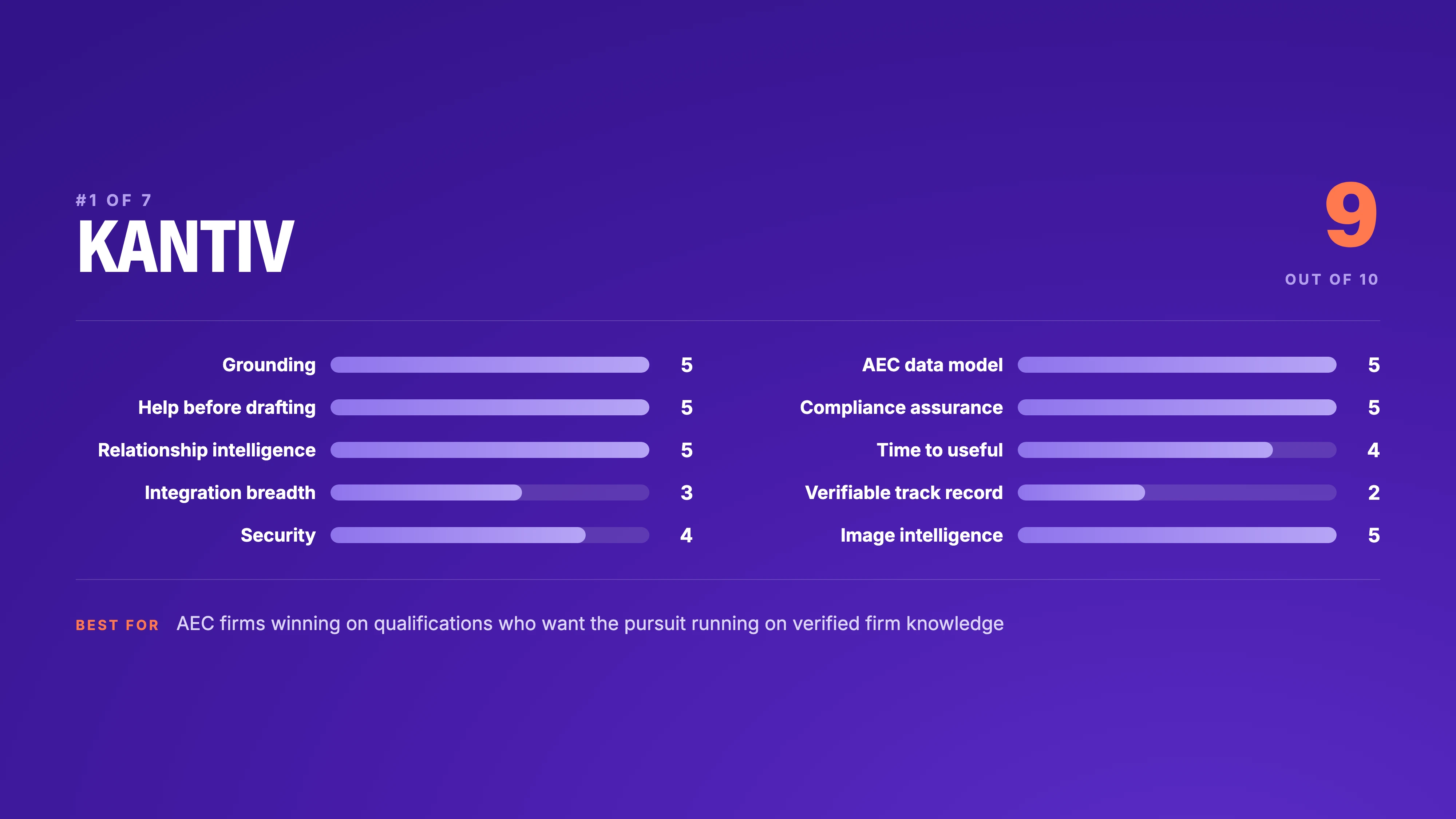
What it automates. When an RFx arrives, Kantiv reads it, then puts the relevant past proposals, project profiles, people and imagery in front of the team rather than leaving them to go looking. Kantiv assembles a win strategy by taking the requirements and surfacing the past projects with the strongest proof points, so the argument gets chosen before anyone starts writing instead of emerging halfway through.
Drafting pulls from that material with the source attached to each passage, and places assets through Kantiv’s InDesign plug-in. Before submission, Kantiv runs a compliance check by reading the requirements back and highlighting what has not been answered. After the decision, the debrief goes back in, so the reasons you won or lost are available the next time a similar pursuit lands.
Content arrives through SharePoint, Egnyte and Deltek without a migration project or re-upload fatigue. If the knowledge exists somewhere, the knowledge graph captures and surfaces it.
Where it stops. It does not price work, and a firm whose proposals are mostly priced quotes closed by signature will find the priorities wrong. Production design stays with your designers. And it can only work from what your firm has actually documented.
Pros.
- Built on an AEC pursuit data model, covering SF-330 and SOQ workflows rather than generic documents.
- Every claim traces to a document the firm owns, which matters when a response can be released under public records law.
- The argument is chosen before drafting rather than discovered during it.
- The graph builds from work the firm already does, so upkeep is a byproduct.
- Replaces the need for a separate DAM through Image Management and Intelligence, so there is one fewer tool to buy.
Cons.
- Built for qualifications work, which is the wrong shape for a priced-quote business.
- Fewer published connectors than the widest platform here.
Best for AEC firms that win work on qualifications and want the whole pursuit running on verified firm knowledge rather than a manually maintained library.
2. Workorb AI, 7/10
Workorb goes directly at the job nobody wants, which is keeping the content library current. It is purpose-built for AEC and takes an RFP through to a compliant first draft.
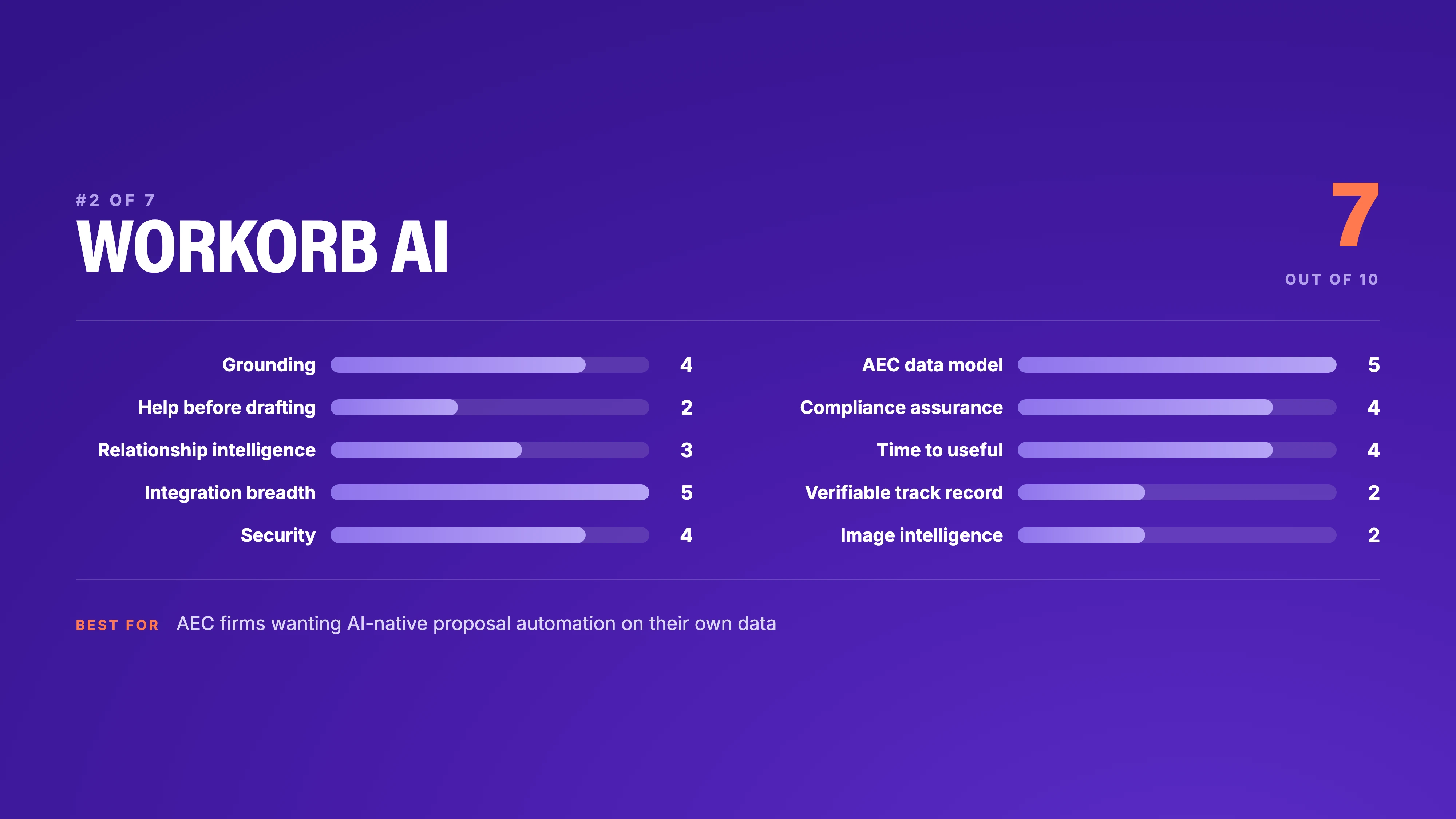
What it automates. Its Knowledge Hub reaches Deltek Vantagepoint, Unanet, SharePoint, OpenAsset and Procore, and the data is curated automatically rather than by a coordinator maintaining it by hand. The project records carry AEC content types including PE stamps, DBE and MBE status, and safety metrics.
Where it stops. Automated curation is the central promise, and it is the thing to pressure-test rather than accept. Ask to see it run against your messiest historical folder rather than a prepared demo set, and ask what happens when two records disagree about the same project.
Pros.
- The widest connector set here, spanning ERP, document management and construction systems.
- AEC record types are native rather than adapted, down to PE stamps, DBE and MBE status and safety metrics.
- SF-330 support is native rather than bolted on.
- Compliance checking sits inside the workflow instead of being a review step after the draft.
- If the curation holds up it removes the task most coordinators dread, and the claimed time to be operational is 48 hours.
Cons.
- Source-tracked drafting is part of the pitch, but it’s best to check if the source is a document or a specific part of its content. Ask to see the trace on a real output.
- Limited independently checkable deployment history so far, and the case studies are still building.
- Go/no-go scoring is there, but nothing documented picks the proof points for you before drafting starts.
- No image intelligence.
Best for AEC firms that want AI-native proposal automation on their own data, particularly anyone burned by tools that need months of manual content management before the AI is useful.
3. OpenAsset + Shred AI, 6/10
OpenAsset is a digital asset manager for AEC, and Shred AI adds an AI layer that reads RFPs and gathers content toward a response.
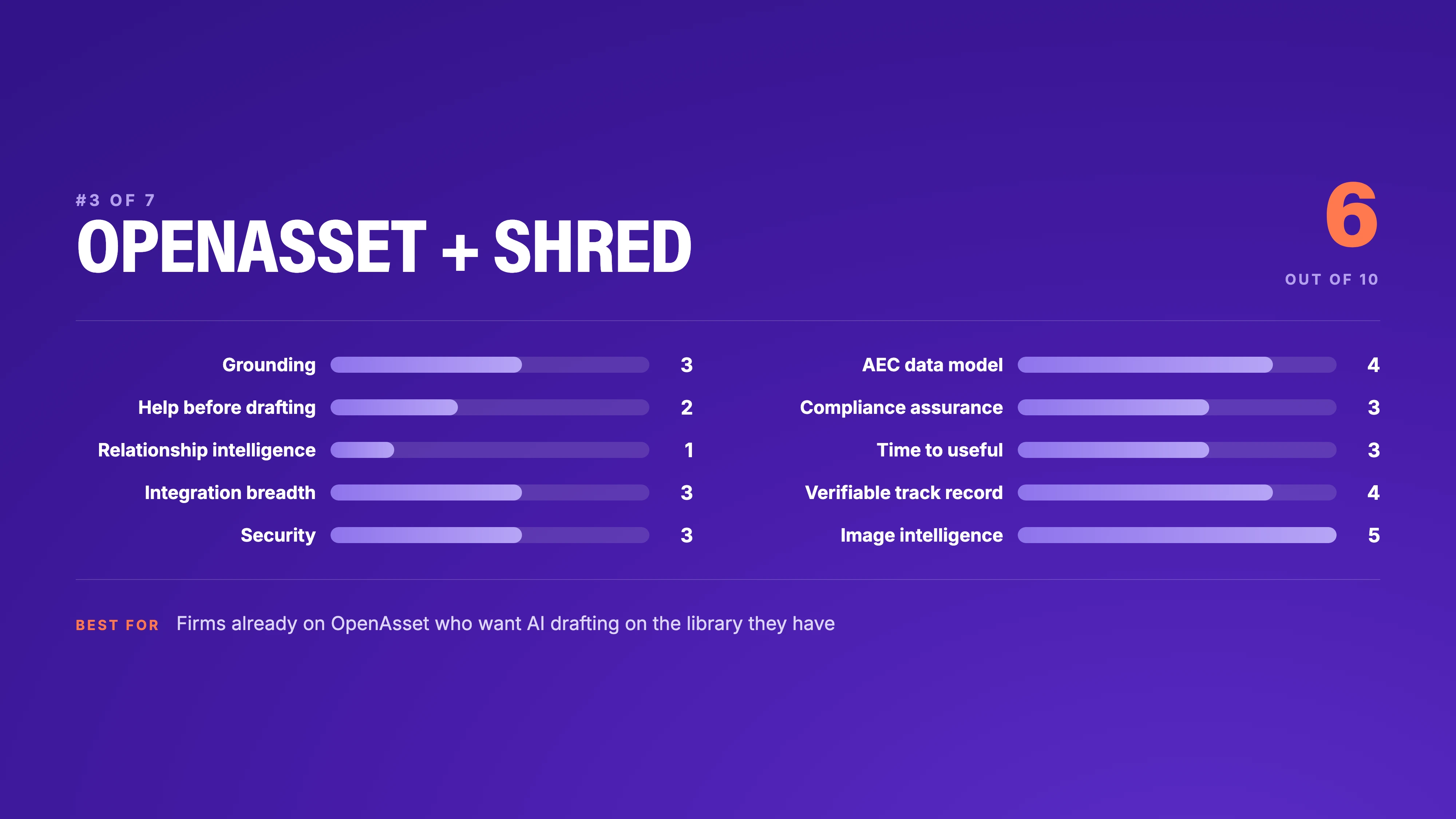
What it automates. Storing, tagging and searching project photography, resumes and boilerplate, with RFP analysis and compliance checking layered on top. A firm already running OpenAsset has a populated library and a connection that is built in.
Where it stops. The model is organized around the asset. Attributes are excellent for finding the right photograph of the right building. What a file-centric structure has nowhere to hold is which principal delivered that project, or which of your people makes the strongest case for the scope in front of you now.
Pros.
- The reference AEC image library, and the deepest tagging and search of any tool here.
- Existing OpenAsset firms get an AI drafting path without changing platforms.
- Years of integration into the AEC stack behind it.
- Strong on visual-heavy pursuits where choosing the right project photography is real work.
Cons.
- The core product is a file and image manager, not a pursuit system.
- AI search model is not trained on AEC-specific terminology.
- Stores images but doesn’t provide image intelligence
- Output is only as good as the metadata somebody maintained.
- Better suited to design and technical narratives than to qualifications-based SOQ work.
- A new adopter takes on a DAM and an AI layer at the same time.
- Seat-based pricing can drive up costs
Best for firms already running OpenAsset that want AI drafting on the library they have, especially where file storage and organization selection carries the proposal.
4. QorusDocs, 5/10
QorusDocs lives inside Microsoft 365, which removes the adoption problem that kills most proposal tools. If your firm runs on SharePoint, Teams and Word, the drafting happens where people already are.
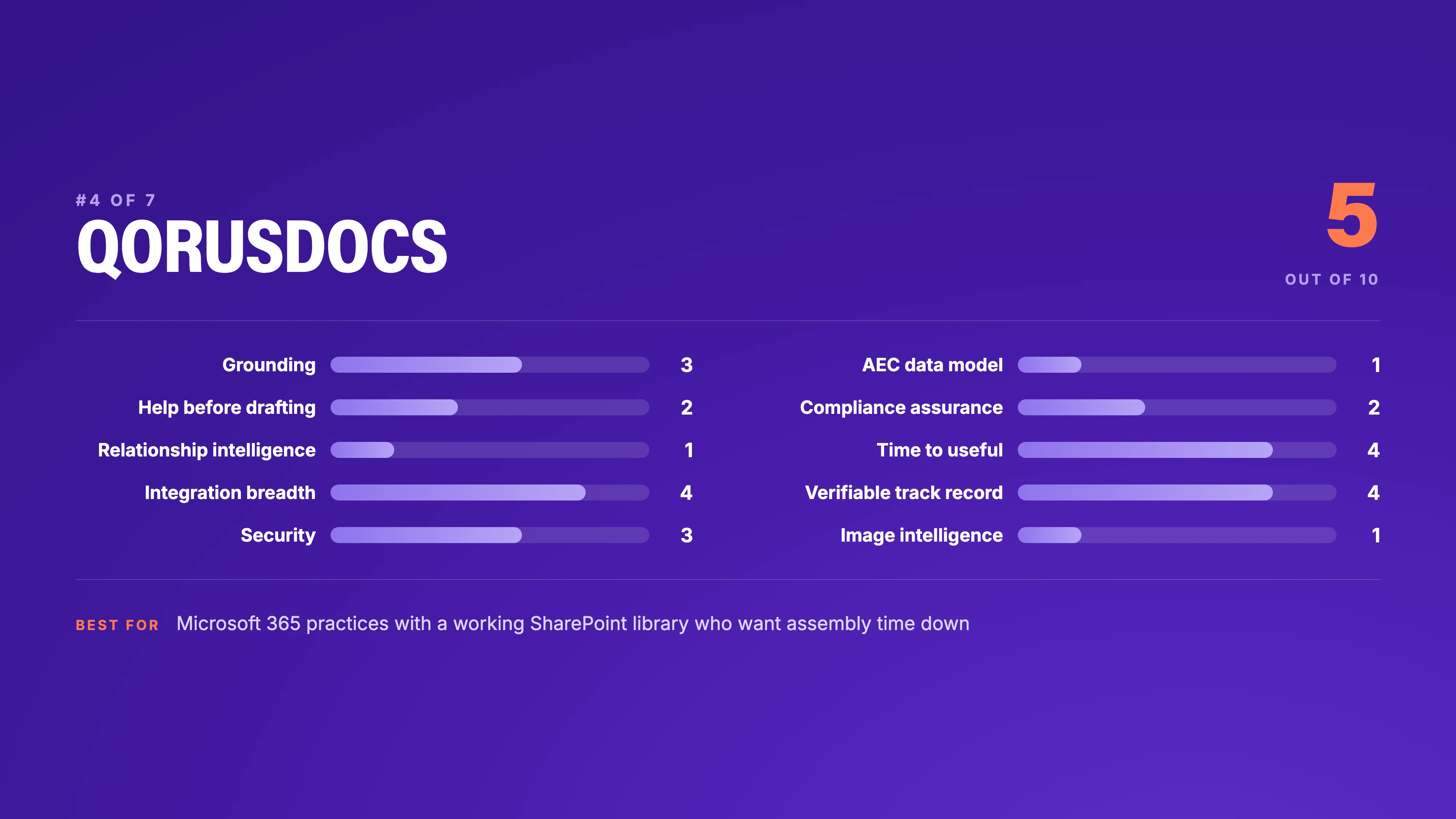
What it automates. AI-assisted drafting inside Word and Outlook, content library search, and pulling approved language into a response without leaving Office. Governance and version control are genuinely strong.
Where it stops. The content primitive is the answer and the document. That suits questionnaire-shaped work and fits loosely around a qualifications package, where the deliverable is a designed, page-limited document assembling project sheets, resumes and imagery against a numbered outline. It also has no view on which pursuits deserve your capacity this month.
Pros.
- Adoption is faster, because there is no new surface to learn.
- Genuinely compresses assembly time where content governance is already good.
- Analytics on content performance help you work out what is actually winning.
- Broad enough to cover several proposal types across service lines.
Cons.
- The data model has no native idea of a project, a pursuit, or SF-330 structure.
- Value tracks library hygiene exactly, so a neglected library returns neglected drafts.
- It solves document assembly, not experience retrieval, and those are different problems.
- Requirement tracking against a solicitation takes manual discipline.
Best for multi-discipline AEC practices living in Microsoft 365 with a working SharePoint library, who want assembly time down rather than a new system.
5. RocketDocs, 5/10
RocketDocs is response management for regulated industries, with a private AI branded Astro. Firm data is not sent to public AI providers, which answers the question your IT director asks first.
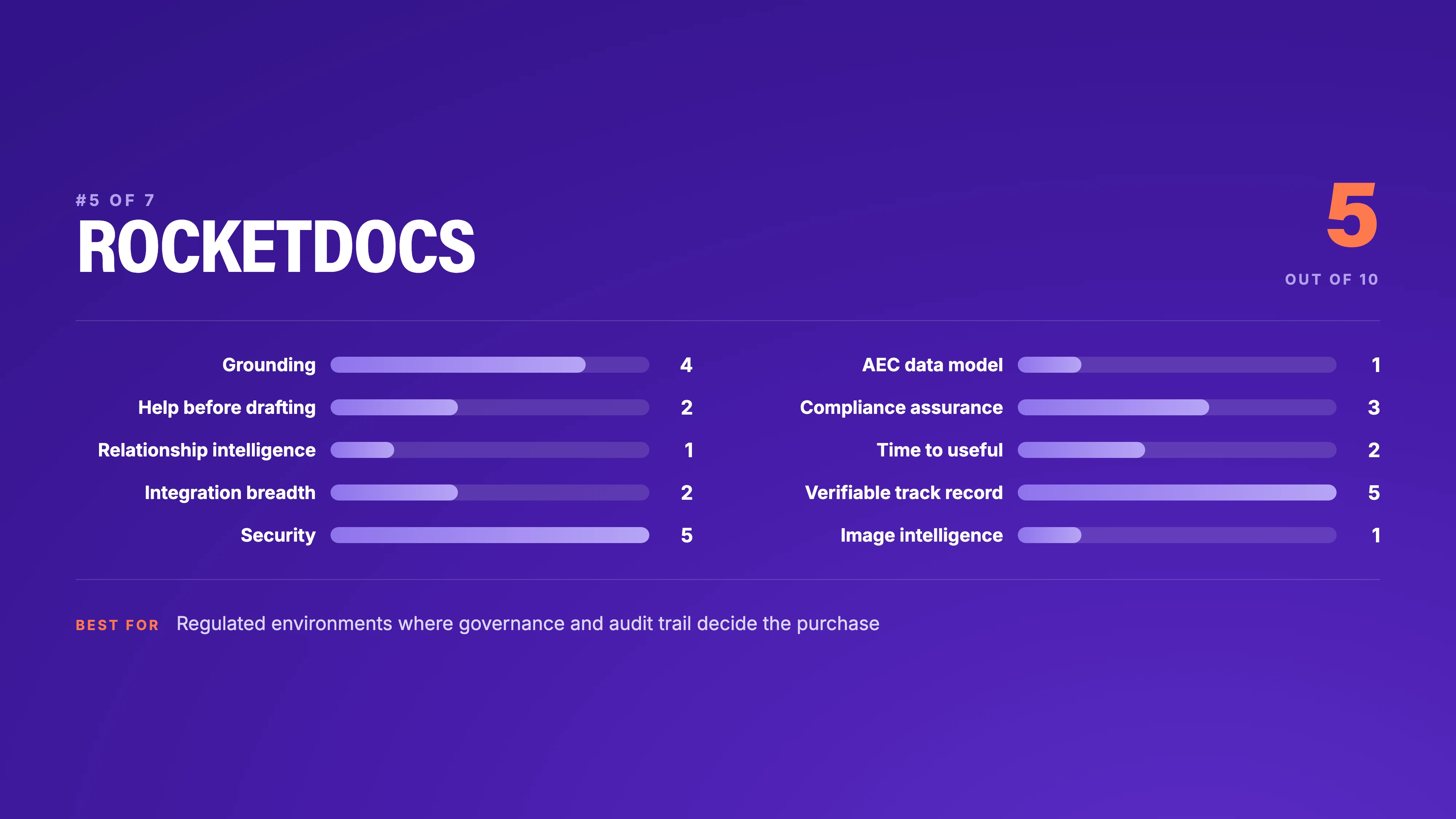
What it automates. A centralized content library with custom tags and attributes, structured workflows for pulling answers out of subject-matter experts, a full audit trail, and Office-native drafting.
Where it stops. The customer base sits in large regulated finance, including Bank of America, Prudential, Deutsche Bank and Aetna. What comes with that is real strength in SME coordination and content governance. What does not come with it is an AEC data model, so it will run a disciplined process around your content without having an opinion about what a project profile is.
Pros.
- Amature SME workflow and approval architecture.
- Private AI, which is a real differentiator when security is a procurement requirement.
- Office-native through LaunchPad, so Word teams adopt it without a fight.
- The content library compounds, each response making the next one faster.
- Long track record in high-stakes regulated response work.
- Publishes a starting price and does not charge per seat.
Cons.
- Primary market is financial services, AEC is secondary, and the data model shows it.
- No native SF-330 or AEC content structures.
- Strong on process governance, light on AEC experience retrieval.
- An $18,500 a year floor rules it out for smaller practices.
- The library only compounds if the team keeps feeding it.
Best for distributed or multi-discipline AEC firms running high-volume, coordination-heavy pursuits, particularly civil, infrastructure and environmental, where SME input, approvals and data security dominate.
6. Ikaun, 5/10
Ikaun brings experience management and AI search to professional services firms, aimed at finding the right past work and the right expertise inside a large organization.
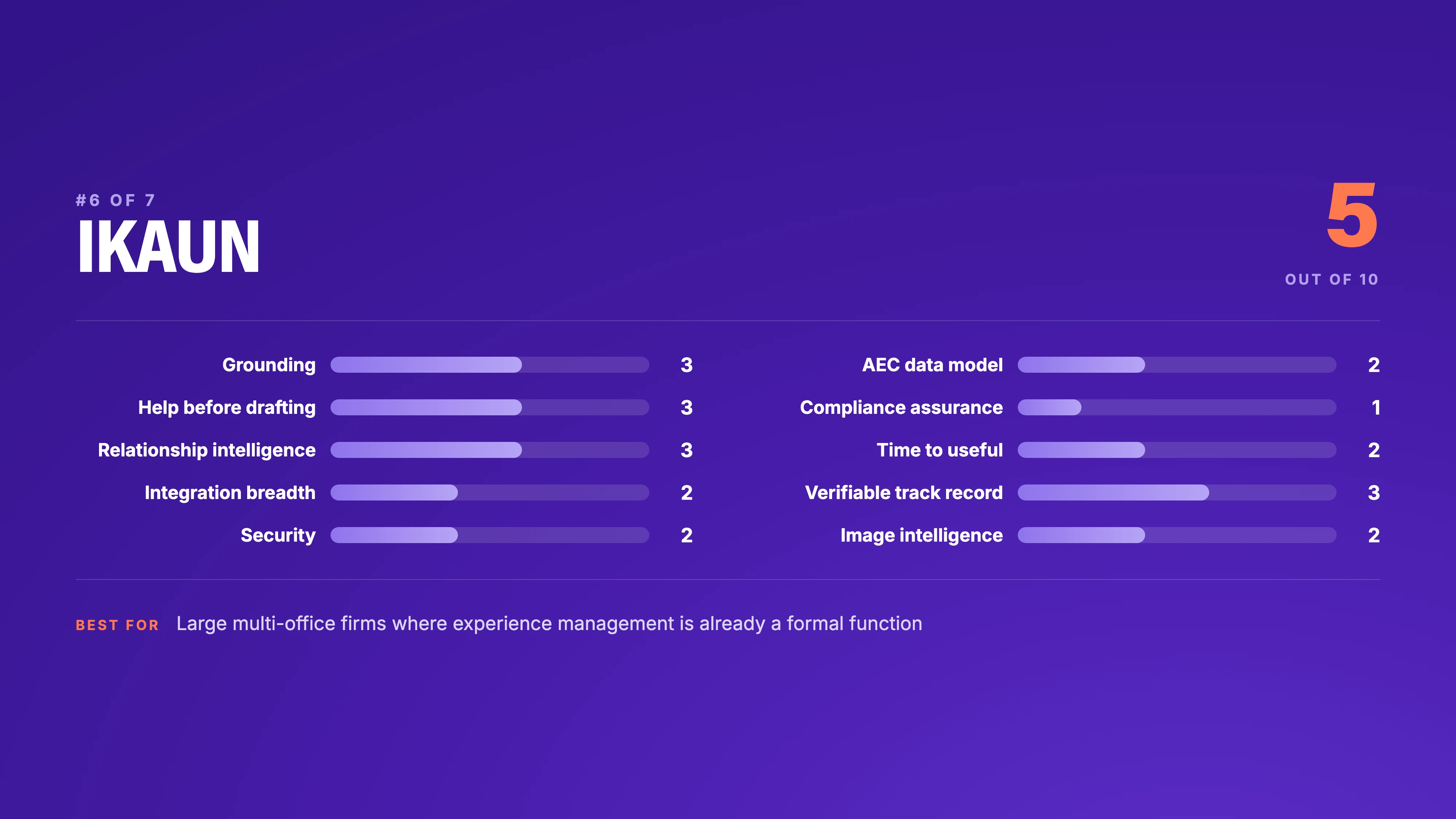
What it automates. Experience and expertise search across the firm, matching past engagements to a new opportunity and pulling that material toward a response.
Where it stops. Ikaun's install base sits with law firms and consultancies, and it has limited AEC track record by comparison. Record types are modelled on professional services, so photography, licensure, delivery method and subconsultant participation either sit in the data model or they do not.
Pros.
- Enterprise governance and permissions built for large distributed organizations.
- A deep experience database for firms with long, complicated project histories.
- Proven at the scale where managing experience data is somebody's actual job.
- Structured content feeds proposal workflows without manual re-entry.
Cons.
- Most documented case studies are law firms; AEC references are thin.
- The interface is functional rather than modern by current AEC standards.
- High total cost once implementation and ongoing administration are counted.
- Publishes no security certifications, where every other tool here holds SOC 2 or better.
Best for large multi-office firms, 500+ staff, where experience management is a formal function and the legal-industry DNA is an acceptable trade.
7. AutogenAI, 5/10
AutogenAI is one of the AI-native options here. It was built for bid and tender writing rather than having AI added to an existing product, and it has a heavy presence in government contracting.
It is genuinely capable at what it was designed for, and firms shortlisting have a strong reason for it. The mark below reflects fit for qualifications-based AEC work specifically, which is not the job AutogenAI was built to do. Read it as an observation about this use case rather than about the product.
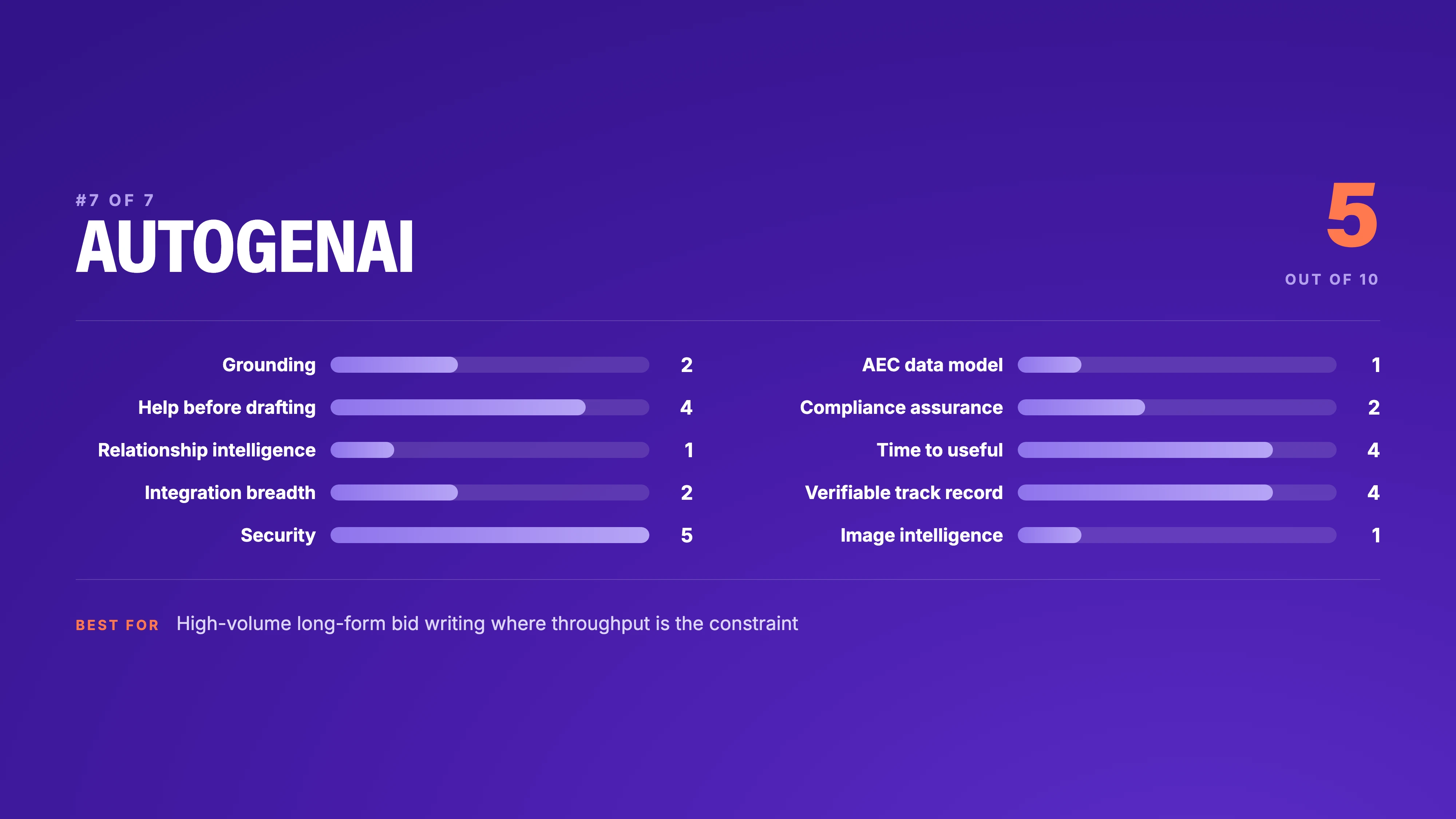
What it automates. Drafting long-form narrative against a requirements schedule, rewriting for tone and readability, and fast iteration on successive versions. A team producing high volumes of written response against a fixed deadline will find the drafting assistance genuinely strong.
Where it stops. The grounding is whatever you give it. It is a language product, strongest where the deliverable is prose and weakest where the deliverable is a structured package assembled against a government form. It has no model of your firm until you have taught it one, and nothing in it knows which of your people belong on which pursuit.
Pros.
- The strongest pure drafting engine here for long-form narrative.
- Purpose-built for bid and tender writing.
- A substantial named customer base in government contracting.
- Among the strongest security postures here, with CMMC 2.0, SOC 2, ISO 27001 and DoD IL5 among its certifications.
- Section-based drafting against a requirements schedule is a genuine strength, and the reason it comes up in shortlists.
Cons.
- No AEC record types, so project sheets, resumes and imagery sit outside its model.
- It knows nothing about your firm until you teach it, and keep teaching it.
- Weak where the deliverable is a structured package rather than prose.
Best for firms whose bottleneck is genuinely long-form narrative writing volume, and who accept it will know nothing about the firm until they feed it.
The test to run before buying any tool for your AEC firm
You do not have to take anyone's scoring on trust. Run the tool against a pursuit you have already been through, and mark it the way the committee did.
- Pick a pursuit you lost. You know the debrief, you know what the evaluators said, and you have the full RFP and your actual response on file.
- Load only what you had at the time. No curation for the demo. The point is to see the tool meet your archive as it really is.
- Give it the solicitation and ask for the sections you were scored down on. Not the easy boilerplate. The approach narrative and the personnel matching.
- Mark the output against the published evaluation criteria, the same way the committee did.
- Check every factual claim it produced. Go through the references, the people, the licenses and the dates, and count how many were wrong or unverifiable.
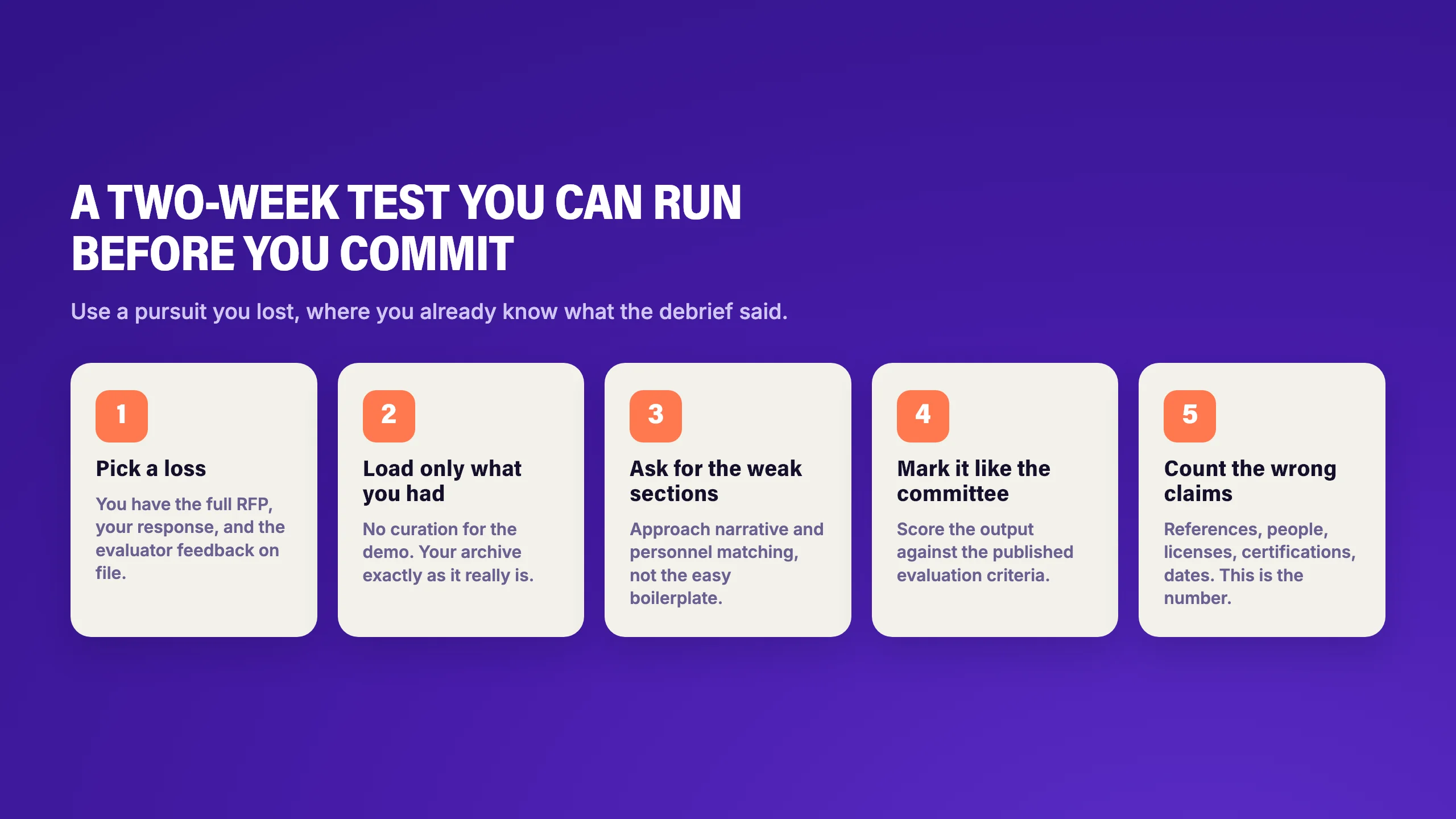
The count of wrong claims is the number that matters. A fabricated project reference or a lapsed license in a public response is not something you fix with a note in review. It becomes a question about whether your firm can be relied on, in a document that can be released under public records law.
Compliance failures work the same way, and they happen before anyone reads your approach. A response over the page limit, in the wrong font, with the tabs out of order or a form missing, is non-responsive regardless of how good the writing is.
None of that is a writing problem, and drafting faster does not fix any of it. It is fixed by a process that checks the response against the solicitation before it goes out.
How to choose the right proposal tool for your AEC firm
Start by diagnosing the bottleneck, because it eliminates most of this list in one move.
First, what shape is your proposal? Pull the last five your firm sent out. If they're priced quotes closed by a signature, everything here is over-built for you, and a CPQ or e-signature tool will cost a fraction of it. If they're numbered lists of questions to answer, you're a response-tool buyer. If they're a case built out of projects, people and past performance, then it is likely that an answer library doesn’t hold what you're actually selling, whatever your shortlist looked like when you started.
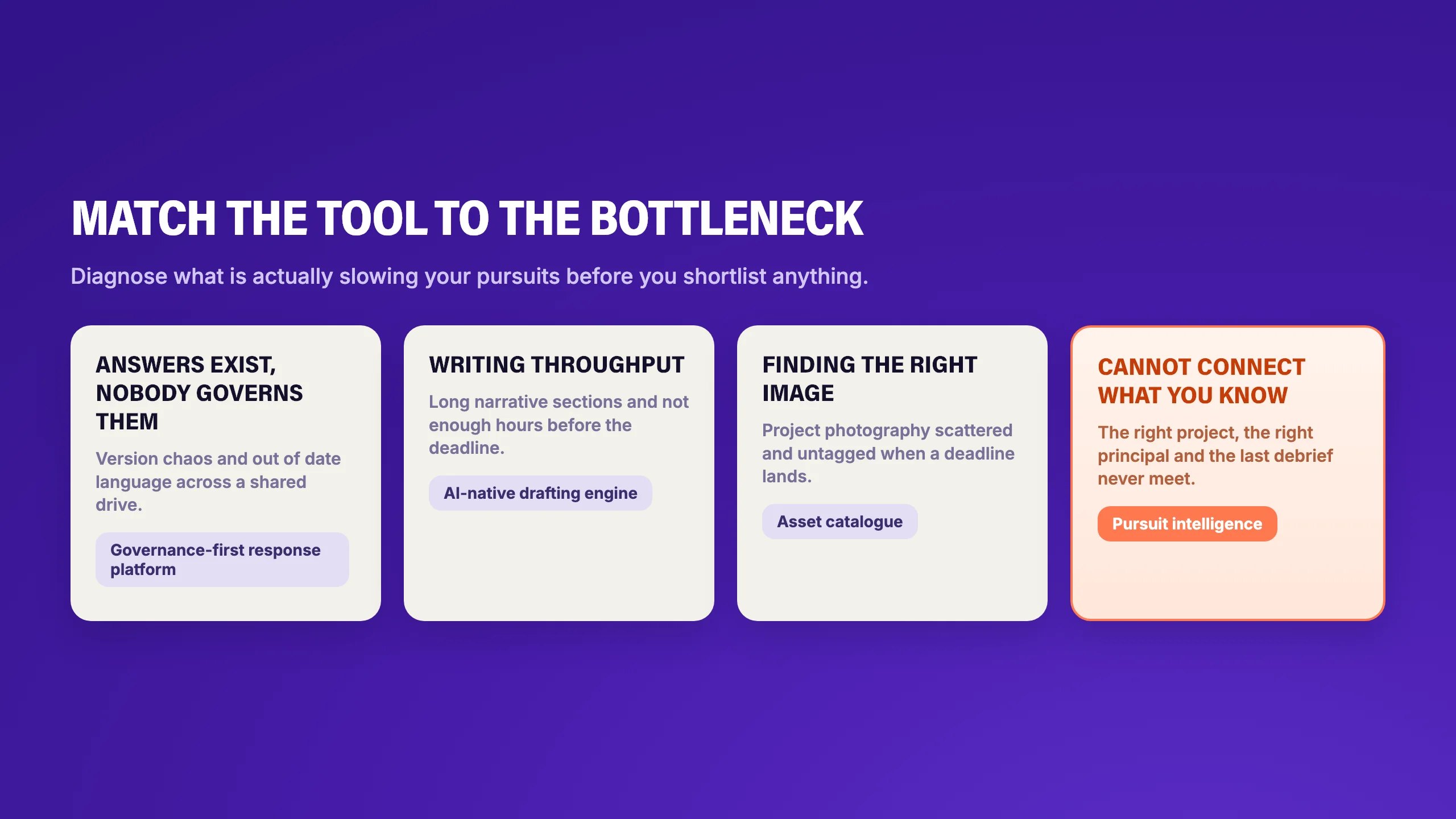
Then name what breaks first. In the response family, the deciding variable is your security posture and where your team already works.
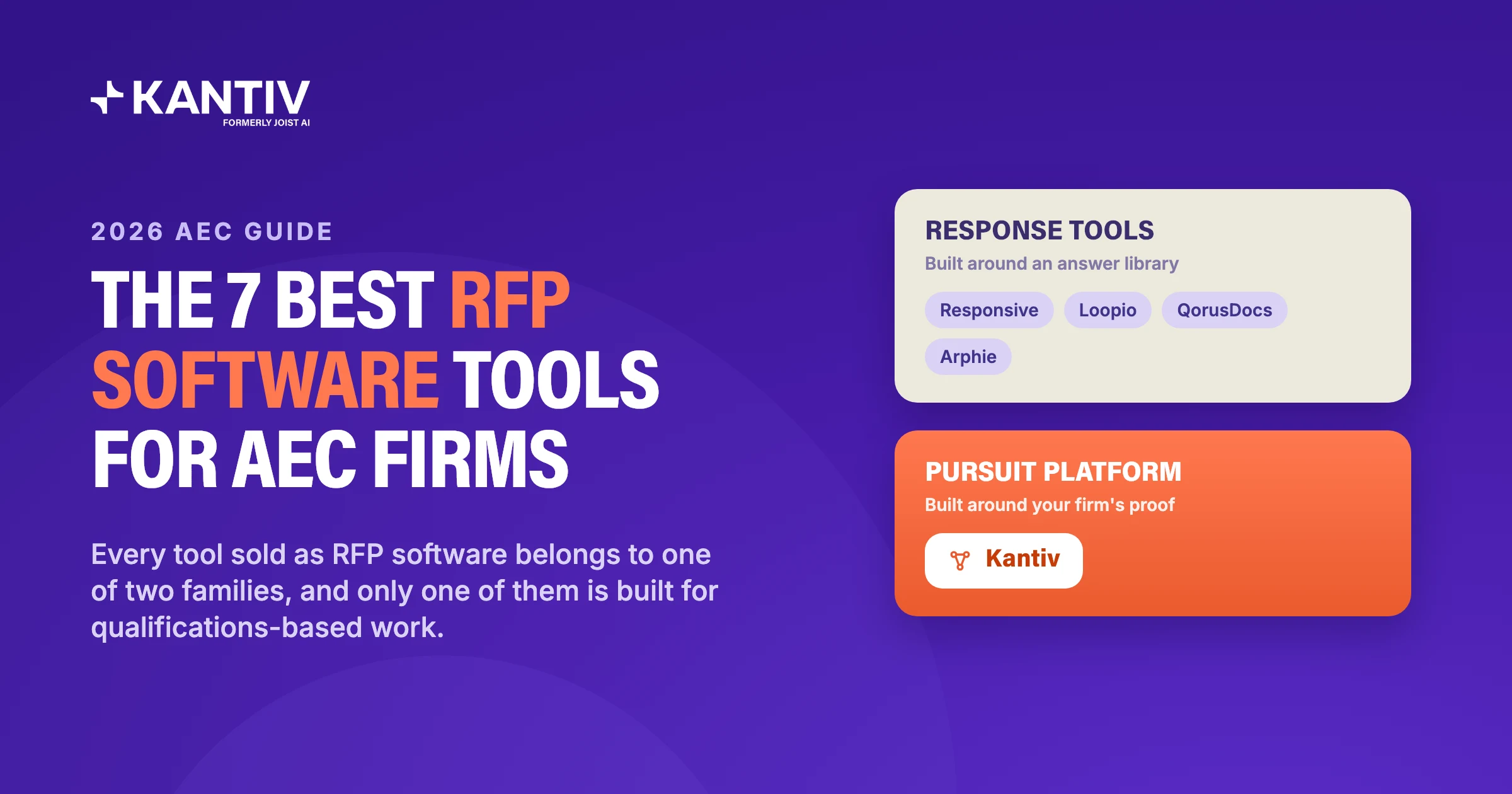
RocketDocs if data security is a procurement requirement and getting answers out of subject-matter experts is the real bottleneck, budget allowing, since it starts at $18,500 a year.
QorusDocs if you live in Microsoft 365 and want the shortest path your team already works.
In the pursuit family, the deciding variable is where your proof is stranded.
If it’s stranded in imagery, and you can staff the tagging, OpenAsset is the honest buy.
If it’s stranded across a 500-person firm where experience management is already somebody's formal job, Ikaun is the managed option, and one to reference-check hard.
If it’s stranded because nobody has ever curated the library and you'd rather nobody had to, Workorb AI is worth pressure-testing, and the thing to test is the automated curation against your messiest folder rather than a prepared demo set.
And if it's stranded across your project history, your people, and eleven years of a coordinator's memory, you need something that maps those together into a structured knowledge graph.
Why more firms are switching to Kantiv
For mid-to-large AEC firms pursuing qualifications-based work, Kantiv continues to be the best solution.
Most firms have the material already. What they do not have is a way to turn it into an argument in the days before a deadline: the project that would win this pursuit sitting in a folder nobody remembers, the principal whose experience makes the case buried in a resume nobody has updated, the debrief explaining exactly why the previous pursuit went the other way and was never written down.
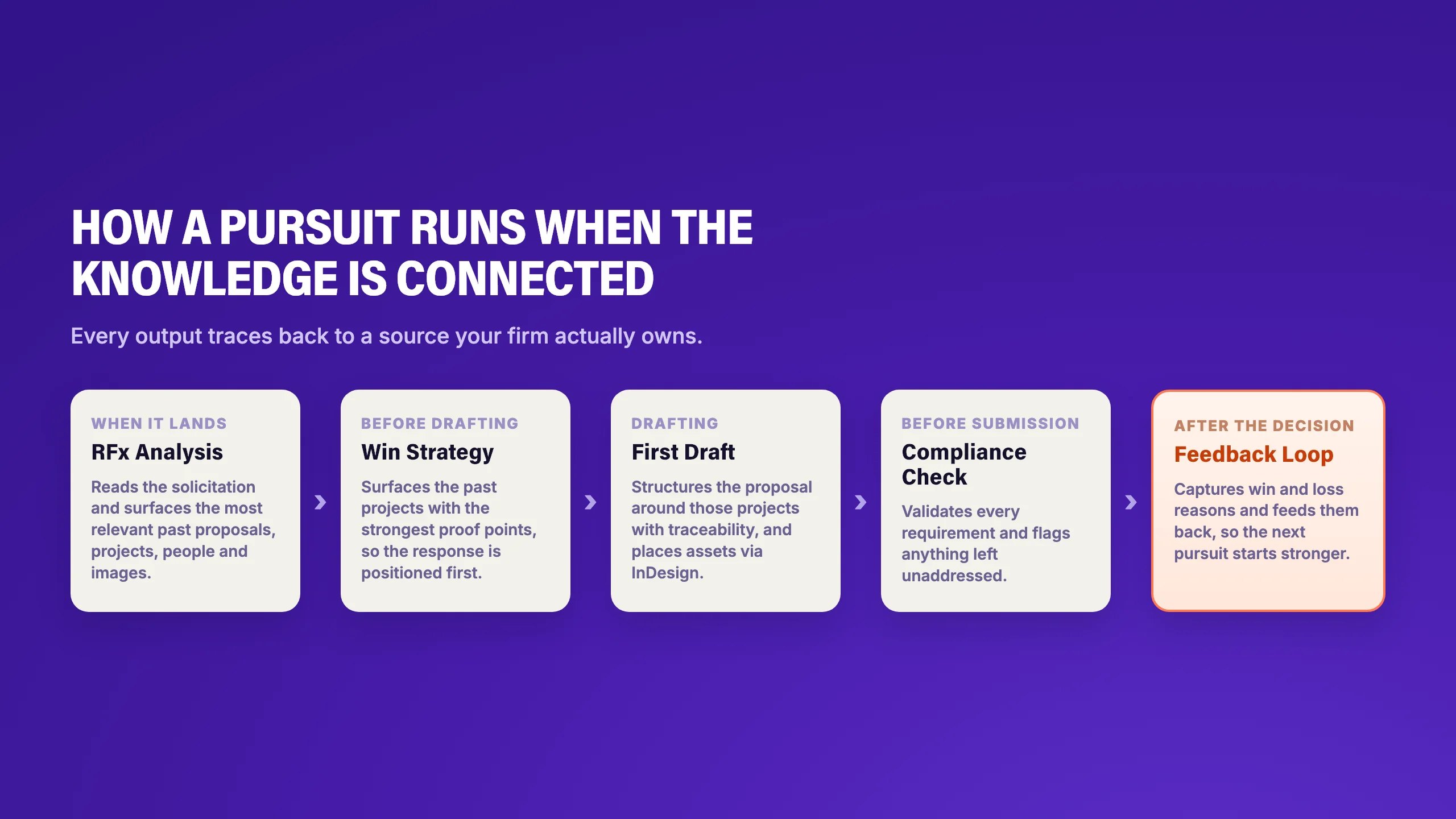
Kantiv fundamentally changes how teams run pursuits. A coordinator opens a solicitation and sees the relevant work instead of starting a search. A principal reviews an argument chosen from evidence rather than assembled from whatever was nearest. A firm stops relitigating the same losses, because the reasons live in the system instead of in somebody's memory. And every output points back at a document the firm owns, so a claim survives a public records request.
More than 200 AEC teams run their pursuits this way, with billions in proposal value submitted through Kantiv. What they have in common isn't size or market. They win on qualifications, and they were tired of their best evidence sitting unreachable at deadline.
Want to see Kantiv in action? Book a demo, and bring the debrief with you.
FAQs
Which AI proposal software is best for AEC firms? There is no single answer, because these tools are grounded in different strengths. Slow writing on long narrative sections is a drafting problem, and an AI-native engine will fix it. Finding the right project photography is an asset problem. Not being able to tell which of your people and projects make the case for a specific pursuit is a relationship problem, and it needs something that holds relationships rather than files. Diagnose the bottleneck before you shortlist.
Can AI write an SF-330? It can draft the narrative content that goes into one. The SF-330 is a government form with numbered parts and a prescribed layout, so the useful question is not whether a tool writes prose but whether it can assemble Section E resumes and Section F project profiles in the required structure, with the right people matched to the right projects. Ask to see that assembly on screen rather than a paragraph of generated text.
Our content library already has everything in it. Why is that not enough? A content library stores items and lets you search them. What it does not store is the connections: which pursuit a proposal came from, which project it became, who delivered that project, and what the client said afterwards. A library returns every proposal mentioning water treatment. What you need to know is which of your principals has actually delivered water treatment work for this client type, and what happened last time you pursued them.
Should we just use ChatGPT or Copilot? For general writing they are fine, and plenty of AEC marketers use horizontal tools for exactly that. The line is grounding. A general model writes from the internet and from whatever you paste into it, so it has no way to verify that a project reference is real or that a registration is current. That’s the true risk of generic AI in proposal writing. As one proposal professional put it in an r/govcon thread on using ChatGPT: "If ChatGPT has no knowledge of your company's profile and past performances and all the details of the contract you're bidding on the generated proposal it usually generates is garbage."
How long before any of this is useful? Plan on several weeks of loading and cleaning past proposals, project profiles and resumes, whichever tool you choose. Vendors promising instant value from your existing archive are shifting that work rather than removing it. Where content lives only in people's heads, expect to run interviews to capture it.
Does the vendor train models on our proposals? Ask directly, get the answer in writing, and check the data processing terms rather than the marketing page. It matters more in this industry than most, because responses submitted to public agencies can be released under public records law, so the exposure is not only commercial.
This comparison was prepared by Kantiv based on publicly available product information and documentation at the time of review. Product features, pricing, plans, and availability may change and may vary by configuration. While we strive to keep this information accurate and current, this comparison may not reflect all available product details. For the most current information, please consult each vendor directly.