Found the content on this page useful? Share it with your team!
AEC Marketing: How to Win More Pursuits


Table of Contents
You have the projects. You have experienced people. You have a track record that should make owners feel safe choosing you.
So why does marketing still feel so hard?
For many AEC firms, this is because the people who sell the work also do the work. Principals often meet with clients and answer proposal questions in the same day. Marketing spends much of its time updating resumes, building interview decks, and trying to get technical input before the deadline moves.
The problem usually is not lack of care or expertise. It’s a lack of time. When teams start from scratch, each new pursuit turns into gruntwork, and that gruntwork eats the hours seller-doers need to actually win pursuits and build great things.
Why do teams start from scratch? Often, it’s because the firm’s expertise lives in too many different places. The website says one thing. The BD conversation adds another. The proposal starts with a hunt for current project facts and staff roles.
AEC marketing works better when your website, BD conversations and proposals draw from the same credible, current project knowledge. The firm gets clearer. Seller-doers get time back. Buyers see the proof they need.
This guide covers what AEC marketing is, which channels to invest in, and how to build positioning, content, and proposals around real project evidence.
What is AEC marketing?
AEC marketing is the work an architecture, engineering or construction firm does to be known, considered and selected for the work, contracts and projects it wants.
Marketing an AEC firm differs from marketing a consumer product or SaaS tool. The buying cycle is long. Decisions rest on relationships and credibility. A buyer may know your firm for years before a pursuit opens. In qualifications-based selections, an evaluation committee may score your qualifications before anyone talks about fee. In other procurements, price and technical factors may be weighed together.
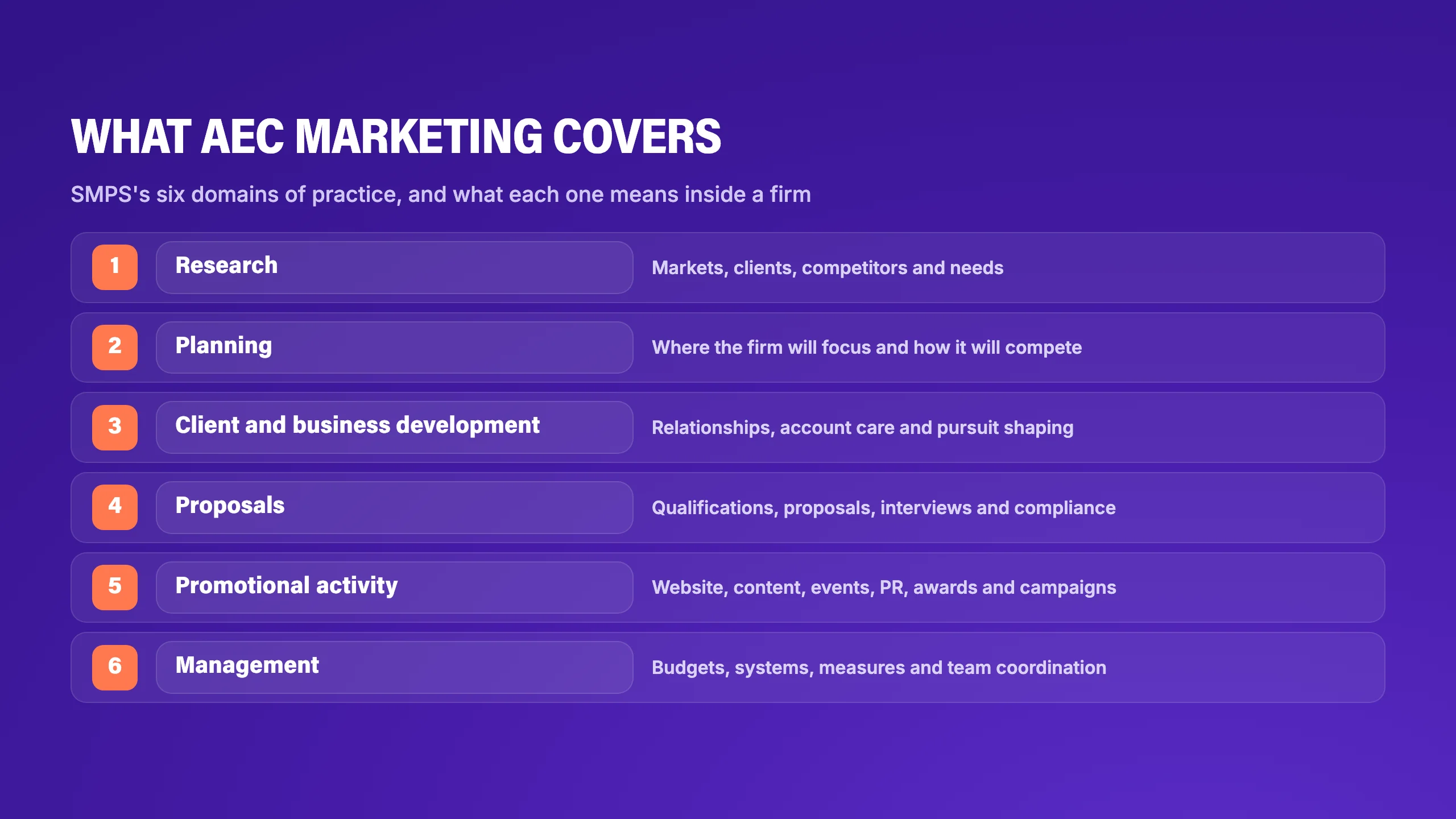
SMPS, the professional association for AEC marketing and business development, lists six domains of practice that together form a useful map of the function.
Good AEC marketing starts building awareness long before a pursuit exists, so the firm has a place in the client's mind when a project takes shape. Its value goes well beyond visibility, though. It gives clients reasons to trust the firm's qualifications, supports the relationships that lead to opportunities, and helps the firm judge which pursuits are worth chasing.
AEC marketing is also distinct from SaaS or consumer marketing in that it includes disciplines like business development and proposal management. These are different jobs, but they overlap:
- Marketing shapes the message and gathers the proof behind it.
- Business development reads the client's needs and priorities while building the relationship.
- Proposal management brings that understanding together with the pursuit strategy in a response that is both compliant and persuasive.
Each of these functions depends on the others, especially in firms where a small team and a few busy principals cover all three.
How does it all come together? It depends on who’s buying. Public procurement often follows a formal RFQ, RFP, bid or qualifications-based selection process. Private developers may put more weight on reputation, prior work and interviews, while institutional owners often combine formal scoring with relationship history.
Marketing has to support each route, with a feel for what the client values and how the firm will be judged. Across those differences, the question worth coming back to is the same: What do we want to be known for, and can we prove it?
Start with the projects your firm wants to win
When you’re crafting an AEC marketing strategy for your firm, the most useful question to start with is this: what kind of work do we want to win? Firms often leave that choice unresolved, creating vague messages and pursuit lists full of unrelated opportunities.
This is where principals come in. Your principals need to help determine which sectors, project types, and geographies deserve attention in the next planning cycle. The answer should be concrete, and should balance a credible right to win, opportunities to deepen expertise, and your team's capacity to deliver.
From there, you have a good starting place to build your positioning, which should be backed by your experience, resources, and brand guidelines. Stay away from broad claims like full-service expertise, trusted partner, and complex project delivery. Buyers hear them all the time from competing firms. They may be true, but they become useful only when they’re specific. and preferably tied to a particular client's project.
One example: compare “An experienced engineering partner” with “An engineering partner for occupied healthcare facility renovations where phasing, infection control and uptime drive the work.” The first asks buyers to judge relevance. The second shows an actual understanding of the project conditions and client concerns.
That narrower, fully differentiated position helps inform what evidence marketing needs to collect, helps seller-doers recognize worthwhile conversations, and guides proposal teams toward relevant projects.
If you’re still trying to identify where your unique differentiation lies, try a simple positioning map:
| Priority market | Buyer concern | Matching projects | People to feature | Outcomes to document |
|---|---|---|---|---|
| Occupied healthcare | Keep departments running | Renovations in active facilities | PM, MEP lead, superintendent | Downtime avoided, phasing success |
| K-12 modernization | Protect school calendar | Summer renovations | Principal, scheduler, architect | Opening date met |
| Water infrastructure | Manage aging assets | Plant upgrades | Civil lead, controls lead | Capacity, reliability, safety |
| Higher education labs | Control technical risk | Teaching and research labs | Lab planner, engineer | Flexibility, compliance |
| Municipal buildings | Defend public spend | Civic projects | Principal, cost lead | Budget control, community use |
A map like this exposes gaps early. Rows relying on one principal's uncertain memory are not ready for a pursuit, even if the experience is real. And where strong experience lacks an approved story, marketing must recover the details. That preparation is a big part of winning work (and often a huge time investment).
Turn project experience into persuasive marketing assets
Knowing the work you want to win is just the starting point. Clients need confidence that you understand their problem, have solved something similar, and can put the right people on the job.
In AEC, showing how your team has handled hard constraints is a big part of proving you have the judgment and qualifications the client is hiring for. Many firms' project sheets stop at the facts that identify the project: client, size, location, completion date. That's all useful information, but it’s a baseline. True persuasion is often measured by your ability to convey what the client was up against, the constraints, what your team contributed, and the results.
The strongest marketing material often connects the project description to the outcome through decisions. “Completed during summer recess,” for instance, gives a timeline. Explaining how the team flagged long-lead switchgear in week 2, sequenced work around the academic calendar, and guided the district's facilities director through opening-day decisions shows how the team acted early to protect what mattered.
Staff bios and proposal resumes deserve the same care, because clients choose people as well as firms. For example: “20 years of experience” establishes seniority. But a truly useful bio explains why the principal or project manager belongs on this team: the problems they have handled, the project types they know, and their next role.
The key here is documentation. One well-documented project can support a website page, shortlist interview, BD conversation, proposal and sector one-pager. What did the team decide? What alternatives did they reject? Why? Capturing these details at closeout with a defined set of questions ensures marketing has the material they need to pursue the next project.
| Closeout question | What it reveals | Asset it feeds |
|---|---|---|
| What worried the client most? | Buyer concern | Win theme, article, BD talking point |
| What made the work hard? | Constraints | Project profile, proposal approach |
| What did our team recommend or change? | Judgment | Case study, interview answer |
| What result can we support? | Outcome | Website, award entry, proposal proof |
| Who can approve the story? | Permission path | Public copy, photography, references |
💡Pro tip: Kantiv, formerly Joist AI, drafts team bios, case studies and sector one-pagers from your firm's projects and people using the Brand Voice Profile, and Kantiv’s Data Collection Agent runs structured voice interviews with the people who did the work. Benesch uses Kantiv for team bios, collateral and case studies, and Chad Bay, Marketing Communications Manager, says “we draft team bios, marketing collateral, and case studies for a variety of uses.”
Choose marketing channels that reach the right buyers you’ve identified
We’ve mentioned a few of the ways AEC marketing is different from, say, SaaS marketing. But it is the same in one crucial way: to do it well, you need to start from the customer.
When thinking about your channel mix, start by identifying who your ideal buyer is. Think about what they need to believe about your firm, what their buyer journey looks like, and which proof points belong at each touchpoint.
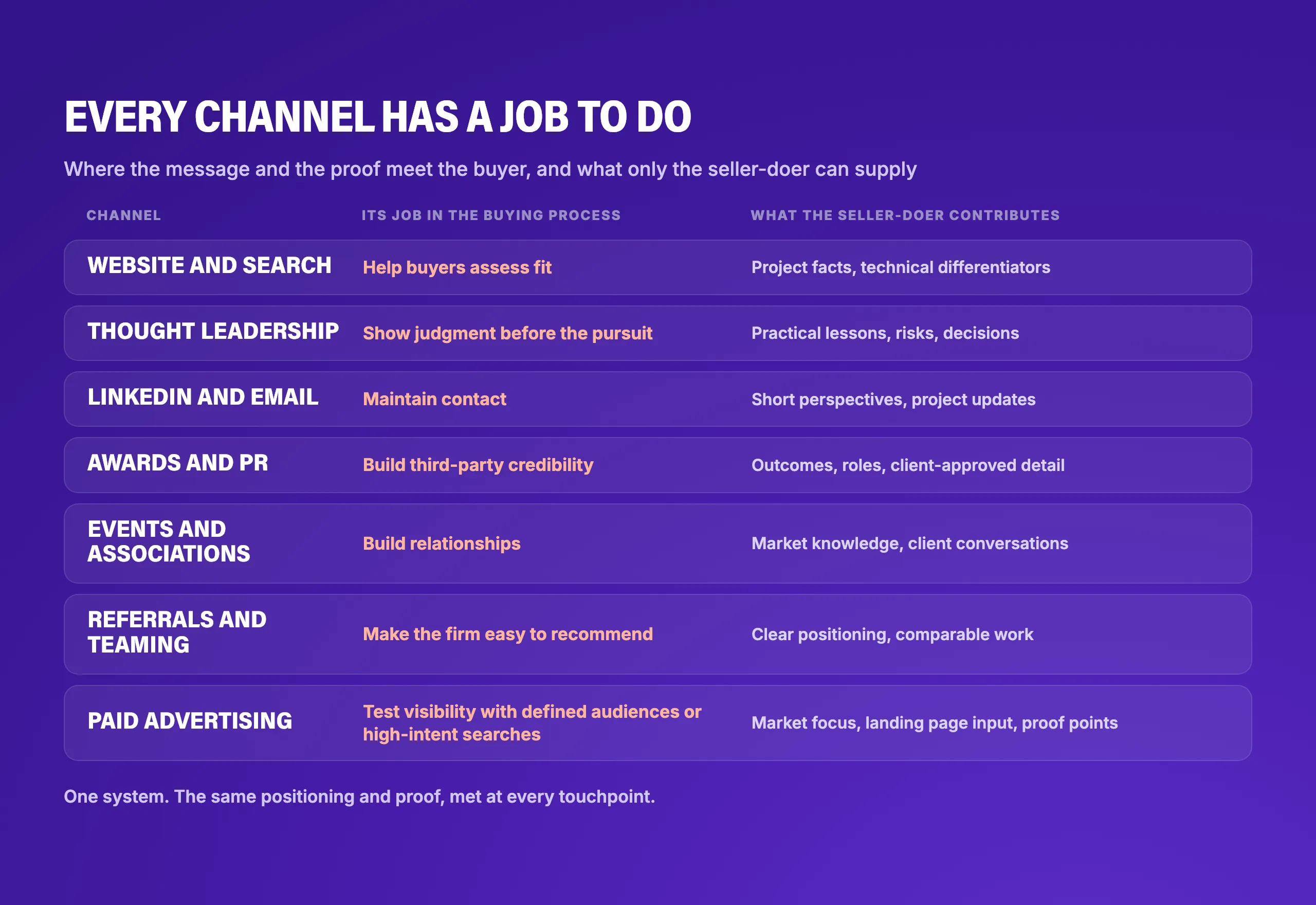
Your website and search presence, for instance, help buyers decide whether your firm belongs in the conversation. In Fusion BD's 2026 survey of owners, 36% of surveyed decision-makers said they use AI tools to build an initial shortlist. AI tools compress the initial credibility check, so it’s crucial that your content is retrievable by AI search models and your firm ranks for queries that your ideal buyers are asking.
LinkedIn is another critical channel for most firms. A principal's LinkedIn profile does work a firm page usually can’t, because owners follow people whose judgment they may need to trust. A well-timed post from your principal about the occupied building where the shutdown window was too short can produce inbound questions from buyers with similar constraints.
When it comes to events, opt for activities that actively get your firm in front of buyers. Booths are great, but they ask passing owners to stop and discover whether your firm has anything useful to say. Compare that to a panel where your principal and her client are explaining how they kept a facility operating through construction. That is one of the strongest business development moves available to your firm, because buyers can hear the reasoning and test it against their own constraints.
AEC work often arrives through a client or a partner willing to vouch for the firm, which makes being easy to recommend a practical marketing advantage. Every gap buyers need to fill in on their own makes that recommendation harder. That means the proof you present in one channel needs to actively reinforce what the buyer encounters in the next step in their journey.
Connect marketing activity to better pursuit decisions
Marketing earns its place in pursuit planning by helping the firm choose better opportunities and produce better proposals. Polished submissions have limited value if the work was never a good fit.
We talked at the onset of this post about agreeing on the work the firm wants to win. Distilling that agreement into your positioning is a great start, but your positioning and evidence maps then need to reach back to your principals and business development staff. Seller-doers meeting clients need to know which proof points matter and why, so the conversations they have with clients reflect the actual marketing strategy you’ve helped develop.
If you do the job well, you’ll start to see your marketing activity working in the form of website visits, email responses, event questions, referrals, and content engagement. For example, a target account visiting your healthcare project pages after a paid campaign, or an owner discussing an upcoming renovation at an event, can give BD a reason to follow up. Bring those signals into pursuit reviews so the people assessing an opportunity understand what prompted the interest and what the client appears to need.
None of these signals justify a pursuit alone. Together, though, they add context before an RFP appears, while your firm can still learn about the client and assess fit.
A practical go/no-go scorecard, like the one below, can then help you determine whether it’s worth pursuing the opportunities marketing is generating. Its criteria should reflect the same sectors, project types and client needs your marketing is focused on.
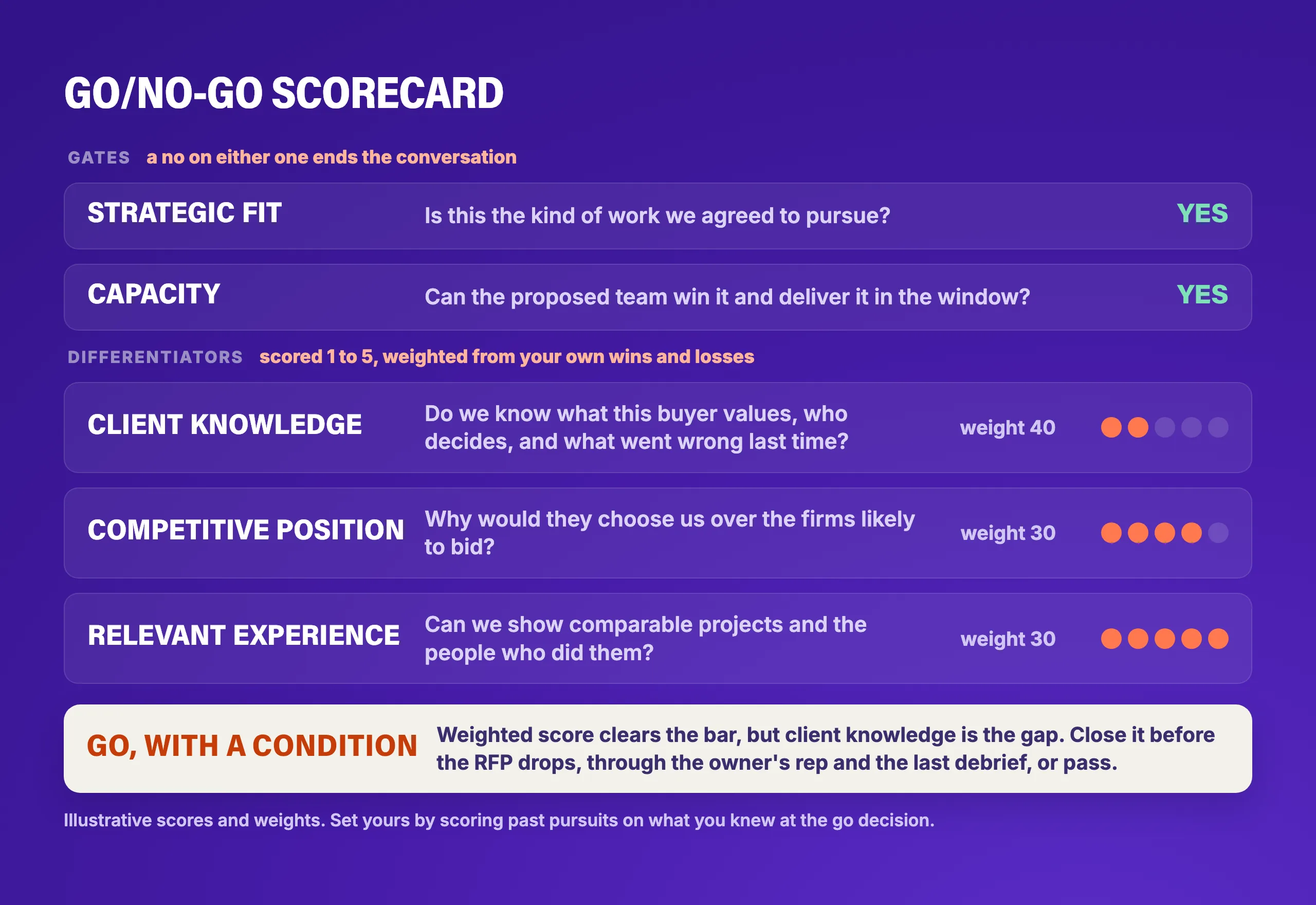
If occupied healthcare is a priority, for instance, relevant experience should carry real weight. Client knowledge should matter too. Identifying gaps early, while your marketing is generating inbound signals, gives your firm time to address them or pass before the team spends nights on work it has little chance of winning.
Build proposals from evidence
For the seller-doer, a proposal is rarely a simple handoff. You shape the strategy, answer technical questions, and choose which projects to show. Which means you’re also the one who finds out whether the groundwork marketing did, holds up.
How this shows up in practice: you may have exactly the experience an owner needs, but if your records are scattered and your resumes are outdated, you’ll likely find yourself submitting generic claims.
You can fix this by building your proposals from evidence. That starts with the RFQ or RFP itself. Building a compliance matrix separates mandatory instructions from scored criteria, and assigning each response item an owner, source, and review status makes the work trackable and keeps compliance from consuming attention needed for the selection argument.
Next comes the evidence itself. New and/or photogenic projects are great, but start with the ones that show how the team handled similar constraints, understood comparable facilities, or solved relevant problems.
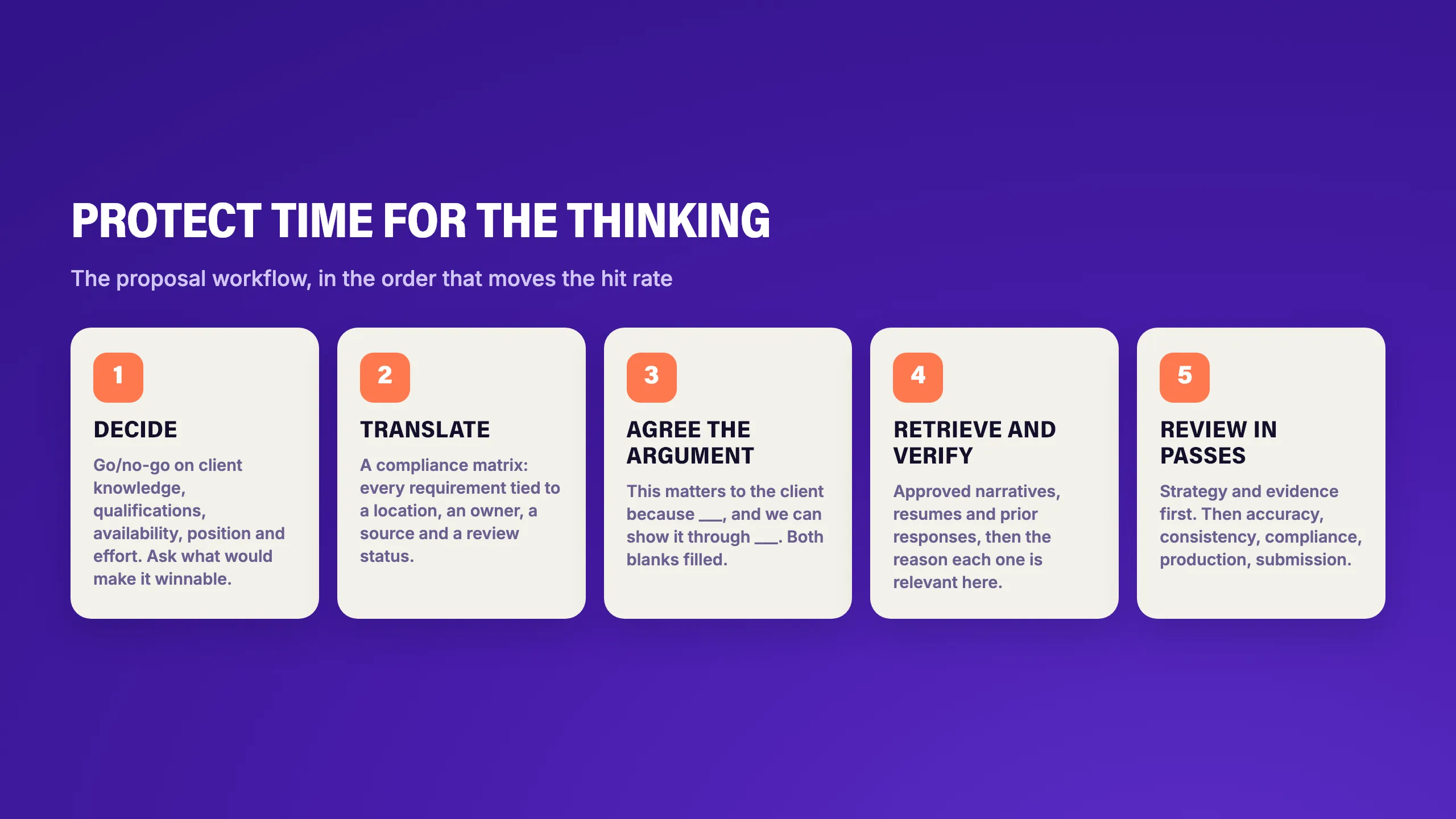
A practical framework to build better proposals and improve win rate.
Experts respond to proposal input requests only about 30% of the time, so when it comes time to loop in technical contributors, give them narrow and specific requests with clear context. For example, rather than just saying "send methodology,” try "Explain how we would phase work around this facility's access needs."
When it comes time for review, don’t just check for completeness; test whether your strategy has actually reached the page. Does the logic hold together? Does the proposal sound like the firm the team intended to present? Your reliability and proven experience should be clearly visible in the copy and supported by the details.
💡Pro tip: Kantiv analyzes the RFQ, RFP or solicitation, finds relevant projects and people, drafts from firm-owned source material and supports the compliance check, with people reviewing. Satterfield & Pontikes estimates that Kantiv saves its team 8 to 10 hours per proposal.
Prepare for shortlist interviews
Shortlist interview prep is a critical part of AEC marketing. The job is to turn your proposal claims into a conversation. The client wants to see how your team thinks and works through uncertainty, and what working together feels like.
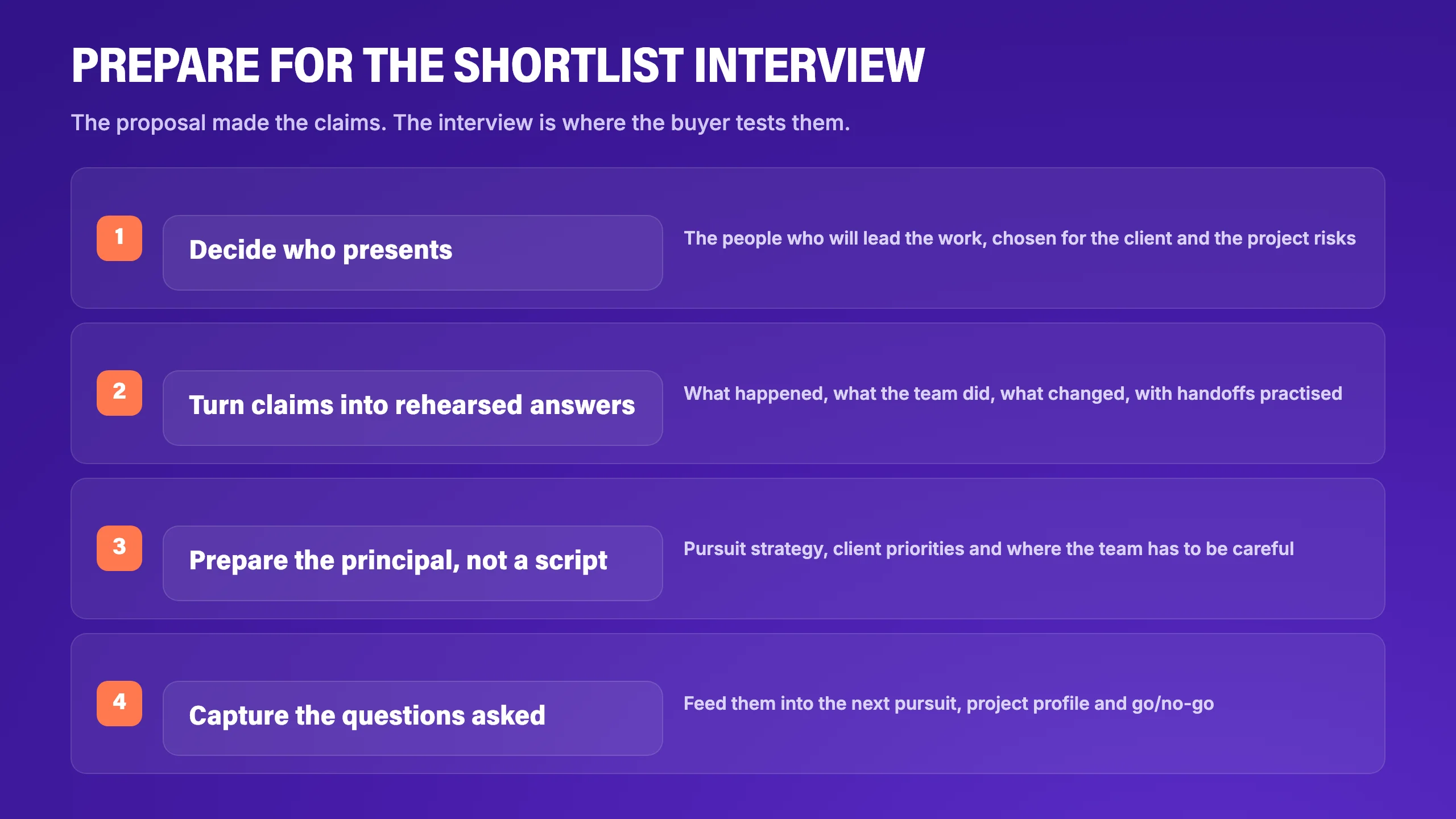
The first step is choosing presenters. Think specifically about the roles needed and the issues the project will actually face, rather than seniority alone. The phasing lead, for instance, should explain the approach and tradeoffs, while the cost lead should explain cost control plainly.
Next, prepare evidence behind your claims. For occupied renovations, for instance, describe what happened, what the team did, and what changed. Make sure you rehearse these finer points and examples so you can articulate them readily in conversation. Practice handoffs, too: knowing when to contribute or let a colleague lead shows the client your team can function as a unit.
It might seem counterintuitive, but your principal needs prepping as well. Seniority doesn’t guarantee familiarity with your pursuit strategy. He or she should be able to clearly articulate why the firm wants the work, its approach, and what the client needs from the relationship.
Finally, make sure to capture all client questions and presenter hesitations before the next deadline takes over. These reveal what clients find credible and where the firm's experience needs strengthening. Carry those lessons into future pursuits, and the value of your interview will transcend the selection decision.
💡Pro tip: Kantiv's shared prompts help the team anticipate the questions a client is likely to ask and prepare tailored answers for shortlist and interview prep.
How to measure AEC marketing
Like most forms of marketing, the value of AEC marketing gets clearer when you measure progress toward revenue. Activity–LinkedIn posts, events booked–shows the work is happening, doesn’t tell you if the firm is any closer to winning the projects it wants.
Here are the key metrics you should be tracking to understand marketing effectiveness:
| Metric | What it tells you |
|---|---|
| Qualified conversations | Whether target markets are warming up |
| Qualified pursuits | Whether marketing is feeding the right pipeline |
| Shortlist rate | Whether your qualifications are credible |
| Win rate | Whether your strategy and proof are working |
| Proposal effort | Where time is being spent or wasted |
| Win/loss themes | What to fix before the next pursuit |
Context is important here. Boosting top-line win rate is great, but like any of these metrics, you want to measure through the lens of your positioning and where you feel your firm can really grow. If healthcare renovations are a priority, for instance, ask yourself: are conversations and pursuits growing there?
Firmwide averages can have a tendency to hide positioning strengths and weaknesses, so in addition to market-specific measurement, you should also segment performance by project type and client type (where volume allows).
Win/loss findings really earn their keep when they improve your firm’s ability to make decisions. In that light, be sure to record each pursuit's outcome and capture as much feedback as possible. As Katy Byers of Middle of Six said on The Shortlist podcast:
"You are getting so much more data when you lose than when you win."
Closeouts turn completed work and relationships into usable knowledge, but don’t just run one project closeout and call it a day. Project closeouts document delivery. Pursuit closeouts preserve competitive lessons. Client closeouts capture satisfaction and future needs. Taken together, they connect marketing to revenue by informing how your firm wins its next project.
Making your expertise easier to find and easier to evaluate
AEC firms rarely win more by saying more. They win by presenting the right proof at the right moments, and by ensuring that the people who have to produce that proof aren't rebuilding it from scratch every time.
For the seller-doer, this is the difference between a pursuit that costs a week and one that costs an afternoon. The time of your firm’s most valuable minds should be devoted to pursuit strategy and to the work itself, not to a search for a project sheet that was accurate two years ago.
Kantiv empowers seller-doers by giving that time back. Knowledge Graph maps your firm's projects, people and pursuit records, so the relevant evidence your pursuit demands is ready when you need it. When the RFQ arrives, Kantiv reads it, finds the matching projects and people, drafts from the firm's own material, and supports the compliance check, with your people reviewing every line.
Want to try it out? Book a demo, bring a live RFx, and see how Kantiv can help your firm win more pursuits.
FAQs
What does AEC marketing include?
AEC marketing includes research, planning, client and business development, proposals, promotional activity and management. In practice, that means positioning, websites, content, events, awards, account support, pursuit decisions, proposals and interviews.
How is AEC marketing different from business development?
Marketing builds visibility, messaging and proof. Business development builds relationships, reads client needs and helps shape pursuits.
What is an AEC marketing strategy?
An AEC marketing strategy defines the work the firm wants to win, the buyers it needs to reach, the message it wants associated with the firm and the evidence that proves it. It also guides go/no-go decisions, content priorities and proposal focus.
How much should an AEC firm spend on marketing?
The right spend varies by firm size, growth goals, market position and how labor is counted. Hinge's 2026 High Growth Study found that high-growth AEC firms reported marketing budgets of about 10% of revenue, against about 5% for slower-growth peers, across a sample of 110 firms.
How do you get technical staff to contribute to marketing without writing?
Stop asking for finished copy. Ask narrow questions in a short interview about the client's concern, the hard part of the work, the team's recommendation and the result, then let marketing draft the asset for technical review.