Found the content on this page useful? Share it with your team!
AEC Is Building More Valuable Firms. So Why Aren’t We Keeping the Value?


Table of Contents
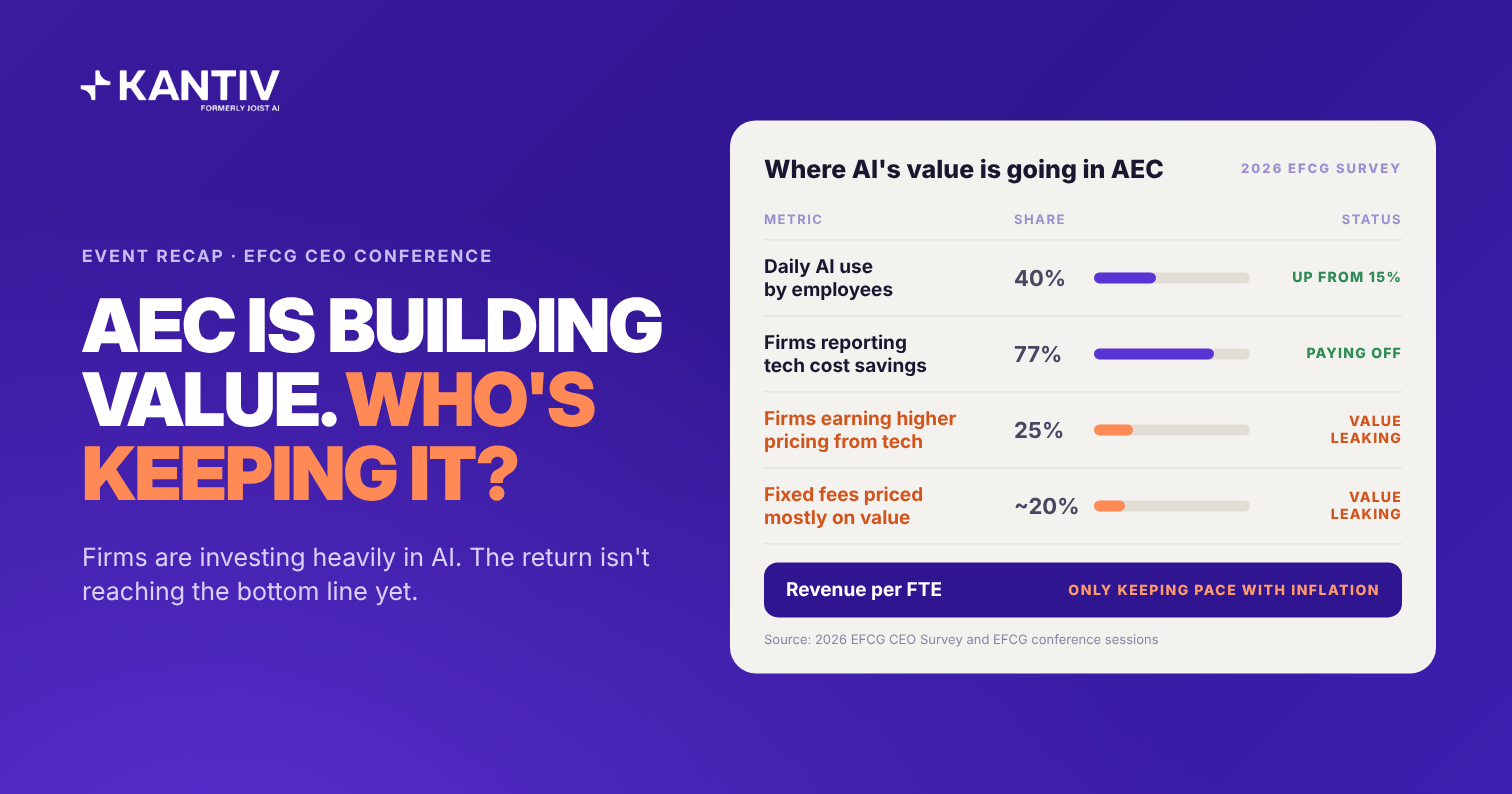
At the EFCG CEO Conference, I caught the session where EFCG presented findings from its 2026 CEO Survey, which covers firms representing more than $200B in revenue. The headline was good news. Median internal growth is holding at 8%, median profit sits around 14%, and EFCG expects record margins in 2027.
Then EFCG asked a question that stayed with me through the rest of the conference: if firms are investing so heavily in becoming more valuable, why isn’t that value showing up on the bottom line?
The investment is real
Firms are doing a lot. Daily AI use among employees went from 15% to 40% in just two years. More firms are selling software, shifting to fixed-price work, and building deeper relationships with repeat clients. Software fees have doubled as a share of net revenue since 2018, and EFCG expects IT spend to double again over the next five years.
The return isn’t showing up
Revenue and profit per FTE are only keeping pace with inflation. After all that investment, productivity per person hasn’t pulled ahead.
EFCG’s technology data explains part of why. Technology that makes a firm more efficient internally is paying off, with 77% of firms reporting cost savings. But technology meant to improve what clients value is working less well. Only 25% of firms report higher pricing from tech-enabled consulting, and the increases are typically under 5%.
Pricing habits are a big part of the problem. Firms are moving toward fixed price but still setting those fees as if they were billing time and materials. Only about 20% base at least half of a fixed-price fee on perceived value. EFCG’s warning was direct:
Without a pricing or win-rate lift, technology investment risks subsidizing clients.

The AI dividend
EFCG’s technology sessions added a framework for how AI affects different service lines. In some, AI commoditizes the work. It gets cheaper to produce, and clients expect it to get cheaper to buy. In others, AI accelerates a firm’s existing advantage by adding speed, quality, or complexity that clients will pay for. And for work that depends on field execution, licensure, or proprietary data, AI has little effect on the economics.
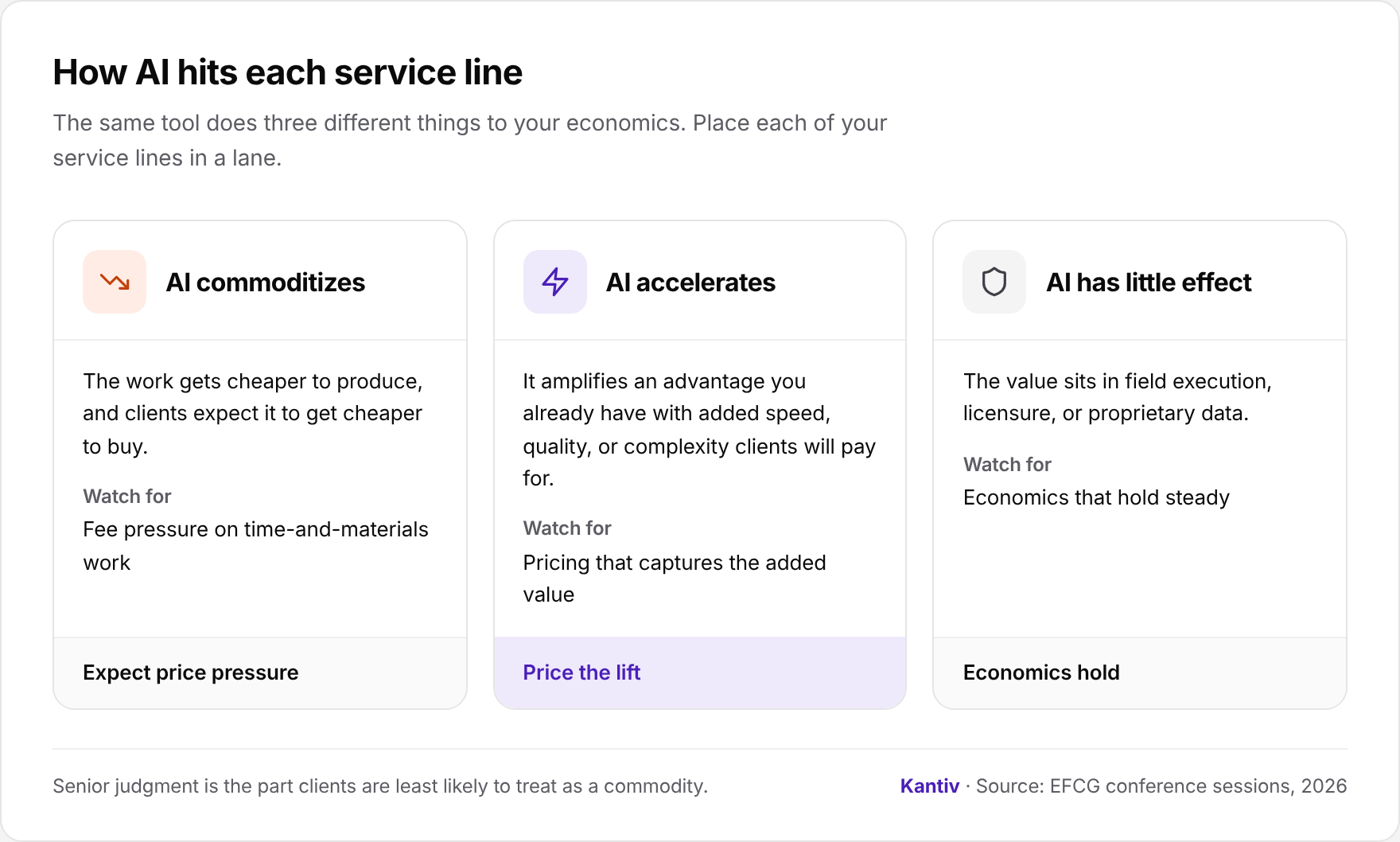
Who keeps the efficiency also depends on the contract. On time-and-materials work, productivity gains go to the client by default. Firms that want to keep them can raise rates, charge for technology (about a third of firms now do), or shift toward fixed-price and subscription work.
EFCG’s pricing playbook put it plainly: every hour AI saves is either a margin point you keep or a discount you give your client. The firms doing this well are growing revenue at least 15 points faster than headcount. They earn more from advisory, technology, or IP, they price on value instead of cost, and they hold onto the savings that technology creates.
That said, there is also a quality side to this. Even as AI speeds up production, final checking has grown from 5% to 23% of the modeled plan-production workflow. Senior judgment is becoming more valuable, not less, and it is the part of the work clients are least likely to treat as a commodity.
Saved hours only count once you decide where they go.
Where this hits BD and pursuits
This is where it gets personal for those of us in business development and marketing.
Clients are more loyal than they used to be, and firms have more leverage than they have had in years. About 60% of firms said they have become more selective about clients and projects over the last 12 months. Yet that leverage isn’t showing up in how firms price.
Now look at what it costs to win work. About half of firms use a seller-doer model. The median firm spends roughly 5% of net revenue on BD and marketing, and about 60% of that is non-billable time from billable staff. Run that on a $50M firm. That’s about $2.5M a year on BD and marketing, and roughly $1.5M of it is technical staff time that never shows up as a BD budget line.
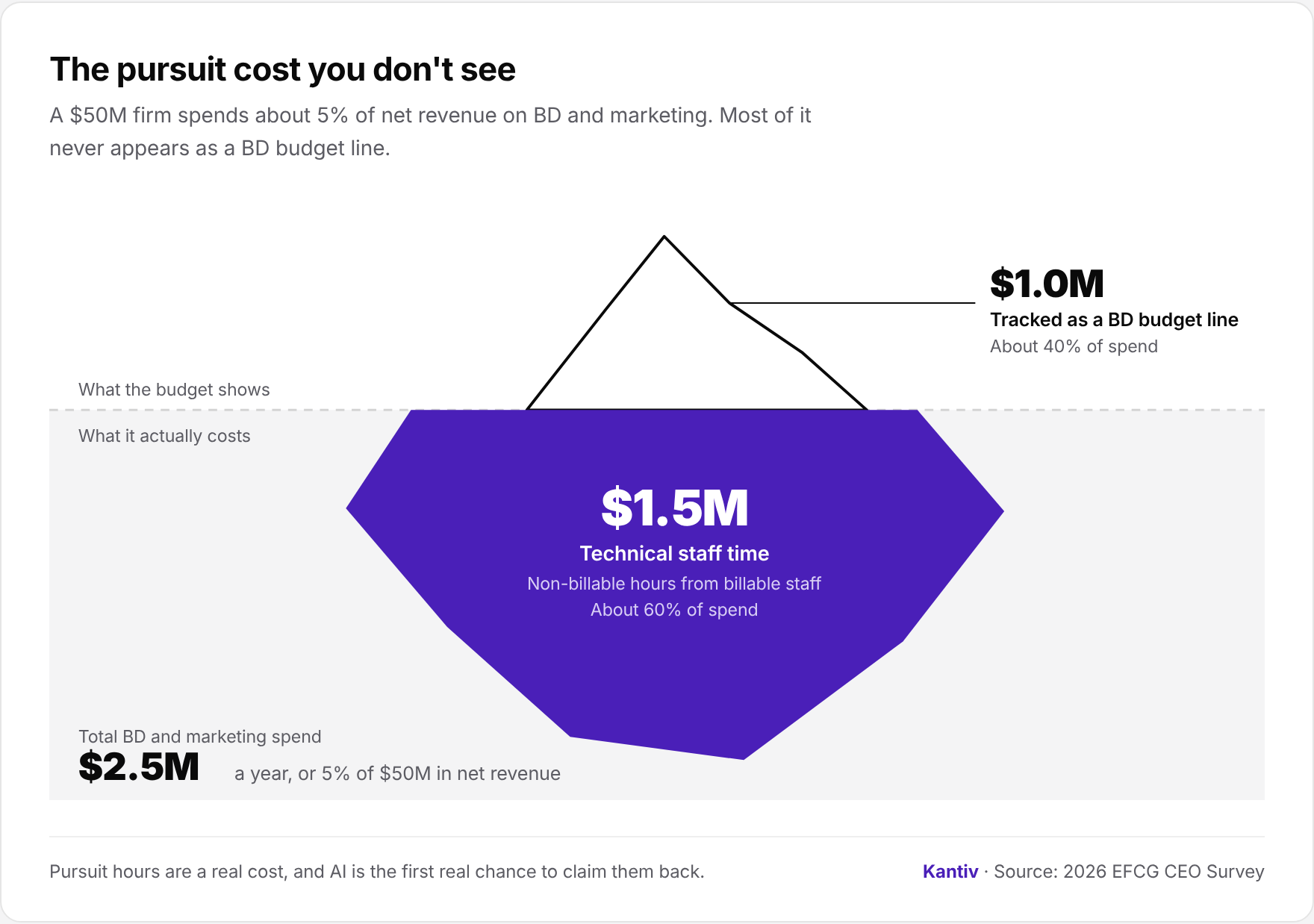
If AI frees up capacity, the pursuit process is one of the best places to put it to work. Cutting the time experts spend researching opportunities, building compliance matrices, and drafting first passes lets a firm redirect those hours to billable work or to better-qualified pursuits. That only counts as a win if the firm decides where the savings go, instead of absorbing them into the same old process.
Pursuit hours are a real cost, and AI is the first real chance to claim them back.
What to do with it
Measure revenue per FTE, not just utilization. It shows whether technology is paying off.
Decide where saved hours go before you save them. Margin, higher-value work, or the client should be a choice, not a default.
Train project managers to price on value. They often set the price, and EFCG pointed to internal obstacles as much as client pushback.
Treat pursuit time as a real cost. Use it to prove what AI can return.
EFCG’s data suggests the firms that do best won’t be the ones using AI the most. They will be the ones that decide, on purpose, where the value goes.

AI adoption is the easy part. Keeping the value it creates is the work.
Troy Meyer and the Kantiv team were on the ground at the EFCG CEO Conference. Statistics are from the 2026 EFCG CEO Survey and EFCG’s conference sessions.