Found the content on this page useful? Share it with your team!
The 7 Best AEC Proposal Management Software Tools in 2026

.png)
Table of Contents

Every AEC firm knows the scene. A proposal goes out the door, the portal confirms it, and the person who held the whole thing together just spent two days chasing resumes and rebuilding the org chart instead of sharpening the actual pitch. Your firm has done a hundred of these. So why does every one still feel like the first?
That question is why firms end up shopping for proposal software. Everything you need to win the next pursuit is already somewhere in your building: the past projects that fit, the right people, the proof that you have done the work. The part that keeps breaking is reaching it.
The market answer is a crowded field of tools, each coming at the problem from a different angle. This guide walks through seven of the leading ones: what each does, what it costs, where it stops, and how to tell which one fits the job that is actually costing you wins.
If you're an AEC marketer or pursuit manager, this guide is for you.
What is proposal management software, and what should AEC firms look for?
Proposal management software helps a firm produce and win competitive proposals, organizing the underlying content, assembling responses, and managing review.
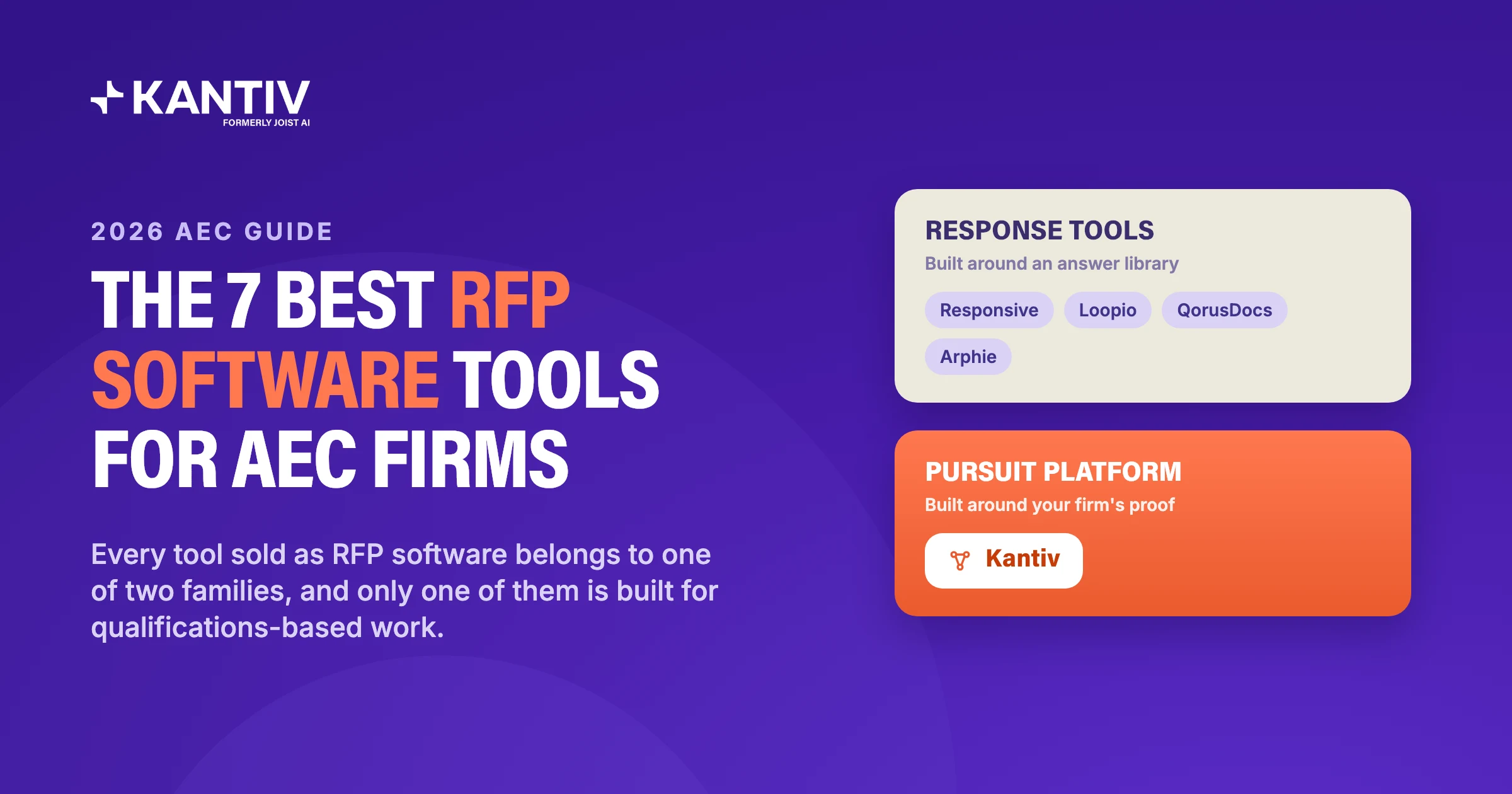
That label hides more than it explains. The tools wearing it actually span five different product categories: proposal management systems, people and credentials databases, digital asset management, sales document software, and practice management.
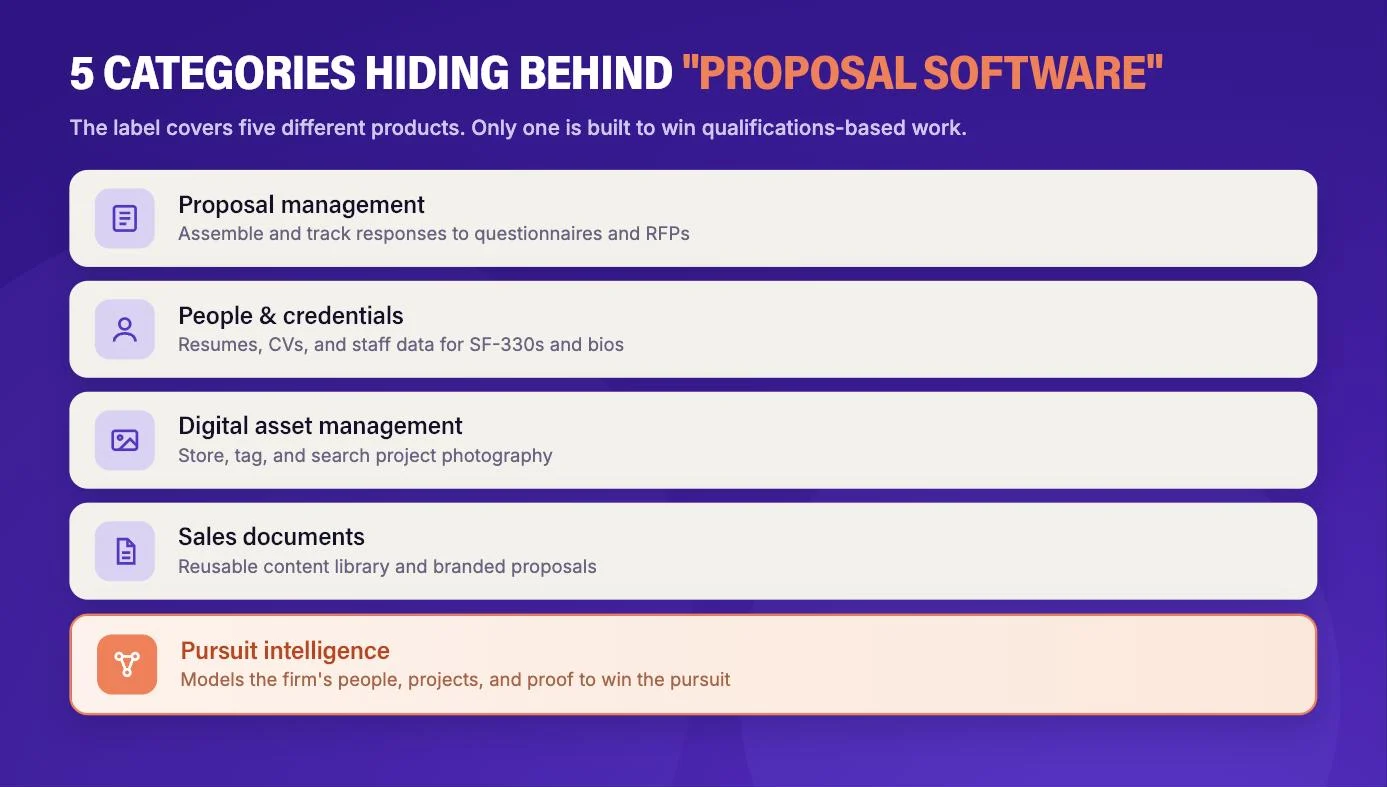
Buy from the wrong category and the demo will look great. The problem surfaces two pursuits later, when the tool does its actual job perfectly and the deadline scramble has not changed.
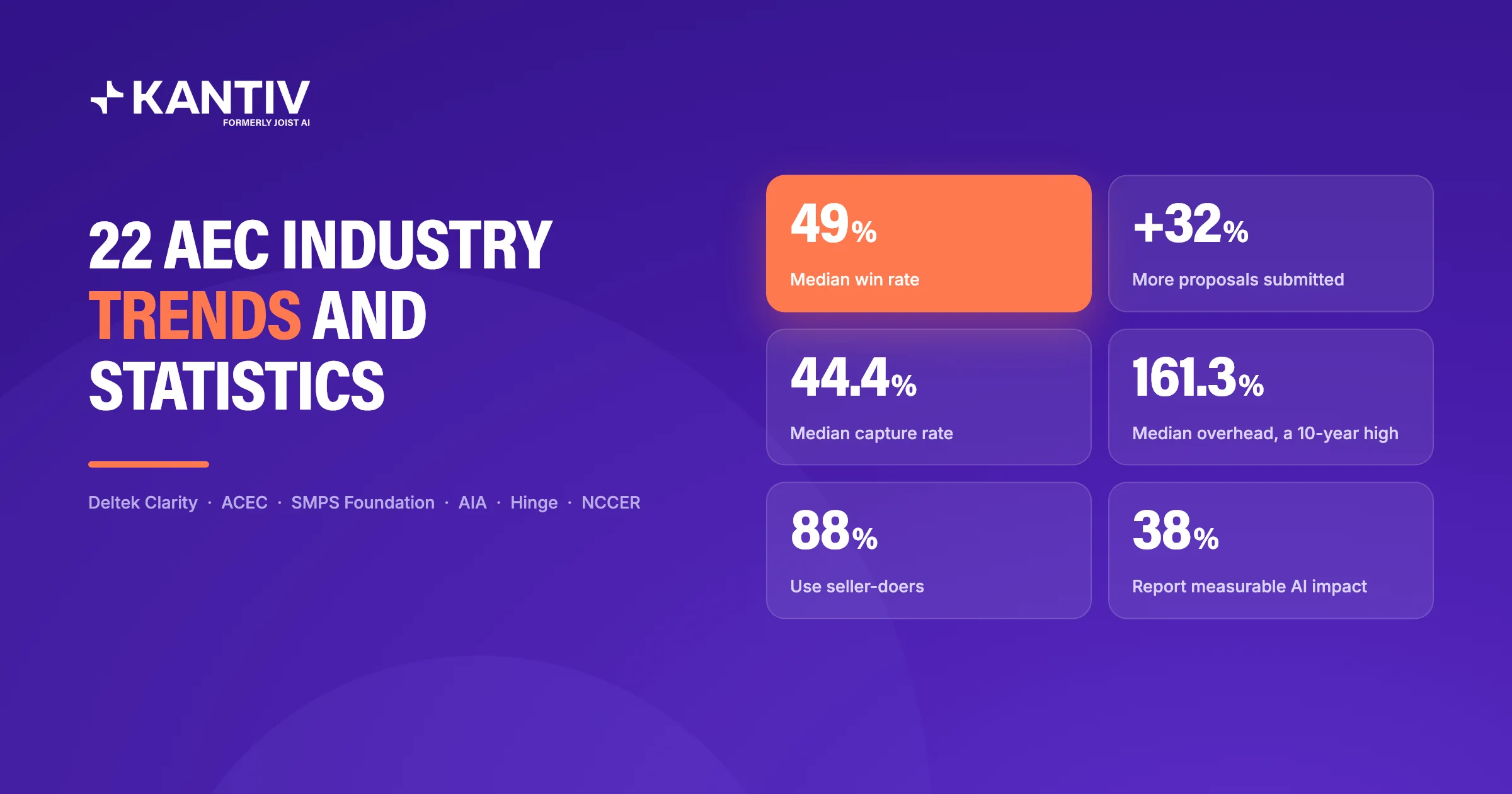
The stakes are measurable. In Deltek's 47th annual Clarity study, the gap between the top quarter of A&E firms (61.3%) and the bottom quarter (30.2%) on capture rate is 31 percentage points. That's a massive delta.
The difference is evidence: which firms can put their best proof forward on every pursuit, and which are still hunting for it when the deadline lands. Matt Handal, the proposal world's most-read contrarian, puts the evaluation mindset bluntly: "Proposal writing does not reward good writing. It rewards understanding how people make decisions."
Key evaluation factors (and the questions to ask on every demo)
Ask a veteran pursuit manager what actually wins work and you will hear the same answer in every market. Everyone proposing has the qualifications. The client picks the firm they want to work with. They’re completely right.
That’s also exactly why the software question matters more than it looks. In qualifications-based selection, evidence is how you become the firm they want to pick, and evidence only counts if you can reach it before the deadline.
If you're evaluating proposal management software for your AEC firm, here's a list of evaluation factors to live by:
- An AEC data model. Does the tool understand people, projects, clients, and pursuits as first-class things, or is everything a document? SF-330 and SOQ work is impossible to fake on a generic model. Say this on the demo: Show me how the system knows which past projects are relevant to this RFP.
- Retrieval of experience, not text. Published AEC benchmarks find 74% of proposals involve 11 or more contributors, and what those contributors need is the right project sheet and the right resume, current, in seconds. Ask this on the demo: How does a project manager's updated resume get into the next proposal without anyone remembering to update it?
- Verified content, not generated filler. If the tool writes, does it write from your firm's actual work? Can you trace every claim to a source you own? Ask this on the demo: Where did this generated paragraph come from?
- Compliance built in. Missed requirements lose otherwise winning proposals. A compliance check belongs in the workflow itself, so nothing rides on a reviewer catching the miss by hand. Say this on the demo: Show me the tool catching an unaddressed RFP requirement.
- The librarian question. Every tool here runs on the firm knowledge underneath it, and most of them quietly hand someone on your team the job of maintaining it forever. Ask this on the demo: Who at our firm has to keep this content current, and how many hours a month does that actually take?
Proposal automation vs. pursuit intelligence
Keep two ideas separate as you read this. Automation makes drafting faster. Pursuit intelligence makes the firm's knowledge usable. When the knowledge underneath is scattered, automation produces polished versions of the wrong content faster, and reviewers spend the saved time fixing it.
We’ve spoken to many AEC teams that solved drafting speed, but kept the same midnight panic. The coordinator just got quicker at assembling the wrong argument.
From our conversations and studies in the AEC community, we have noticed a repeated pattern that more than 60% of the proposal managers state SME delays as their top bottleneck. The knowledge existed somewhere in the firm, but reaching it before the deadline was the hard part.
That is why the foundational question for any tool on this list is what it retrieves: stored text, stored files, or structured firm experience. Get that right and the drafting speed follows. Get it wrong and you own a very fast machine for making the wrong proposal.
The 7 best AEC proposal management software tools, at a glance
| # | Tool | What it actually is | Best for |
|---|---|---|---|
| 1 | Kantiv | Pursuit intelligence on a knowledge graph of your people, projects, and past performance | AEC firms that win qualifications-based work |
| 2 | Flowcase (formerly CV Partner) | CV and case-study management built for AEC, with SF-330 support | Firms whose bottleneck is resumes and credentials |
| 3 | Ikaun | Proposal automation plus experience management, built for legal and AEC | Large firms with offices everywhere and heavy compliance demands |
| 4 | OpenAsset + Shred | An AEC digital asset manager with a newer AI proposal writer on top | Firms whose bottleneck is file storage and organization |
| 5 | QorusDocs | Horizontal proposal automation, Microsoft 365 native | Services firms that live in Word and SharePoint |
| 6 | Workorb AI | Purpose-built AEC proposal AI, from RFP to compliant first draft in minutes | AEC firms that want AI-native proposal automation on their own data |
| 7 | RocketDocs | RFP response management with private AI, structured SME workflows, and a governed content library | Multi-disciplinary or distributed AEC teams managing high-volume, compliance-sensitive pursuits |
Ranked by AEC specificity where every tool here earns its place at its own job.
How the seven tools compare
1. Kantiv
Kantiv, formerly Joist AI, is the only tool on this list built as pursuit intelligence rather than a faster way to make documents. The clearest way to see the difference is to run a real pursuit against the five evaluation factors above.
The data model is the Knowledge Graph, that maps a firm's people, past projects, and historical performance into a structured knowledge graph. When a new RFP comes in, Kantiv surfaces the most relevant past projects by requirement, the right people by qualification and availability, and the performance data that backs up your claims, without requiring someone to maintain a library manually.
The distinction matters operationally. Most tools here put the curation burden on a person: a marketing coordinator, a BD manager, someone who owns the content and keeps it current. Kantiv's architecture tries to eliminate that role by connecting to the systems where that data already lives (Deltek, Unanet, SharePoint, project management tools) and keeping it current from the source.
Key features:
- Knowledge graph of people, projects, clients, and past performance, not a flat file store
- RFP parsing and automated relevance matching against structured firm experience
- SF-330 and SOQ assembly from live data, not static content blocks
- Automated resume and project sheet updates from connected CRM and ERP systems
- Compliance checking against RFP requirements built into the pursuit workflow
- Proposal drafting grounded in verified firm data, with source tracing on every claim
Pricing: by quote, scoped to the firm. The pricing and ROI calculator models the return in recovered pursuit hours.
Pros
- The only AEC pursuit data model in the set, including SF-330 and SOQ workflows
- Outputs trace to the firm's own work, so nothing is invented
- Covers the imagery use case through Image Hub, reducing tool sprawl
- No library for a coordinator to maintain by hand; the graph builds from work the firm already does
Cons
- Not built for security questionnaires or sales RFP volume; teams with that workload want a response tool instead
Best for: AEC firms that win work through qualifications and want the whole pursuit running on verified firm knowledge. Benesch, a 1,000-person engineering firm, reports it has been able to triple productivity in certain use cases.
2. Flowcase (formerly CV Partner)
Flowcase started as CV Partner, a Scandinavian SaaS company that built a clean answer to one specific problem: professional services firms spending enormous time reformatting resumes for every pitch. It has expanded since, but the core product remains a credentials and case-study management system, and it remains the most polished solution in that specific lane.

For AEC, the relevant differentiator is native SF-330 support. The system can export properly formatted Section II and Section E entries directly from the staff database, which removes the most common formatting bottleneck in government proposal work. The case study module follows the same model: write once, update in place, export in whatever format the pursuit requires.
Key features:
- Staff CV and resume database with role-based editing and automatic version control
- SF-330 Section II and Section E export support
- Case study library with structured project data fields
- Configurable export templates for different pursuit formats
- Bulk update tools so staff can update their own profiles without coordinator intervention
- Integrations with Deltek Vantagepoint, Unanet, and major AHR systems
Pricing: Tiered by user count; publicly listed starting prices available on the Flowcase website. Generally in the mid-market SaaS range. Request a quote for AEC-specific packaging.
Pros:
- Best-in-class for resume and credentials management in AEC
- Native SF-330 support is rare and genuinely useful for government proposal teams
- Staff self-service for CV updates reduces coordinator burden significantly
- Template system handles format variation across pursuit types cleanly
Cons:
- Purpose-built for credentials; pursuit-level relevance matching and RFP parsing are limited
- Does not replace a proposal writing or content assembly workflow. It feeds one
- At larger firms, content governance across offices requires discipline the tool doesn't enforce automatically
Our take: If your firm's proposal problem is that every submission requires a coordinator to chase down updated resumes and manually reformat project sheets, Flowcase solves that problem better than any other tool on this list. It does not solve the broader question of which projects and people to include, or how to write the technical narrative, but for what it does, it does it cleanly.
Best for: Firms whose primary bottleneck is credential management and SF-330 formatting, especially those pursuing government contracts with frequent submission requirements.
3. Ikaun
Ikaun is an experience management and proposal automation platform that has historically served large law firms and professional services organizations, with AEC among its use cases. The product combines a credentials and experience database, similar in concept to Flowcase, but more enterprise-scale, with proposal automation features that help assemble qualifications-based submissions from stored experience.
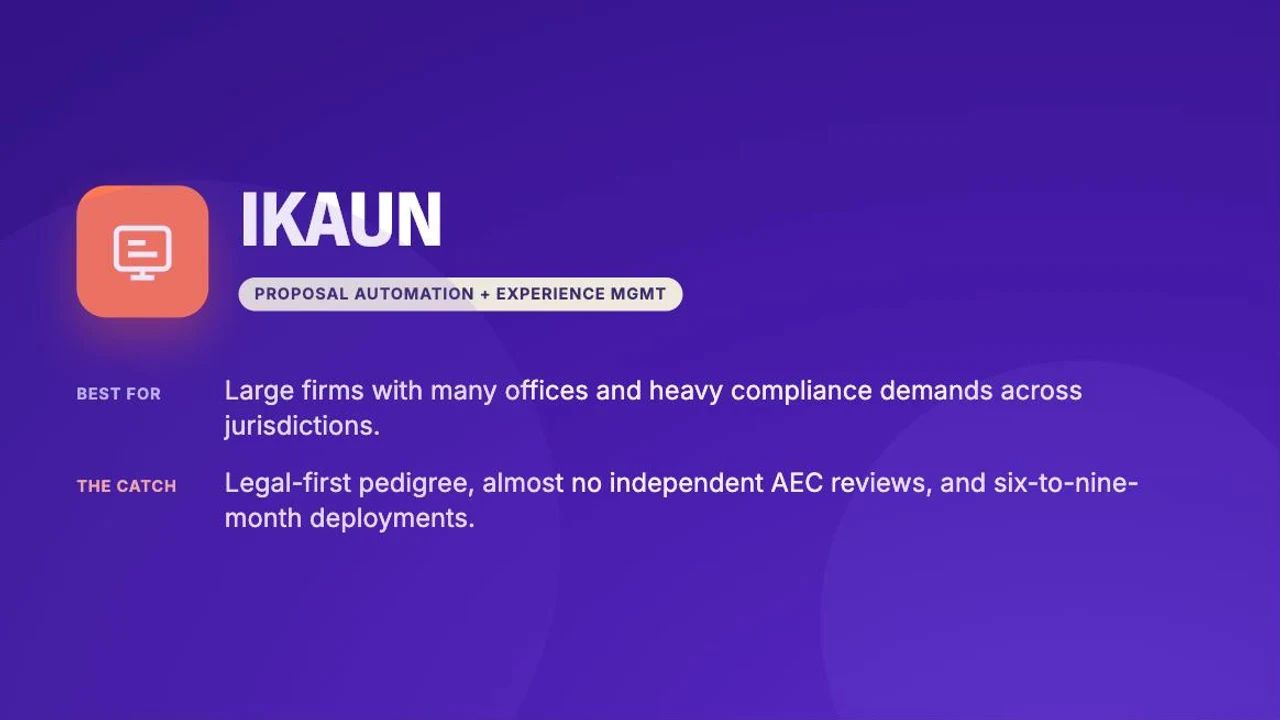
Arup is the most frequently cited AEC reference; most of Ikaun's documented case studies are from law firms. That's worth knowing before a demo. The platform is capable, but its AEC depth is narrower than its legal depth, and the implementation footprint is sized for large, multi-office organizations.
Key features:
- Enterprise experience management database for people, projects, and credentials
- Proposal automation from stored content and structured experience records
- Strong role-based permissions and content governance for multi-office deployments
- Integration with document management systems and CRMs common in large firms
- Matter and project history tracking at a scale appropriate for global practices
- Search and filtering across experience records by practice area, geography, and role
Pricing: Enterprise pricing, not published. Sized for firms with significant headcount and project volume.
Pros:
- Enterprise governance and permissions model is suited to large, distributed organizations
- Experience management database is robust for firms with deep, complex project histories
- Proven at the firm scale where managing experience data is itself a discipline
- Content structured in Ikaun can feed proposal workflows without manual re-entry
Cons:
- Implementation is a significant project; not suitable for small or mid-size AEC firms
- AEC-specific references are limited compared to legal; most documented case studies are law firms
- User experience is functional but not modern by current AEC software standards
- High cost of ownership when you include implementation and ongoing administration
Our take: Ikaun earns a place on this list because it genuinely works at enterprise scale, and at firms large enough to warrant it, experience management without structured tooling becomes an unsustainable manual burden. But the evaluation for a mid-size AEC firm should be honest about what you're buying: an enterprise system built primarily for law firms, with AEC as a secondary market.
Best for: Large, multi-office AEC firms with 500+ staff where managing experience data is a formal function, and where the legal-industry DNA of the product is an acceptable tradeoff for the governance capabilities it provides.
4. OpenAsset + Shred
OpenAsset has been the dominant digital asset management system in AEC for over two decades. It does one thing extremely well: organizing, tagging, and surfacing the photographs, renderings, and finished project imagery that AEC firms need for proposals, award submissions, and client presentations. Shred.ai is a newer AI proposal writing layer built on top of the OpenAsset content store.
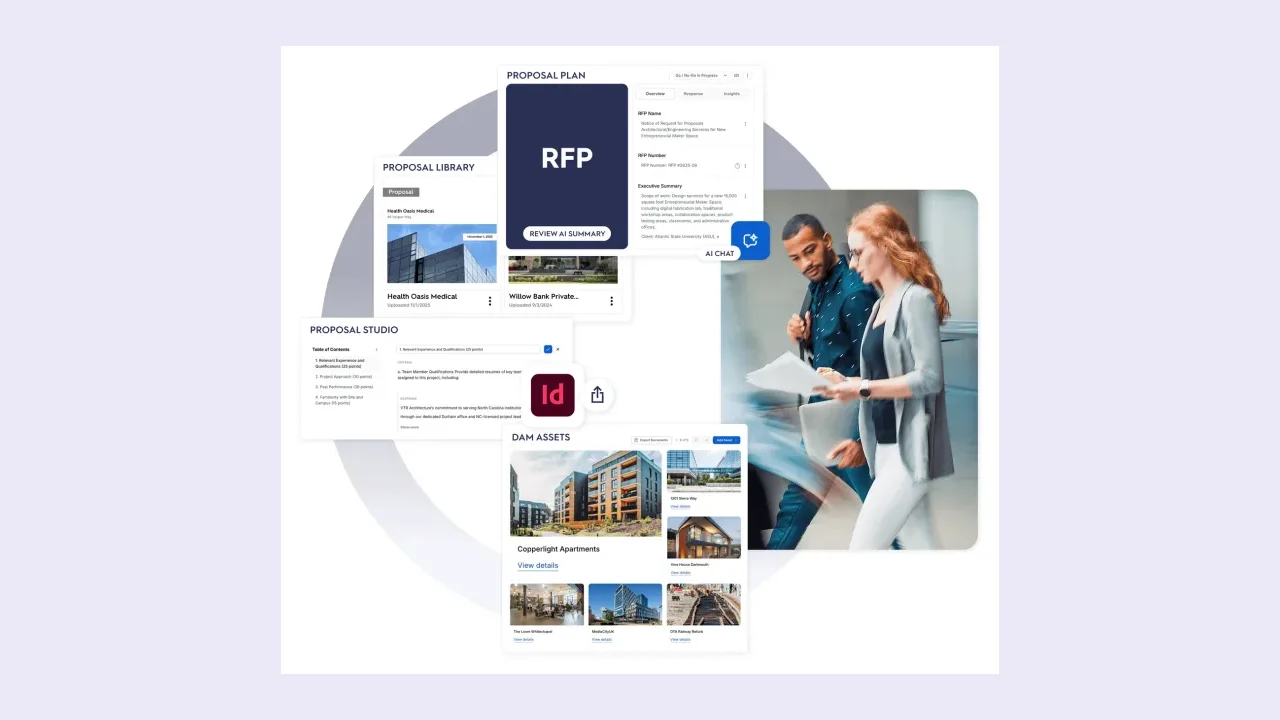
The combination is worth understanding clearly. OpenAsset's core is a file and image management system. It is very good at that. Shred provides a drafting layer that generates proposal content from the assets and text stored in OpenAsset. The integration is direct, and for firms already on OpenAsset, the combination offers a path to AI-assisted drafting without switching platforms.
The caveat is stated plainly in OpenAsset's own help documentation: the AI "has not been trained on AEC-specific terminology." That is a meaningful disclosure for a market where SF-330, QBS, LEED certifications, and project delivery method vocabulary are foundational.
Key features:
- Industry-leading digital asset management for project photography and renderings
- Structured metadata and tagging system for project records and staff profiles
- Shred integration provides AI proposal drafting from stored OpenAsset content
- Long AEC customer base with integrations into Deltek, Vantagepoint, and common AEC workflows
- Approval workflows for asset use and content publishing
Pricing: OpenAsset and Shred pricing are separate; both are by quote. Mid-to-enterprise pricing range based on firm size and asset volume.
Pros:
- Best-in-class digital asset management for AEC imagery; no other tool on this list competes here
- Existing OpenAsset customers get a native AI drafting path without a platform change
- Deep integration with the AEC software ecosystem built over many years
- Strong for visual-heavy pursuits where project photography selection matters
Cons:
- Core product is a file and image manager, not a pursuit intelligence or proposal management system
- AI drafting layer (Shred) explicitly lacks AEC-specific terminology training per OpenAsset's own documentation
- Proposal writing from assets is only as good as the metadata and structured data maintained in the system
- Less suited for qualifications-based SOQ work than for design/technical proposal narratives
Our take: OpenAsset is the right answer if your firm's proposal problem is managing and finding project photography and visual assets efficiently. As a complete proposal management solution, it is better described as a strong content store with a drafting layer on top, and the drafting layer's own admission about AEC terminology gaps is worth stress-testing in the demo before committing.
Best for: AEC firms that already use OpenAsset and want an AI-assisted drafting path on top of their existing asset library, particularly for design-forward proposals where imagery selection is a meaningful part of the work.
5. QorusDocs
QorusDocs is a horizontal proposal automation platform built for Microsoft 365. It is not AEC-specific: the company serves legal, technology, financial services, and professional services firms broadly, but it has a meaningful AEC user base, primarily because it meets firms where their content already lives: Word, SharePoint, and Teams.
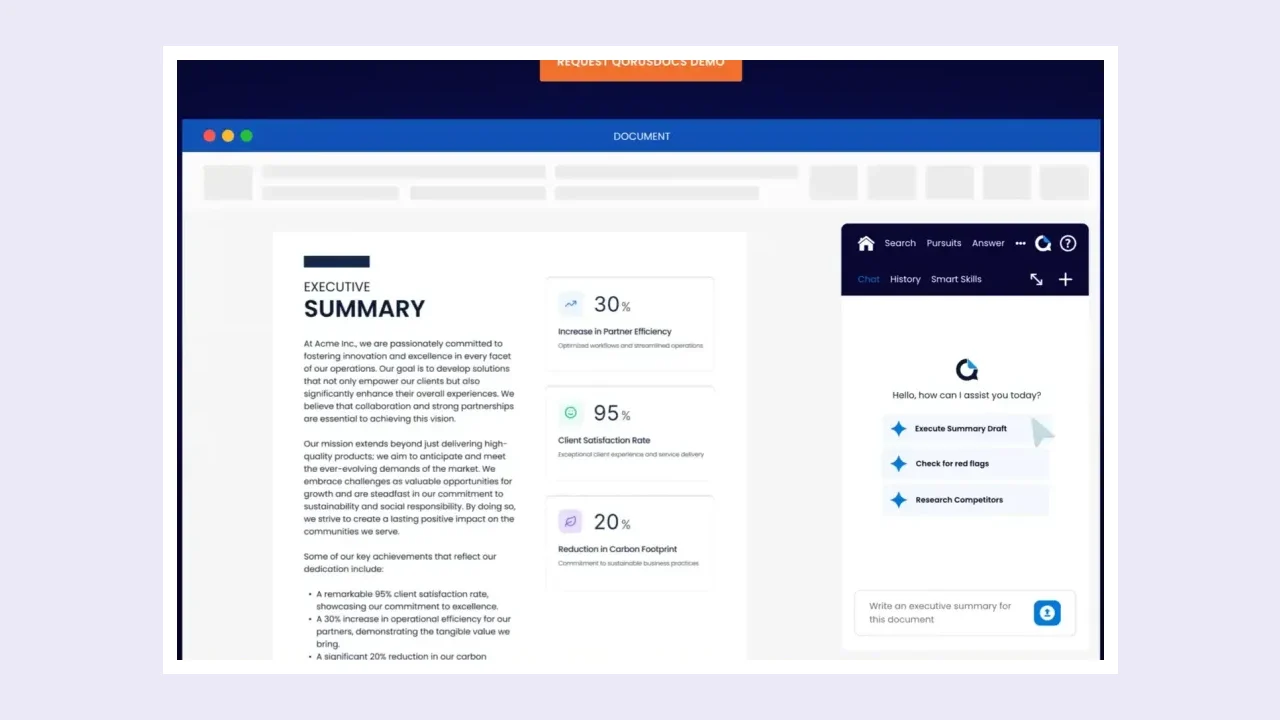
The core value proposition is content reuse at scale. QorusDocs maintains a centralized content library, surfaces relevant snippets when you're drafting in Word, and generates proposal documents from pre-approved blocks. Its AI assistant can draft responses to RFP sections by pulling from the approved library. For firms that have disciplined content governance in SharePoint and want to reduce the time coordinators spend hunting for the right boilerplate, it materially compresses the assembly phase.
Key features:
- Deep Microsoft 365 integration (Word, SharePoint, Teams, PowerPoint, Outlook)
- Centralized proposal content library with search, tagging, and review cycles
- AI-assisted drafting that generates from approved library content
- Proposal analytics: tracks which content is used, approved, and winning
- Workflow automation for review, approval, and version control
- Configurable templates for RFP responses, SOQs, and client presentations
Pricing: Tiered SaaS pricing by user; details available on the QorusDocs website. Mid-market range with enterprise options.
Pros:
- If your team already lives in Microsoft 365, adoption friction is low
- Content reuse library genuinely compresses assembly time for firms with good content governance
- Analytics on content performance are useful for iterating on what works
- Broad enough to serve multiple proposal types across different service lines
Cons:
- Not AEC-specific; the data model doesn't natively understand projects, pursuits, or SF-330 structure
- Value is proportional to how well-maintained the content library is, garbage in, garbage out
- Doesn't solve the experience retrieval problem; it solves the document assembly problem
- AEC-specific compliance checking (RFP requirement tracking) requires manual discipline
Our take: QorusDocs is the right tool for AEC firms whose proposal bottleneck is document assembly and content reuse, and who are deeply invested in Microsoft 365. It is not the right tool for firms whose bottleneck is finding the right experience before they can start assembling. If your team spends more time debating which projects to include than formatting the document, the Microsoft-native content library won't move that needle.
Best for: AEC services firms or multi-discipline practices that live in Microsoft 365, have a functioning content library in SharePoint, and want a structured tool to reduce assembly time and improve content reuse.
6. Workorb AI
Workorb AI is a purpose-built AEC proposal automation platform that has entered the market positioning itself squarely against the coordination problem: too much time spent assembling the proposal, not enough time spent winning it.
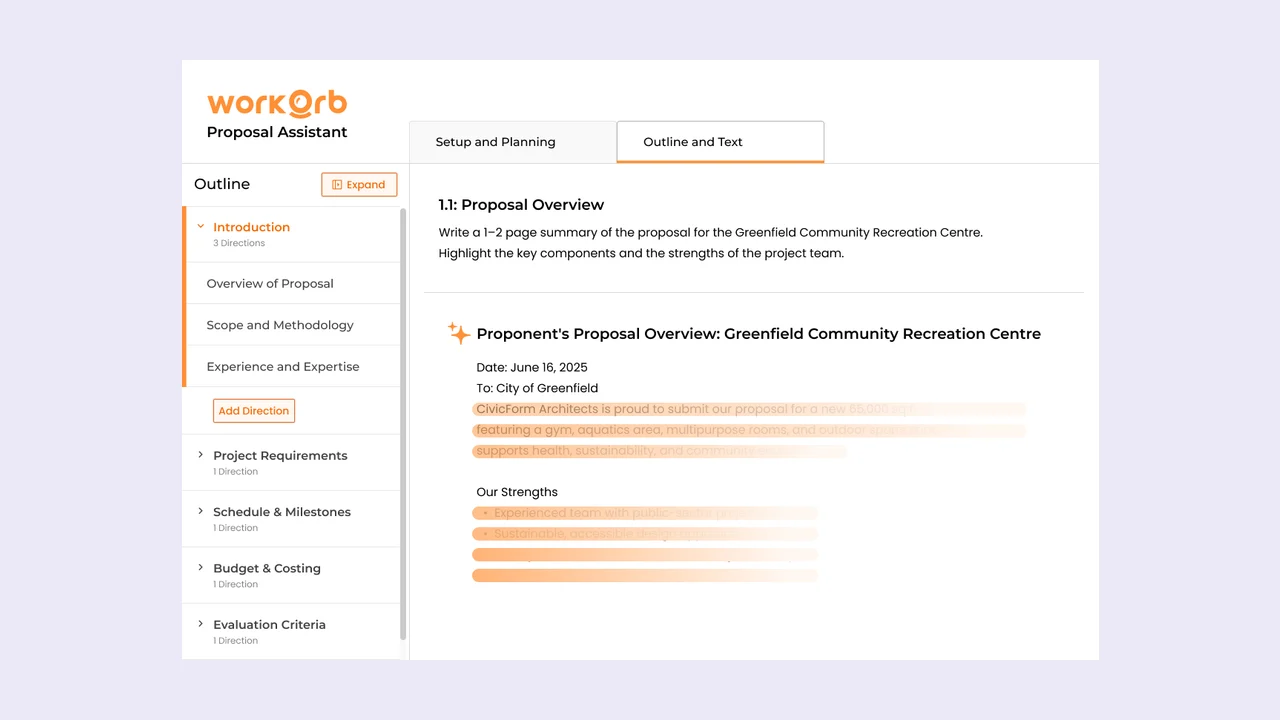
The platform is built around three interconnected hubs: a Proposals hub that takes an RFP to a compliant first draft; a Knowledge Hub that automatically ingests and organizes past proposals, project sheets, and team bios from the firm's existing systems; and a Relationships Hub that surfaces the network of firm relationships relevant to a pursuit, without requiring manual data entry.
What distinguishes Workorb from the horizontal tools is where it grounds the AI output. The Knowledge Hub connects to the firm's existing systems, Deltek Vantagepoint, Unanet, SharePoint, OpenAsset, Procore, and others, and uses AI agents to automatically curate and organize the content without requiring a person to manually upload, tag, or maintain a library. The claim is that the platform can have a firm operational within 48 hours, with AI agents doing the curation work.
The AI drafts proposals from the organized knowledge base and applies the firm's writing style and templates. A compliance and proofreading layer evaluates the draft against the RFP requirements before submission. For government work, section templates match SF-330 and SOQ structures natively.
Key features:
- End-to-end AEC proposal automation from RFP ingestion to compliant first draft
- Automated data curation via AI agents, connects to Deltek, Unanet, SharePoint, OpenAsset, Procore, and more
- Knowledge Hub: automatically indexes past proposals, project sheets, and team bios by project, sector, geography, and expertise
- SF-330-compatible section templates and AEC-specific content model
- Go/No-Go scoring from the firm's own criteria
- Compliance checking evaluates the draft against RFP requirements before submission
- Relationships Hub: maps firm's client and contact network for BD intelligence
- Compliance and legal hub: extracts obligations and flags issues across large bid packages
Pricing: Not publicly listed. Pricing is by demo/quote. Contact workorb.com.
Pros:
- Deeply AEC-native in its data model, project records are structured for PE stamps, DBE/MBE, safety metrics, and AEC-specific content types
- Automated data curation means no dedicated librarian required at launch; the AI agents handle organization
- SF-330 support is native, not bolted on
- Compliance checking is built into the workflow, not a post-draft review step
- Fast time-to-value claim (48 hours to operational) suggests a lower implementation burden than enterprise alternatives
Cons:
- Newer entrant; the case study depth and long-term customer references that more established tools carry are still building
- Pricing is opaque; budget conversations require a demo before any figure is available
- Relationships Hub and BD features are differentiated but add scope, firms with a narrow proposal automation need may not use the full platform
- The AEC-specific AI grounding is a central claim that deserves rigorous testing in the demo with real firm data
Our take: Workorb is one of the more interesting entrants in AEC proposal software because it takes AI-native automation seriously in an industry where most tools added AI to existing architectures. The automated data curation claim, AI agents that ingest and organize the firm's knowledge without manual effort, is the key thing to pressure-test in a demo. If it holds, it removes the biggest hidden cost in most knowledge management deployments: the person who has to maintain the system. If you're evaluating AEC-native AI proposal tools, Workorb belongs on your shortlist.
Best for: AEC firms that want AI-native proposal automation built on their own data, particularly firms that have been frustrated by tools requiring extensive manual content management before the AI becomes useful.
7. RocketDocs
RocketDocs is a response management platform that has been used by large regulated-industry organizations since 1994. Its primary market is financial services, healthcare, and enterprise technology, regulated industries where RFP responses have compliance and audit requirements baked in. It has an AEC user base, particularly among civil engineering and infrastructure firms that approach proposals as structured response management problems rather than design or narrative storytelling exercises.

The platform's structural strengths are SME coordination and content governance. RocketDocs assigns questions or sections to subject matter experts, tracks their progress, routes content through configurable approval gates, and maintains an immutable audit trail of every change and approval. The content library grows with each proposal cycle and feeds AI autofill for future responses. The private AI, called Astro, runs inside RocketDocs' own environment; firm data is never sent to a public AI provider, which is a specific procurement requirement at regulated organizations.
The Microsoft 365 integration (LaunchPad) lets teams work in Word and Excel without leaving familiar tools. For distributed AEC firms dealing with complex multi-discipline proposals where engineering, environmental, and administrative teams all contribute, the workflow and approval architecture handles the coordination overhead that typically falls on a proposal manager.
Key features:
- Private AI (Astro) for RFP drafting, firm data never sent to public AI providers
- Centralized content library with custom tags, attributes, and review cycles
- LaunchPad: native Microsoft Word and Excel integration for SME contributions
- Configurable proposal workflows with structured approval gates
- SME assignment and tracking, assign questions/sections, track progress, automate handoffs
- Immutable audit trail across all edits, approvals, and submissions
- RapidDocs: logic-driven proposal generation from approved content templates
- RocketVault: browser extension for filling web-based portals and questionnaires directly
- Open API and Salesforce bidirectional integration
- SOC 2 Type II and ISO 27001 certified
Pricing: Starts at $18,500/year (as listed on rocketdocs.com). Custom-fit pricing by deployment size; not a per-seat model, priced on active response team members, not every reviewer and approver. Enterprise and multi-affiliate tiers available.
Pros:
- Best-in-class SME workflow and approval management; the coordination architecture is mature
- Private AI is a genuine differentiator for firms where data security is a procurement requirement
- Microsoft 365 integration (LaunchPad) reduces adoption friction for teams that live in Word
- Content library compounds over time, each proposal makes future proposals faster
- Long track record in high-stakes, regulated response management
- Transparent starting-price disclosure and no per-seat trap
Cons:
- Primary market is financial services and regulated industries; AEC is a secondary market and the data model reflects it
- No native SF-330 support or AEC-specific content structures
- Strong on process governance; lighter on AEC-native experience retrieval
- $18,500/year floor puts it out of range for smaller AEC practices
- Content library value requires consistent input discipline from the team
Our take: RocketDocs is the right answer for AEC firms whose proposal problem is primarily process and coordination: getting the right people to contribute the right content by the right deadline, with a complete audit trail. The platform's SME workflow and approval management is among the most mature in this space. Where it underdelivers for AEC is in the AEC-native data model, it does not understand projects and credentials the way Kantiv or Flowcase do. If your firm is managing complex, multi-contributor proposals across distributed offices and your biggest pain is coordination overhead rather than experience retrieval, RocketDocs is worth a serious look.
Best for: Multi-discipline or distributed AEC firms managing high-volume, coordination-heavy proposal processes, particularly those in civil, infrastructure, or environmental services where structured SME input, approval workflows, and data security requirements dominate the proposal challenge.
Which AEC proposal management software should you choose?
The honest answer is that it depends on where your firm is actually losing time.
If your bottleneck is finding and assembling the right experience before a deadline: the right past projects, the right people, the right proof, then you need a tool with an AEC data model: Kantiv for pursuit intelligence and experience retrieval.
Go for Workorb AI if your primary use case is proposal automation, or Flowcase if resumes and credentials are the primary pain.
If your bottleneck is document assembly and content reuse, boilerplate management, version control, getting consistent approved language into proposals without starting from scratch, then QorusDocs (if your team lives in Microsoft 365) or RocketDocs (if SME coordination and process governance are the core challenge) are the more appropriate solutions.
If your bottleneck is experience management at enterprise scale and you have the implementation appetite to match, then Ikaun is built for that problem at global-firm complexity.
If your bottleneck is digital asset management: project photography, rendering libraries, visual assets for proposals and award submissions, OpenAsset (with or without the Shred drafting layer) is a good option.
A few honest signals to watch for in any demo:
- Ask where the AI gets its content. "From your library" is only as good as the library. Ask what happens if the library is incomplete.
- Ask who maintains the knowledge base. Every tool here requires structured data underneath it. Ask specifically who at your firm does that work, how often, and what happens when they leave.
- Ask about AEC-specific output. Generate an SF-330 or SOQ section on the spot, from your firm's real data. What comes out tells you more than any feature list.
The right tool is the one that removes the constraint that's actually costing you wins, not the one with the most features, the best demo, or the lowest price.
How to evaluate Kantiv for your firm
If you're interested in evaluating Kantiv for your AEC firm, here's what we'd recommend:
- Run the numbers first. The ROI calculator models the return in recovered pursuit hours, so you walk in knowing what the tool would have to earn.
- Book a demo and bring a real RFP your team recently answered. Any tool looks good against a canned example; the useful test is your own pursuit.
- Ask the five demo questions from this guide. How the system knows which past projects fit, how an updated resume reaches the next proposal, where a generated paragraph came from, how an unaddressed requirement gets caught, and who has to play librarian.
FAQs
What is the best proposal software for AEC firms?
For pursuits won on qualifications, Kantiv, because it is the only option built on an AEC pursuit data model with verified, traceable firm knowledge underneath, purpose-built for proposal managers. For narrower jobs like CV management, asset storage, or sales quotes, the specialist tools above fit better.
Is proposal software the same as a CRM or project management tool?
No. A CRM tracks relationships and pipeline, practice management runs projects and billing, and proposal software runs the pursuit itself. Plenty of firms need two of the three; almost none should buy one expecting it to do another's job.
Do we need proposal software if we already have a DAM?
A DAM answers "where is the photo." A pursuit needs "which projects, people, and proof win this one," which is a knowledge problem, not a storage problem. If storage is genuinely your only gap, a DAM is enough.
How much does AEC proposal management software cost?
Almost nobody in this category publishes full pricing. Kantiv, Flowcase, Ikaun, OpenAsset, QorusDocs, Workorb AI, and RocketDocs all quote per deployment, scoped to firm size and modules, so expect to run a demo before you see a number. Budget for the hidden line item too, which is the staff hours any content library needs to stay current. For modeling the return on the pursuit side, see the Kantiv pricing and ROI calculator.
Is there free proposal software for AEC firms?
Nothing credible at the pursuit level. Generic free proposal makers exist for sales quotes, but they have no AEC data model, no SF-330 or SOQ support, and no compliance checking, which is where the losses actually happen.
See how Kantiv puts your firm's strongest evidence into every pursuit. Book a demo
Disclaimer: This comparison was prepared by Kantiv based on publicly available product information and documentation at the time of review. Product features, pricing, plans, and availability may change and may vary by configuration. While we strive to keep this information accurate and current, this comparison may not reflect all available product details. For the most current information, please consult each vendor directly.