Found the content on this page useful? Share it with your team!
Win Themes for AEC Proposals: How to Prove Them

.png)
Table of Contents
Picture the evaluator. Six proposals to get through before the end of the day, and a scoring sheet the agency published months ago. Nobody at that desk is reading your proposal. They're scoring it, section by section, against criteria you can go and look up.
Now picture your response in that stack. Four of the six firms are qualified to do the work. All six describe themselves as collaborative, experienced, and committed to quality. The evaluator is looking for a reason to move one to the top.
A win theme is how you hand over that reason. It's a short, client-specific message that says why your firm is the right choice for this project, repeated everywhere the evaluator looks.
Most AEC teams know that much. The trouble starts one step later, when the theme needs evidence, and the evidence turns out to be spread across a shared drive, an old proposal, and somebody's memory.
This piece covers what a win theme actually is, how it differs from a feature, where it belongs in the response, where AEC proposals go wrong, and how to build one you can prove before the deadline forces you to settle for less.
What is a win theme in an AEC proposal?
A win theme is a concise, client-focused message explaining why your firm is the best choice for a specific project. It follows one simple structure:
The client's need or problem → your differentiator → the benefit to them.
Skip the need, and it turns into a brochure line about your firm. The differentiator is what stops a competitor from writing the identical sentence, and the benefit is the part that actually gets scored.
Win themes are most effective when they're chosen before anyone starts writing, and then reinforced through the cover letter, the section introductions, the graphics, and the interview. Repetition is what makes them work, because anyone reading six proposals in an afternoon retains what they saw more than once.
In qualifications-based selection, this matters more than it does in most industries. The evaluator isn't weighing your price, so the score comes down to who you are against criteria the agency published: specialized experience, past performance, capacity, and key personnel. That makes your win strategy a claim that your firm can do something specific that the other five firms can't, and a claim like that invites the evaluator to go and check it. Every theme you write is a promise that the checking will go your way.
Win theme vs. feature: the difference that decides the score
Most AEC responses are full of features presented as themes. But there’s a difference.
A feature is a fact about your firm. A win theme is that fact aimed at this client's problem, with the outcome attached.
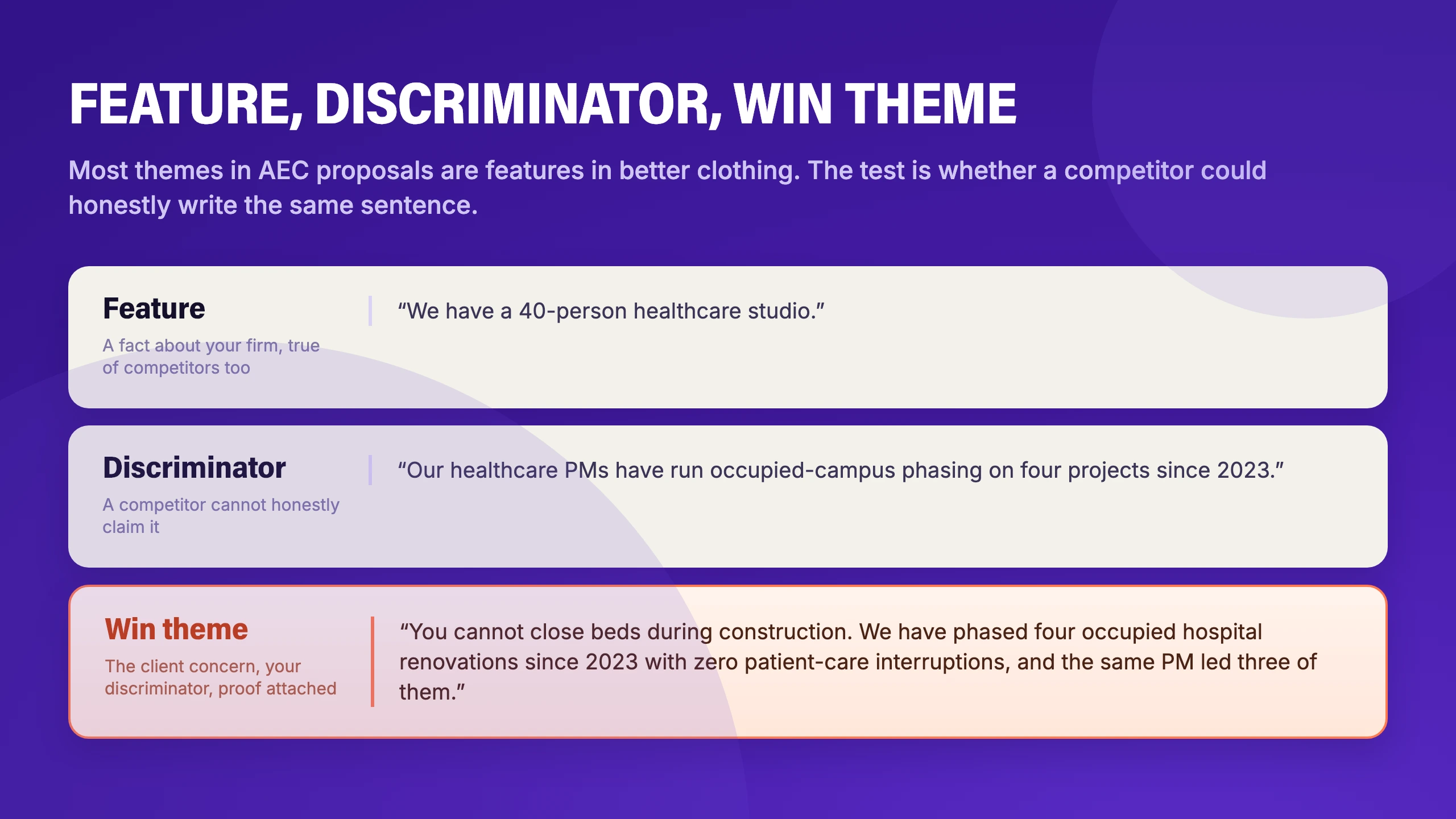
Feature: "We have 40 years of experience."
Win theme: "Our 40 years with California school districts means we anticipate DSA review issues early, which keeps your campus modernization off the critical path."
Notice that both sentences describe the same firm and the same 40 years, but only the second one gives the evaluator something to score. It names a jurisdiction, a review body, and a consequence for this client's schedule.
The test to run on every theme you write is whether three of your competitors could write the same sentence honestly. If they could, what you have is a feature, and you either sharpen it until it's specific to your firm, or cut it.
This is also the line between a theme and a discriminator. The discriminator is the capability your rivals can't claim, and the theme is that capability pointed directly at the client's stated need.
Where win themes appear in the response
A theme that appears in a single paragraph will read to the evaluator as one more sentence in a long document. Evaluators score section by section, so a theme only earns its place by showing up in each section that carries points.
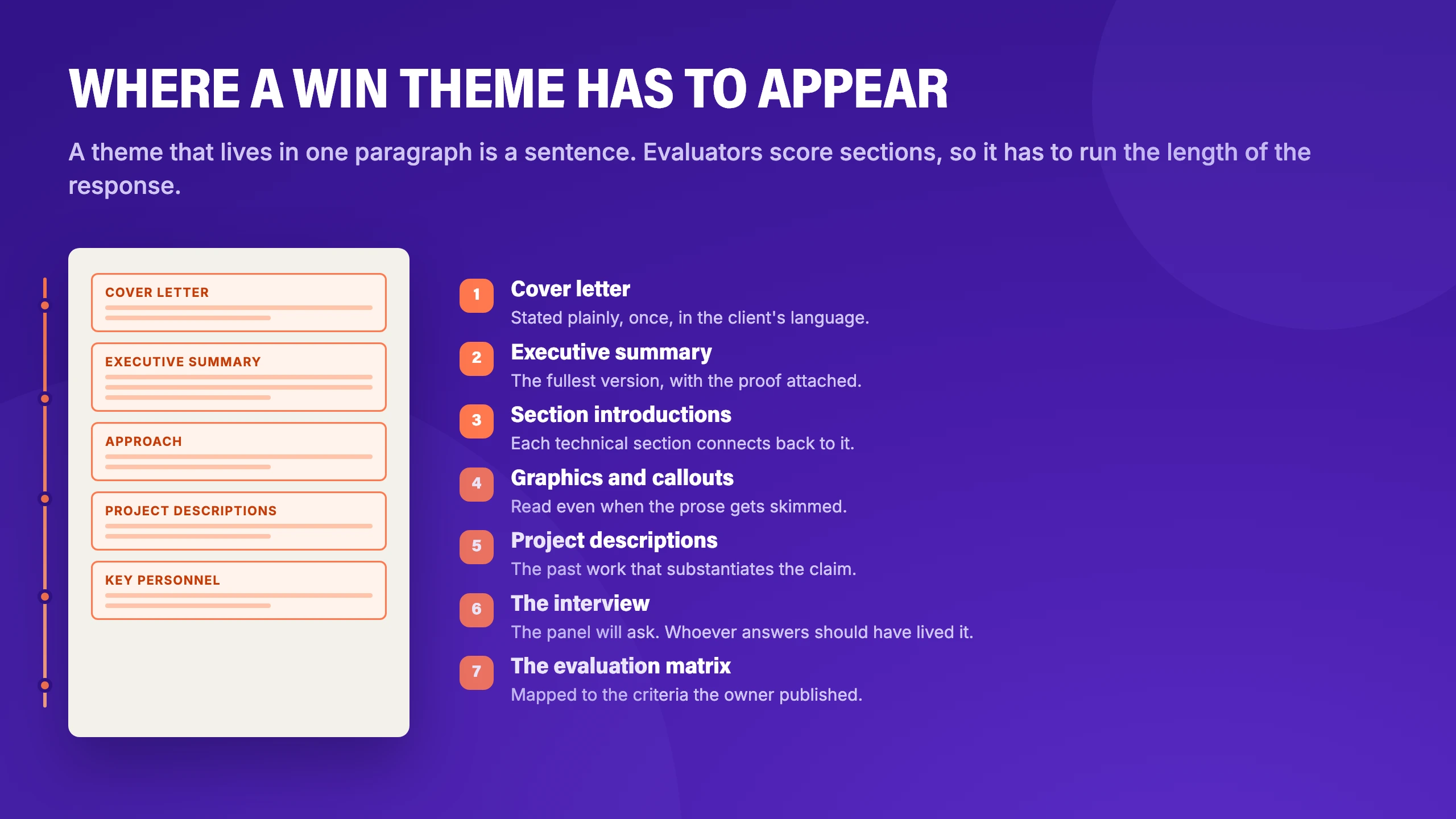
If you’re an AEC marketer or pursuit manager, make sure your win themes appear in the following sections of your proposal:
- Cover letter. Stated plainly, once, in the client's language.
- Executive summary. The fullest version, with the proof attached.
- Section introductions. Each technical section opens by connecting back to it.
- Graphics and callouts. The theme as a diagram or a pull-out, because these get read when the prose gets skimmed.
- Project descriptions. The past work that substantiates the claim.
- The interview. The panel will ask about it, and whoever answers should have lived it.
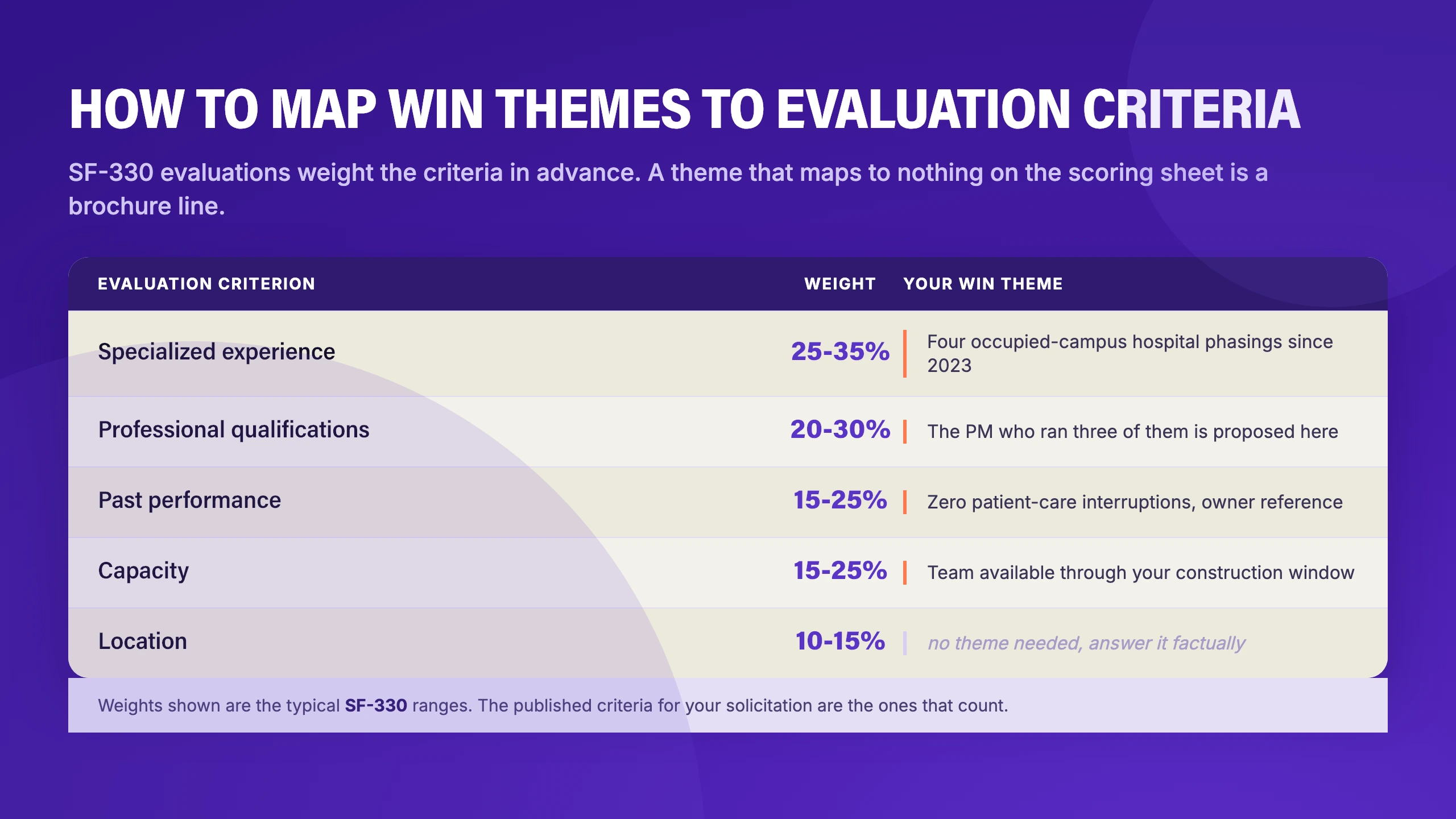
- The evaluation matrix. Each theme mapped to the criteria the owner actually published.
Mapping the themes to the published evaluation criteria is the part most firms leave undone, usually because it happens last and the deadline arrives first. When your themes don't map to the scoring sheet, the evaluator has to do the mapping on your behalf. Nobody reading six proposals before dinner is going to do that work for you.
What makes a win theme strong?
A theme that holds up under scoring satisfies four conditions, and most guides on the subject cover only the first two.
1. It uses the client's own words. Pull the language directly from the solicitation and from whatever was said at the pre-proposal meeting. When the RFx says "minimize disruption to ongoing operations," your theme should say disruption rather than a synonym you preferred, because the evaluator is scanning for the words the agency wrote.
2. A competitor couldn't honestly write the same sentence. This is the feature test from the previous section, applied to every theme before it goes any further.
3. You can assemble the supporting evidence within an hour. This is the condition that separates AEC proposal work from general proposal advice, and it decides more responses than the other three combined. When gathering the proof means three days of chasing people who are on site, the theme doesn't survive contact with the schedule. Your team falls back to whatever it can support from memory, and that substitution happens in week two without anyone consciously deciding to make it.
4. It survives the interview. The shortlist panel will probe the theme directly, and if the person who lived the story isn't sitting at the table, a theme that read well on paper turns into a liability in the room.
AEC marketing strategist Abbie Davenport described what the response looks like when that third condition fails, writing on LinkedIn:
"There isn't enough time to weave a cohesive narrative, define deep capabilities, or establish genuine win themes. The response reads like a disjointed checklist, not a winning proposal."
A disjointed checklist is what a capable team produces when the evidence sits somewhere it can't reach before the deadline.
Win theme examples
The three pursuits below are different in every respect except the structure of the argument. In each one, the weak version is perfectly true, and the evaluator still has no way to award it a point.
| The pursuit and what the client needs | The version that can't be scored | The version that can |
|---|---|---|
| A hospital renovation on an occupied campus, where the facility can't take beds offline | "We have extensive experience with complex renovations in sensitive environments." | "Keeping beds open through construction drives every decision on this project. We've phased four occupied-campus hospital renovations since 2023, including Mercy Regional's 60,000 sf surgical wing, with zero patient-care interruptions. Dana Whitfield, who ran that phasing plan, is your proposed project manager." |
| A public agency whose appropriation expires in June | "Our team is known for meeting aggressive deadlines." | "Your funding window closes in June. On the Route 9 corridor we compressed a 14-month design schedule to nine by running geotechnical and survey concurrently, a sequence our civil lead has since repeated on three agency projects. The county's project manager will confirm the date we hit." |
| A design-build pursuit for an owner who has been burned by teams that weren't genuinely integrated | "We collaborate closely with our construction partners." | "This is our fourth design-build pursuit with Hollis Construction and our second in higher education. On Westfield's science building we co-located design and preconstruction from week one, which is why the GMP came in 2% under the owner's budget." |
Every version in the right-hand column names a project, a number, a person, and something a third party could confirm on a phone call. Each one is also shorter than the claim it replaces, because a specific fact takes fewer words than a careful hedge.
The takeaway is simple: strong win themes cost you four times the words. They also buy you something the evaluator can go and check, which is the kind of claim a scoring sheet can actually reward.
Where do win themes come from?
Good themes are built during capture, in the weeks or months before the solicitation is published, and not at the proposal kickoff meeting after it lands.
The reason is that a theme has to be about the client, and everything worth knowing about a client is learned before the RFx exists. Capture work is the set of conversations that tell you which commissioner is nervous about the phasing plan, which incumbent is expected to bid, and which part of the scope the owner has already been burned on. A firm doing that work arrives at kickoff knowing what this client is actually worried about. A firm that skips it arrives with a blank page and two weeks, and writes positioning out of whatever the room happens to remember.
Consequently, this is why so many themes end up describing the firm rather than the client's problem.
The go/no-go conversation is where the two halves meet. That meeting is usually run as a question about whether the pursuit is worth the hours, but the more useful question is whether you can already name the theme and the evidence behind it. When nobody in the room can, you've learned something important about the pursuit while there's still time to act on it.
Why AEC win themes get watered down
Choosing a strong theme is the easy half. Whether it survives the next two weeks depends on something less discussed, which is how quickly your firm can put its hands on the evidence.
The proof almost always exists somewhere inside the firm already. It sits in a 2019 project folder under a filename nobody would guess, in a resume that hasn't been touched since the last proposal, and in the head of a project manager who's on site until Thursday.
Under a two-week turnaround, a capable team writes what it can reach rather than what would score highest. Those are rarely the same thing, and the distance between them shows up in your win rate long before anyone traces it back to a filing problem.
Firms rarely lose because the right past project didn't exist. They lose because nobody could find it before the submission deadline.
One veteran proposal professional, on Krystn Macomber's thread about how proposal managers get judged, put it sharply:
"A proposal is an artifact. It's a description of an offer. The offer is what wins, not the proposal."
In qualifications-based selection, the offer is the evidence. Your themes are only as strong as the proof you can assemble behind them in the time you have.
How to build a theme you can prove
Building a theme you can defend means assembling a chain of four connected pieces before you commit to the claim, and working that chain in order is what keeps you from writing a promise you can't support.
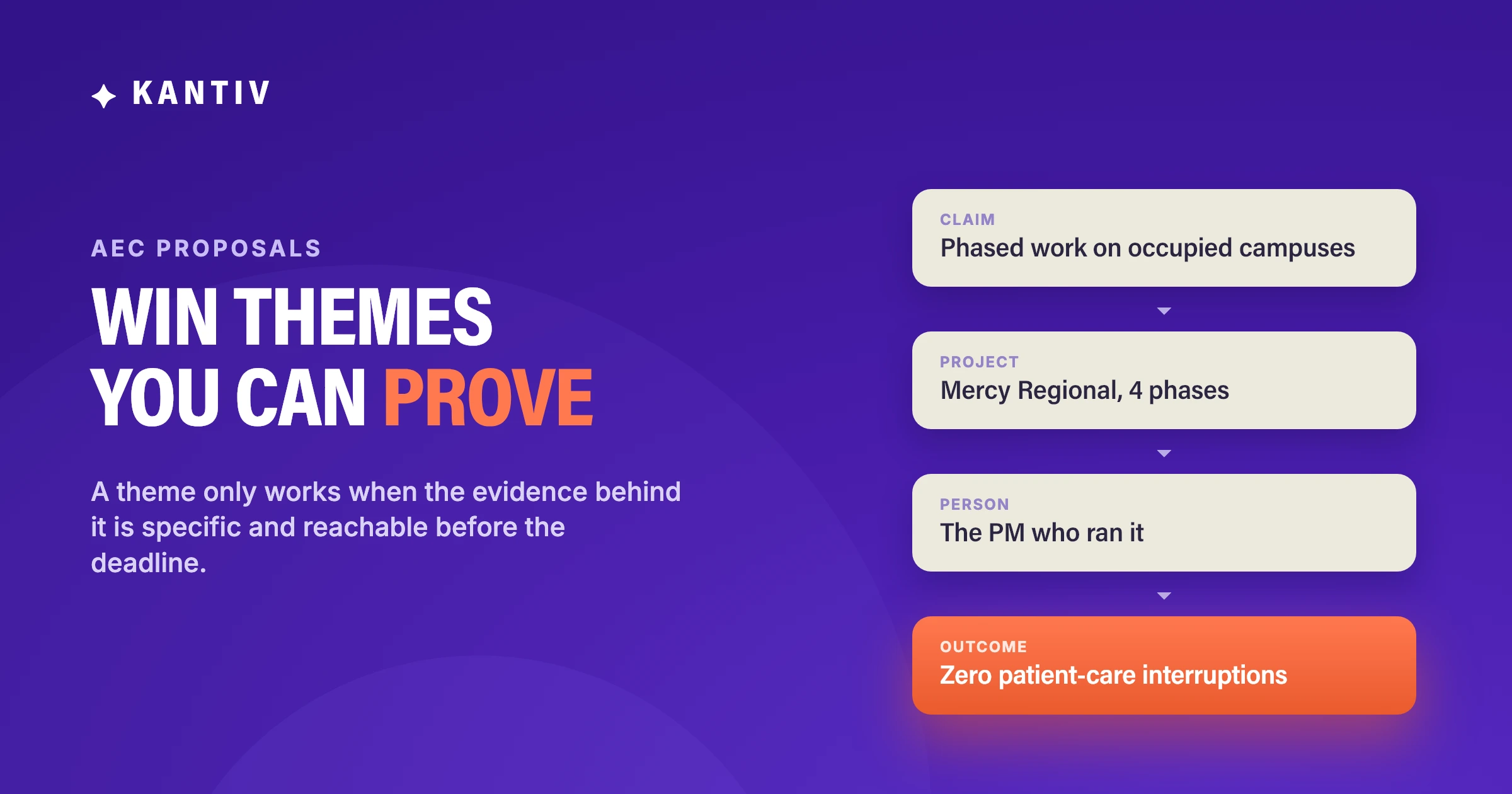
Claim → project → people → outcome.
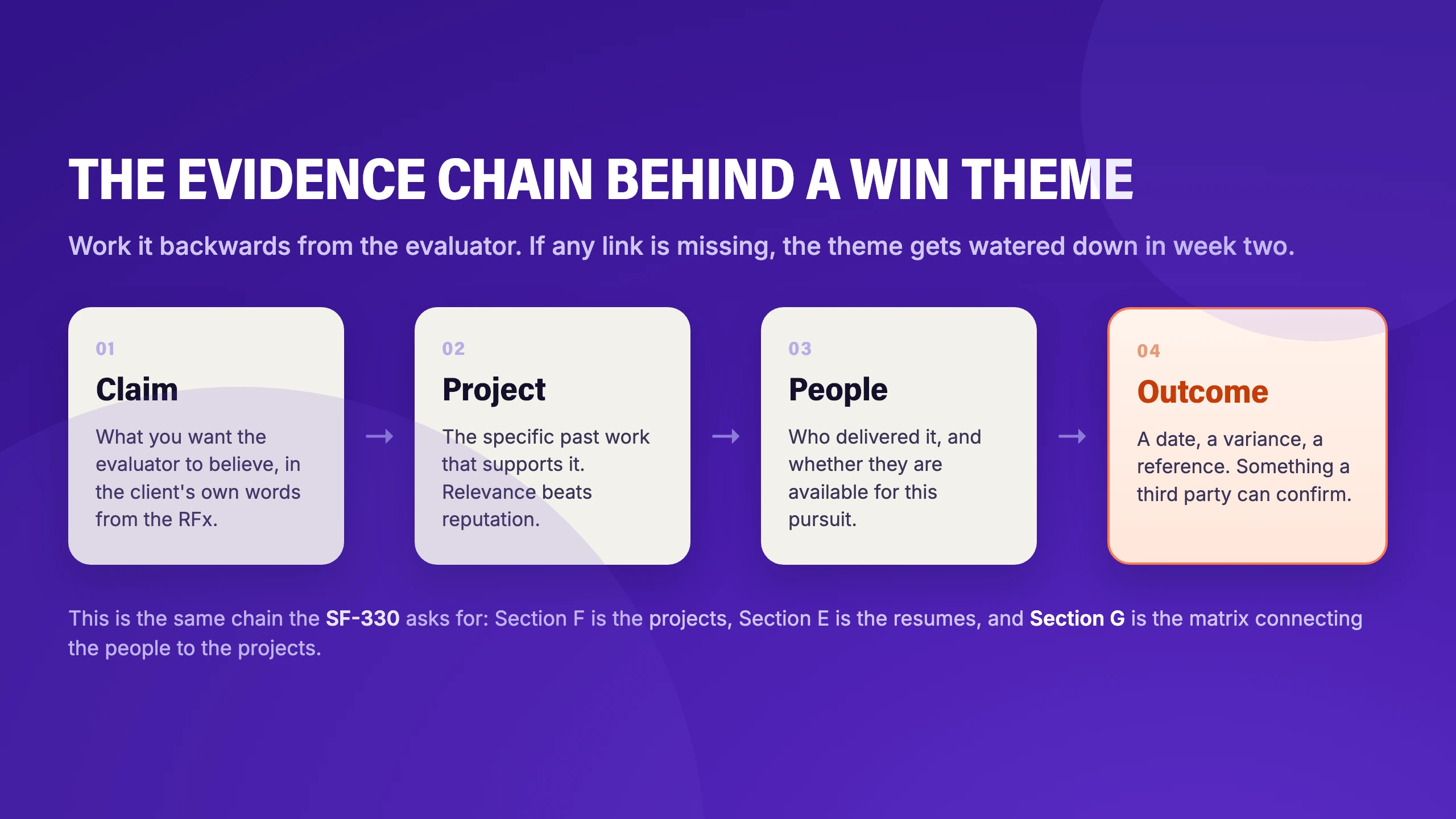
Start with the claim you want the evaluator to believe. Then identify the past projects that support it, keeping in mind that relevance matters more than reputation at this stage: the marquee job your firm is known for counts for less than the smaller one that matches this client's problem. From those projects, identify who actually delivered the work and whether those people are available for this pursuit. Finish with the documented outcome, which means a date, a variance, a reference, or a measured result that somebody outside your firm could confirm.
When one of the four is missing, you have two honest options. You can pick a different theme you're able to complete, or you can go and get the missing piece now, while there's still time, rather than discovering the gap in week two.
The SF-330 has been asking federal submitters for this exact chain for years. Section F holds your example projects, Section E holds the resumes, and Section G is the matrix showing which key people worked on which of those projects. The form is a proof structure disguised as paperwork, and it won't accept an adjective in place of a name. Firms that do federal work tend to write more provable themes for precisely this reason: they've been made to show the connections in a grid.
Commercial pursuits almost never make you fill in that grid. Build it anyway, because the evaluator scoring your commercial response is making the same connections in their head whether you show your work or not.
Which themes actually won?
Most firms never find out which themes won. The pursuit closes, the team moves on, and the positioning that worked disappears along with the debrief nobody scheduled.
Christina Godfrey Carter, a proposal professional, described the fix as a small change to how firms track pursuits:
"Add a field for key win themes or proof points used in each bid. When you win, tie it back: 'This positioning worked in 3 of our last 4 wins.'"
The change she's describing costs almost nothing to make. Record the theme you led with, record the result when the decision comes back, and within a year, your firm is choosing positioning from its own evidence rather than from instinct. That's the point at which win/loss intelligence stops being a report nobody opens and starts being an input to the next pursuit, and it's how a firm's institutional knowledge about what actually persuades its clients survives the people who learned it.
How Kantiv makes a win theme provable
Everything above is achievable with a spreadsheet, a disciplined capture process, and enough lead time. The firms that consistently write provable themes aren't better writers than their competitors, and they aren't more disciplined either. They can simply reach their own evidence faster, which means the theme they choose in week one is still the theme they can support in week two.
Kantiv, formerly Joist AI, was built to close that gap. It maps your people, past projects, and historical performance into a structured knowledge graph, so the connections the SF-330 grid asks you to draw by hand already exist before a solicitation arrives.
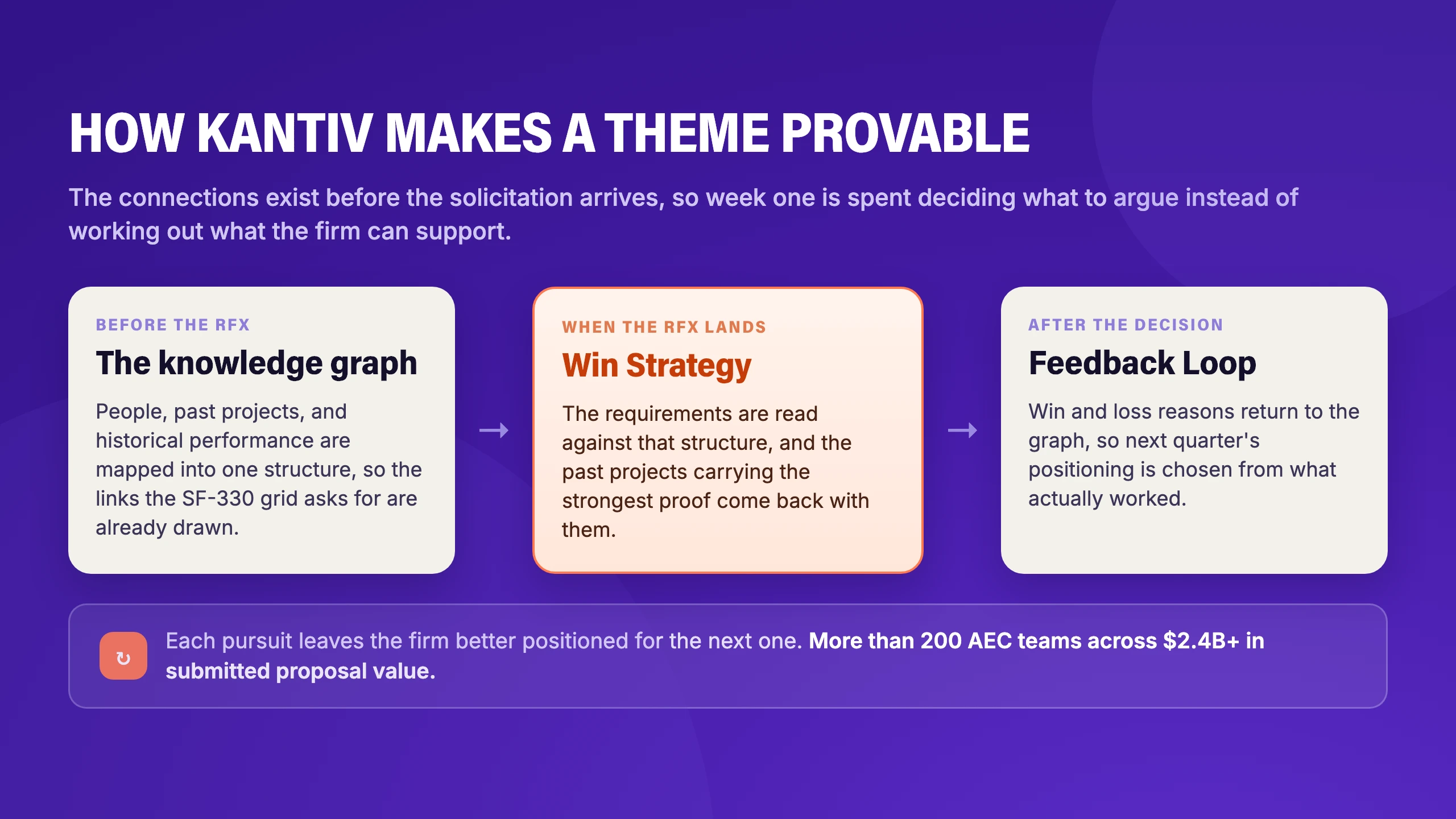
When an RFx lands, Win Strategy reads the requirements and surfaces the past projects carrying the strongest proof points against them, which lets the team decide its positioning before anyone writes a section rather than after. Once the pursuit closes, Feedback Loop captures the win and loss reasons and returns them to the same knowledge graph, so the themes you choose next quarter are informed by what actually worked this one.
More than 200 AEC teams work this way across $2.4B+ in submitted proposal value, and the pattern they report is consistent. Week one stops being spent working out what the firm can support and starts being spent deciding what to argue.
Want to try it? Book a demo and bring a live RFx.
FAQs
What are the three C's of proposal writing? Compliant, compelling, and complete. Useful when you're editing a draft. It won't help you choose a theme, which is a positioning decision made before any writing starts.
How many win themes should a proposal have? One to three. Closer to one for a compact SOQ, two or three for a full technical response. Past three, none of them repeat often enough to register with somebody reading six proposals in an afternoon.
What's the difference between a win theme and a discriminator? A discriminator is the capability a competitor can't honestly claim. A win theme is that discriminator connected to the client's stated need, with the benefit and the proof attached. Discriminators are ingredients. Themes are the argument.
Do win themes matter as much in a statement of qualifications as in an RFP? More, if anything. An SOQ is shorter and almost entirely about who you are, so a single well-evidenced theme carries a larger share of the argument.
Who should write the win themes? Whoever ran capture, with the project manager who'd deliver the work in the room. Marketing sharpens the language. A theme written without the person who'd defend it in the interview tends not to survive the interview.
Where do we find the proof for a theme? Past projects, resumes, and documented outcomes, connected to one another. The go/no-go scorecard is a useful forcing function: if you can't name the evidence at the go decision, that's worth knowing before you commit the hours.
Before you commit to a theme, run the evaluator's test on it. They'll call the owner you named and ask whether it happened the way you described. If you'd be comfortable on that call, the theme is real. If you'd be hedging, you have an adjective.