Found the content on this page useful? Share it with your team!
Pursuit Intelligence: What It Is, Why It Matters, and How AEC Firms Use It

.png)
Table of Contents

Your firm has already done the work that should help you win the next pursuit. The project story exists. The right principal has the client context. The resume language has been written before. The win themes from a similar shortlist are probably buried in a folder somewhere.
And still, when the RFP lands, the first two days disappear into the hunt.

Pursuit intelligence is the discipline of turning your firm's past pursuits, project history, people expertise, client context, and win/loss patterns into usable knowledge for the next pursuit. It helps AEC marketing, proposal, and business development teams start with evidence instead of memory.
That distinction matters. AEC firms don't struggle because they lack experience. They struggle because the experience is scattered across old proposals, shared drives, CRMs, DAMs, InDesign files, and people's heads.
The findability problem
Most AEC firms don't have a proposal problem first. They have a findability problem.
The RFP asks for relevant healthcare experience in occupied facilities. Someone remembers a project from 2019, but the final project sheet lives in SharePoint, the better narrative is inside an old InDesign file, the latest image is in the DAM, and the project manager who knows the real story is on site all day.
"By the time I tracked down everything I needed for that pursuit, we had only two days left to submit the proposal," one proposal manager told us. "The experience was there. It just wasn't anywhere I could get to it fast."
Your proposal manager doesn't need more content. She needs the right content, current enough to trust, with enough context to use. That's the problem pursuit intelligence is built to solve.
What is pursuit intelligence?
Pursuit intelligence is structured firm knowledge used to decide which work to chase, how to position for it, and how to build the strongest response.
In AEC, that knowledge includes past proposals, SOQs, and SF-330s, project sheets, resumes and bios, client history and relationship context, go/no-go decisions, win themes, shortlist feedback, debrief notes, market sector and geographic experience, principal and seller-doer expertise, images, awards, and project narratives, and the lessons learned after the pursuit closes.
Pursuit intelligence turns all of that into a system your team can use while the deadline is still far enough away to matter. It tells the team which projects are relevant, who has the right experience, what language has worked before, what the client already knows, and where the pursuit is weak.
Without that layer, proposal teams keep opening the most recent proposal and hoping it's close enough.
What is a pursuit intelligence platform?
A pursuit intelligence platform captures, connects, and surfaces firm knowledge across the pursuit lifecycle. It should understand the relationships that matter in AEC:
- Which people worked on which projects
- Which projects map to which markets, clients, delivery methods, and scopes
- Which proposals led to shortlist, interview, award, or loss
- Which client relationships shaped the pursuit
- Which content was approved, reused, revised, or retired
- Which requirements appeared in the RFP and how the team answered them
A shared drive can hold the PDF. A CRM can hold the opportunity record. A DAM can hold the image assets. A pursuit intelligence platform connects the proof, context, and outcome so the next team doesn't have to rediscover the same ground manually. Unlike a sales intelligence platform built for pipeline tracking, pursuit intelligence is built around proposal-ready knowledge, the kind that changes what goes into the response, not just what's in the pipeline.
The platform should help your proposal manager ask questions the way she actually thinks:
- "Show me water treatment projects with this principal."
- "Find the strongest school renovation narrative from the last five years."
- "Which resumes mention occupied healthcare work?"
- "What did we submit last time this client asked about sustainability?"
- "Which pursuits like this did we win, and what did we say?"
That's a different job than file storage or drafting.
Why AEC proposals start from scratch every time
AEC proposals keep starting from scratch because most firm knowledge is organized around where it lives, not how the team uses it.
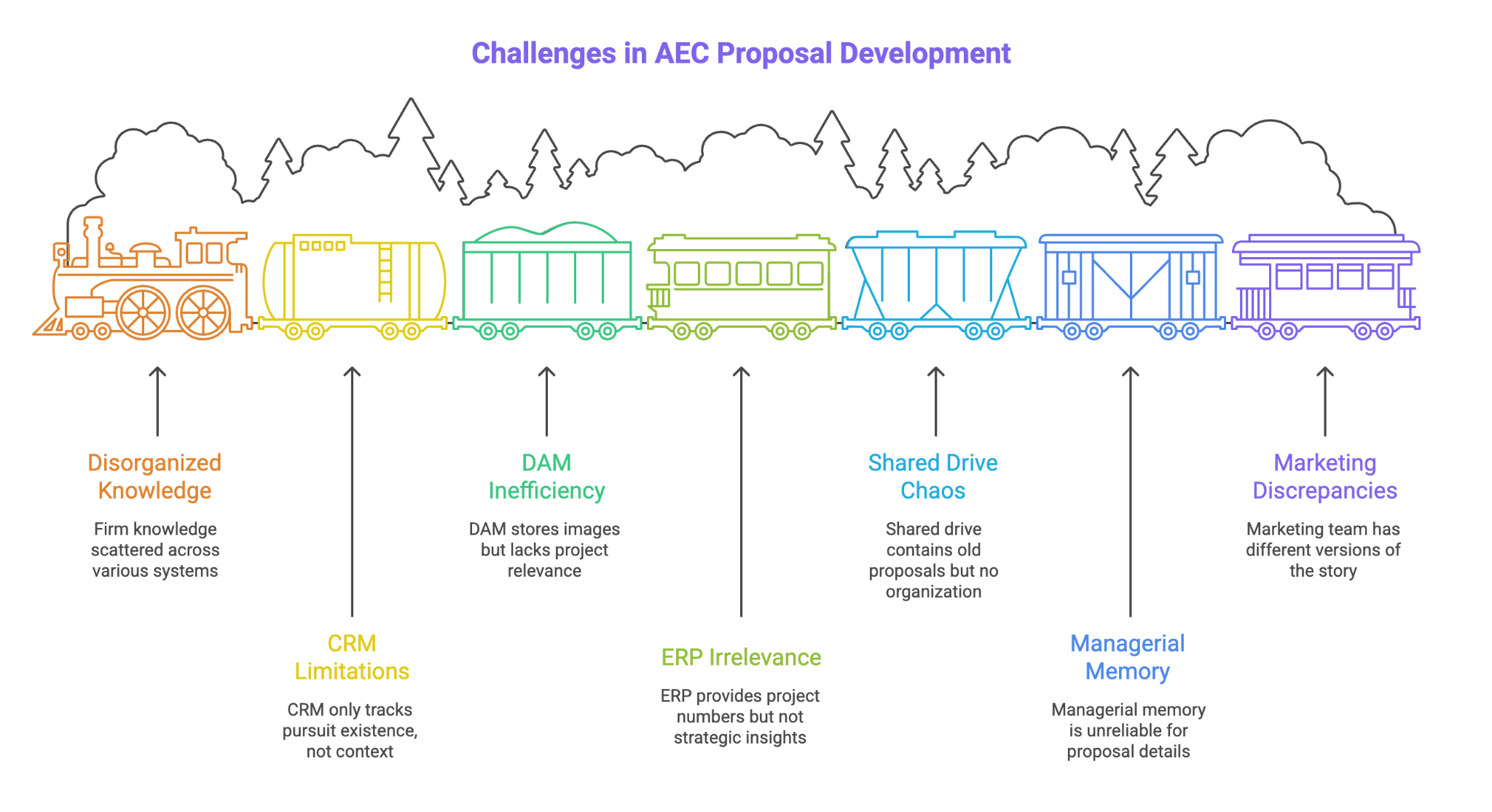
So the team rebuilds the foundation every time.
- A coordinator searches for the last similar proposal
- A principal rewrites a project description from memory
- A BD lead checks the CRM but still has to ask around for context
- A marketing manager compares three resume versions to find the current one
- A designer pulls images without knowing which project details matter for this evaluator.
That work looks tactical. But it shapes the quality of the pursuit. If your team spends the first half of the schedule finding proof, the strategy happens late. Win themes get written after the outline is already fixed. The go/no-go conversation becomes a formality. The proposal is compliant, but not as sharp as it should be.
Starting from scratch is not a writing failure. It's a knowledge-system failure.
Proposal management vs. pursuit intelligence
Proposal management gets the response out the door. It covers the calendar, compliance matrix, assignments, content collection, reviews, formatting, production, and final checks.
Pursuit intelligence sits underneath that work. It gives your proposal manager better raw material before production takes over. It helps your BD lead understand whether the firm should pursue. It helps your marketing director see what the firm knows about this client, market, and project type. It gives your seller-doer enough context to contribute from a position of command over the pursuit, before the deadline closes in.
Proposal management asks: how do we get this response done?
Pursuit intelligence asks: what does our firm already know that should change how we pursue this?
Both matter. When firms confuse the two, the proposal manager ends up responsible for strategy without the system needed to support it.
Proposal automation is only useful if the knowledge is ready
Proposal automation helps teams draft, assemble, or format content faster. It can be useful. It also hides the real problem.
If the source material is stale, the automated draft will be stale. If the project data is incomplete, the output will be incomplete. If your firm doesn't know why it won the last similar pursuit, no writing tool will invent that context in a trustworthy way.
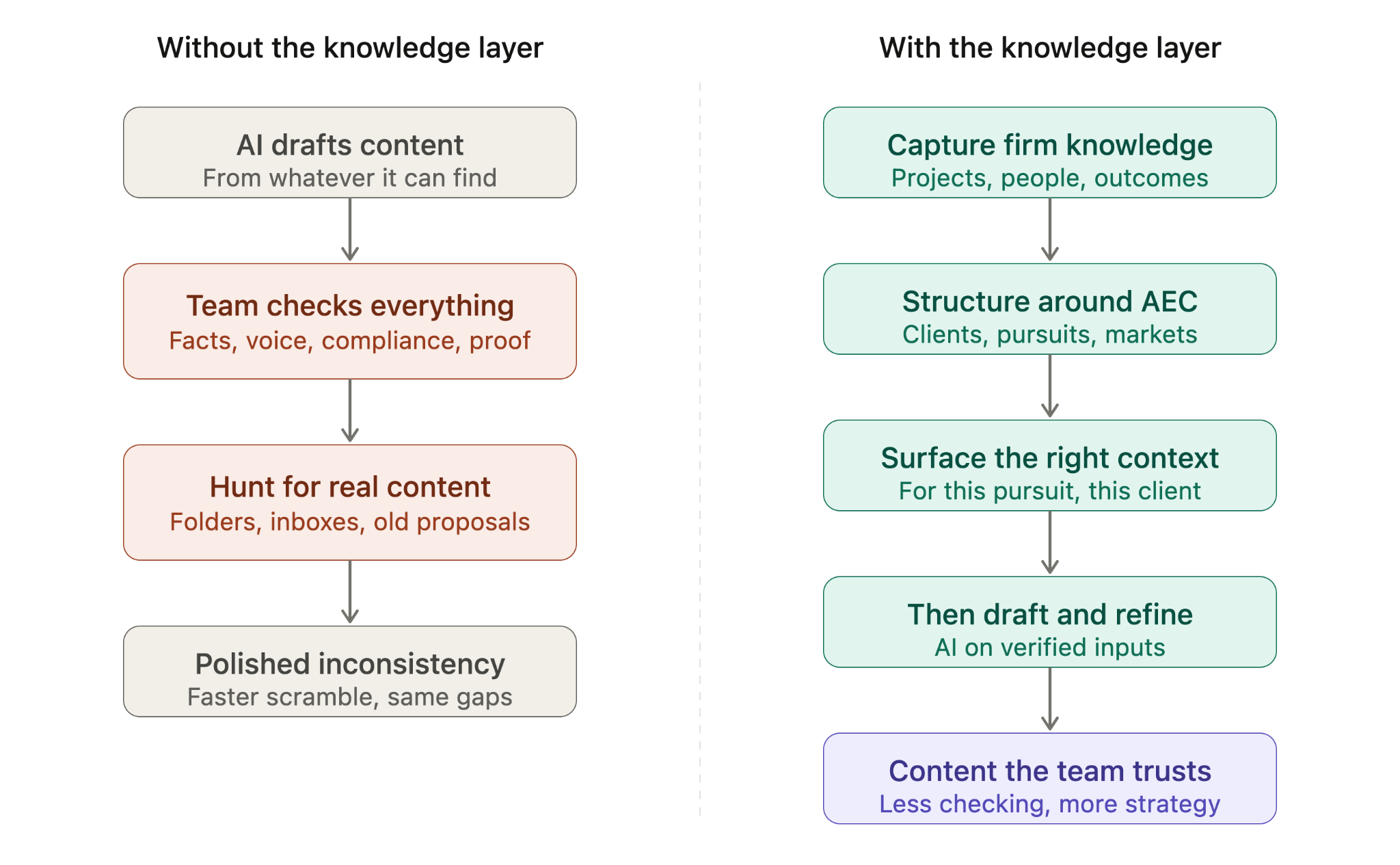
This is where most AEC teams feel the gap with generic AI. The first draft may appear faster, but the review burden comes back in a different form: checking facts, correcting voice, hunting for proof, fixing compliance gaps, making sure the response actually sounds like your firm.
Pursuit intelligence makes automation more useful because it gives the drafting layer better information to work from. Capture the firm's knowledge first. Structure it around AEC relationships. Surface the right context for the current pursuit. Then draft and refine. When teams skip the first three steps, automation only makes the scramble look cleaner.
What changes when the knowledge is ready
Most AEC marketing teams are already moving fast. The calendar is full. Seller-doers are hard to pin down. Review cycles compress. The proposal manager is already doing the work of five systems.
"We weren't understaffed. We were just spending half our time finding things instead of doing things."
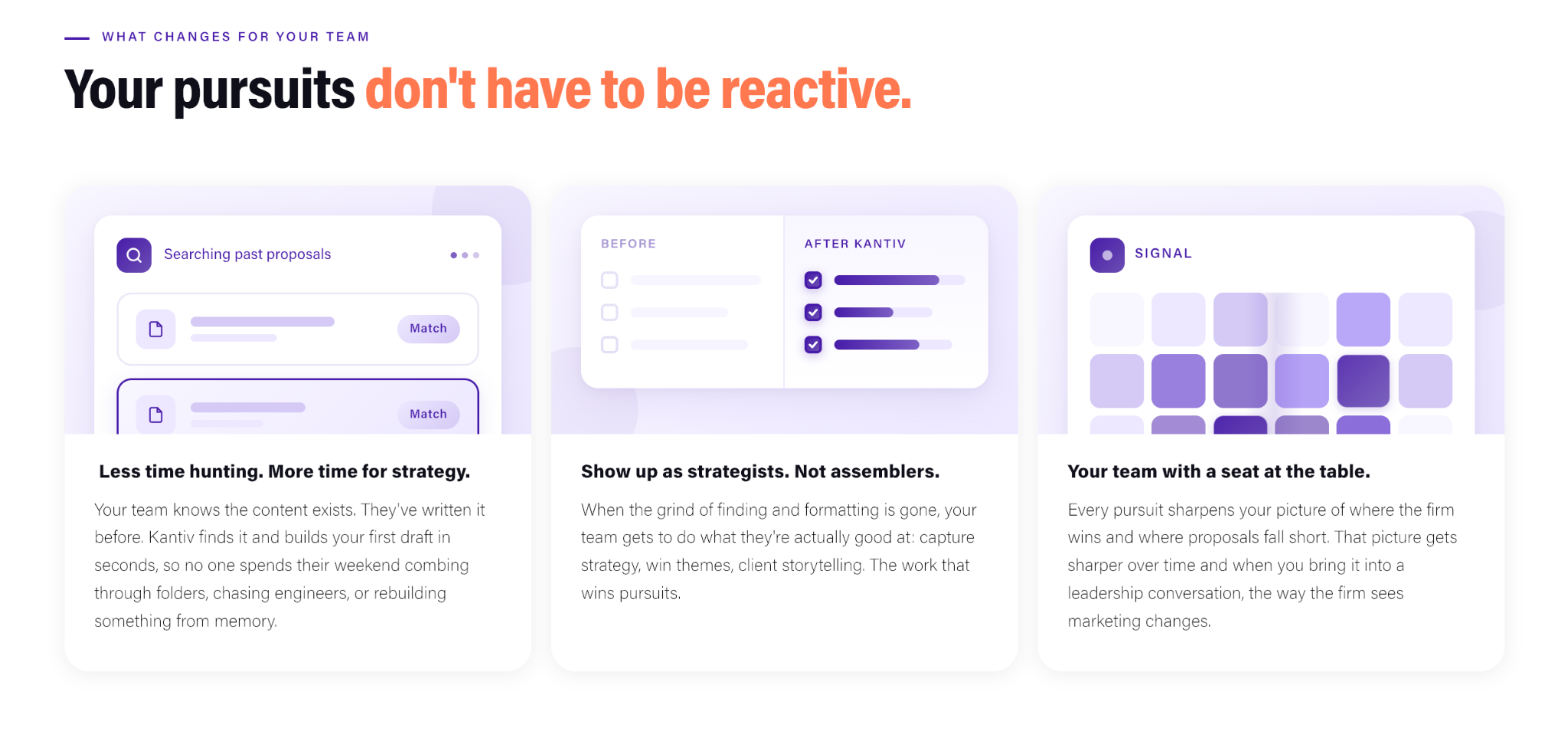
When your team can find current resumes, approved project narratives, relevant past proposal language, client context, and win/loss patterns in one pursuit workflow, the work changes. Your proposal manager spends less of the schedule chasing inputs and more of it shaping the response. Your BD lead gets better context for go/no-go. Your marketing director can connect pursuit activity to win rate, not just production volume.
That's how AEC firms support more pursuits without adding headcount. They stop rebuilding the same knowledge base every time the RFP arrives. The point isn't to turn marketers into production machines, but to give them enough institutional memory and enough bid security to do the strategic work they were hired to do.
Where Kantiv fits
Kantiv is the pursuit intelligence platform built for AEC marketing and business development teams.
Most tools organize knowledge around where it lives. Kantiv organizes it around how your team uses it during a pursuit: your people, projects, clients, outcomes, approved content, and the institutional context that usually lives across folders, inboxes, and long-tenured employees' heads. All of it connected and searchable before the RFP lands.
Kantiv isn't a DAM, a CRM, or a generic proposal automation tool. It sits across the pursuit workflow where those systems leave gaps: finding the right proof, connecting it to the current pursuit, keeping content grounded in your firm's reality, and making sure every pursuit improves the next one.
For teams evaluating the category, the question is simple: can your current system show what your firm already knows in time to change the pursuit? If the answer is no, you don't just have a content problem. You have a pursuit intelligence problem.
How AEC firms use Kantiv
More than 200 AEC firms, including 20% of the ENR Top 100, use Kantiv as their pursuit intelligence platform. The pattern behind those firms is more useful than the names. Lean marketing teams, high pursuit volume, scattered institutional knowledge, and a need to make every pursuit strengthen the next one.
Architecture teams need portfolio intelligence, not just image storage. Engineering teams need SF-330, QBS, and project experience data that's current enough to trust. Construction teams need fast, consistent access to project history, safety context, key personnel, and owner-specific proof, with enough data security to know the information is verified before it goes into a response.
Pursuit intelligence becomes valuable when your firm has enough knowledge that memory alone can no longer carry it.
Summing up
Your firm probably has the knowledge to win the next pursuit. The question is whether your team can reach it before the deadline does.
Pursuit intelligence is the system that makes your firm's knowledge usable before, during, and after a pursuit. It helps your team decide what to chase, understand what proof to use, reuse what the firm has already learned, and build stronger proposals without rebuilding the foundation every time.
Proposal automation helps with drafting. DAMs help with visual assets. CRMs help with relationships and pipeline. Pursuit intelligence connects the knowledge underneath all of those systems so your marketing and BD teams can use it when the pursuit is still winnable.
See how Kantiv captures and structures firm knowledge so every pursuit starts with context.
FAQs
Why do AEC proposals start from scratch every time?
Because most firm knowledge is organized around where it lives, not how the team uses it. The CRM has the opportunity. The DAM has the image. The shared drive has the old PDF. None of that automatically becomes a pursuit strategy, so the team rebuilds the foundation every time the RFP arrives.
How does pursuit intelligence help with AI and proposal automation?
Pursuit intelligence gives AI and automation tools better information to work from. Generic AI can draft faster, but if the source material is stale or scattered, the output will be too. When your firm's knowledge is structured and current, AI stops being a liability your team has to verify and starts being a tool your team actually trusts.
What size AEC firm needs pursuit intelligence?
Pursuit intelligence becomes valuable when your firm has enough knowledge that memory alone can no longer carry it. That usually means high pursuit volume, multiple offices or market sectors, lean marketing teams, and a need to make every pursuit strengthen the next one.