Found the content on this page useful? Share it with your team!
Why Asset Management Tools Fall Short for AEC Pursuits

.png)
Table of Contents
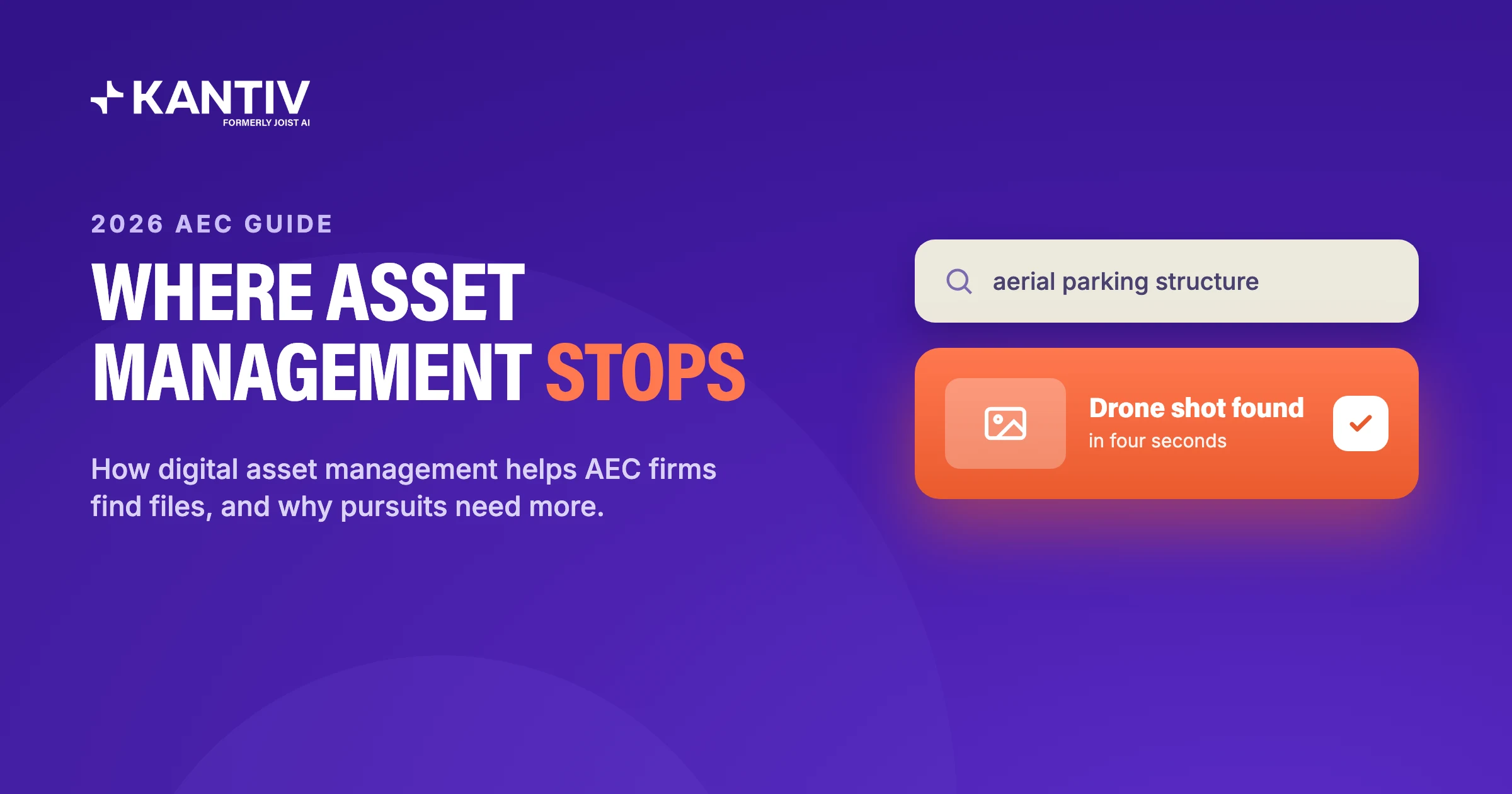
The good news: your DAM works. Type "aerial parking structure" into the search bar and the drone shot is on screen in four seconds flat. That is exactly what the demo promised, and the platform delivered.
The pursuit that needed the photo? It still ate your entire week. Because as most AEC marketers and pursuit managers know, the photo was never the hard part.
Digital asset management software organizes a firm's images and files so they can be found. However, when it comes to AEC pursuits, asset management alone doesn’t cut it. Winning the right work starts with institutional knowledge, i.e. knowing which projects, people, and past performance make the case for this client.
A file library does not model any of that. There is a category above storage that does, and understanding the difference is worth more than any feature comparison.
That is the argument of this piece, and it starts with a genuine concession, because the argument only matters if we give credit where it’s due.
What a DAM does well
Before DAMs, the state of the art was worse than most firms admit. Katie Robinson, now CMO at LS3P, describes her early proposal years plainly:
"I would sit in the marketing closet on a floor with a three ring binder, flipping through pages of stuff."
The digital asset manager, one organized, tagged, searchable home for project photography and marketing files, ended that era. Firms that adopted them stopped losing afternoons to the hunt through the image library.
If finding files were your firm's only problem, you could stop reading here. Most firms discover it’s not, and that realization usually arrives mid-pursuit.
The fine print on "AI-powered" storage
It is worth knowing what the storage category's own documentation says about how the magic works, because the mechanics matter when you are deciding what to buy.
Even in the best DAM solutions available today, the AI search layer runs on a generic model that is pre-trained on hundreds of millions of ordinary images, and not on AEC workflows. Its automated tagging produces suggestions that a human is advised to verify rather than accept blind. And its data model is project folders plus whatever taxonomy your firm maintains. The platform itself does very little of the heavy lifting pursuit managers are responsible for.
Which means the honest architecture of every DAM is this: software stores, people tag, people search. And the search part of that equation is only as good as the tagging discipline your busiest coordinator sustains under deadline.
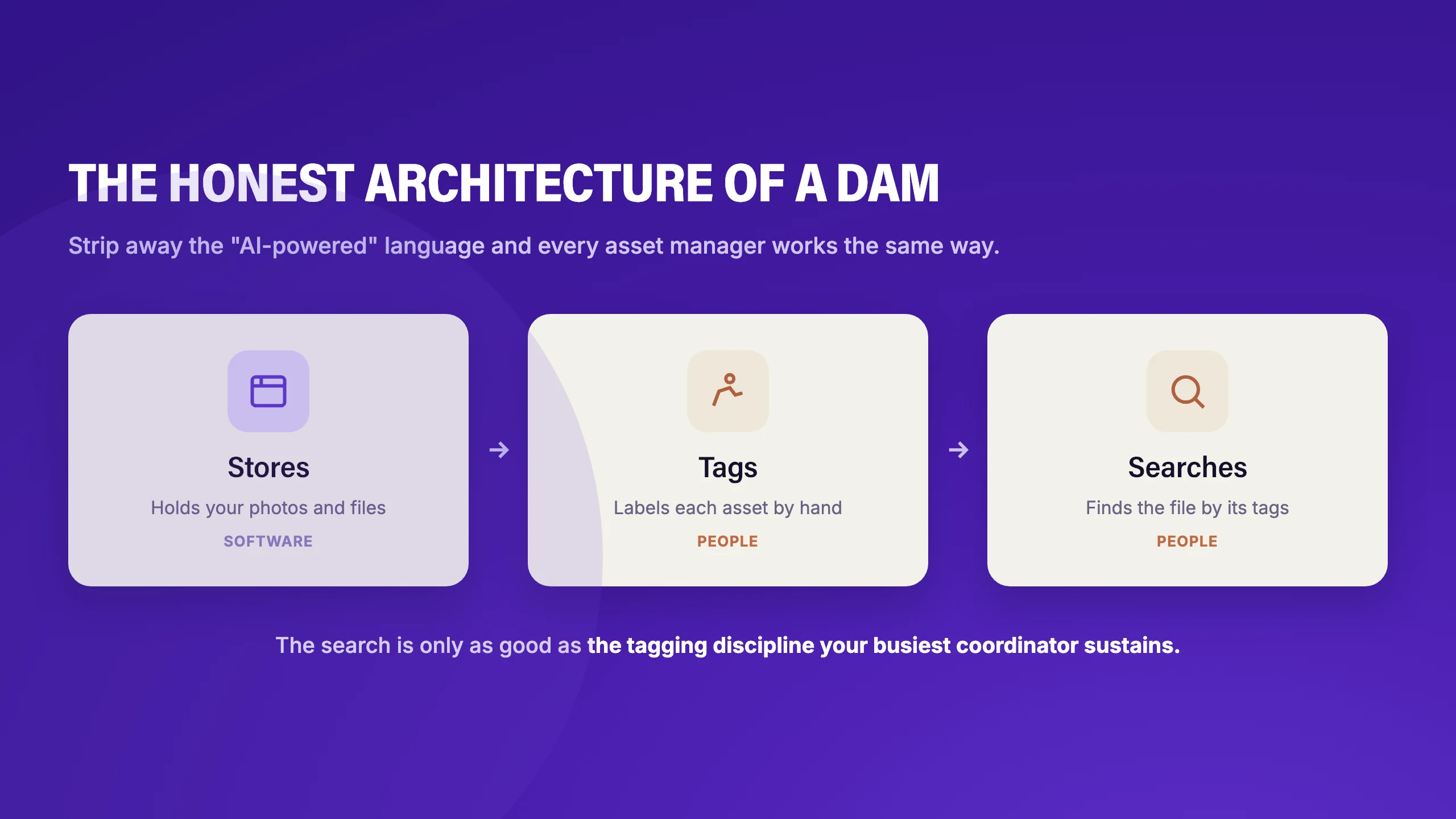
So, for instance, finding the right image mid-pursuit is a real-pain and often comes down to remembering who saved the file, where and what the naming convention was.
That’s why AEC marketers that use DAMs consistently say that instead of pressure-testing which pursuits deserve a go so that they win more of the right work, thus shaping their win strategy, they end up spending much of their time hunting for the right assets and acting as a de-facto librarian.
None of this, by the way, is revelatory. This is what storage is. A filing cabinet with excellent labels.
Where storage isn’t enough
What happens after the photo is found? You know the story.
Someone has to decide which of the firm's four hundred projects belong in this pursuit, whose resume goes forward, which reference will pick up the phone, and what past performance makes the strongest case for this owner and this scope.
None of those are file questions. They are judgment questions about the firm's experience, and the DAM has no opinion, because a filing cabinet does not know what any of its contents mean.
We've heard the same stories from AEC marketing teams over and over. The resume exists in fifty versions across old proposals, and nobody knows which one is current. The winning approach narrative from the last treatment plant shortlist is in an InDesign file from 2021, on a drive, under a name only its author would recognize.
Every one of those firms already owned storage tools. What still hurts is finding the proof, and proof lives in relationships between projects, people, clients, and outcomes that metadata tags were never built to carry.
To put it plainly: The photo was in the DAM. The proof was everywhere else.
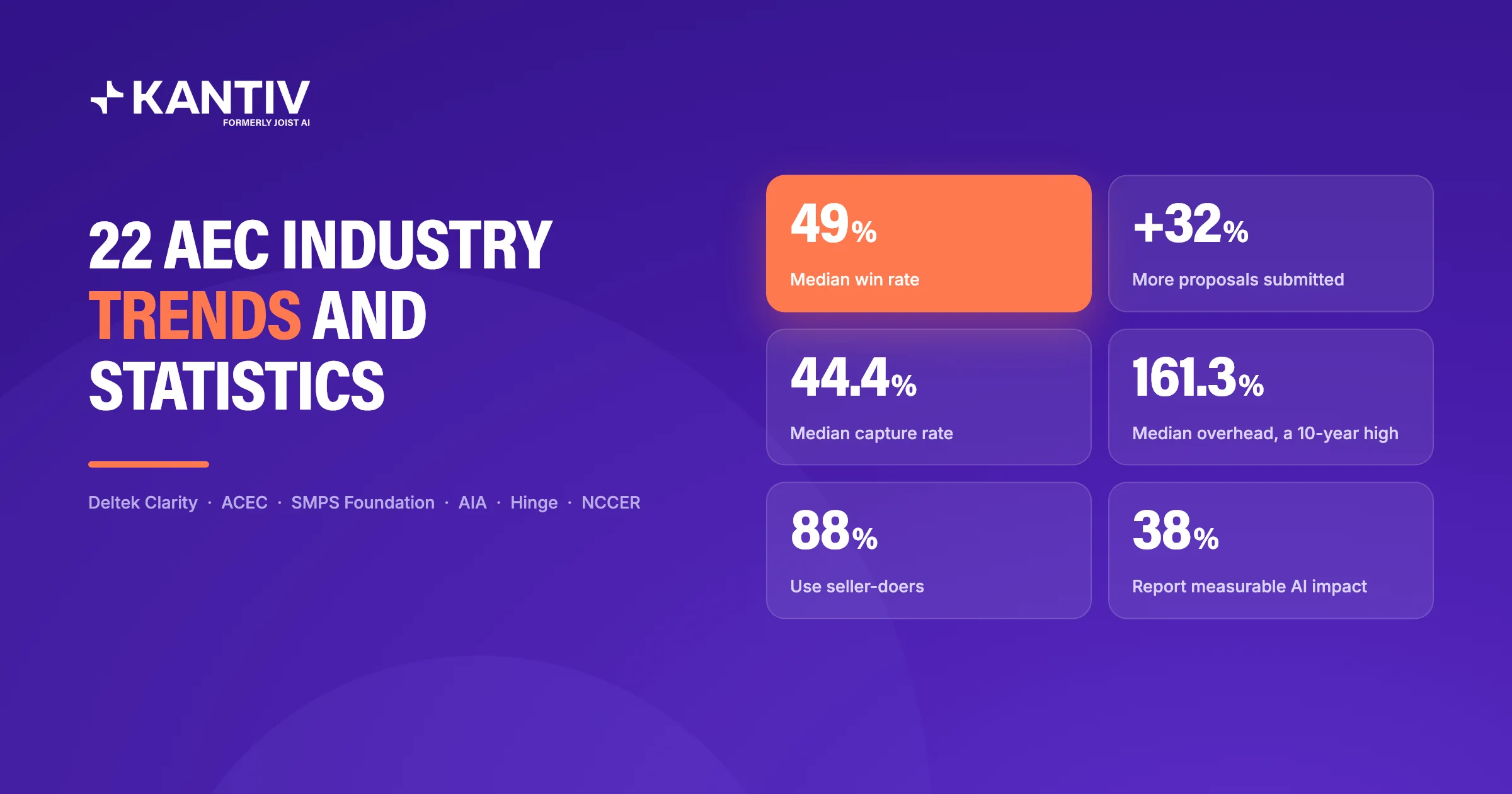
The stakes of that gap are measurable. In Deltek's 47th annual Clarity study, the gap between the top quarter of firms (61.3%) and the bottom quarter (30.2%) on capture rate is 31 points. Same industry, same RFPs, same tools on the shelf. The difference is which firms can put their best evidence forward on every pursuit, and which firms are still hunting for it when the deadline lands.
Play it out on a real pursuit. A municipal water district issues an RFQ for a treatment plant expansion. The winning proposal needs your three most relevant treatment projects, the PM who delivered two of them, the resume that proves it, the go/no-go call made with actual win probability context, and photos of the built work.
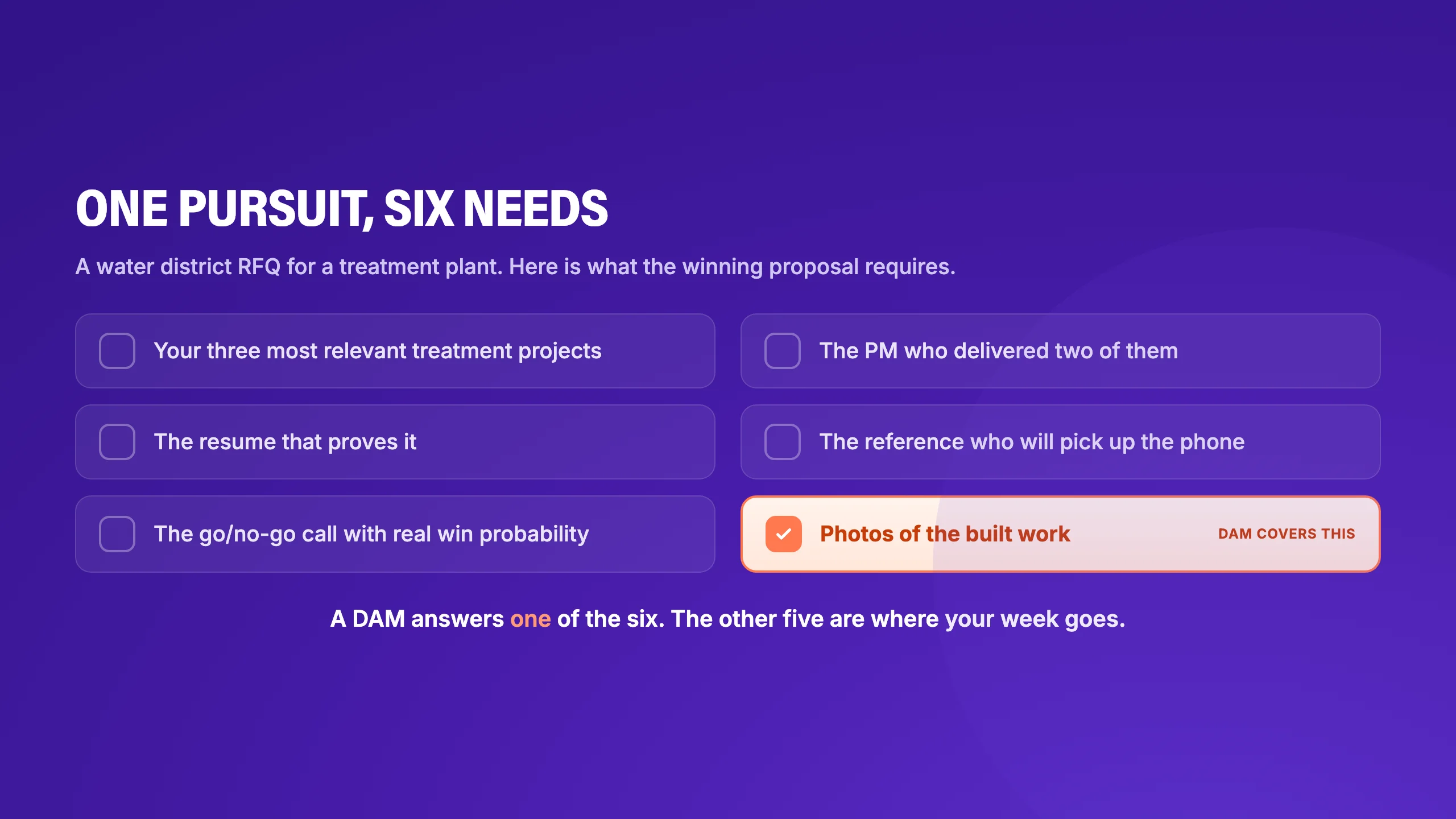
A DAM answers exactly one of those six needs (the photos). The other five, though they clearly belong to the pursuit, are the reason your week disappears even after the photo turns up in four seconds of your search.
Why AEC firms are switching to pursuit intelligence
As a marketer at an AEC firm, you do proposals. You manage pursuits. You oversee events. And somewhere in between, you are also the one managing the library where your images, people, projects, and clients live. Being the one person doing multiple jobs, you know the importance of context more than anyone. It’s not just about storing files; but about connecting the right piece of knowledge to the right pursuit.
A generic tool doesn't understand the nuances of architecture, engineering, and construction, where each document, drawing, and spec carries unique implications and value. That’s where pursuit intelligence becomes important. At its core is a living knowledge graph of your firm's people, projects, clients, and pursuits, extracted from work the firm has already done.
Upload an RFx, and Kantiv (formerly Joist AI) surfaces the most relevant past proposals, project profiles, people, and images for that specific opportunity. It can do this because it models what a DAM cannot, showing that this engineer led that treatment plant for this kind of owner, and that the combination is exactly the proof this pursuit needs.

The practitioners who run these systems well have been saying the underlying truth for years. Nobody has said it better than Lindsay Diven, who spent a career inside AEC marketing teams before teaching them:
"You're not ready for proposal automation until your data is in the database, you've agreed that the database is your one source of truth, and you're not going to hold files somewhere else too."
How Kantiv replaces and outperforms DAMs
We’ve hinted at it throughout this piece, but here’s the true dividing line: A DAM is somewhere to hold files. A knowledge layer like Kantiv is the agreed source of truth about what your firm has done and who did it, which is why it can assemble an entire pursuit instead of just returning search results.
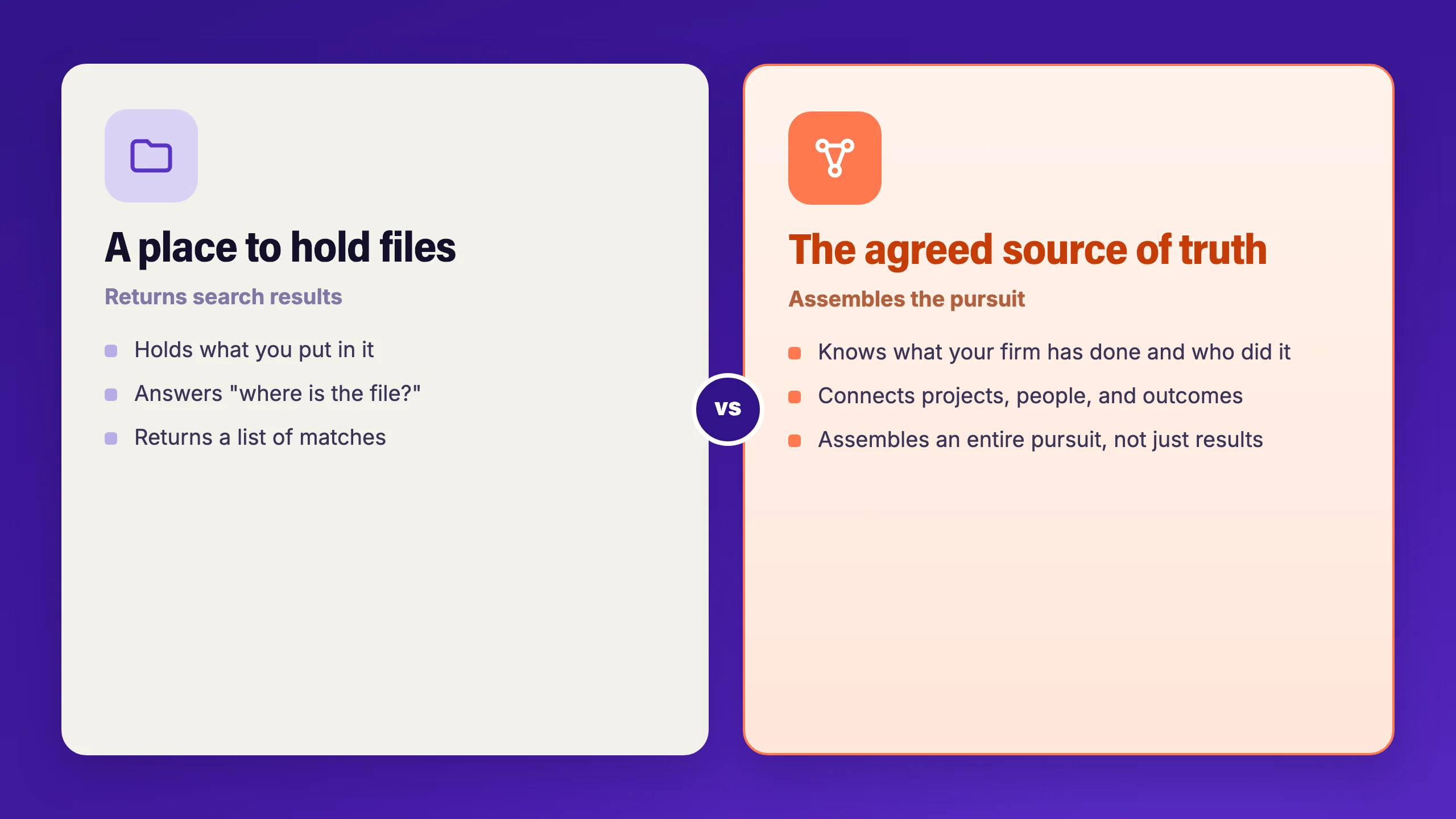
For pursuit managers used to a DAM, Kantiv’s Image Hub handles the visual side along the way, making project photos searchable by what is in them. So moving up a category does not mean giving up the job the DAM did well.
Pursuits need more than a photo
Let’s go back to that drone shot from the opening. It took four seconds to find it, and the week still disappeared into the pursuit around it.
Storage stays necessary. It is one component of the broader intelligence a firm needs to win pursuits.
We call this knowledge work, and it is exactly what Kantiv was built for. It knows what your firm has built, who led it, and how it performed, and it puts that knowledge to work across the entire pursuit.
Want to see it in action? Book a demo.
FAQ
What is the difference between a DAM and a pursuit intelligence platform?
A digital asset management system stores and organizes files. A pursuit intelligence platform structures a firm's knowledge around the way pursuits actually happen: people, projects, clients, and outcomes. In our case, Image Hub automatically tags and labels images by what is in the photo, so the right visuals surface instantly when building a pursuit response, without needing a separate DAM.
How is Image Hub different from a DAM or visual asset management platform?
Portfolio and visual asset platforms are built around showcasing your firm's work. Image Hub is built around using it. Every image in Kantiv is connected to the projects it came from, the proposals it has appeared in, and the markets it supports. When a pursuit lands, your team isn't browsing a gallery; they're pulling proven assets grounded in your firm's actual performance history.
Why do AEC firms struggle to reuse institutional knowledge?
Most AEC firms store knowledge across disconnected systems: shared drives, email inboxes, project management tools, and people's memories. When an RFx lands, teams rebuild content from memory rather than from a structured knowledge base. The result is inconsistent proposals, duplicated effort, and expertise that walks out when people leave.
How does Image Intelligence help us make better proposal decisions?
For any image, Kantiv shows you every document and proposal it has appeared in, how many times it has been used, and what variants exist. That means your team builds with images that have already performed across past submissions, not just whatever's findable before the deadline. It also surfaces coverage gaps by market or project type before a pursuit lands, so you know where your library is thin.