
Found the content on this page useful? Share it with your team!
What Is a World Model and Why Should AEC Care?

.png)
Table of Contents

One of the underrated perks of working in AEC technology is that you have a legitimate reason to watch keynotes from conferences you did not attend.
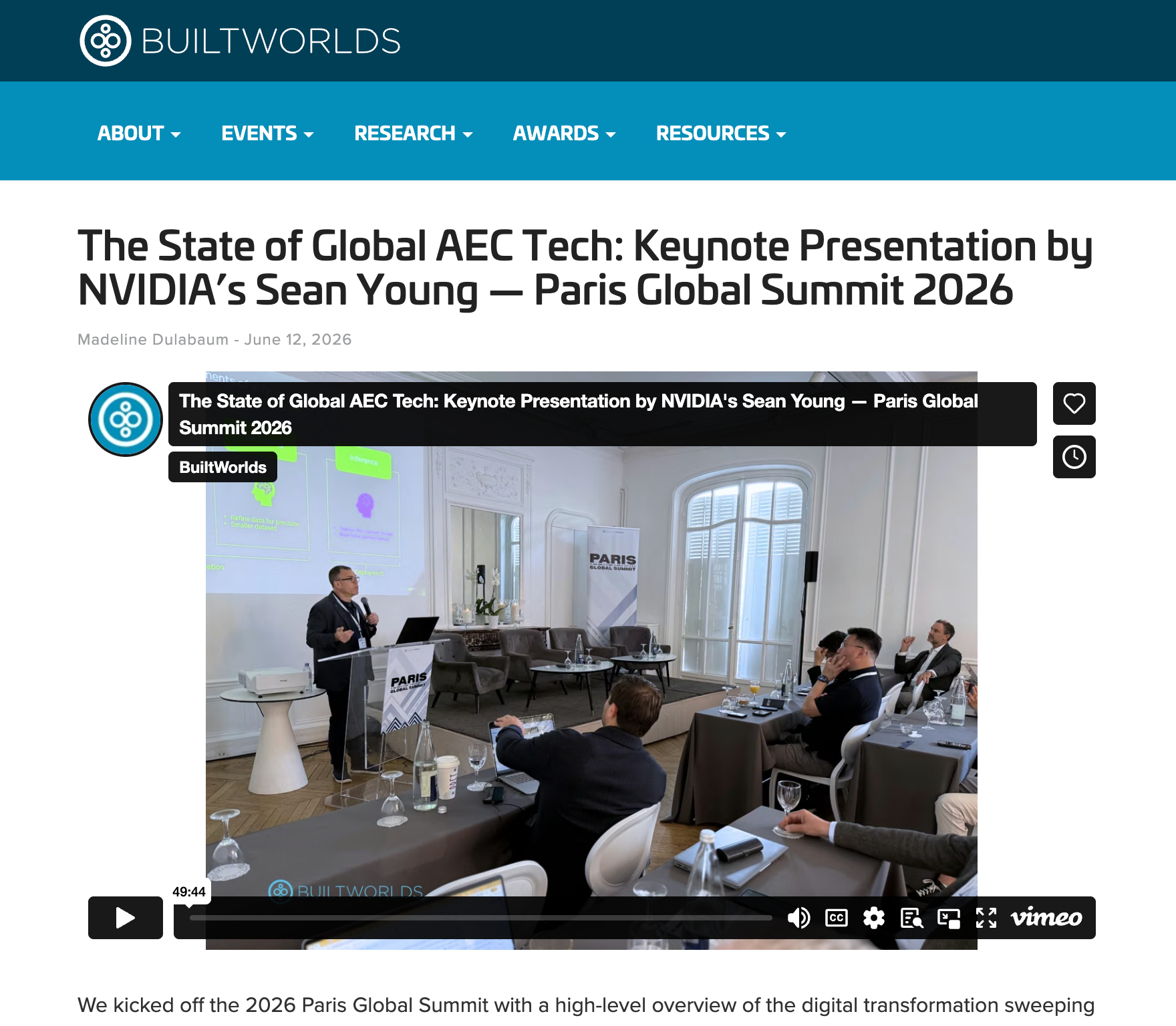
I recently caught the opening keynote from the BuiltWorlds 2026 Paris Global Summit: NVIDIA's Head of AEC, Sean Young, presenting to a room full of global AEC leaders, investors, and software developers. Fifty minutes of dense, fast-moving material covering agentic AI, digital twins, physics simulation, robotics, and data centers.
A lot to unpack. But one concept kept coming back to me after I closed the tab: the world model.
It sounds like jargon. It is not. And once you understand what it actually means, it reframes a lot of what is happening in AI right now, including something that matters directly to how your firm wins work, not just how it builds.
The three phases of AI and where we actually are
Most people in AEC have lived through two phases of AI without necessarily labeling them that way.
Phase one was perception AI
The ability to recognize things: images, objects, patterns. In AEC terms, this is the AI that looks at a photo of a job site and identifies whether a worker is wearing a hard hat.
Phase two was generative AI
This is what most people mean when they say "AI" today. ChatGPT, image generation, proposal drafting tools, content summarization. It understands language and produces language. Most of the AI adoption conversation in AEC marketing and BD lives here right now.
Phase three is agentic AI
An AI agent is a task automator. It moves between a language model and one or more software applications to complete multi-step work without a human in the loop at every step. One prompt, multiple applications, running in parallel, making decisions along the way.
The keynote opened with a live demonstration of exactly this: a single prompt that kicked off a process moving through Rhino, FreeCAD, and SketchUp in sequence, producing massing, BIM, and a rendering in roughly ten minutes, unattended.
That is not where we are headed. That is where we are.
So what is a world model?
A world model is a specific type of AI model, distinct from the language models most people are familiar with.
A large language model understands text. It reads a proposal, generates a response, summarizes a document, and writes code. Extraordinarily useful, and it is what powers most of the AI tools in the AEC market today.
A world model understands what it is looking at, through video or images, and it also understands physics. It has been trained not just on what things look like, but on how things behave. Gravity. Motion. Load. Cause and effect in the physical world.
Here is why that matters.
A language model watching a job site camera can tell you what it sees: "There is a person near the edge of the roof." A world model watching the same camera can tell you what is about to happen: "That person's body position and trajectory suggest they are at risk of falling in the next three seconds."
Not reacting to an event. Predicting one.
That distinction, reactive versus predictive, is the entire ballgame for safety, quality control, and schedule management on a live project. And as I will come back to, it is the same distinction that separates the pursuit teams grinding through every RFP from the ones who have built something smarter.
What this looks like in practice
The applications are not theoretical. They are deployed now.
A large general contractor running data center projects in the Southwest fitted their sites with cameras paired with world models last year. Not for compliance theater. For prediction. The system does not flag a PPE violation after it is caught on video. It tracks a person across the site and identifies the moment a helmet comes off, before a supervisor would notice, before an incident occurs. It monitors schedule progression by comparing what the camera sees on day 28 to what the digital twin predicted day 28 should look like and surfaces the delta automatically.
The underlying architecture follows the same pattern as agentic AI broadly. A camera feed goes to a world model, the model generates a description of what it sees and what it predicts, and an agent decides what to do: sound an alarm, alert a supervisor, log an incident, update a schedule.
The reason world models are essential here, rather than standard vision models, is the physics layer. Predicting a fall requires understanding that a human body at a certain angle, at a certain height, with a certain momentum, will follow a particular trajectory. That is not linguistic pattern matching. That is physics-informed inference.
The bigger shift this points to
The era where software proficiency was the primary competitive differentiator in AEC is ending. Not because technical skill stops mattering, but because the relationship between humans and tools is changing structurally.
For decades, competitive advantage was partly about who could operate the tools best. You hired people who knew Revit. You built workflows around tool proficiency. When an agent can now operate Revit, Civil 3D, SketchUp, and FreeCAD simultaneously with best practices baked in, that moat erodes.
What the advantage shifts toward is the quality of what you give the agent to work with: your data, your project context, your institutional knowledge about how you build, what has worked, what has not, what your clients actually want.
The firms that pull ahead will not be the ones with the best software stack. They will be the ones whose knowledge is organized well enough to inform an agent that can act on it.
What this means for your pursuit team
Most of the job site examples above will resonate with operations and construction leadership. But the same predictive logic applies directly to the business development and pursuit side of an AEC firm.
Right now, most proposal teams operate reactively. An RFP drops on a Friday afternoon and the scramble starts. You're hunting through shared drives for the right project descriptions, pulling resumes you've used before, trying to remember which pursuit had a similar scope two years ago. The process is mostly backward-looking and manually assembled, which is why it's exhausting and why it produces inconsistent results.
The pursuit intelligence version of the world model argument is this:
What if an agent, informed by your firm's complete history of wins, losses, project data, and client relationships, could anticipate what a pursuit needs before the deadline pressure hits? Surface the right past projects automatically. Flag experience gaps before they become a problem in the submittal. Identify patterns in what your winning pursuits have in common versus the ones you lost.
Anticipate rather than react. The same concept, just upstream of the job site.
This is exactly the problem that pursuit intelligence platforms are built to solve. The idea behind Kantiv is that your firm's institutional knowledge shouldn't live in disconnected folders and individual heads.
It should be organized, searchable, and usable for all, so that when an agent needs to inform a pursuit, it has something substantive to work with. The firms building that knowledge infrastructure now are the ones that will be able to move faster, respond better, and win more work as the agentic layer matures.
Where we actually stand
The adoption curve here is real and uneven. Global firms like Arup, large GCs with innovation budgets, data center builders with margin pressure to optimize: they are further along than most. But the gap between where the technology is and where most AEC firms' mental models are is significant and closing faster than people expect.
World models are not a research concept. Physics-informed neural networks that predict simulation results in real time are already in use. Agentic workflows moving across multiple design applications in a single session are already running. The robots are already on job sites.
The gap right now is not capability. It is awareness and readiness.
Sean Young closed his keynote to that room of global AEC leaders in Paris with a version of this: the constraint is no longer what technology can do. It is whether the firms in the room are ready to use it.
That question applies to job sites. It applies equally to your next pursuit.
FAQs
What is a world model in simple terms?
A world model is an AI that understands not just what it sees but how physical things behave. Unlike a language model that processes text, a world model processes video and images and applies physics-based reasoning to predict what will happen next, not just describe what is happening now.
How is a world model different from a regular AI vision system?
A standard vision system recognizes objects and events. A world model predicts them. The difference is the physics layer: understanding gravity, motion, load, and cause and effect well enough to anticipate an outcome before it occurs. That predictive capability is what makes world models useful for safety monitoring and schedule management on live construction sites.
Is this technology available to mid-size AEC firms or only large ones?
Right now, the early adopters are larger firms with innovation budgets and specific use cases like data center construction, where margin pressure justifies the investment. But the underlying tools are becoming more accessible quickly. The more urgent question for mid-size firms is not whether to adopt world models today but whether their data and knowledge infrastructure is ready when the adoption curve reaches them.
What does agentic AI mean for AEC marketing and BD teams?
Agentic AI means multi-step work that currently requires a human at every stage, hunting for project data, pulling resumes, assembling pursuit content, can increasingly be handled by an agent working across your firm's systems. The quality of that output depends entirely on the quality of the knowledge the agent has access to. Firms with structured, searchable project history and pursuit intelligence will get dramatically better results than firms whose knowledge lives in shared drives and people's memories.
Where should an AEC firm start if it wants to prepare for the agentic shift?
Start with your knowledge infrastructure. Standardize project metadata. Connect resumes to project records. Capture win and loss intelligence in a searchable format. Build tagging conventions that hold across offices. The firms that do this work now will be able to move fast when the agentic tools mature. The ones that do not will spend their first agent budget recreating the knowledge they already had.
-----------------------
The full keynote from Sean Young, Head of AEC at NVIDIA, is worth watching if you have 50 minutes. It covers agentic AI, OpenUSD, digital twins, synthetic training data, and data center design in more depth than I could cover here. You can find it on the BuiltWorlds site: The State of Global AEC Tech — Paris Global Summit 2026

.png)