
Found the content on this page useful? Share it with your team!
Can an agent do this? 24 agentic use cases across the AEC proposal lifecycle

.png)
Table of Contents

It is Wednesday morning and a proposal manager is waist-deep in a complex RFP due Friday afternoon—split-screening bad OCR text to build a compliance matrix, hunting for updated executive resumes, and waiting on a Principal-in-Charge who still hasn't provided missing project details.
That afternoon, a second major RFP drops into the queue. It’s a regional infrastructure pursuit right in the firm’s core sector, with a fast-track deadline of its own just eight business days away.
The Marketing Director walks over, looks at the spread of open tabs and half-filled compliance spreadsheets, and does the mental math. Taking on the new bid means pulling her team off the current Friday deadline—or asking them to spend the next two weeks pulling 14-hour days just to handle the administrative setup for both.
Realizing the manual friction of the current runaround will cause both submissions to suffer, she makes a frustrating, familiar call: “We have to pass on the second one.”
It’s a scenario I’ve seen play out for years across every corner of our industry. The core issue is always the same: teams are stretched far beyond their operational capacity.
The numbers back this up. Industry data shows 44% of AEC firms turn away 20% to 29% of incoming RFPs solely due to team capacity constraints, while 67% report that less than half of their proposal workflow utilizes automation.
Most firms are forfeiting nearly a fifth of their pipeline simply because they are running the process by hand. More often than not, the underlying issue is vagueness. In fact, as per a recent Deloitte survey, 55% of CCOs indicated that the primary barrier for them being able to use AI to create business value was detecting the right use cases. And "Use AI for proposals" is not an actionable instruction.
What you can act on is an operational framework. Below is a breakdown of 24 specific tasks across the 8 stages of the AEC proposal lifecycle, defining the exact boundary where agent automation stops and human strategic authority begins.
The 3-Point "Agentic Task" Test
Before deploying an AI agent to any pursuit stage, run the task through this three-part validation test:
- Structured Inputs & Standard Outputs: The process follows a clear structure (e.g., a compliance matrix, resume layout, or project sheet).
- Internal Source Data Exists: The task draws from internal records (past proposals, CRM databases, or project logs).
- Rapid Verification: A coordinator can verify the accuracy of the output in under one minute.
You can also check out our field guide on what is an AI agent or learn how to determine whether you could use generative AI or if you need an Agent for a particular use case.
At a Glance: The 24-Task Agentic Matrix
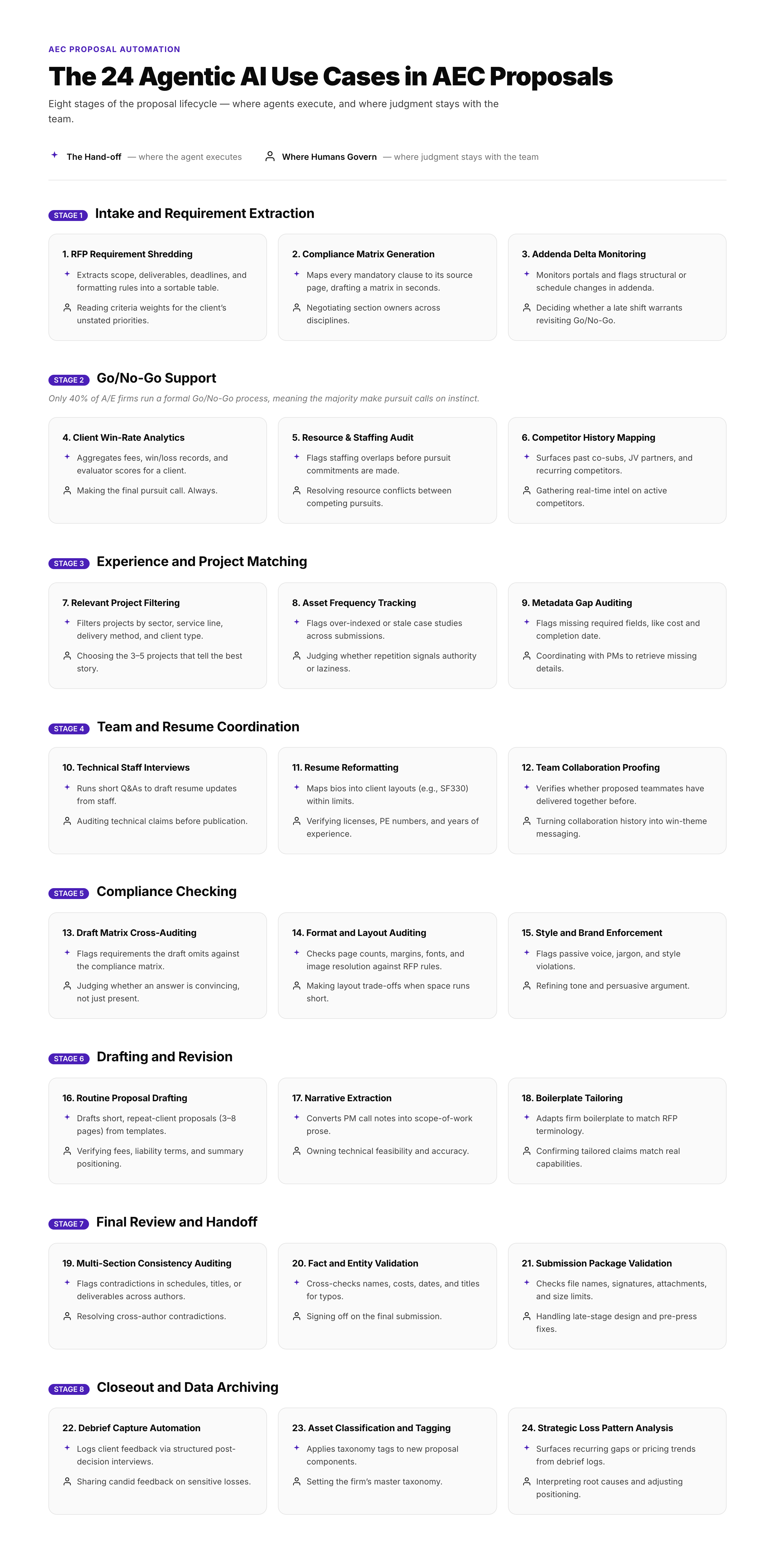
Below is a visual overview mapping how AI agents can handle automated data execution while human judgment governs strategic decisions across all 8 stages of the proposal lifecycle.
How to Use This Blueprint in Your Shop
You don’t need to automate all 24 tasks at once. Use this list as an audit tool for your next pipeline review:
- Audit Your Current Capacity: Go through the 24 tasks with your team and mark each one as Manual, Automated, or Skipped.
- Target the "Skipped" Work First: Look closely at the tasks your team currently skips due to deadline pressure (typically in Stage 8: Closeout or Stage 3: Experience Matching). These are usually your highest-return opportunities for AI agents.
- Define Your Boundaries: Use the Where Humans Govern guidance to establish clear approval rules for your team—ensuring everyone knows what the machine is allowed to draft and where a human must sign off.
Stage 1: Intake and Requirement Extraction
1. RFP Requirement Shredding
- The Hand-off: An agent parses dense, unsearchable PDFs to extract scope, deliverables, deadlines, evaluation criteria, and formatting rules into a sortable table.
- Where Humans Govern: Evaluating criteria weights to determine what they signal about the client’s unstated priorities.
2. Compliance Matrix Generation
- The Hand-off: An agent maps every mandatory clause ("shall," "must") directly to its source page and section, generating a complete draft matrix in seconds.
- Where Humans Govern: Negotiating section owners across disciplines and assigning unowned sections nobody wants.
3. Addenda Delta Monitoring
- The Hand-off: An agent monitors procurement portals, compares updated addenda against master files, and highlights structural or schedule changes.
- Where Humans Govern: Deciding whether a late scope shift warrants revisiting the initial Go/No-Go pursuit decision.
Stage 2: Go/No-Go Support
Did you know? Only 40% of A/E firms run a formal Go/No-Go process, meaning the majority make pursuit calls on instinct.
4. Client Win-Rate Analytics
- The Hand-off: An agent aggregates historical proposals, submitted fees, win/loss records, and past evaluator scores for a specific client.
- Where Humans Govern: Making the final financial and strategic pursuit call. Always.
5. Resource & Staffing Audit
- The Hand-off: An agent cross-references named key staff against active project commitments to flag scheduling overlaps before pursuit commitments are made.
- Where Humans Govern: Leading executive discussions on resource allocation when two high-value pursuits collide.
6. Competitor History Mapping
- The Hand-off: An agent queries internal pursuit archives to identify past co-subconsultants, joint venture partners, and recurring competitors on similar scopes.
- Where Humans Govern: Gathering real-time market intelligence on active competitors for the current bid.
Stage 3: Experience and Project Matching
7. Relevant Project Filtering
- The Hand-off: An agent filters project databases by sector, service line, delivery method, and client type, returning matched candidates with specific reasoning.
- Where Humans Govern: Selecting the final 3–5 project profiles that tell the most compelling narrative for a specific evaluator panel.
8. Asset Frequency Tracking
- The Hand-off: An agent monitors project sheet usage across recent submissions to highlight over-indexed or stale case studies.
- Where Humans Govern: Deciding whether project repetition signals deep domain authority or lazy positioning.
9. Metadata Gap Auditing
- The Hand-off: An agent audits project records against required proposal fields (e.g., final construction cost, completion dates) and flags missing data.
- Where Humans Govern: Coordinating with project managers to retrieve missing project details.
Stage 4: Team and Resume Coordination
10. Technical Staff Interviews
- The Hand-off: An agent conducts short, structured digital Q&As with technical staff to draft recent project accomplishments into resume updates.
- Where Humans Govern: Auditing technical claims to prevent accuracy or registration errors before publication.
11. Resume Reformatting
- The Hand-off: An agent maps existing employee bios into client-required layouts (e.g., SF330) while automatically enforcing character limits.
- Where Humans Govern: Verifying active professional licenses, PE numbers, and years of experience.
12. Team Collaboration Proofing
- The Hand-off: An agent scans past proposals to verify whether proposed team members have successfully delivered projects together in the past.
- Where Humans Govern: Translating past collaboration records into tailored "Win Theme" messaging.
Stage 5: Compliance Checking
13. Draft Matrix Cross-Auditing
- The Hand-off: An agent cross-references draft narrative sections directly against compliance matrix requirements to surface omitted items.
- Where Humans Govern: Judging whether a requirement is answered convincingly rather than just mentioned.
14. Format and Layout Auditing
- The Hand-off: An agent performs rapid audits of page counts, margins, font sizes, and image resolutions against strict RFP constraints.
- Where Humans Govern: Making creative typography and layout trade-offs when spatial edits are required.
15. Style and Brand Enforcement
- The Hand-off: An agent checks draft text against internal brand guides to flag passive voice, corporate jargon, and style violations.
- Where Humans Govern: Refining tone, narrative pacing, and persuasive arguments that win over evaluators.
Stage 6: Drafting and Revision
16. Routine Proposal Drafting
- The Hand-off: An agent generates structured initial drafts for short-form, repeat-client proposals (3–8 pages) using firm templates.
- Where Humans Govern: Verifying proposed fee structures, liability terms, and executive summary positioning.
17. Narrative Extraction
- The Hand-off: An agent converts raw PM audio transcripts or rough call notes into structured scope-of-work prose matching your firm's format.
- Where Humans Govern: Taking professional liability for technical execution feasibility and accuracy.
18. Boilerplate Tailoring
- The Hand-off: An agent adapts standard firm descriptions, safety policies, and QA/QC boilerplate to reflect specific RFP terminology.
- Where Humans Govern: Confirming that all tailored assumptions accurately match firm capabilities.
Stage 7: Final Review and Handoff
19. Multi-Section Consistency Auditing
- The Hand-off: An agent scans multi-author drafts to flag cross-section contradictions in schedules, team titles, or deliverables.
- Where Humans Govern: Selecting the correct technical direction when cross-author contradictions occur.
20. Fact and Entity Validation
- The Hand-off: An agent cross-checks client names, project costs, dates, and staff titles across all submission volumes to catch typos.
- Where Humans Govern: Performing final executive sign-off on submission documents.
21. Submission Package Validation
- The Hand-off: An agent verifies file-naming conventions, required digital signatures, attachment completeness, and upload size limits.
- Where Humans Govern: Managing complex InDesign graphic layouts, pre-press setups, and late-stage design fixes.
Stage 8: Closeout and Data Archiving
22. Debrief Capture Automation
- The Hand-off: An agent prompts pursuit leads with structured digital interviews post-decision to log client feedback immediately.
- Where Humans Govern: Providing candid, qualitative feedback regarding sensitive loss reasons.
23. Asset Classification and Tagging
- The Hand-off: An agent applies standardized enterprise taxonomy tags to newly created proposal components for future searchability.
- Where Humans Govern: Establishing and updating the firm's master data taxonomy.
24. Strategic Loss Pattern Analysis
- The Hand-off: An agent aggregates debrief logs over multi-year periods to surface recurring capability gaps or pricing trends.
- Where Humans Govern: Interpreting root causes of systemic losses and altering firm positioning strategy.
Recovering the Work That Gets Skipped
Software vendors love to pitch AI by promising to save hours on manual tasks. But in most proposal departments, the reality is that no one has the time to get to a lot of these things.
Nobody tags the library. Nobody tracks project sheet overuse. Nobody collects and archives debriefs.
Sixty-nine percent of AEC marketing teams have fewer than 10 people, while three-quarters of firms pull 11 or more contributors into every response. When capacity tightens, upstream tasks—data tagging, debriefing, intelligence gathering—are always the first to be dropped. Yet this omitted work is precisely the data required to make future pursuits easier.
Generative AI makes producing baseline proposal text effortless. What it cannot generate is your proprietary context. Your project history, client relationships, win records, and debrief logs constitute your primary competitive advantage.
Take these 24 items to your next pipeline review and mark what you handle manually versus what gets skipped. That second list is where your real capacity is hiding.
If all this sounds overwhelming and you need help figuring out where agents fit into your pursuit workflow, we’re here to help.
If you’d like to understand whether to use an agent or if generative AI could do the trick read our breakdown of Generative AI vs Agentic AI.
P.s. If you came here wondering “how can AI help prepare a stronger SF330 for a public-sector AEC pursuit”, that’s the 25th possible use case for an AI agent that I’ve seen teams use!



.png)