Found the content on this page useful? Share it with your team!
AI Doesn’t Wait for You to Be Ready


Table of Contents

I spent two days in Cleveland at ACEC’s Business Development & Marketing Forum, and by the end I’d noticed something nobody said out loud but almost everybody implied.
Every conversation about AI came with a clause attached. Once we clean up the data, then we’ll really use it. Once we get people actually entering things into the CRM, then. Once the culture catches up, once leadership is bought in, once we’ve done the groundwork—then AI.
It sounded responsible. It sounded like diligence. But sit with it long enough and you realize the industry has turned AI into something you have to qualify for—a reward you unlock after finishing some big prerequisite project. Clean the house first, then you’re allowed to have nice things.
Here’s the problem. A lived-in house is never 100% clean.
The AI-readiness that never comes
“Ready” is a moving target, and it stays that way by design. Your data will never be clean enough—new projects create new mess faster than anyone can tidy the old. Adoption will never be universal—there’s always another holdout, another office doing it their own way. The culture is always a few months from catching up.
So “we’ll be ready soon” becomes a permanent condition. It feels like progress, because you’re working on something. But you’re working on the prerequisite, not the thing itself. And while you wait for a starting gun that never fires, the firms that stopped waiting are already laps ahead.
The readiness you’re waiting for isn’t coming. The firms pulling ahead didn’t fix everything first—they pointed the technology at the mess and improved it as they went.
Perfect data is not the price of admission
Let me be clear about something, because I was in those rooms and I heard the pain. Data debt is real. In some firms half the contacts in the system are dead or gone. Nobody trusts the numbers, so nobody uses them, so they decay further. “Garbage in, garbage out” isn’t a cliché to the people living it—it’s a daily tax. The data management panel was right to put it front and center.
But look at what one of the smartest voices in that room actually said. Karen Cotton of Timmons Group didn’t describe data hygiene as a heroic, one-time cleanup. She compared it to brushing your teeth—a small daily habit, not a wall you scale once and never think about again.
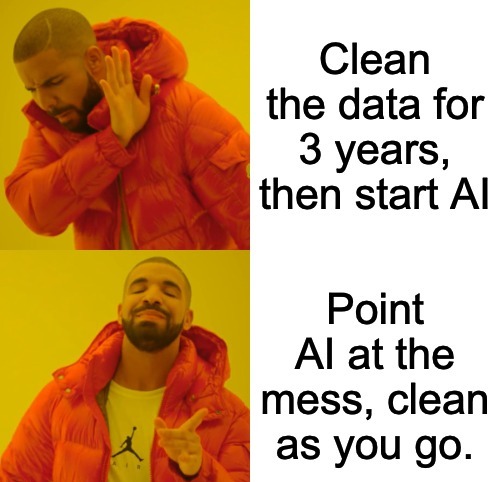
That’s the part a lot of firms missed. “Fix your data” got heard as “stop everything until it’s perfect.” And that version—the big freeze, the multi-year cleanup initiative, the steering committee—is the stall dressed up as diligence. It’s a project you can hide behind for years.
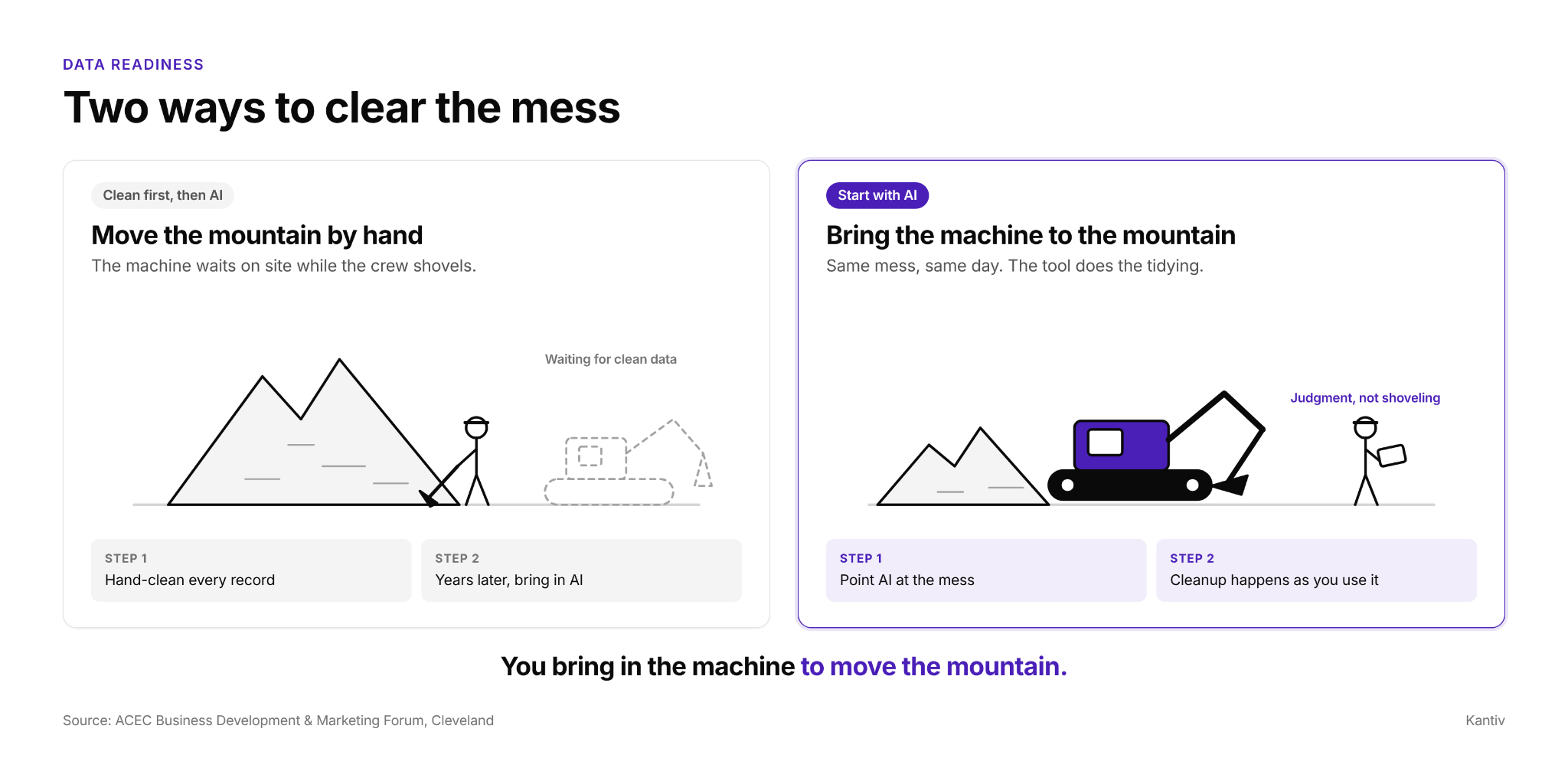
Here’s what the room demonstrated even as it worried: AI doesn’t need your data clean before it’s useful. It meets the mess where it is. Attendees described pointing AI at messy project descriptions to pull structured fields into the CRM. Others used it to clean the database itself—the tool doing the tidying instead of the person. Cleanup stops being the thing you do before AI and becomes a byproduct of using it.
I’m not telling you data doesn’t matter. It matters enormously. I’m telling you that you don’t need it perfect to start, and that starting is how it actually gets clean. The firms waiting for pristine data to earn their shot at AI have the order backwards.
You don’t move the mountain by hand so you can finally bring in the machine. You bring in the machine to move the mountain.
Stop turning your experts into data clerks
The adoption conversation had the same shape, and the same blind spot.
Nearly every fix on the table was a way to make humans behave. Dashboards that put missing data on the big screen so peers can see who’s behind—public accountability, or public shaming, depending on where you sit. Bonuses tied to CRM entry. Spreadsheets banned from meetings so people have no choice but to use the system. Leadership modeling the behavior from the top.
Some of that works. But step back and look at what it’s actually asking. It solves an adoption problem by turning your most valuable people into data-entry clerks—and then builds an enforcement apparatus to keep them there. Your seller-doers, your principals, the people whose judgment is the entire product, spending scarce hours typing notes into fields so a dashboard turns green.
There are two different things happening in a client relationship, and we keep confusing them. One is the human part—the conversation, the read of the room, the relationship, the instinct for what a client isn’t saying. That’s not replicable, and you wouldn’t want to automate it even if you could. That’s the work.
The other is the capture—the record of what happened, who was there, what got decided. That has no business being manual. Auto-tracking, logging, notetaking, a data collection agent that listens and files the record without anyone opening a form—that’s where the technology belongs. It’s the thinking behind the data collection agent we built at Kantiv, and the principle holds no matter whose tools you use: let the person do the irreplaceable thing, and let the system remember it.
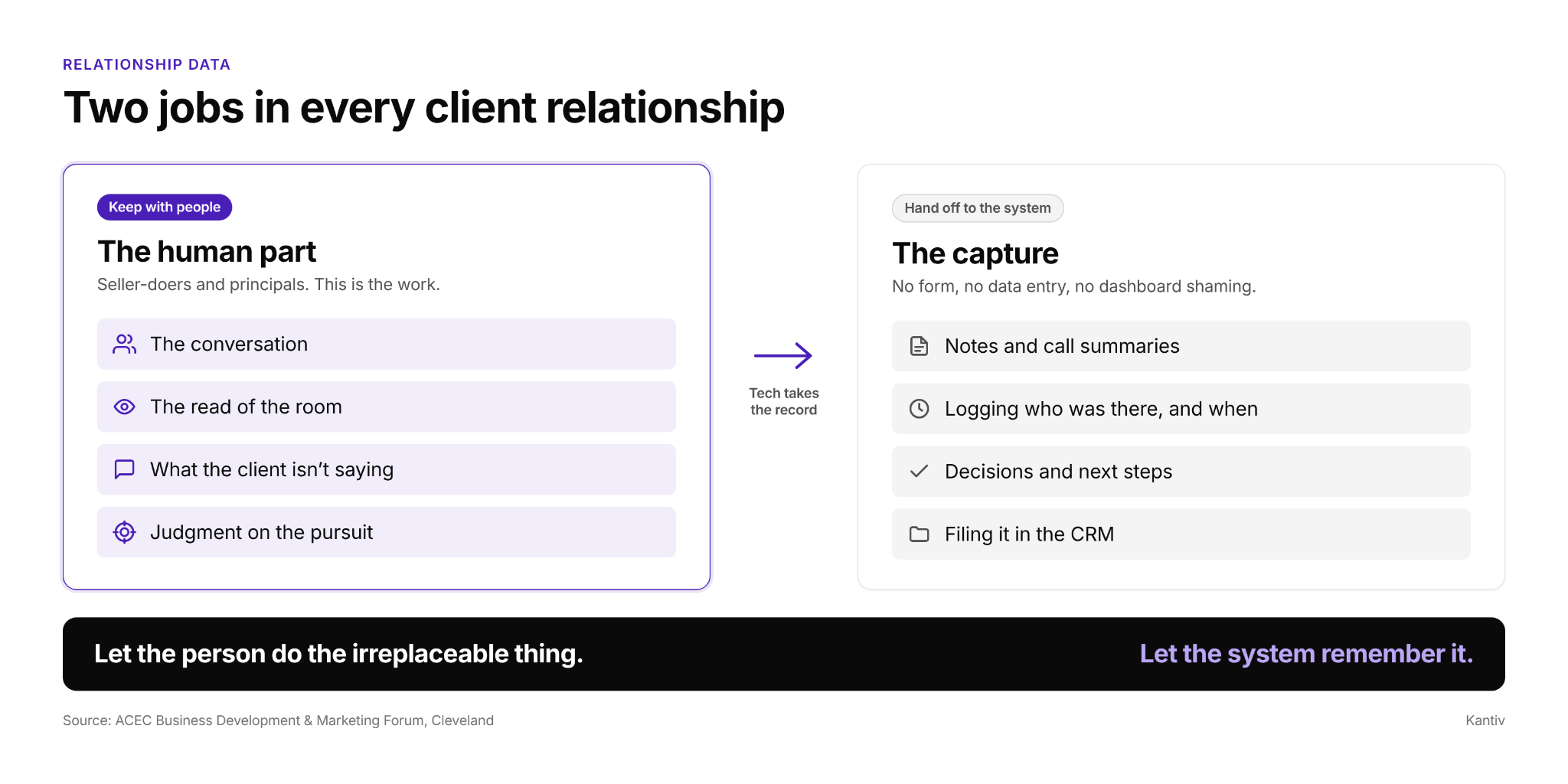
One panel framed AI as a way to “elevate people” by taking the back-office load off their plates. This is what that actually looks like. You don’t make people better at data entry. You make data entry disappear so people can do the part only they can do.
AI put firm pricing on trial
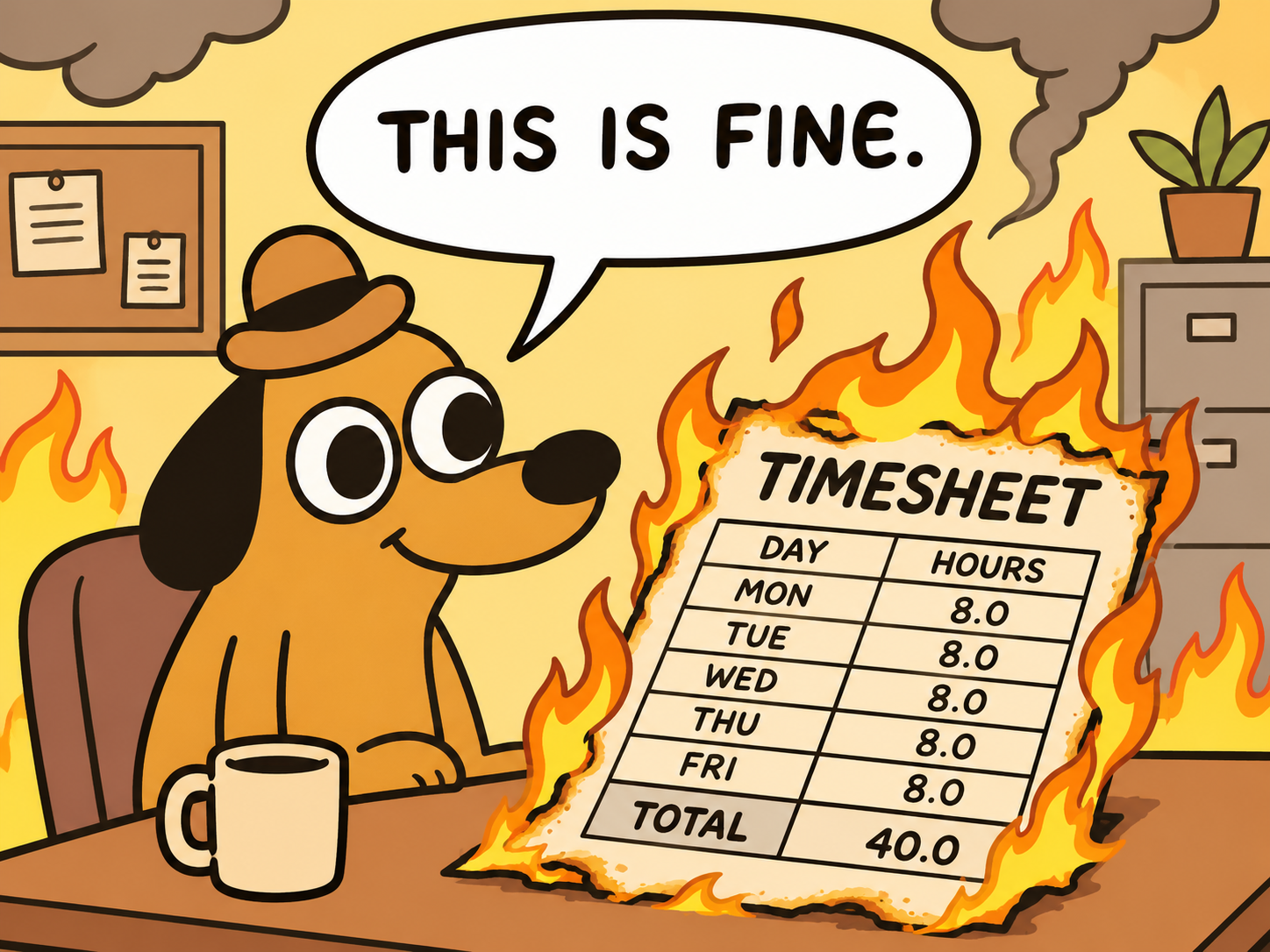
There was another theme running underneath all of this as well. If AI takes a task that used to burn 900 hours and does it in 10, what happens to the firm that bills by the hour? The math is brutal. The efficiency everyone is chasing is also a loaded gun pointed at the labor-based business model. You can’t celebrate the time savings and keep selling time.
Elizabeth Scarce of Dewberry made a sharp version of this from another angle—measure by value, not volume. She described how tracking hit rates by value exposed a firm that was winning plenty of work, but winning its way into low-value task orders instead of the high-value projects it actually wanted. A healthy win rate was hiding a strategy problem.
Put those together and you get the real stakes of everything above. Clearing the grunt work only pays off if you do something with the capacity it frees. Automate the busywork and then fill the saved hours with more busywork, and you’ve gained nothing—you’ve just lowered your own price. The point of moving work to the machine is to move people up the value stack, toward the judgment and relationships and strategy that AI can’t touch and clients will still pay real money for. I’ve argued before that the hourly rate itself is on trial; this is the same reckoning, arriving faster.
The efficiency isn’t the win. What you do with the room it creates is the win.
The two-sided knowledge cliff
I’ll end on the thing that keeps this from being a story about replacing people—because it isn’t.
The industry’s demographic math is no secret. The Silver Tsunami is real: decades of experience walking out the door as a generation retires, and most of what they know lives nowhere but their heads. Several firms at the Forum described a smart response—recorded knowledge-transfer interviews, run through AI transcription, to capture forty years of hard-won nuance before it leaves the building. That’s a genuinely good use of the technology, and it’s exactly the kind of institutional memory most firms are terrible at keeping.
But there’s a second edge to that cliff, and it got named too. Call it the residency gap. If you hand all the foundational grunt work to AI—the stuff juniors used to grind through—how does the next generation ever build the judgment that made the retiring experts worth recording in the first place? The reps are how people get good. Automate the reps away entirely and you capture this generation’s wisdom while quietly failing to grow the next one’s.
I don’t read that as a reason to slow down. I read it as a reason to be deliberate. Technology can move the grunt work and it can preserve what’s leaving. It cannot manufacture wisdom, and it can’t replace the experience that builds it. Capture what’s walking out the door—just don’t automate away the path that got those people there.
What this means if you lead marketing or BD
Here’s where I landed after two days in Cleveland.
The firms that win the next few years won’t be the ones with the cleanest data or the most locked-down CRM culture. They’ll be the ones that stopped treating AI as a prize to be earned and started treating it as a tool to be used—messy data and all. Push the grunt work to the machine. Move your people up to the work only people can do. And stop waiting for permission from your own systems.
The readiness you’re waiting for isn’t coming. Start anyway. That’s how you get ready.
Troy Meyer and the Kantiv team were on the ground at ACEC’s Business Development & Marketing Forum, held in Cleveland, September 27–29, 2026.