Found the content on this page useful? Share it with your team!
Why AI and Proposal Management Software Fail AEC Teams

.png)
Table of Contents

You tried AI because your proposal team needed relief. For a week or two, it looked like relief had finally arrived: cleaner first drafts, faster rewrites, better phrasing from rough notes. Hooray!
Then the real pursuit showed up.

The project examples were still hard to find. The resume still needed checking. The boilerplate still sounded like it came from three different offices. Someone still had to know which past proposal, principal bio, client detail, win theme, and proof point actually fit the RFP.
That's why so many AI pilots stall in AEC. They don't solve the firm knowledge layer underneath the pursuit.
Why proposal writing still breaks down after the first demo
The first demo usually solves the cleanest part of the problem. You paste in rough notes. The tool turns them into better sentences. You ask for a first draft. It gives you one. You ask it to shorten, expand, or make something sound more polished, and it responds in seconds.
For a proposal manager who has spent years turning bullet points from technical staff into readable prose, that feels real.
It is real. But it's just not enough. For instance, it doesn't know what your CRM says about the client relationship, or whether that CRM data is current enough to trust.
AEC proposals don't fall apart because the team can't produce sentences. They fall apart because the team is trying to assemble a scored pursuit from scattered knowledge under deadline pressure.
The strongest project example might be in an InDesign file from 2021. The current contract value might live in Deltek, Unanet, Procore, or a spreadsheet. The better proof point might be in a principal's memory. The latest resume might be in Word, SharePoint, OpenAsset, or someone's desktop folder.
Generic AI can't fix that. It can only work with what you give it.
The tool writes. The team still searches.
Why the wrong tool makes every pursuit harder
Most tools treat pursuits as a document problem. Proposals are documents, yes. They have sections, templates, deadlines, review rounds, compliance requirements, and production steps. But the real problem isn't the document. It's knowing what should go into it.
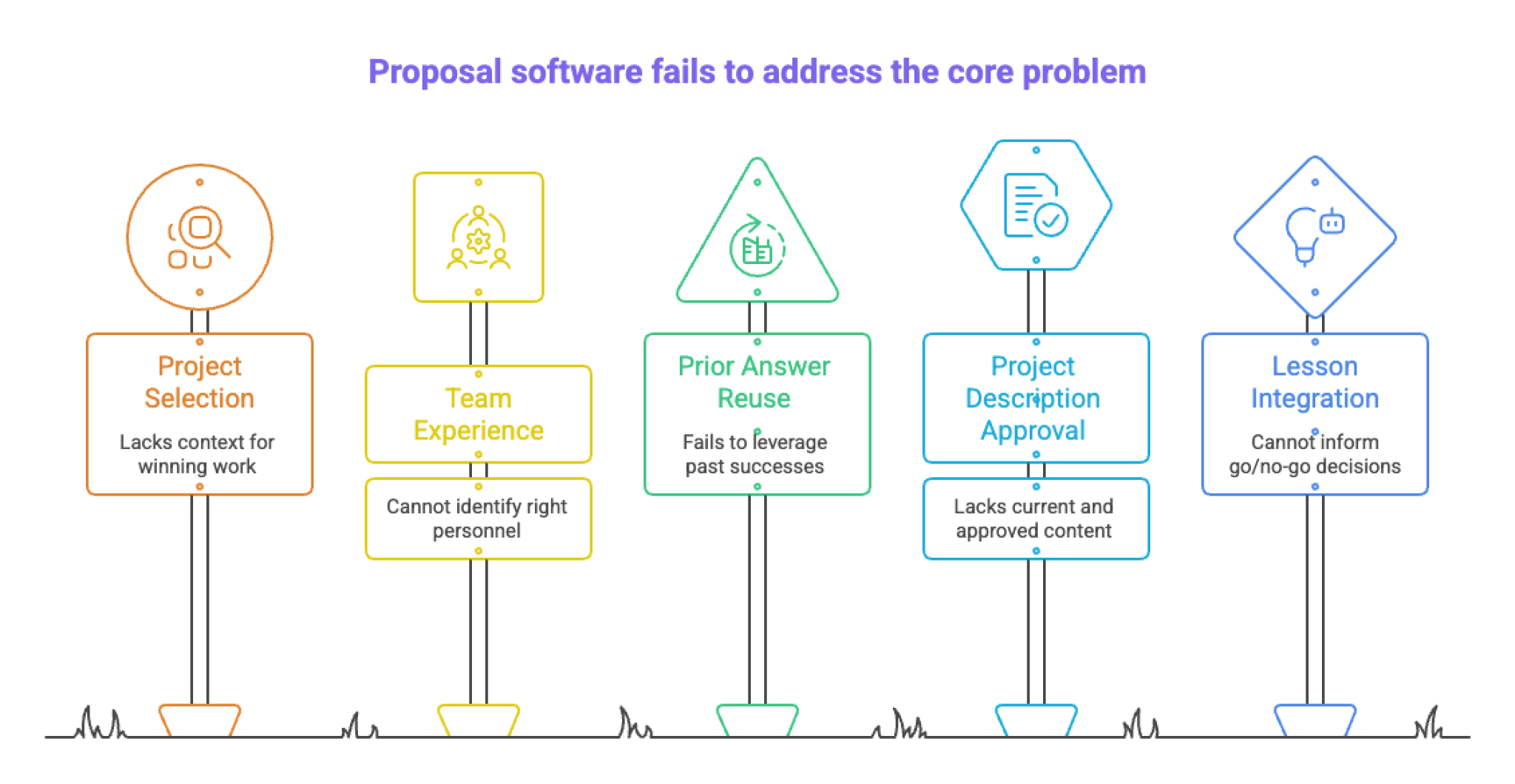
You need to know:
- Which project proves the firm can win this specific work?
- Which people have the right experience for this client, delivery method, market, and scope?
- Which prior answer helped the team shortlist with a similar agency?
- Which project description is approved, current, and written in the firm's voice?
- Which lesson from the last pursuit should shape the go/no-go call before anyone writes a word?
Most proposal tools help with the first layer. They store boilerplate, assemble sections, manage reviews, keep templates organized, and help draft cleaner language. That's useful. It isn't enough.
AEC proposal work is a coordination, judgment, and evidence exercise. Your proposal manager is constantly deciding what to include, what to cut, which proof point is stronger, which technical claim needs support, and which standard answer is too generic for the client in front of them.
If the software can't help with those decisions, the team goes back to the old workflow. Not because they hate new tools. Because the old workflow, messy as it is, still contains the context the tool lacks.
How AI pilots fall apart under deadline pressure
Across the AEC firms we talk to, failed AI pilots tend to follow the same pattern.
Someone gets access to a general AI tool or a horizontal proposal platform. The first few tests look promising. A principal asks whether it can write a project approach. A proposal coordinator uses it to clean up a section. A marketing leader sees a path to supporting more pursuits without adding headcount.
Then a real RFP arrives with specific evaluation criteria, and something has to give.
The client wants proof of similar work, not a polished summary. The team needs a project example from the right office, with the right delivery method, the right staff, and a current description. The AI can produce language, but it doesn't know which facts are safe to use.
So the proposal team starts checking everything. They check whether the project exists in the right form. Whether the team member was actually on it. Whether the dates, values, locations, and client names are current. Whether the answer sounds like the firm. Whether the language is too generic. Whether the output invented anything.
The tool was supposed to reduce the burden. Instead it creates a new review layer. And that review layer is what kills adoption.
The team may not announce that the tool failed. They simply stop using it. It becomes another tab, another pilot, another thing the marketing team has to remember while the real pursuit keeps happening in SharePoint, email, Slack, InDesign, and someone's memory.
It isn't your team's fault
There's a quiet guilt that follows a failed AI pilot. Leadership asks why the firm isn't moving faster. The assumption, sometimes spoken and sometimes not, is that if your team isn't using AI every day, you're slow to change.

Pursuit teams are some of the most practical technology evaluators in any firm. They don't keep tools because the tools are interesting. They keep tools because the tools hold up when the RFx drops, the principal is unavailable, the deadline moves up, and the final review exposes three missing pieces.
If your team tested AI and walked away, that was probably good judgment.
Maybe the tool required too much prompting. Maybe the output sounded smooth but generic. Maybe it missed the difference between an SF-330, an SOQ, and a full technical proposal. Maybe it wrote around the answer instead of giving the evaluator what they needed to score.
Or maybe it simply didn't know your firm.
That's the point most AI conversations skip. AEC firms don't win pursuits with generic knowledge. They win with specific, earned knowledge: past performance, client relationships, technical experience, team credibility, delivery history, and lessons from previous pursuits.
If that knowledge isn't structured and available, AI has nothing solid to work from.
What generic AI still can't know
Generic AI can sound confident about almost anything. That's useful in some settings and genuinely risky in proposals.
It doesn't know that the bridge project description in the old folder is outdated, or that the project manager changed markets. It has no idea that the client pushed back on a delivery approach two pursuits ago, or that the Dallas and Denver offices use different versions of the same firm story.
Generic AI doesn't know which claims your firm is willing to stand behind. And that makes a big difference. Evaluators aren't reading for polished language. They're looking for evidence they can score against the criteria in front of them.
Generic AI can help draft a paragraph about relevant experience. It can't decide which experience is relevant unless your firm's knowledge is already organized around projects, people, clients, markets, outcomes, and past pursuits.
Without that structure, your proposal team becomes the quality control system for the AI. A tool that creates more checking than confidence won't stick.
What good pursuit software actually does
A good proposal software should make firm knowledge easier to trust under deadline pressure. That means doing more than storing content. It has to connect the knowledge underneath the pursuit.
For an AEC proposal team, the system should help answer the questions that actually slow the pursuit down:
- Which project examples best match this pursuit?
- Which staff have the right experience for this scope?
- Which boilerplate is approved and current?
- Which past proposals used a similar evaluation structure?
- Which win themes are actually supported by evidence?
- Which content has changed since the team last used it?
- Which lessons from previous pursuits should affect this go/no-go call?
When the system can answer those questions, AI becomes useful in a different way. It's no longer a blank proposal writing assistant waiting for prompts. It becomes part of the pursuit workflow.
Your proposal manager still uses judgment. The tool gives that judgment better ground to stand on.
The real AI adoption test in AEC
The question isn't whether people will use the tool. It's whether the tool removes enough uncertainty that people want to use it during a real deadline.
That's the adoption test.
AEC marketers don't reject tools because they dislike change. They reject tools that look good in controlled settings and fall apart inside the actual workflow.
Before buying AI or proposal management software, test it on a real pursuit.
Give it a real RFP, not a sample prompt. Ask it to recommend relevant projects, people, and proof points. Check whether those recommendations are accurate and current. Ask it to explain why each recommendation fits the evaluation criteria. Ask it to draft one section using only approved firm content. Review how much human cleanup is required.
Then ask whether your proposal coordinator would reach for it again without being reminded.
That last question matters most. Adoption happens when someone reaches for a tool during a stressful week because it helps more than it gets in the way.
Where Kantiv fits
Most AI pilots fail at the same moment. Not during the demo. During the first real pursuit, when the proposal coordinator realizes the output looks polished but can't be trusted without checking every fact behind it.
That's not an AI problem. That's a knowledge problem.
Kantiv is built around fixing that layer first. Your people, projects, clients, outcomes, approved content, and the institutional context that usually lives in folders, inboxes, and long-tenured employees' heads. All of it structured, connected, and searchable before the RFP lands.
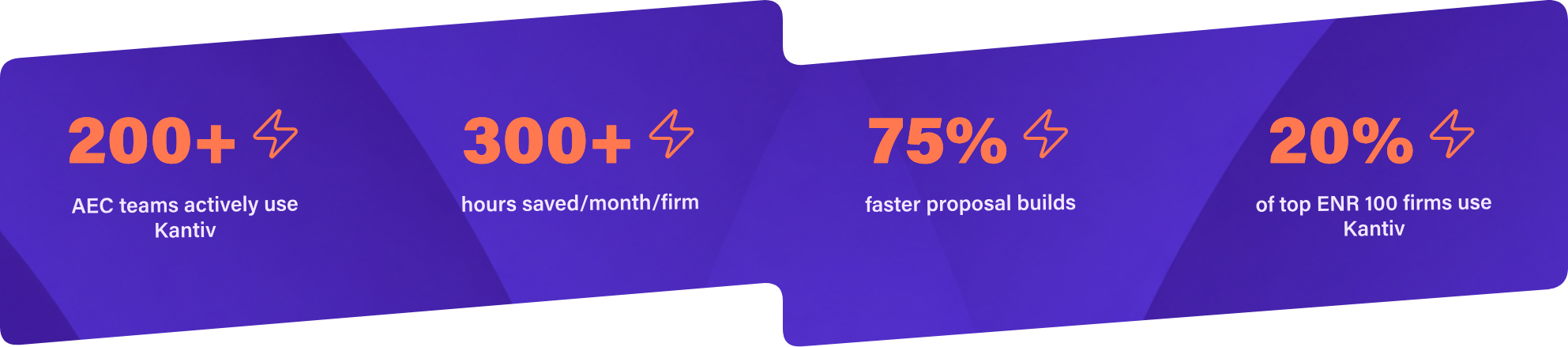
When your knowledge foundation is solid, AI stops being a liability. Your team isn't checking whether the output invented something. They're using it to move faster on work they already trust.
That's the version of AI adoption that actually sticks.
What to do after a failed AI pilot
If your pilot didn't stick, don't start by blaming the tool or the team. Start by looking at the knowledge layer underneath it. Ask five questions:
- Where does approved proposal content live today?
- Who decides whether a project description, resume, or boilerplate section is current?
- Can a new proposal coordinator find the right content without asking three people?
- Can your system connect people, projects, clients, and past pursuits?
- Does your AI know which sources are approved, or is your team still verifying everything manually?
If the answers are unclear, the next tool will probably fail the same way.
The work before AI isn't glamorous. Clean the content. Structure the data. Decide what counts as approved. Connect the systems that matter. Make the firm's knowledge searchable before the next pursuit starts.
Then test AI inside one real workflow: SF-330 assembly, project example selection, resume updates, boilerplate review, or compliance mapping. Judge the tool against that workflow, not against a demo script.
- Don’t ask whether the tool produced a draft. Ask whether it reduced the Slack messages, folder searches, copy-paste checks, and late-stage corrections required to get the proposal out the door.
- Don’t ask whether it sounded professional. Ask whether it sounded like your firm.
- Don’t ask whether the first answer was impressive. Ask whether the fifth answer was trustworthy.
That's the bar. Can I trust this under pressure?
Summing up
If your firm tried AI and it didn't stick, the lesson isn't that your team is behind. It's that proposal work in AEC depends on firm-specific knowledge, and most tools are not built for that. The harder work is knowing what to write, which proof to use, which content to trust, and how to make the proposal feel specific to the pursuit in front of you. The firms that get AI right will be the ones that organize their institutional knowledge first, then use AI on top of a foundation the team already trusts.
If a tool fails, take that seriously. Your team may have spotted the real problem before anyone else did.
See how Kantiv helps AEC firms turn firm knowledge into pursuit intelligence their team can trust before the next RFP lands.
FAQ
Can AI write AEC proposals?
AI can help draft, summarize, and rewrite AEC proposal content, but it shouldn't produce proposals without firm-specific grounding. A strong proposal depends on accurate project history, current staff experience, client context, evaluation criteria, and approved language. AI is useful only when those inputs are reliable.
Why did our AI proposal pilot fail?
Most AI proposal pilots fail because the tool can write but can't access your firm's real knowledge. The output may look polished, but your proposal team still has to verify facts, find project examples, update resumes, check compliance, and make the content specific to the pursuit. That extra review burden kills adoption.
What should AEC firms look for in proposal software?
Look for software that understands pursuits, not just documents. It should help your team find approved content, surface relevant project experience, connect people to past work, support go/no-go and capture decisions, and keep knowledge current across the pursuit lifecycle.
Is Copilot enough for AEC proposal creation?
Copilot can help with drafting, summarizing, and working inside Microsoft tools. For AEC proposal teams, the bigger question is whether it understands your firm's project history, people, clients, approved content, and pursuit outcomes. If it doesn't, your team still has to provide and verify the context manually.
How do we make AI adoption work in AEC?
Start with the knowledge layer. Clean and structure approved content, project descriptions, resumes, client history, and past pursuit data. Then test AI inside one real workflow, such as SF-330 assembly or project example selection. AI adoption works when your team trusts the inputs, not just when the output sounds polished.