Found the content on this page useful? Share it with your team!
Capture Management for AEC Firms: 5 Steps to Build a Plan Before the RFP Arrives


Table of Contents
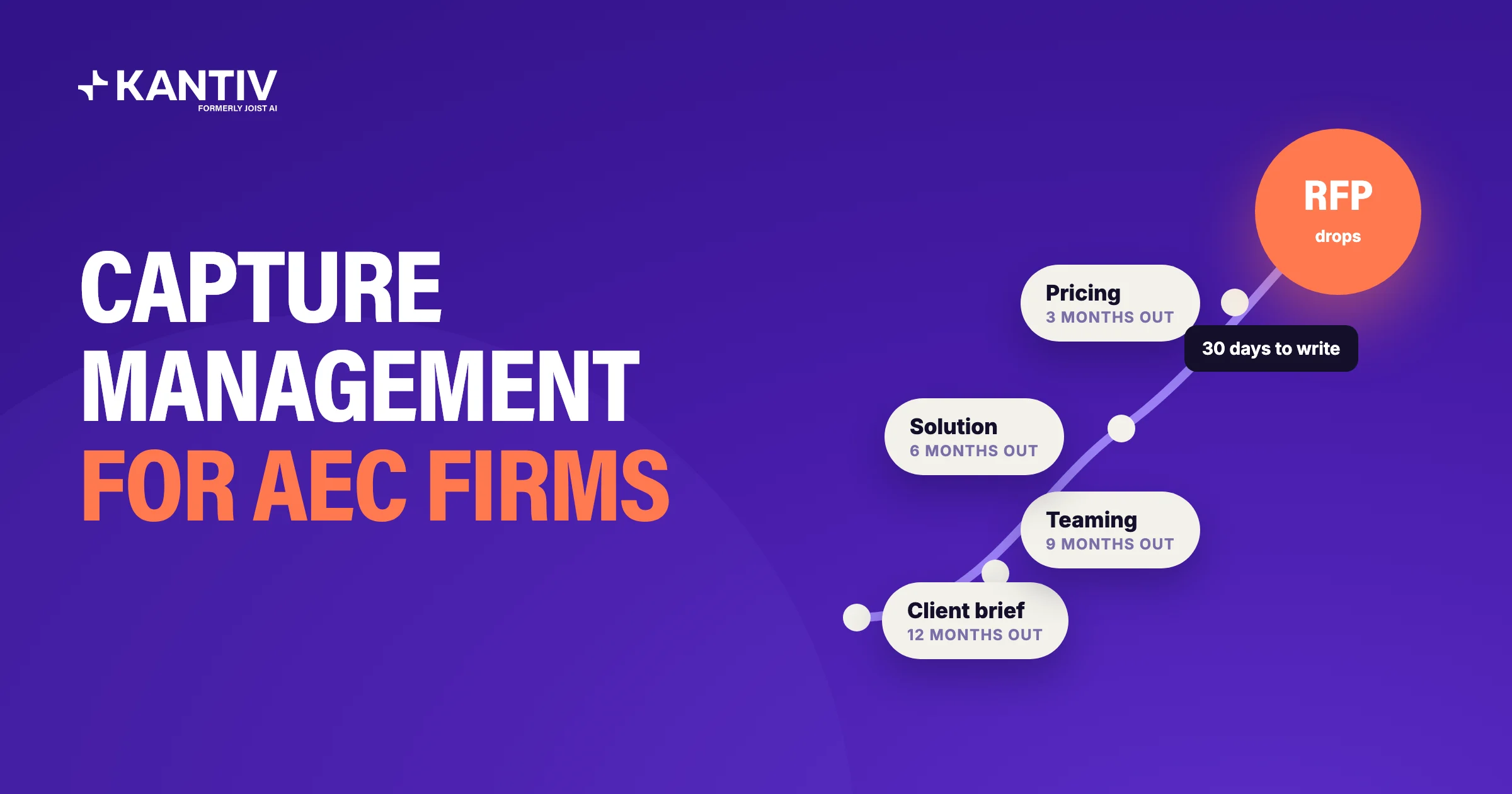
A facilities director mentions a school modernization under next year’s bond. You promise to follow up, then delivery work takes over. Six months later, the RFQ lands, and your marketing coordinator needs details that never reached the pursuit record.
Because they’re doing the work, your seller-doers hear about projects like this all the time. But unless your firm captures that knowledge, your principal may end up having to reconstruct a months-old conversation on deadline.
That's where capture management comes in. Done well, it tells you early on which pursuits deserve effort, and positions your firm to win before the RFP arrives. In this guide, we walk through five steps to do just that.
What is capture management?
Capture management is the work of positioning your firm to win a specific project, starting well before the owner publishes the RFQ or RFP, often months or years ahead, and continuing through selection. It allows your firm to understand what the client needs, check whether your firm has the qualifications, people, and relationships to win, determine who else is likely to compete, and line up the partners the submission will need.
AEC firms often call this positioning, pre-positioning or just BD (business development), and it doesn’t require a dedicated capture manager. Often, a principal or seller-doer leads capture management while a proposal manager keeps the pursuit plan current.
Given that the same people at your firm often do both capture management and BD, the line between the two is easy to blur. Here’s a good way to delineate them: Business development is the broader work of developing client relationships and building pipeline. Capture management focuses on one pursuit, even if the principal who built the relationship also leads it.
Then, it’s the job of your proposal manager to turn that preparation into a compliant, responsive submission.
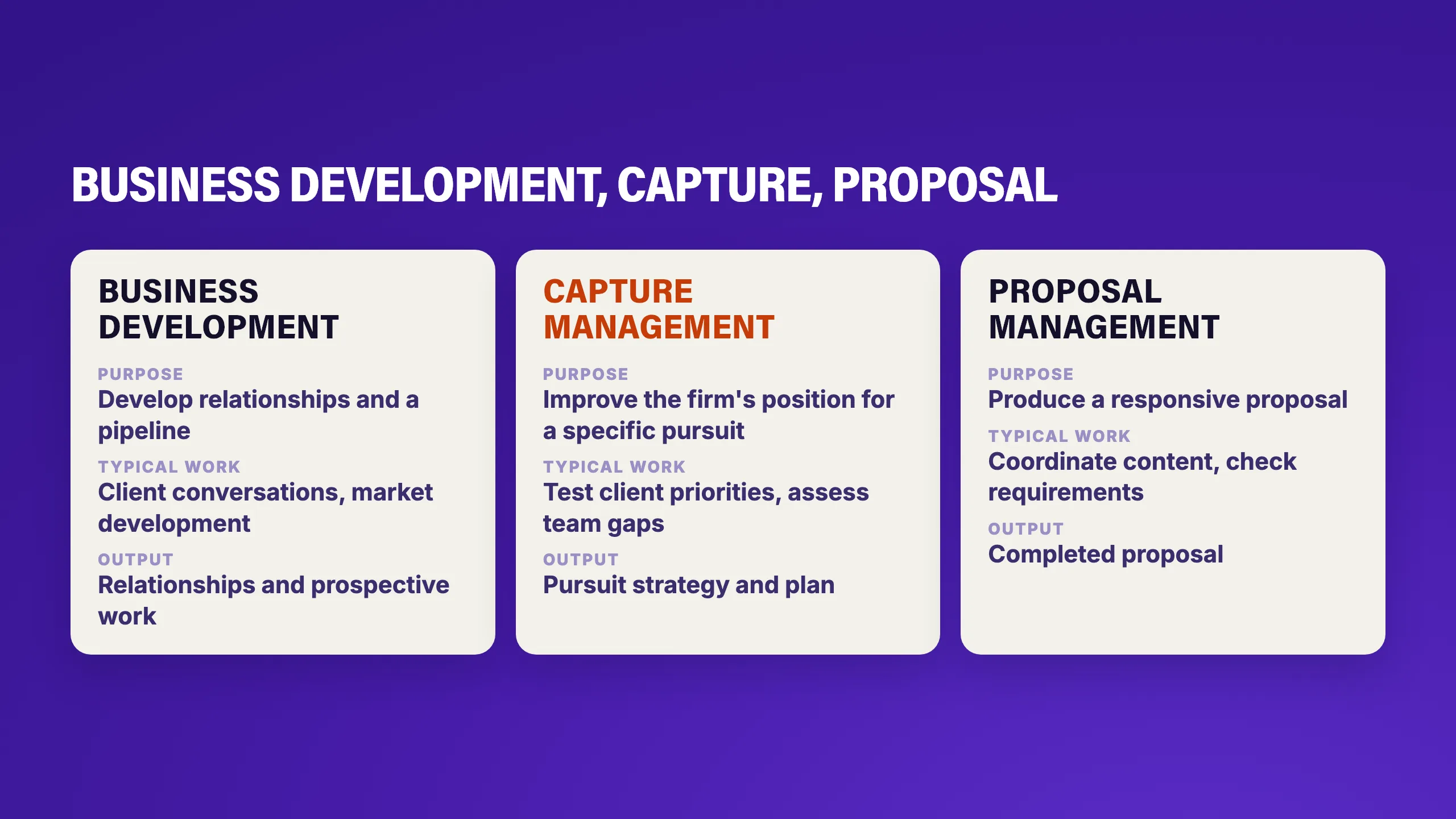
Capture management in AEC differs from other industries in two primary ways.
- Clients evaluate the key personnel proposed, so a capture plan identifies the project manager and lead designer early and checks their availability against the backlog.
- Prime firms often pursue with subconsultants, so the plan also lines up the partners the scope or the participation goals call for, and settles any exclusivity before a competitor does.
Inside capture management, capture strategy defines why the client might pick your firm, while the capture plan assigns the actions needed to test and support that case. Relevant experience, for instance, is capture strategy. Confirming that the proposed project manager ran a given project is a capture plan.
Your capture plan isn’t going to be static; it keeps changing as you learn more. Capture usually starts before the RFQ or RFP and runs through selection, so once the owner publishes the solicitation, you can check your earlier assumptions against it. February’s conversation with the facilities director still matters, but the published criteria decide where it belongs in the response.
Who owns capture when you also deliver projects?
The principal who knows your client best is often the hardest person to get into a pursuit meeting, because delivery deadlines fill the calendar first.
That competition for time is common. 96% of firms surveyed say client meetings are a seller-doer responsibility, and 70% say writing proposals is. For the people who both win and deliver work, those duties regularly compete with delivery.
The fix? Name a pursuit lead who keeps the capture plan moving. A principal, seller-doer, or BD lead can hold this position, but whoever owns the client relationship should write down what the client wants the project to fix while it’s fresh.
The same goes for delivery commitments. Before your plan promises a project manager, your technical lead needs to confirm that manager is available and has the experience the job needs. One customer told us their BD, marketing and technical staff start updating project descriptions and resumes roughly six months before an expected recompete.
As the decision gets closer, end each meeting with an action, an owner, a due date and the evidence that closes it, so the staffing question doesn’t come up again until the technical lead has confirmed availability.
Now that you've got an owner in place, you can start building your capture plan with the steps below.
1. Build a client brief from evidence you can check
Your client brief holds what your principal and seller-doers know about the client, and it has to separate what you’ve confirmed from what you’ve assumed. An approved bond measure, for instance, establishes borrowing authority without settling what the district intends to procure or when the money is allocated.
Build your client brief from verifiable intelligence: the district’s capital improvement plan, the facilities master plan, board agendas, and procurement notices. Past solicitations and debrief notes add history, but every material finding needs a source and a date, with what the client said kept separate from what’s published and from your team’s read of it.
Strong client briefs keep findings next to their sources.
| Finding | Source | Date | Confirmed fact or assumption | Pursuit implication | Next action |
|---|---|---|---|---|---|
| Funding status | Bond measure | Publication date | Record confirmed provisions | Scope remains open | Check allocation |
| Recorded client priorities | Facilities master plan; board agendas | Document dates | Distinguish statement from interpretation | Test project fit | Seek confirmation |
| Academic-calendar phasing | Source pending | Unconfirmed | Assumption | Occupied-campus experience may fit | Verify phasing needs |
For the school pursuit we mentioned in the intro, verifying the phasing need means going back to your project records. Which occupied-campus project supports the case, who led its phasing, and what don’t you know yet about the fit?
💡Pro tip: Prepping for a client meeting is faster when the history is already pulled together. Kantiv, formerly Joist AI, is a pursuit intelligence platform whose Client Intelligence Agent builds a client brief from past RFPs, proposals, notes and public information, so your team walks in knowing what the client has asked for before and how the firm answered. It needs at least two RFPs and two proposals on file for that client, and people check the brief before it shapes the meeting. At Mortenson, Proposal Manager Jen Orthaus says Kantiv lets the team "show up differently in the proposal process, not just as information gatherers, but as strategists."
2. Use early client conversations to inform the requirements
Early client conversations are where you find out whether your experience applies. Your occupied-campus project may look like a match for the school modernization, but if the district needs certain buildings open during construction, it may not be.
This is called “shaping requirements”: contributing technical understanding while the client is still defining the assignment (where procurement rules allow it). Check those rules first, since many public owners impose a cone of silence once the solicitation is out.
Federal capture has its own clock. Many agencies publish procurement forecasts and announce A-E requirements in a SAM.gov synopsis. Early conversations can help inform requirements before the synopsis appears. After publication, follow the agency’s communication instructions and applicable procurement rules.
Once you’ve secured a meeting with the client, ask about outcomes. What has to stay operational? What went wrong last time? What does this project have to fix? The answers tell your principal which qualifications are worth discussing.
For the school pursuit, your principal can describe what happened on the comparable campus, say where the comparison breaks down, and ask whether this district faces the same constraint. The answer to that question gives your technical lead something specific to investigate: the phasing experience that applies, and the staffing it would take.
3. Turn capture strategy into a working capture plan
Promising projects are great, but they still need checking; and in many cases, they need to be checked more carefully. Before your occupied-campus project goes into your capture strategy, the engineer who ran its phasing has to confirm your firm's scope on that job. Your capture plan should then tie that phasing check to the pursuit record.
Your capture strategy should read like a claim your technical lead can test. For the school district pursuit, it might read: “The district needs teaching to continue during construction, and our phasing approach draws on the occupied-campus project.”
Before the proposal manager builds a case on that sentence, your technical lead needs to confirm the client outcome, proposed approach, and named project. This connective tissue maps the client’s priorities to a credible reason to choose your team.
Take the capture-plan extract below as an example.
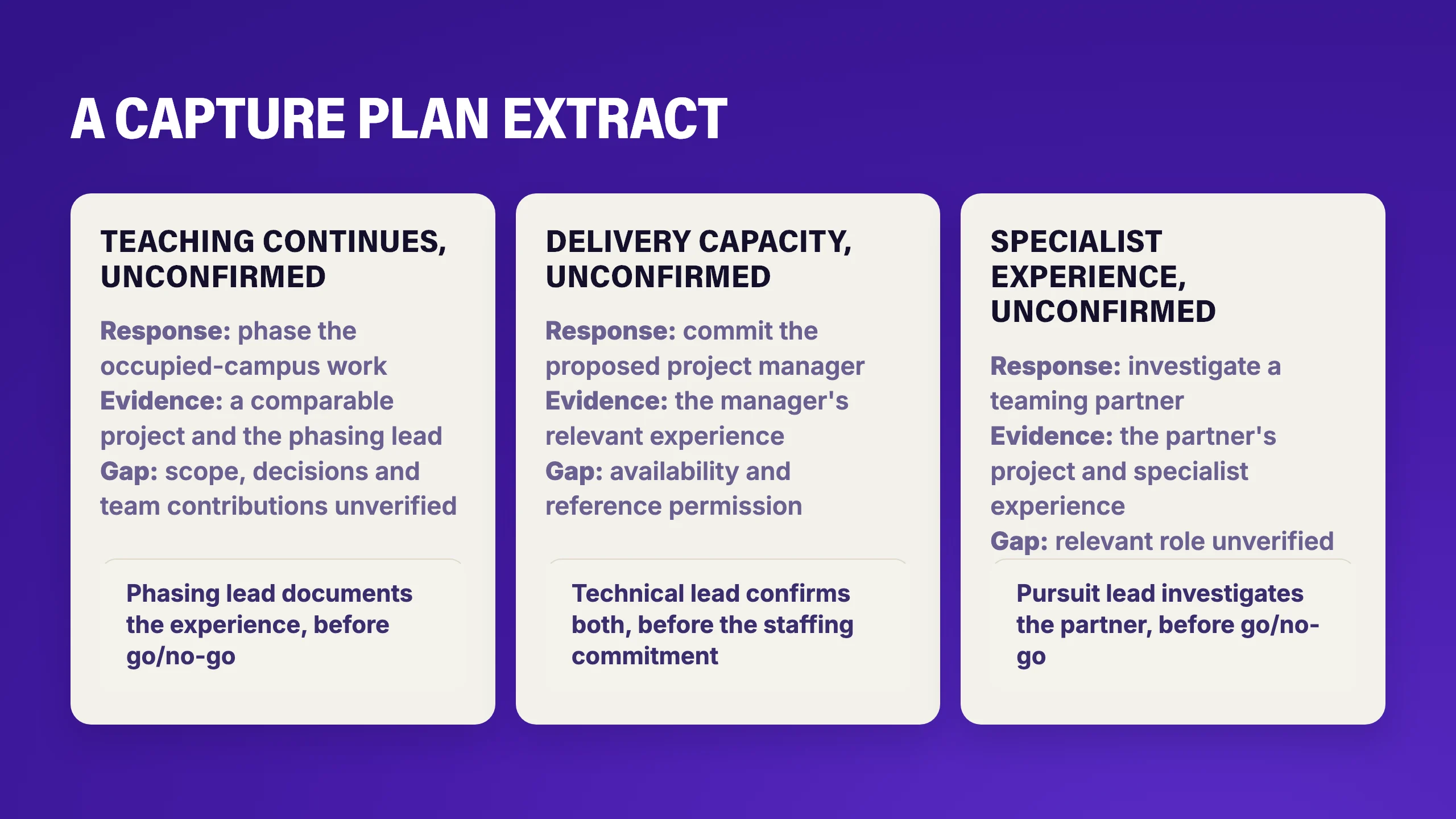
For the first row, the person who ran the phasing verifies the firm’s scope, explains the decisions, and confirms which of the proposed team members worked on it. If the phasing lead’s check shows the experience or the capacity isn’t there at the checkpoint, it goes straight into the go/no-go decision.
💡Pro tip: Go/no-go is easier to defend when the client history is on the table. Kantiv’s Client Intelligence Agent shares go/no-go recommendations based on client & firm history. People still verify the evidence and supply the judgment. Satterfield & Pontikes saved 8 to 10 hours per pursuit.
Keep your capture plan next to your pursuit record so the pursuit lead can act on any open questions. Relationship history stays in your CRM, and pipeline stays in your pipeline tracker. Your capture plan is the working document between them.
4. Use capture findings to make the go/no-go decision
One of the goals of a visible and stalwart capture plan is to expose open questions before enthusiasm carries the pursuit forward. And your go/no-go is where those questions get answered.
Make the first call when your team identifies the pursuit: does this opportunity warrant the positioning effort at all? Revisit it when the owner publishes the RFQ or RFP, and again before you commit proposal staff.
When you’re building your go/no-go matrix, score the opportunity against factors the firm agreed on in advance: client understanding, relevant experience, competitive position, delivery capacity, commercial fit, and proposal effort.
Each score needs a source or a reason behind it.
| Criterion | Evidence | Unresolved issue | Decision | Conditions | Approval owner |
|---|---|---|---|---|---|
| Relevant experience | Occupied-campus project | Proposed lead’s phasing role | Conditional go | Principal accepts condition and deadline | Responsible principal |
| Gap resolution | Project records pending | Role remains unverified | Revisit decision | Principal verifies before staffing commitment | Responsible principal |
| Approval | Written rationale | Any leadership override | Record final disposition | Document go, no-go or conditional go | Responsible principal |
A conditional go only works if the principal accepts the condition and the deadline. Otherwise, the proposal manager is holding an open question with no principal to close it. Be sure to write the rationale down, including any leadership override, so the next closeout has a decision to examine.
5. Carry the capture plan into the proposal and closeout
Once your firm decides to go, your proposal manager should compare the solicitation with the capture brief before drafting begins. If the published scope and criteria don’t match what the team expected, the gap needs to be bridged at kickoff. Bring the client priorities, selected evidence, proposed team, and open questions so your technical writers can see where the approach still needs work.
💡Pro tip: In Kantiv, if there are existing projects with data similar to the RFx you’re viewing, the RFx Intelligence feature will display them with a summary of their similarities. Likewise, any people in your library with relevant project experience will appear here with brief summaries, and you can click their names to view their profiles. This makes it easier for you to assess the fit and identify gaps.
For our school pursuit example, the win theme is clear: the district needs classes to continue during construction, and your occupied-campus project provides proof that you’ve done it. From there, use your compliance matrix to track every requirement against the response. Our RFP process guide covers the rest of the submission.
Once the award is announced, win or lose, closeout is where your pursuit lead examines the choices the firm made during capture: the projects it put forward, the people it proposed, and the win theme it built on. Keep the client’s feedback in its own record, separate from the firm’s interpretation of it.
With client feedback and the firm’s interpretation kept separate, your pursuit lead can trace what changed in the client’s expectations, and check which capture actions closed the gaps they were meant to.
Start capture before the RFQ drops
A capture plan that starts early gives your team time to investigate the client’s concern, verify the proposed answer, and decide whether the pursuit deserves your firm’s time and effort. Wait for the RFQ to drop, and that investigation is going to compete with your deadline.
Kantiv gives your team that time back. Its Client Intelligence Agent builds a client brief from past RFPs, proposals, notes and public information ahead of a client meeting, and RFx intelligence gives your team a headstart in identifying the right people and projects to prove your fit. Your people verify the evidence and supply the judgment. The result is less time reconstructing old conversations and more time deciding, on evidence, which pursuits deserve the effort.
Want to see how it works? Book a demo, bring a capture plan, and see what Kantiv pulls together on a client you already know.
FAQs
What is the difference between capture management and proposal management?
Capture management develops the firm’s position before the solicitation arrives, including whether the opportunity deserves proposal effort. Proposal management carries that preparation into a response to the published requirements. The handoff matters because a principal’s client knowledge still needs verification before the proposal team can use it.
What should an AEC capture plan include?
An AEC capture plan should connect client priorities with relevant project evidence, the proposed team and the gaps that could change go/no-go. Each unresolved question needs an owner and a checkpoint. For an occupied-campus pursuit, that might mean verifying the proposed lead’s phasing role before committing proposal staff.
Who acts as capture manager in a firm without a dedicated BD team?
A seller-doer principal or project manager often leads the pursuit, with the proposal manager keeping the capture plan usable and the evidence organized. Responsibility needs to be explicit. If the principal owns the client relationship, the plan should name that principal against the questions only the client can answer.
How does federal proposal capture differ from private-sector positioning?
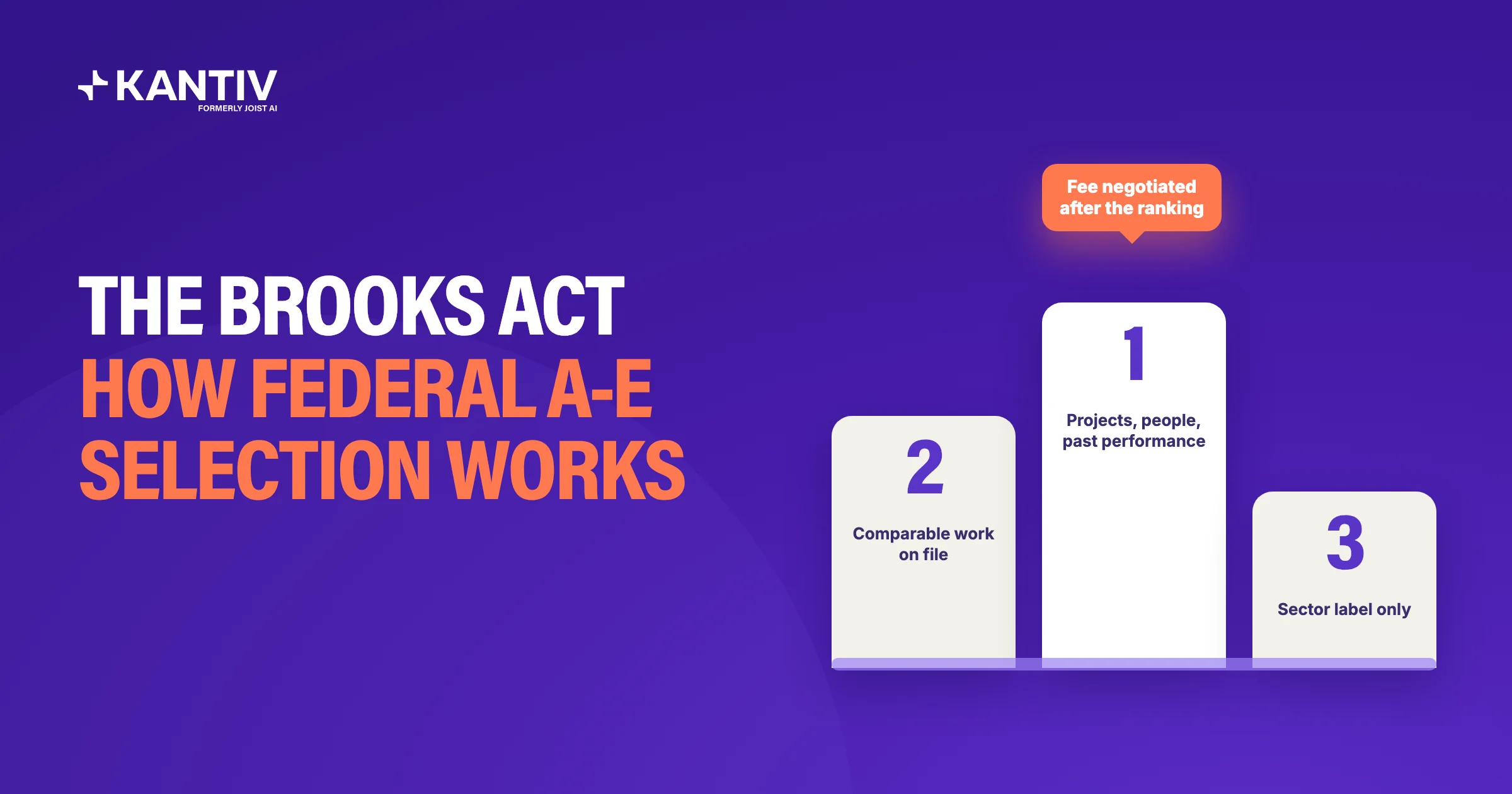
For federal A-E work, check the synopsis for the published selection criteria and the agency’s communication instructions. Under the qualifications-based selection the Brooks Act requires, price is not part of the ranking: the agency negotiates a fair and reasonable fee with the highest-ranked firm after selection. Private-sector positioning may allow more flexibility in how the client develops the assignment and selects a firm. In either setting, your pursuit team still has to verify what it heard in client conversations.
Can Kantiv help prepare a client brief when the firm has limited client history?
Kantiv’s Client Intelligence Agent needs at least two RFPs and two proposals for that client on file before it can build a client brief. Below that threshold, your team should not assume the agent can prepare a client brief. Your team still verifies the evidence and supplies the judgment.